Showing posts with label religion. Show all posts

Friday, 15 March 2019

The Ides of March

Today I saw the best and worst of what people can be. The best, first-hand; the worst, mostly via Facebook. I live in Dunedin, which is about a five-hour drive away from Christchurch, southward down the coast. I’m going to start with the bad thing, even though it happened later, so that I can end with the good thing. Quite apart from the fact that the good thing deserves the attention more, I believe that’s the way the world is going; courage is, gradually, conquering hate.

Today New Zealand got in the world news for about the worst possible reason. Our decades-long run without a public mass shooting has been broken, and the number of people killed in political terrorist acts in the entirety of our history has gone up from three to over 40. In Christchurch, this afternoon, during the Friday prayer, a white man walked into the Al Noor Mosque in Riccarton in the central city, sprayed the place with bullets, and fled. Soon afterward, a white man walked into the Linwood Islamic Centre a few kilometres across town, and began shooting.

Co-ordinated attacks by two shooters, or did the Riccarton shooter get in his car and drive to Linwood? I’ve heard both, and at a time like this I think it’s especially important to be mindful of the limits of one’s knowledge. The police also found at least one car bomb and defused it. The number of people killed is currently estimated to be in the 40s. Several of them are known to be refugees from the war in Syria, some of them children. One man has been arrested and charged with murder. Three others have also been arrested; last I heard, one had been released and the other two were being questioned. Presumably the police cordoned off the area and took in anyone who happened to have a firearm in their car.

I gather the shooter livestreamed the attack, and also published a manifesto online, just in case anyone was in doubt that the main motive for terrorism is notoriety. I understand that the local internet providers have been working to take them down, and good on them. Let me copypaste a Facebook post by a friend of mine who’s seen the manifesto:

Here’s a few quick facts from this shooter’s manifesto that he published online, so that you don’t have to read his pathetic excuses and unintelligent hate-speech.
  • He isn’t even a Kiwi. He’s an Australian citizen who was here temporarily. A little ironic considering he’s anti-immigration.
  • He originally planned to attack the mosque in Dunedin, because of a video on Facebook that he saw from the Otago Muslim Association.
  • He was most influenced by Candace Owens. I really hope that she faces the consequences of her disgusting rhetoric over this.
  • He supports Trump’s nationalist and anti-immigration stances.
There’s literally nothing else of value. Don’t read it.

I have not seen either the video or the manifesto. I have seen the shooter’s name. It will never cross either my mouth or my fingers. May it be swiftly forgotten.


Now for the good thing. I didn’t hear about the shooting until this evening because, when it was happening, I was regretfully heading back to work after attending the Dunedin branch of the School Strike For Climate. It was astonishing. I’ve been in many protests in my time, helped orchestrate a fair number of them, and I have never, ever seen one as well-organized and inspiring as this. I’m pretty sure I have, at times in the past, tutted and waxed superior over the maturity of teenagers, for which I humbly apologize. I won’t do it again. I think the last time I saw George St filled like that was when they threatened to take away Dunedin Hospital’s neurology unit, and before that the war on Iraq. And this was put together by high school students.

For all that pundits make money touting this or that existential threat to civilization that we all need to be shaking in our shoes about, climate change is the only one that’s both real and imminent. (Nuclear war is a genuine danger but a remote one. Peak Oil is a secondary consequence of the same institutional stupidities that are causing climate change. Nothing else qualifies.)

It’s already begun; New Zealand has had a “hundred-year flood” every year for over a decade now, two of them right where I live and two more just out of town on the Taieri Plain. I knew when last winter was unseasonably mild that an unprecedentedly hot summer was on its way; I even went around telling people there were going to be big bushfires in Australia. I didn’t predict they would come as far south as Tasmania, and I certainly didn’t count on them hitting New Zealand as well, but both things happened. These events are a tiny foretaste of what is to come if we don’t take drastic action.

New Zealand doesn’t account for much of the world’s greenhouse gas emissions, but because of our small size we’re a good location for experimental social changes that the world can then scale up from. After both our major political parties embraced neoliberalism in the 1980s, neoliberals elsewhere in the world pointed at us – prematurely, it turned out – as a success story. A decade ago we got the opportunity to lead the way as developers of smart green technology, and we squandered it and hung our economy on milk instead. Can’t we please be world leaders again?

It’s easy to fall into despair over the magnitude of the problem, and that despair is a major contributor to the political inertia that has caused it. That’s why today’s demonstration brought tears to my eyes. Today I saw teenagers with a better handle on grassroots political organization than my generation ever had. Today I saw where the political will can be found to solve this problem. Today I know there is hope.


On this day 2062 years ago, a determined posse of political activists, deeply concerned for the integrity of the Republic of Rome, publicly murdered the man at the hub of the changes that they feared, and so brought about the very crisis they had hoped to avert. Their act fell short, however, of the ineffectuality of terrorism, because Julius Caesar was a genuine centre of power. Terrorism by definition strikes at the powerless; it is the epitome of cowardice. And it never succeeds. Mohandas Gandhi in India eschewed violence, and India broke free of the British Empire. The IRA in Northern Ireland embraced violence, and Northern Ireland remains a British province. The numbers across history bear out the lesson of these two examples; violence, even against legitimate targets, reduces a political movement’s chances of success by over half. Terrorist violence guarantees failure.

So, out of the action today that deserved the world’s attention and the action that hijacked it, I know which one I believe represents the future. I stand for courage, I stand for truth, and I stand for hope.

Thursday, 23 August 2018

In defence of multiculturalism

“This is the future that liberals want”: a woman in full-face hijab sitting next to a transgender woman on public transport

Though this blog could very well be retitled Stuff I Disagree With, I try not to argue with the same person two posts in a row, especially when it’s someone who is mostly on the same side as me. So I’m sorry to have to pick on Chris Trotter again. But his recent Bowalley Road post “Checkmate In Two Years?” needs a response. I’m not debating its major thesis – I don’t know whether the present media flap over free speech for “alt-right” bigots will or will not blow up into an electoral defeat for Jacinda Ardern’s Labour-Greens government in 2020. I can’t see it myself, but Trotter has historically been better at predicting New Zealand election outcomes than I have. But I have some things to say about the points Trotter raises along the way.

Let’s start with this:

There’s a saying, often attributed to Voltaire, which declares: “To learn who rules over you, simply find out who you are not allowed to criticize.” The free speech controversy, by identifying multiculturalism as the concept Kiwis are not allowed to critique without drawing down the unrelenting wrath of its state-sanctioned and supported defenders, has caused many citizens to wonder when and how “nationalism” and “biculturalism” became dirty words.

Do I have to pull out that xkcd cartoon again? When did Southern and Molyneux get arrested? Because I don’t remember seeing that bit on the news. People protested against them, yes. That is to say, people criticized them loudly and angrily. There’s a saying, often attributed to Voltaire, which declares—

OK, cheap shot. Again, I’m not here to rehash my previous post. I’m here to talk about “multiculturalism” and “nationalism”, and in New Zealand that means giving biculturalism a look-in as well. Trotter’s post makes as good a springboard as any.

First up, either Trotter or I must be confused about what “nationalism” means. Trotter says

A country whose elites have signed up to an economic philosophy based on the free movement of goods, capital and labour – the three fundamental drivers of globalization – is more or less obliged to adopt multiculturalism as it core social philosophy.
Old fashioned New Zealand nationalism, and its more recent offshoot “biculturalism”, were products of a country which saw itself as offering something uniquely and positively its own to the rest of the world. It is probable that a substantial majority of Kiwis still subscribe to this notion (although a significant minority still struggle with the concept of biculturalism).
What the free speech controversy of the past four weeks revealed to New Zealanders was that too forthright an expression of cultural nationalism can result in the persons advocating such notions being branded xenophobic or racist – and even to accusations of being a white supremacist, fascist or Nazi.
The battle for free speech cannot, therefore, be prevented from extending out into a broader discussion over whether or not New Zealanders have the right to reject the downsides of neoliberalism, globalization and multiculturalism. Is it any longer possible to advance the radically nationalistic idea that the nature and future of New Zealand is a matter which New Zealanders alone must decide, without finding oneself pilloried on Twitter or banned from the nation’s universities?

Abstractions are always fuzzy around the edges, and “nationalism” shades into “racism” along one edge and “patriotism” along another. Still, Trotter is here giving the term a usage that I do not recognise. As I understand the word, the central concept of nationalism is to connect political sovereignty within a given state to membership of some particular ethnicity, understood as being the rightful owners (in some sense) of that state. Foreigners and immigrants, except for expatriates of the favoured ethnicity, are to be excluded from the political process. Typically this exclusion is to be accomplished by exclusion from the territory, sometimes with the alternative option of cultural and linguistic assimilation into the favoured ethnicity. It is not about “offering something uniquely and positively our own to the rest of the world”. It’s about keeping something uniquely and positively our own all to ourselves and the rest of the world can naff off.

What does Trotter mean by “the nature and future of New Zealand is a matter which New Zealanders alone must decide”? Is the “New Zealand” whose future is being decided exactly the same entity as the “New Zealanders” doing the deciding? Is there a concern that the New Zealand electorate might start accepting votes from citizens of Sri Lanka, Ghana, or Luxembourg? Or does the sentence mean “People of Pākehā and Māori ethnicity have a special right to exert political control over the lives of anyone, of any ethnicity, resident in the territory governed from Wellington”? (That’s insofar as “Pākehā” is a distinct ethnicity, of course. I’m not clear what we white New Zealanders have, as Pākehā, that’s “uniquely and positively our own” and couldn’t just as readily be found among, say, white Australians or English-speaking white South Africans.)

A lot of the opposition to global neoliberal capitalism is framed in terms of the threat it poses to the “national sovereignty” of individual countries over their own economies and ecologies. If this is where Trotter is coming from, then my only quarrel with him is his choice of words. I don’t like the idea of land or other local resources being owned and controlled by people who don’t live or pay taxes or buy goods and services in the area. But I also don’t like the “national sovereignty” framing. It doesn’t bother me that the people who own the farms or mines or whatever aren’t New Zealanders; it bothers me that the feedback loop between cause and effect is severed, that a small group of powerful people can wreak extensive damage on the landscape and economy without experiencing any consequences to discourage such behaviour. If some corporation is polluting rivers in Otago, it’s not important to me whether their headquarters are located in Auckland or Beijing.

But at least Trotter does offer some explication of his use of the term “nationalism”, however incomplete. That gives me some idea what he’s talking about. Not so “multiculturalism”. That word he never unpacks. It is evidently associated with “neoliberalism” and “globalization”, but more than that is hard to discern. So I genuinely don’t know whether what I will defend for the rest of this post under the name “multiculturalism” is the same thing as what Trotter is opposing, or at least lending support to the opponents of, under that same name. Bear that in mind as we proceed.

Friday, 1 June 2018

Against enforced monogamy

The issue of sexual violence has never gone away. The #metoo movement is just one more response to it, though so far one that’s been getting more notice than many. In the last, I don’t know, month or so, the media at large has at last started to notice the well-established connection between misogynistic violence and mass shootings, and the word “incel” – involuntarily celibate – has achieved a greater currency than it had before. I gather “incel” was first coined to describe the experience of being queer and unable to find someone of the gender you like who likes people of your gender, but it has now unfortunately been very firmly appropriated as a self-identifier for that subset of men who (a) aren’t getting sex and (b) believe they are owed sex. And this of course has led to suggestions that maybe mass shootings would be averted if more women would “take one for the team” and have sex with incels. Because, apparently, some people aren’t content with being horrible human beings in the privacy of their own homes.

I have seen it claimed, mind you, that incels aren’t real because it’s not actually hard to find someone to have sex with and these men must be just being needlessly picky (or obsessive) about their choice of partner. I can’t hold with this. For some people it may be easy to find people to have sex with, but there are many circumstances which make it difficult for others. One, as already noted, is being the only queer person in your offline circle. Various disabilities – physical and social – have similar effects. It’s not the not getting sex that makes incels horrible people, it’s the belief that they are owed it. Men who believe they’re owed sex are horrible people whether or not they’re getting it, which brings this digression nicely back to the point.

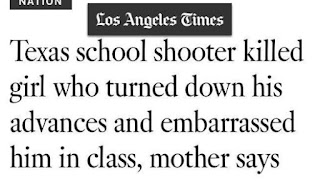
A couple of weeks ago a guy walked into Santa Fe High School in Texas and shot people, killing ten of them. Following an excellent suggestion that’s been passed around Twitter and Tumblr, I’m going to refer to the perpetrator as “Shooter #101” (this was the 101st mass shooting in the United States this year). The mother of one of the dead, Shana Fisher, has claimed that her daughter was repeatedly harassed by Shooter #101 for a date and ultimately turned him down publicly in front of the school, and that she was the first person he shot. Several articles on the incident have used this for a lede. Apparently it hasn’t been corroborated by witnesses – which is bad enough, but I’ve worked in journalism in a very small way, I can understand going ahead with the article on the assumption that the mother knew what she was talking about. What’s not forgivable is that this was how they framed this element of the case:

Spurned advances from [Shooter #101] provoked Texas shooting, says mother of girl killed (NZ Herald)Texas school shooter killed girl who turned down his advances and embarrassed him in class, mother says (LA Times)

And these are far from the worst. You see the narrative being put forward here? Men (overwhelmingly) do the shooting, but never fear, we can always find a way that it’s ultimately a woman’s fault. Women are put on earth to meet men’s needs, and men go astray when women fail to fulfill that function. Men’s sexual and romantic yearnings give them a proprietary right over women’s bodies, attention, and time. Most commentators would recoil from this position if it were stated openly; the danger of framing male violence as the headlines above do is precisely that this narrative sneaks under the radar as a tacit premise instead of being exposed to challenge as an explicit proposition. To men who do believe that women owe them sex, this subtextual confirmation helps that belief fit just that little bit more comfortably into their picture of the world.

Tuesday, 14 March 2017

Why abortion isn’t murder

A fertility clinic is on fire. In the storage area at the back of the building there’s a portable freezer unit containing 100 live human embryos. In the reception lounge at the front, trapped under a chair, there’s a screaming three-year-old child. You can save one, but as soon as you open the door and let in the oxygen the fire will take the building. Which one do you save?

You see where I’m going here, right? This sort of question is bread and butter for moral philosophers: think of a scenario where the answer is obvious, then extrapolate principles that can be applied to situations where the answer isn’t obvious. Most people choose to save the child. From this it must follow that they don’t value an embryo’s life the same as a child’s, or even at one-hundredth the price.

Try asking a pro-lifer this question and see how they respond. I’ll tell you how they don’t respond, or at least haven’t lately in my many arguments with them since joining Tumblr: they don’t answer “I would save the embryos, of course. It’s very sad about the one child in the reception lounge, but it would be immeasurably sadder to lose all the children in the freezer.” Instead the answer you repeatedly get is “I would probably save the one child, but that’s an emotional response and doesn’t have anything to do with right and wrong.” And you have to prod them to get even that much. Generally they evade the question until you’ve asked it three or four times.

First off, if morality isn’t about emotions, what is it about? Most moral philosophers will tell you that morality isn’t objective, because you can’t get from an “is” statement like (in this instance) “A child is in danger” to a “should” statement like “I should save the child” except by calling in another “should” statement like “One should always protect children”, and if you try and prove that second “should” statement you just go around the circle again, and so on forever. Without rational proofs or empirical backing, all you have to call on is your moral instincts. And here they’re pretty clear.

Pro-lifers, as a rule, seldom get their morality from philosophers, but they are disproportionately likely to pay at least lip service to a certain 1st-century populist rabbi who will be found to have said (following Rabbi Hillel) that morality is an expression of love and consists of doing for other people what you would want for yourself, and obviously love and empathy are both subjective emotional states. But religion doesn’t break the circle; “You should do what God says” is just another “should”.

Personally I think the philosophers are overly pessimistic. A “should” statement can, in fact, be objectively true if it rests on an “I want” statement; if I want functional teeth then I should cut back on sugar, if I want to sleep tonight then I should get off the internet. (To use more technical language, “should” statements may have no truth-value, but they do have utility-value.) Might there be some “should” statement that applies to any possible “I want”?

Well, if we’re really pedantic about what counts as “possible”, then no there won’t be, because for any “should”, someone can always say “I want to do the opposite of that.” But there are some “should”s that at least apply to any plausible “I want”, and one of them is “You should not destroy anything you might need”, and one thing you can count on always needing is other people’s trust. And it just so happens that our moral instincts evolved to allow us to trust one another. I have made a longer, but not necessarily clearer, case for trust-based morality here.

Now if you want to earn people’s trust, you can’t weigh every decision separately according to how much it’ll make them trust you, because then they have to worry that one day your calculations might tell you to harm them. You have to behave in a way that allows them to predict you won’t do that. Your actions must not only be benevolent, but clearly and consistently benevolent. For an individual, that means practising virtues – kindness, fairness, courtesy, charity, patience, and so on. For an institution or a society, it means treating people according to a consistent code of rights. And this is where we can start to buckle down to the abortion problem, because here it seems that one person’s right to life conflicts with another person’s right to bodily autonomy. It’s conflicts like this that send us looking for a deeper principle that can resolve them, and I say that principle is trust.

The pro-life position is that abortion is murder. Murder is the breach of the human right to life, and I do hope I don’t need to explain how that might erode trust between people. Two questions arise here. First, who or what has the right to life, and who or what does not? Where do you draw the boundary? And second, if you have to choose between one person’s right to life and another’s right to bodily autonomy, which one should win? Always life, always bodily autonomy, or sometimes one and sometimes the other?

Thursday, 22 December 2016

The false meaning of Christmas

’Tis the season to be sappy. Twee cartoon reindeer and Santas, pointy trees and beribboned boxes, tinsel wreaths and spray-painted snow, and above all, inescapably, in every shop, that dreary treacly music that is the aural equivalent of sitting in a bath as it goes lukewarm. The fact that late December is midsummer in New Zealand gives all the doggedly wintry imagery an extra edge of falseness. You can tell that people are feeling it, because the other thing you get this time of year is movies and TV specials offering to reveal the true meaning of Christmas, which evidently is hard to find otherwise.

Well, if it’s hard to find, then the true meaning can’t be money worries and time pressure. Which is pretty much what Christmas is nowadays, if you’re an adult: a time to lavish gifts and food and hospitality on your friends and family or they’ll think you don’t love them. Even that wouldn’t be so bad, if only the gifts were things that were useful, beautiful, thought-provoking or informative. But no. As George Monbiot recently noted, businesses ravage the environment and sweat poor workers half to death so that we can present each other with

a solar-powered waving queen; a belly button brush; a silver-plated ice cream tub holder; a “hilarious” inflatable zimmer frame; a confection of plastic and electronics called Terry the Swearing Turtle... a Scratch Off World wall map... An electronic drum-machine t-shirt; a Darth Vader talking piggy bank; an ear-shaped iPhone case; an individual beer can chiller; an electronic wine breather; a sonic screwdriver remote control; bacon toothpaste; a dancing dog...

Monbiot’s right. These things amuse us for a day or two and then we compound the damage done in their manufacture by adding them to the world’s overflowing landfills. They end up in the ocean. Plastic doesn’t rot. Tools exist that we can use to clean it up, but not at the rate it keeps arriving. And once we’ve cleaned it up, what do we do with it? Burn it, and release the carbon to the atmosphere? Another bad idea. The best I can think of is to recycle it as building materials – say, underfloor insulation – since that’s at least something we would like to have last forever.

It’s become a kind of society-level addiction: better to buy cheap plastic crap than be that one guy who doesn’t give Christmas presents. And of course, the more people who behave like this, the more of a Scrooge you’ll look like if you don’t join in as well – ironically, considering Dickens’ original Scrooge was motivated by profit maximization just like the businesses foisting the cheap plastic crap on us. I don’t know how long the cycle of guilt and cheap plastic crap would go on if it weren’t regularly given a kick along by all the advertising.

This commercialism has even managed to infect the “true meaning” stories. Back in 1956, Ted Geisel (aka Dr Seuss) could write How the Grinch Stole Christmas!, in which the townsfolk of Whoville wake to find all their presents and decorations gone and still sing for joy that it’s Christmas. Contrast that with the 2011 movie Arthur Christmas, whose plot-driving problem is that a single present has fallen off the sleigh, destined for a child who already has lots of presents from her family but will apparently nevertheless be absolutely devastated if she doesn’t get something from Santa as well. Hear that, parents? Better nip out and buy one more just in case.

Wednesday, 23 November 2016

We won’t defeat bigotry by ignoring it

“We really should just be completely ignoring Tamaki,” said a friend of mine (whose name is Andy) on Facebook last week. “I’m thoroughly sick of giving time and space to nonentities. Sign of the times unfortunately – lazy, sensationalistic journalism, and all that.”

Tamaki who? Well, my little country made international news a couple of days previously when we had a gigantic earthquake, which fortunately hit a rural area in the early hours of Tuesday morning with very few people in harm’s way, and I think the death toll stands at 2. Now Brian Tamaki, self-anointed Bishop of Destiny Church, had preached on Sunday that major earthquakes (such as those that devastated Christchurch, our second-largest city, back in 2011) are Nature crying out to God in grief at human sin – sin being murder, gay marriage, and Lloyd Geering. After Monday night’s events he put up a blog post claiming that the sermon had been a prophecy.

Maybe Andy is right in the specific case of Brian Tamaki. He gets media space because his Destiny Party was the second-latest in the ongoing series of attempts to forge authoritarian Christianity here in New Zealand into the kind of political force that it is in the US. The pattern is: rebuke sin, claim endorsement from God, announce a nationwide revival, fail to cross the 5% vote threshold required to get your party into Parliament, fall off the radar, surface a year or two later in a sex scandal. Except in Tamaki’s case it was a money scandal, and it didn’t sully his standing within the small group of devout followers who are his season-pass on the gravy train.

I can’t fault Andy’s opinion of current standards of journalism either. Objectionable behaviour from public figures gets clicks, and clicks get advertising dollars. But in the light of the recent US election, it’s now clear that the Left has catching up to do; and one thing we need to catch up on is convincing people that we have answers worth listening to. During my time in student political activism there was a general practice – nothing ever so concrete as a policy – of avoiding engaging with our opponents’ arguments directly so as not to give the impression we thought them worth bothering with. In effect we assumed that our target audience’s default position was to agree with us as long as they didn’t encounter opposing views. I believe a similar assumption was a big part of Hillary Clinton’s failure.

So if certain people blame earthquakes on deviant sexual activity, does that mean we need to go out and hold educational community seminars on plate tectonics? Not what I have in mind. Apart from anything else, we don’t know why earthquakes strike at one point on a fault rather than another, and for people who think like Tamaki, that sort of gap in our knowledge means there’s still room for God (or aggrieved Nature) as an explanatory factor. Anyway, the earthquakes per se aren’t the point. The point is whether being LGBT, or tolerating LGBT partnerships, is the sort of thing that makes a country deserve earthquakes. We progressives say “No.” Many people still say “Yes.” We have not worked hard enough at convincing them otherwise.

Thursday, 25 August 2016

On rugby and sex work

Someday, I will figure out a way to blog fast enough to respond to things in real time instead of commenting on news from a month ago. Until then, this is what you get. Content note: sexual assault, misogyny, racism, slut-shaming.

Back at the beginning of August, the Waikato provincial rugby team, the Chiefs, hired a stripper for a social event in a place called Matamata. They sexually assaulted her and blocked her way when she tried to leave the venue. She has since lost her job, apparently for agreeing to let them touch her for an extra $50 – under some duress, by the sound of it, and she didn’t get the $50. There followed the predictable faux-scandalized response in the media and the usual nonsense about rugby-players being “role models”. I mean, they’re role models in the de facto sense that New Zealand males do, in fact, follow their example. It’s nonsense to recommend that anyone should follow their example.

Yes. Yes, it is absolutely a rugby problem. That is exactly what I’m saying. (OK, one qualification: it is a men’s rugby problem. I’d bet good money no women’s rugby team would ever do this.) I would expand on this, but while I was busy on the previous post two other bloggers did it for me:

Which is why the “Come on guys, we’re better than this” tone of much of the mainstream media response to the Chiefs’ sexual assault scandal rings so hollow. Rugby is not better than this. Rugby is this. Rugby is where boys will be boys, and gay people will be abused, and women will be assaulted. And if you don’t like it, that is because you and your PC mates are destroying Our Country, where whacking your kids and then leaving them in your car while you get pissed with The Boys is the only way to stop us turning into a society of “Male Mothers”...
Because on a very basic level we all know... that This Is What They Are Like, the ruggers. We all walked the school hall in fear of their approach, or sided with them so as not to fear... We all worked that hospitality job where The Boys descending on your bar / hotel / restaurant was the occasion for the spilling of blood and beer and piss and puke and the boss said to grin and bear it because it’s The Boys, and Boys Will Be Boys.
The incidents arising out of the Chiefs rugby team’s “Mad Monday” celebrations in the Waikato town of Matamata have been presented to the public as the deeply regretted failure of a number of young sportsmen to live up to the ideals of their code.
Alternatively, the behaviour in question, far from being aberrant, could be seen as entirely consistent with the values of twenty-first century professional sport. These young men are paid to live in a “hard” culture where the slightest indication of “softness” will be taken as proof of either femininity, or queerness, or both... It wasn’t an aberration – it was the norm.

Friday, 8 April 2016

What really happened to Jesus?

Easter came early this year, which is my excuse for why this blog post about it is late. In accordance with tradition, I made hot cross buns on the Friday and waited until Sunday before consuming any Easter eggs. You might think that I wouldn’t have much time for a tradition based on something I no longer believe, but somehow the buns and eggs both taste more meaningful this way. Also, this semester I’m taking notes for a New Testament Greek class, who are reading their way through the Book of Revelation. So I can’t help speculating, from time to time, on what may have really happened one Passover in Roman Jerusalem to inspire the world’s most popular faith.

Thanks to my personal history, I know a lot of people whose sense of self-worth and identity hangs on the answer to that question. Indeed, they themselves would go further – their eternal destiny hangs on it. That being the case, my putting forward an alternative answer might be seen as something of a red rag to a bull. What do I hope to achieve by doing this, except to make those people angry? Well, for one thing, I don’t think I should have to shut up about my own opinions just because they differ from other people’s. Like I said, personal history. I researched this for over a year in my early twenties, not to annoy people but because I needed to know the truth. I wrote it up rather hurriedly and incoherently and put it on my first website, which may or may not still be knocking around somewhere. It’s important to me too.

I no longer believe in either God or miracles. This necessarily implies that I think people who do believe in God and miracles are wrong. It does not imply, and I want to be very clear about this, that I think those people are fools, or dishonest, or cowards. There is a school of thought among atheists that religious people will sooner acknowledge the wrongness of their beliefs if we just mock, belittle, and insult them enough – the beliefs, not the people, but that distinction blurs all too easily, especially on the internet. I think those atheists are also wrong.

However, that doesn’t mean I hold with the opposing school of atheist thought either – that we should never criticize religious beliefs because they are so important to the people who believe them. Speaking as a former believer, that’s a deeply patronizing attitude. “Oh, of course we who are mature rational adults can handle the world without gods, miracles, or an afterlife, but these poor little lambs couldn’t cope with the nasty truth. We must be gentle with them.” That might apply to anyone in limited circumstances, such as bereavement; as a classifier, it’s insulting.

Atheists of the first school are often referred to these days as “atheist fundamentalists”. Mostly, I don’t think this is helpful. Often it seems “fundamentalist” means nothing more than “anyone who thinks it’s a matter of fact whether God exists or not” (or any other religious proposition), which tars an awful lot of moderate religious people with the “fundamentalist” brush.

That being said, there is a cast of mind I remember from my Christian past and recognise in some atheist discourse now. It’s related to what has recently been dubbed “virtue-signalling”. Basically, you take a question that your group takes a firm stance on, and you take a slightly further-out version of that stance, and you proclaim it loudly so that if your fellow group-members disagree they look like a bunch of compromisers. Then someone else steps still further out, and of course you have to agree or you look like a compromiser. And so on.

Humans are human regardless of our beliefs, and this behaviour is common to us all. From the outside it looks either competitive – “I’m more Christian / atheistic than you!” – or fawning – “I really do belong in the Christian / atheist club with you guys!” But from inside it’s often prompted by sincere enthusiasm, with a wash of pity for those unlucky enough not to have seen the light. I see it just as often in groups that I happen to agree with as groups that I don’t. I presume I indulge in it myself more often than my own (equally humanly common) self-serving cognitive biases allow me to recognise.

Among atheists (this is where all this becomes relevant to the Easter question) this insidership-signalling sometimes takes the form of a conspiracy theory. Not only was Jesus of Nazareth not the Messiah, the Son of God, the Saviour of Mankind, the Prince of Peace, the King of Kings, or any of the rest of it – he didn’t even exist! He was made up out of whole cloth by the early Church, or St Paul, or the Council of Nicaea, or some such. Take that, Christians!

Wednesday, 11 November 2015

What are we escaping?

If you’re wondering why you haven’t heard from me in a while, it’s not the usual reason (i.e. procrastination plus Nearly Finished Syndrome) this time. It’s because I’m in Japan on the last day of my first ever overseas holiday, and I didn’t spend much of it sitting in hotel rooms typing. I have picked up enough of the language to compose a few simple sentences and say them, but I still need a lot of help understanding what other people are saying to me. So far I have not experienced anything like what people call “culture shock”. Maybe this is because, with my social disability, I have never found that my own culture makes all that much sense either.

I guess it’s the same principle as learning to pronounce other languages. People have commented with favourable surprise on how quickly I master the pronunciation of Norwegian and Finnish – my choir had a Scandinavian-themed concert recently. The secret is quite simple: English is not the centre. The sound of the Norwegian word meg (“me”), for instance, is halfway between the sound of the English words may and my. It is quite comfortable there. It is not trying to be one or the other, as if English vowels were the underlying structure and Norwegian vowels had to be propped up between them.

I’ve been here two weeks now, which obviously isn’t enough time to have gained any deep ethnographic insight into Japanese culture. Still, superficial as they are, I have found the cultural differences I’ve observed quite easy to adapt to, simply because I wasn’t assuming that the way things are done in New Zealand is the most sensible or obvious way to do them. For example, in Japan, aesthetic and artistic sensibilities aren’t felt to be unmanly. Why should they be? In New Zealand, a real man drinks crappy beer, watches rugby avidly, and is disgusted by any form of entertainment that requires more than a kindergarten education to understand. This is presented as a “low-key” or “easy-going” or, of course, “un-PC” way to live; in fact it’s aggressively policed with homophobic ridicule.

But it’s not a difference between Japanese and New Zealand culture that’s really grabbed my attention this last couple of weeks – it’s a similarity. New Zealand and Japan are both modern countries, with advertising and traffic lights and shopping malls and, in Japan’s case, public transport. And both have that quintessentially modern phenomenon: abundant fantasies about not being modern. In amongst its narrow high-rise boxes, Japan has magnificent temples and shrines and old market areas, all clearly preserved with close attention. In New Zealand, of course, an “old” building is at most Victorian, but we made the Lord of the Rings movies, and we like to go out into what little remains of our wilderness areas and pretend we’re conquering undiscovered territory.

Sunday, 16 August 2015

An atheist reflects on death

I’ve mostly tried to keep my personal life out of this blog, because that’s what I use Facebook for. But this post was prompted by the recent, unexpected death of my friend Brent. Brent had cerebral palsy, which in his case limited his movement to his head and one arm, slurred his speech, and also affected his cognition. (I never heard the official diagnosis until his funeral on Wednesday.) We met through a volunteer outfit called FriendLink about eight years ago; since then we’ve had a weekly appointment to visit museums and art galleries and libraries in town to look at art or books together. I think he preferred the art, which allowed us to move around and meet people rather than sit in one place as we would with books. Brent was a sunny, sociable person who would say “Hi” to just about everyone we passed.

But he was also sensitive. He could tell if someone had had a bad day, and it would distress him. He would worry, if I coughed or sneezed, that I was “sick”. He commented on death and dying from time to time. Once I remarked that my cat was at the vet, and this reminded Brent that his dog had not long since gone to the vet and then, as he put it, gone to Heaven. He cried. Sometimes, he had questions I couldn’t answer. This past April there were WWI-related exhibits everywhere, and Brent asked me two or three times “Why do they have wars?” I doubt I’m the only person who’s been stumped by that question. Museum displays are often about people who lived a long time ago, and sometimes it would bother Brent that they were dead. He would say things like “I’m sorry to hear that,” or “Oh no, that’s terrible,” or “How did they die?” – the way one speaks of people who have just recently died, who still have people mourning them.

He was right, of course. Most of us partition off the people of the distant past in our minds. They were people, obviously, but we don’t think of them as people people. Well, when I say “we”, it differs between cultures – the dead seem to be much more present to Māori than they are to Pākehā, if my limited cross-cultural observations can be trusted – but there comes a point when we shrug it off. That was the olden days, what do you expect? But the reality is that every name fading in a dusty genealogical manuscript, every fragmentary human skeleton dug up from under two metres of sand, had someone somewhere who grieved over either their stilled body or their absence. Everybody has somebody to say goodbye to them. (Fortunately the dead cannot suffer from our dehumanizing them, making this probably the most benign instance of that disastrous human habit.)

The last time I saw Brent he was in hospital, but that wasn’t all that unusual given the impact his disability had on his health, so I was not remotely expecting the phone call the following morning telling me he had succumbed to a suspected stroke or heart attack some time between eleven and midnight. This kind of bad news takes a long time to go into your head. For those first few minutes I couldn’t tell you what I was feeling, because Brent’s departure left a gap in my mind that no feeling filled – though it did gradually fill up with grief over the rest of the day. I guess when people say they’re “blindsided” or “dumbfounded” or “numb” in the wake of tragedy, that’s what they’re talking about. And there is some part of my mind that still doesn’t quite believe it, thinking of things to talk about when we meet up as usual on Thursday. After all, that’s what I promised him the last time I saw him.

Tuesday, 7 July 2015

Why we don’t celebrate “straight pride”

A few days ago, around when the US Supreme Court made marriage equality constitutional, an old friend posted this on Facebook:

Straight Pride — Funny thing... I’ve seen others post this and they are attacked viciously.  Apparently it is now intolerant and bigoted to be straight and proud in this upside down, politically correct society we live in.  I invite everyone who is straight and unashamed to post this on your wall.

The quickest way to see the problem with this is to take the word “straight” each time it occurs in the image and replace it with “white”. There’s nothing wrong with being white any more than there is with being straight, but the phrase “white pride” is disturbing nonetheless, and for good reason. See, “black pride” and “queer pride” both have a history behind them: a history of disempowerment, marginalization, humiliation; a history of being “lesser” in the eyes of society. The “pride” movements are about defying that humiliation and that disempowerment, about refusing to be “lesser”. They’re about raising oneself up to the level of the white or straight majority and demanding to be treated like a fellow human being. Now, the white people and the straight people are already on the higher level, being treated as human beings; if they raise themselves higher than they already are, the result is that we once again have a two-tier society, with white / straight people on top and everyone else a step down. That’s why “straight pride” is a bad thing, even though being straight isn’t.

It’s entirely possible that this simply didn’t occur to my friend. It happens. If I had a dollar for every time I’ve hurt people or crossed boundaries without meaning to, I would be cringing in retrospective shame in a much fancier house. But intention, as I’ve been told a couple of those times, isn’t magic. Harm done by mistake is still harm. If someone stands on your toe completely by accident, it hurts just as much as if it was on purpose. You’ll still probably yell out in pain and ask them to move their foot. It’s not that whether they intended to hurt you doesn’t matter, but that it matters because of how it drives their response to your pain. Let’s suppose someone’s trodden on you; you’ve yelled “Ow! You’re on my toe!”; and they make one of the following possible responses. I think you’ll agree with me that only one of these is acceptable.

  1. [hastily removes foot] “Oh! I’m so sorry! Are you badly hurt? I hope I haven’t broken anything. Can you walk? If it’s serious I’ll take you to the emergency doctor. I’m so sorry.”
  2. [still standing on you] “Well, I didn’t do it with the intention of hurting you. It’s not my fault your foot got in my way. How dare you accuse me of being the kind of person who stomps on people’s toes on purpose! Maybe you need stronger shoes.”
  3. [silence, aims another stomp at your toes]

Now let’s switch roles: you’ve stood on someone else’s foot by mistake. It’s natural to want them to be very clear that you are not in category C, so even people who are genuinely in category A usually mix in a lot of “I didn’t mean to!”s with their apologies. But if that’s your primary concern, and especially if you think that your innocent intentions excuse you from the effort of repairing the harm you’ve done, then – sorry – you are in category B.

Only I’m not sure that’s what’s actually going on here. Look again at the wording on the Straight Pride image: the writer thinks the widespread rejection of “straight pride” shows our society to be “upside-down” and “politically correct”. In discussions of sexual diversity, these are red flags that someone is in category C: that is, they act harmfully towards non-conforming genders and sexualities, if only in terms of public expression. Well, there are highly specific situations in which an otherwise harmful act is an appropriate response, and it’s my bet that the writer thought the Supreme Court decision was one of them. Some examples might be

  • smacking a toddler away from a hot stove
  • performing the Heimlich manoeuvre on someone who’s choking
  • amputating a gangrenous foot

These acts all have something fairly obvious in common: a context of imminent, severe danger, which justifies drastic steps to counteract it. Imagine smacking a toddler away from a harmless cupboard, or doing the Heimlich on someone who’s not choking, or amputating a healthy foot. It wouldn’t be enough to plead that you sincerely believed there was danger; you have to have a compelling reason to believe there was danger. Precisely because you’re trying to do the right thing and help somebody, it’s crucial to get the facts right. Granted, a “straight pride” meme doesn’t do very serious harm compared to some other things people do to those who don’t conform to gender norms; but those other things are motivated by the same attitude, which therefore needs to be confronted wherever it appears.

Only, when I say “attitude”, you’re picturing someone nasty, right? My mental image is of the boys at my schools who called me “poofter” and “fag” and various other synonyms (pretty sure they weren’t detecting my actual bisexuality, which I was in ironclad denial about; I just fit their stereotype of what a gay person was like). But there’s a reason why no-one admits to being one of the Nasty People, and it’s the paragraph above this one. Occasionally, harmful acts are genuinely justified by the context – and the sincere belief that one of those occasions has arrived is the state of mind in which approximately 90% of violence is committed. Mostly, when people hurt other people, it’s through trying to do the right thing. Hatred, from the inside, feels like “I am a good person and this has to stop.”

Which is why I am not remotely impressed by this webcomic, which also crossed my Facebook feed in the day or two after the Supreme Court decision. A guy called Adam Ford is opposed to gay marriage, and what’s more he thinks gay sex is evil, but he wants gay people to be very clear that he doesn’t hate them, he loves them. What really gets me is when he insists that he is not trying to do this:

“My way is better than your way!”

but rather this:

“God’s way is better than our way!”

See what’s wrong here? Ford, here represented by the guy on the left, believes certain things about God – at minimum, that (s)he exists, that (s)he disapproves of gay sex and gay marriage, that her/his approval is a sound basis for moral judgement. The generic gay person represented by the guy on the right presumably disbelieves at least one of these things. Ford presents no argument whatever in favour of any of them. So the second cartoon still amounts to no more than “My way (of thinking about God) is better than your way.” As the comic proceeds Ford starts citing the Bible, but again with no explanation of why the Bible would be a better moral guide than, say, the works of Shakespeare. His claims still don’t exceed “My way (of assessing the value of the Bible) is better than your way.”

For all his self-professed love of gay people, Ford offers no assurance that they will not be stigmatized, dehumanized, or made “lesser” if they stop having sex with the people they’re attracted to, like he wants. All he has to offer is a feeling. Here’s the thing, though: I don’t think love is the ultimate social value. I think trust is. I only need a dozen or so people in my life to love me; I need to be able to trust everyone I meet. I need to be sure they won’t harm me. If their interests clash with mine, which is what happens when you put independent individuals in a space with finite resources, I need to be able to enter a rational conversation with them to resolve the clash. There might be a good reason why they should get their way and I shouldn’t, but if so then both of us will be able to see that reason, because the truth is the truth for everybody. Whether it’s a selfish reason or a selfless one isn’t the point.

We humans have evolved part of the way to understanding the importance of trust. That’s where our moral instincts come from in the first place. Unfortunately, we’re adapted for survival in the world of the first 90% of human existence, which was like The Walking Dead with animal predators instead of zombies. You live in a small group of close friends and family, and if you meet strangers you can never be certain they aren’t planning to kill you and take your stuff – or on a hair-trigger in case you were planning to kill them and take their stuff.

We therefore have a flaw woven into our moral sense, which says that only people who do things our way deserve full respect as human beings. Except we don’t think of it as “our way”, or we’d see what an unjust attitude this is. We think of it as the “proper” way, like the three-year-old who, told to say “Spasibo” to a Russian visitor who was giving her an apple, haughtily replied “No. I will say ‘Thank you’ properly.” And sometimes, we can become morally outraged when people do things “improperly”, and harm them – all the while thinking we’re being especially upright. This is not conducive to mutual trust. Morality must be rational, or it is prejudice.

Thursday, 30 April 2015

How political correctness saved civilization

Last week, a woman who works as a waitress at an Auckland café told the left-wing Daily Blog that whenever Prime Minister John Key patronized her place of work he would come up behind her and pull her hair, and he had laughed off her discomfort until her manager backed her up, after which he presented her with two bottles of wine as an apology, apparently under the misapprehension that pulling someone’s hair when they don’t want you to constitutes some kind of relationship. A reporter from the NZ Herald rang her posing as the café company’s PR department, and the following day her name was published nationwide without her consent. I guess they were betting that, being young, female, a worker, a Daily Blog follower, and willing to call out harassment by a powerful person, her political views would be significantly leftward of the Prime Minister’s. This proved to be the case, and so they’ve been able to frame the whole thing as a politically-motivated smear campaign.

I would just like to point out, before we go any further, that there’s been a case recently where someone identifiable only as “a prominent New Zealander” has been caught sexually assaulting underage girls. He – the perpetrator, I think this needs emphasis – has been granted permanent name suppression, contrary to the wishes of his victims and their families. That means I can’t spell out his connection to the Prime Minister here, nor link you to someone who can. But Google around the Australian news sites and you should find him. New Zealand is now a place where sexual perpetrators get more legal protection than their victims, if they happen to have government connections.

Now a friend of a friend wrote a Note on Facebook explaining exactly what the problem is with the Prime Minister’s behaviour; it’s here, with permissions set to Public, so if you have a Facebook account you should be able to read it. I have little to add to what he says in the Note, but I do have a response to make to the person who (at the time I read it) was the most prolific commenter.

Friday, 13 February 2015

Atheism is not a vaccine against bigotry

The three victims of the Chapel Hill shooting

A couple of days ago in Chapel Hill, North Carolina, a guy called Craig Hicks walked into the house shared by his newly-married neighbours Deah Barakat and Yusor Mohammad and shot them and Mohammad’s visiting sister Razan, killing all three. Hicks’ immediate inspiration for the act seems to have been a parking dispute. Would he have done the same over a disagreement with his white neighbours, his neighbours with north-western European names, or his neighbours whose ancestors had lived more than two generations in the US? If so, it would break the nauseously familiar pattern that so far his crime seems to instantiate. Us-and-Them thinking cannot be uprooted from the human psyche; all the more urgent that its shoots be plucked off at first sight.

There’s a twist. As well as their skin colour, ethnicity, and provenance, the victims were all Muslim. That’s not the twist. Hicks advocates right-wing politics and opposes gun control. That’s not the twist either. The twist is that Hicks is an atheist, indeed a “New Atheist”, a devotee of Richard Dawkins, Sam Harris, and Christopher Hitchens. It’s looking like his atheism was part of the parcel that led him to think shooting someone is OK if they’re Muslim and nick your parking space.

New Atheism is one of multiple crowds that I hang out on the fringes of. I’m not a big fan of Harris or Hitchens and my opinion of Dawkins has taken a pounding in the last couple of years, but I still admire Daniel C. Dennett and Steven Pinker, and I applaud Stephen Fry’s stance on God in the recent viral YouTube video. I could distance myself from Hicks by doing some Us-and-Themmery of my own – redneck! gun-nut! libertarian! patriarch! – but that wouldn’t be honest. His crime has no bearing on the existence or otherwise of God, but it has punctured the protective bubble of self-praise that New Atheists have blown up around ourselves, part of which was that New Atheists don’t blow that sort of bubble.

So here goes. No, violent aggression against people seen as “other” did not come into the world with religion. Most of today’s major religions became major by harnessing it, but it predates them and, if Hicks is anything to go by, will survive their demise. No, rejecting supernatural beliefs does not make you immune to it. Yes, reason is one of the antidotes, but for that to work you have to commit yourself to the use of reason as your sole means of persuasion. Using the word “reason” as a badge of superiority won’t cut it.

Yes, Islam is a religion, not a race. Yes, some of Islam’s sternest critics are former Muslims. Yes, they include leftists like Maryam Namazie as well as neocons like Ayaan Hirsi Ali. Yes, one can leave Islam through mental effort. No, that doesn’t make it OK to harass Muslims for being Muslims. Yes, everyone should have the right to free speech. No, that doesn’t mean Muslims have to stop complaining when people trash-talk them. Actually that’s kind of the opposite of what it means, when you think about it. Yes, false beliefs can be harmful. Yes, clinging to beliefs beyond the warrant of the evidence is therefore dangerous. No, that doesn’t mean it should be punished, except insofar as rational debate constitutes punishment.

No, Islam does not contain qualitatively nastier ideas than Christianity, Judaism, or Hinduism. Yes, there is historical contingency as well as present geopolitics in the tangle of contributing factors that help explain why majority-Muslim countries nowadays are trailing the rest of the world on violence and human rights. Yes, particular readings of the Qur’an are part of the tangle. No, there is no sense in which they are “core beliefs” of Islam but the phobia of Jews, heresy, and Satan were not “core beliefs” of Christianity well into modern times.

Yes, 9/11 and the Charlie Hebdo shootings were committed in the name of Islam. No, that doesn’t mean every single Muslim is more violent than every single non-Muslim, even by a tiny degree. It means, at most, that (at present) the proportion of people who are violent is slightly larger in Muslim populations than in other populations. If that justifies shooting Muslims, then the same logic mandates the extermination of men; the prevalence of violence among men is orders of magnitude greater than the prevalence of violence among women (and chronically so). No, Muslim immigrants into non-Muslim countries are not all sleeper agents of the global caliphate waiting for a signal to convert everyone by the sword. Not even mostly.

No, Muslims are not responsible for what other Muslims do just because they’re Muslims. That Enlightenment humanism stuff? That stuff we talk about, where you get judged by your individual actions, not the characteristics of a set that you happen to be a member of? That applies here too.

Thursday, 29 January 2015

Sexism in the Bible

Look, I’m sorry about this. I don’t mean to pick on anybody, honest. But I’m trying to blog weekly if I possibly can, and that means I need to find something to comment on every week, and it’s much easier to comment on things I disagree with. And this is a topic on which I often encounter opinions I disagree with. So it will tend to come up. And Parliament wasn’t in session for the year when I began writing, and my only lecture over the summer is Chemistry, which doesn’t generate many disagreements. So it’s back to religion. My previous post discussed a conflict between Christianity and progressive politics, and that’s also the topic of this one. Sorry.

There was an argument on a friend’s Facebook over how sexist the Bible is. In my experience there are two ways these kinds of argument go, and this was the more common one, between Christians and non-Christians who agree that sexism is bad, disagreeing over whether the Bible is sexist (and therefore bad). The other way it goes is when Christians who think sexism is bad (and therefore the Bible can’t be sexist) argue with Christians who think the Bible is sexist (and therefore sexism can’t be bad). Either way, the non-sexist Christians always end up in a bit of a bind. You can get feminist messages out of the Bible if you wring it hard enough, of course, but then with sufficient verbal gymnastics you can get any message out of any text. Let me demonstrate, using a deliberately outrageous example.

Friday, 16 January 2015

Nerds, feminism, and privilege

Content note: rape, sexual entitlement, homophobia, suicidal thoughts

You know that thing the internet does, where comments inspire blog posts inspire articles inspire whole pop-cultural trends? It reminds me most of a drama-class exercise I once did (in preparation for my only stage performance ever, at Allen Hall Theatre), where everyone stands in a circle and you stare at the person opposite you, and any movement they might make, no matter how tiny or unintentional, you copy but make slightly larger. Gradually something that started as an involuntary twitch of a finger turns into a whole-body thrash. Anyway, it’s starting to do it again, and I find I have something to say on the issue.

It started with a guy called Scott Aaronson, who nearly a month ago wrote a short blog post on a physics teacher at MIT who’d been caught sexually harassing his students via e-mail. His comment section blossomed the way mine don’t, and about a week later the conversation had come around to the question of whether nerdy men are more creepy towards women than other men, or less, or about the same. And something someone said hit a nerve, and Aaronson gave a very personal response.

Sunday, 23 November 2014

The kind of religion I’m against

I am an atheist from a Christian family. Quite a few of my Facebook friends are people I knew from church back in the day, and most of them are still Christians if not necessarily still at that church. So quite often I get religious memes across my feed, and there will sometimes be religious conversation around the dinner-table when I visit my family. It seems to me that I exercise quite a noble degree of restraint on these occasions, continually refraining from passing critical comment, saying nothing in front of the children. But of course everybody feels that they respond better to annoyances than they really do, and that they themselves are less annoying than they really are.
This isn’t going to be about why I don’t believe in God. Nor is it going to be anywhere near all my thoughts on religion. I just want to stake out my position on the question: to what degree should religion be tolerated, and to what degree should it be opposed? Is it like race or gender, so that opposition to a belief different from one’s own is bigotry? Is it like politics, so that the rights and wrongs depend partly on what you want and what you stand for? Or is it like science, so that there is a “truth of the matter” and other positions are factually false? And can everyone please at least pick one of those and stick with it, rather than being like “My religion is like my race and you’re a bigot if you dispute it, but other people’s religions are like their politics and I hereby declare my opposition to them because I don’t want them to be true”?
I’ve been drafting this post on and off for a while now. I started it when Libby Anne over at Love, Joy, Feminism wrote this post on the four major goals of the atheist movement, of which she endorses three, the exception being “working toward a world without religion”. I agree with most of what she says, but somehow the whole thing doesn’t quite sit comfortably in my head. (By contrast I agree completely with what she said recently about Sam Harris, though admittedly because it’s just what I already thought.) Of all things, what’s drawn me back to it is that, in the small choir I sing in, we’re now practising a setting of Thomas Hardy’s 1915 poem The Oxen for the upcoming Christmas concert. But I’ll get to that.

Wednesday, 22 October 2014

The “context” doesn’t always make it better

When Libby Anne of Love, Joy, Feminism wrote this post about being an atheist but not working against religion, I started drafting a reply. But that was three weeks ago, and other things have taken up my attention in the meantime. Then Sam Harris posted this complaint about having his words (from The End of Faith) taken out of context in an image meme. And he provided what he considered to be the necessary context. The thing is, the context doesn’t actually make him look much better. I do think that religion in general is something that should be opposed, and some day I’ll get around to explaining why. But it is much more important that Sam Harris’s kind of atheism be opposed. I’ll give you the full passage, with the offending sentence in bold. Content note: violence, casual reference to torture, fear tactics targeting a non-Western religion.
The power that belief has over our emotional lives appears to be total. For every emotion that you are capable of feeling, there is surely a belief that could invoke it in a matter of moments. Consider the following proposition:
Your daughter is being slowly tortured in an English jail.
What is it that stands between you and the absolute panic that such a proposition would loose in the mind and body of a person who believed it? Perhaps you do not have a daughter, or you know her to be safely at home, or you believe that English jailors are renowned for their congeniality. Whatever the reason, the door to belief has not yet swung upon its hinges.
The link between belief and behavior raises the stakes considerably. Some propositions are so dangerous that it may even be ethical to kill people for believing them. This may seem an extraordinary claim, but it merely enunciates an ordinary fact about the world in which we live. Certain beliefs place their adherents beyond the reach of every peaceful means of persuasion, while inspiring them to commit acts of extraordinary violence against others. There is, in fact, no talking to some people. If they cannot be captured, and they often cannot, otherwise tolerant people may be justified in killing them in self-defense. This is what the United States attempted in Afghanistan, and it is what we and other Western powers are bound to attempt, at an even greater cost to ourselves and to innocents abroad, elsewhere in the Muslim world. We will continue to spill blood in what is, at bottom, a war of ideas.

Note on the above:
We do not have to bring the membership of al-Qaeda “to justice” merely because of what happened on Sept 11, 2001. The thousands of men, women, and children who disappeared in the rubble of the World Trade Centre are beyond our help – and successful acts of retribution, however satisfying they may be to some people, will not change this fact. Our subsequent actions in Afghanistan and elsewhere are justified because of what will happen to more innocent people if members of al-Qaeda are allowed to go on living by the light of their peculiar beliefs. The horror of Sept 11 should motivate us, not because it provides us with a grievance that we now must avenge, but because it proves beyond any possibility of doubt that certain twenty-first-century Muslims actually believe the most dangerous and implausible tenets of their faith.
Sam Harris, The End of Faith, cited by the author in On the Mechanics of Defamation
I hadn’t read The End of Faith before. Otago University’s copy is housed in a special collection of books on religious topics which for historical reasons is outside the campus and bothersome to get to. If I had read this passage before now, I would have held Harris in much lower esteem than I did up until he blogged it. Honestly, I’m mystified as to what part of the “context” he provides is supposed to make it any better to suggest it might ever be OK to kill people for their beliefs. Granted that a person’s beliefs motivate their action to an extent that nothing else does; still, belief in turn is contingent upon circumstances, as the gratuitously horrifying analogy Harris himself opens with should have demonstrated (what would have been wrong with Steven Pinker’s illustration of the same point, “Your car is being towed”?). One way belief can change is through rational conversation, albeit usually some time after the fact, but I can think of no strategy better designed to close the doors on rational conversation than to suggest you might be justified in killing your interlocutor for their beliefs. A more common reason for belief to change is that the new belief makes better sense of the believer’s life experience than the old one, but if the old one is “Westerners are evil and must be destroyed”, then a pronouncement like Harris’s is only going to confirm it.
There was a time when it was generally accepted that it was reasonable to kill someone for their beliefs. Then people changed their minds about that, and there’s a reason why that change of mind was called “the Enlightenment”. Yes, I know that Europeans used the gains they enjoyed from killing each other less to consolidate their power and go and harass the rest of the world. Nevertheless, Enlightenment sceptics didn’t go around killing Christians. Or suggesting killing Christians. Or saying it would be ethical to kill Christians if they couldn’t capture them. Considering what Catholics and Protestants as groups at that time earnestly believed they needed to do to sceptics, as well as to “witches” and each other, by Harris’s standards the sceptics’ conduct was needlessly and indeed foolhardily restrained. Does Harris – does anyone – think civilization would have been better advanced if they’d taken up arms?
Harris might answer that those are pragmatic considerations, bearing on the wisdom of saying that it’s ethical to kill some people for their beliefs rather than on whether it’s true. Harris and I have different views of what constitutes the ethical, of course. I agree with him that the basic measure of goodness is subjective well-being. And my view on subjective consciousness allows at least the theoretical possibility of aggregating and comparing well-being across multiple subjects (Harris’s view, that consciousness is irreducibly and unfathomably mysterious, would rule this out). But ethics is not just about what circumstances would, in theory, be best, if only they could happen. It’s about what actions on our part will bring about the best result. For this purpose there is no getting around the fact that you can’t measure well-being in practice. You have to factor your uncertainty, and other people’s uncertainty about you, into your calculations. In the end it works out to maximizing trust and minimizing fear. If someone is actively trying to kill you or other innocent people, killing them might in many tragic cases be the best you can do; but attacking first creates fear, not trust, and is therefore unethical. I can’t quite believe that actually needed saying.

Thursday, 18 September 2014

Purity vs. consent

Content note: rape culture, victim-blaming, sexual entitlement
Seeing as you’re reading this on the internet, you are presumably already aware that somebody hacked into a whole bunch of well-known women’s electronic devices (most prominently Jennifer Lawrence’s), stole nude photos which were not intended for publication, and posted them on Reddit. No, I haven’t seen them. No, I won’t be looking for them. Yes, I’m aware that the theft has been given an offensive and puerile name online, and no, I won’t be using it. I’m not really here to talk about it anyway. I’m here to talk about an attitude I’ve seen coming through in people’s responses to it. If you are unclear at all as to what’s wrong with looking at nude pictures of people who haven’t given their permission for you to look at them, start here. Or here. Or here. Or here. Or, for some appropriately thunderous sarcasm, here (“It’s basic logic: If you don’t want your wallet stolen, don’t have money. If you don’t want to be strangled to death, stop breathing”).
I’m not a big risk-taker myself, but my faith in humanity must be, because I often read the comments on articles like that. Here are some excerpts.
I agree with your view and urge you to direct your obvious energy and intellect to the cause of banning pornography.

There are zero photos of me naked on the interweb. Know how I know this? I’ve never taken one (zero, coincidentally, is the number of people who would be interested in seeing said photos were they to exist, but I digress). Knowing they’re in the spotlight and knowing that predators like the criminal who hacked their accounts are out there, I do think they’re silly for taking the risk of sharing photos of this sort...

Just one question. Why did JLaw have nude pics done in the first place?

Can we have more articles supporting sending naked pictures to loved ones? I think any idiot should be allowed to electronically send their face atop their exposed body.
On the other hand, maybe people can learn from their mistakes, and not try to avoid the idea of deserving to have regrets. Is it perhaps possible that, though all rape is rape, girls can voluntarily do things with their body that they wish they never did?
Maybe, I’ll receive a scathing response from the public, who will tell me, “Even though this hacking has been happening for years, it is a woman’s choice if she wants to take that chance.”

If you’re an attractive female celebrity, you can be certain that at any point in time there are hundreds, if not thousands of people (some of them newspaper reporters), doing their absolute best to hack into any and all of your personal information. Hence, it would be prudent to restrict the amount of personal information you store in a digital form.

To be honest, I feel no sympathy for anyone affected by this hacking.
Anyone who allows their sensitive, personal, private information on the internet – no matter how “secure” the storage location – shouldn’t be at all surprised when that information is stolen. It’s unfortunate that there are people in our society willing to exploit others, particularly women... But ultimately, I cannot see anyone naïve enough to misuse technology in this manner as blameless.
Someone did point out to that last person that people’s medical history is stored in the Cloud, so that any new doctor they go to can access it quickly. Try the thought experiment: replace “nude photos” with any other kind of private information, and nobody would try to pretend that the hack was anything other than the nasty assault on personal autonomy that, indeed, it was. The “It was their own silly fault” stance makes no sense.
But you know me. I’m never content with “It makes no sense”. Let’s see if we can find a perspective from which it does make sense, and see if that teaches us anything.

Tuesday, 8 July 2014

The Last Battle

        
Up far beyond [Jove]

Goes Saturn silent
in the seventh region,

The skirts of the sky.
Scant grows the light,

Sickly, uncertain
(the Sun’s finger

Daunted with darkness).
Distance hurts us,

And the vault severe
of vast silence;

Where fancy fails us,
and fair language,

And love leaves us,
and light fails us

And Mars fails us,
and the mirth of Jove

Is as tin tinkling.
In tattered garment,

Weak with winters,
he walks forever

A weary way,
wide round the heav’n,

Stoop’d and stumbling,
with staff groping,

The lord of lead.
He is the last planet

Old and ugly.
His eye fathers

Pale pestilence,
pain of envy,

Remorse and murder.
Melancholy drink

(For bane or blessing)
of bitter wisdom

He pours for his people,
a perilous draught

That the lip loves not.
        

Thursday, 12 September 2013

In which I argue with myself about abortion

I’ve written on this subject before, but that was a couple of years ago and I’ve had time to think about it more since then. Especially since a lot of the bloggers I read are passionate about it. Mostly on one side but some, including some of those closest to me, on the other. Though – don’t get me wrong – I have firmly picked one side, I’m more convinced than ever that the two sides are talking past each other.
What I’d really like to see is for people from both sides to sit down and have a civil conversation about it, but that’s not looking likely. The last time I saw a debate on the subject, it ended with someone ragequitting Facebook. Failing that, I decided to write a dialogue between a pro-choice character and a pro-life character. It’s been done before, of course; Peter Kreeft’s The Unaborted Socrates was one of the formative books of my childhood. And that brings up the next problem, namely writing a dialogue honestly when you disagree with one side. Who gets to stand for the Wrong side and get zinged? How long will it take before they become a blatant strawman?
Well, in my case I have the perfect candidate. This is an issue on which I have changed my mind; therefore, my interlocutors will both be myself, on either side of the change. I’m not claiming that everybody – or anybody but me – on either side holds the opinion I present on their behalf here. I do promise that they both honestly represent my opinion on the subject at different times in my life. I know myself well enough to know that if I were to meet myself I would ignore any topic to hand and try to figure out how the time loop I’d obviously run into worked. Therefore, the dialogue takes place over the internet and neither side is aware that they are the same person.
TheHatMan is approximately me at age 19, but I haven’t pinned him down to an exact point in my life. Also, he’s magically clued-up on things like Google which weren’t around in 1997. However, a content note: he is even less mindful of privilege than I am and at one point makes an inappropriate rape analogy. VeryRarelyStable is obviously me now, except that wherever TheHatMan discusses things in his own life VeryRarelyStable has conveniently forgotten them (and vice versa).