Showing posts with label literature. Show all posts

Tuesday, 28 May 2019

Now our watch is ended

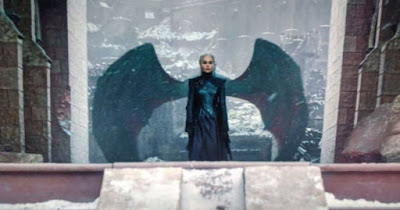
Daenerys Targaryen

Crossposted from Dreamwidth

So everyone’s angry with the way Game of Thrones ended. Some people are being very rude about it. I gather someone’s started a petition to have the final season rewritten, and presumably to have watched Game of Thrones in the first place these people have to be over the age of seven. I haven’t heard for a fact that Dave Benioff and Dan Weiss have received death threats, but with all the entitlement and nerd-rage fizzing in social media right now it would be more surprising if they hadn’t.

I’m not completely happy with it myself, mind you. There are some things that I think went wrong, and I’ll get to some of those. I’m also aware that quite a few of the things I’m OK with a large number of other people aren’t, and I don’t feel like picking fights for no reason. But I feel the sweeping judgements people have made about Benioff & Weiss’s writing competence are unwarranted, especially considering how well they did for so many years before this. Also, you can’t watch anything Thrones-related on YouTube now without screeds of whinging in the comments, and it’s getting irritating.

Everybody’s saying the last season was “rushed”, and that’s true to an extent, but I don’t think it’s the root of the problem. The problem is that there’s a difference between advancing a narrative, which Benioff & Weiss have been doing solidly for years, and resolving a narrative, which they’ve just had to do without assistance from their source material. You can advance a story indefinitely given starting premises and a reasonably realistic imagination; but realism won’t resolve it for you, because reality, not being a story, never gets resolved.

Which may or may not be the underlying reason for the source material problem. It’s been eight years now since the last Song of Ice and Fire book came out, and George R. R. Martin has stopped making promises about when The Winds of Winter is due. And there’s at least one more book to come after that one. Supposedly. Apparently Martin gets a lot of personal remarks about his age and health in this context, which I think is uncalled-for. I think Martin could live to be three hundred years old, and fill a bookcase with A Song of Ice and Fire, and it would still be no nearer ending. I have seen no evidence that the writing of A Song of Ice and Fire is a process with an end-point. Seven-part stories don’t have whole new protagonists appearing and plot arcs blossoming in Part V.

I gather Martin wanted the show to run to ten seasons, and Benioff & Weiss pushed for seven, and what we ended up with – eight, with the last two shortened – was the compromise they settled on. It certainly did feel rushed, but I don’t know that lengthening seasons 7 and 8 out to ten episodes each would have fixed that. I think the series as a whole could have done with one or two less subplots; most of the Sand Snakes and Euron Greyjoy threads in particular could have been dropped without too much violence to the overarching story, and then we’d have had a bit of breathing room to resolve a few other things. (Bear in mind that Benioff & Weiss already cut a bunch of subplots out completely, to complaints from book fans.)

Now I’ll move on to the main specific complaints; some I agree with fully, some partially, some not at all. Here I really do need to cut for spoilers.

Saturday, 13 April 2019

Game of Thrones: a pre-Season 8 thoughtdump

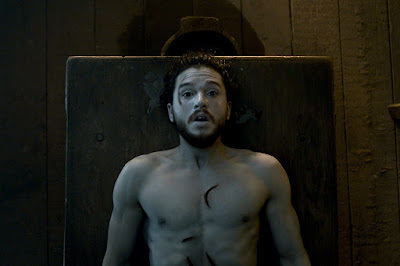
Jon Snow

Crossposted from Dreamwidth

To get this out of the way first: a large proportion of my family and close friends don’t watch Game of Thrones for various reasons. I gather this makes them feel a bit left out of some online conversations, since Game of Thrones has pervaded pop culture so thoroughly by now. I can relate. When I was a kid at primary school, we were the only household that didn’t have a TV. For context, in 1980s New Zealand there were exactly two TV channels, of which only one had children’s programming; so every day, every kid in the school had seen the exact same TV the previous afternoon, which made it ideal fodder for conversation icebreakers and small-talk. Every kid, except us. At the time I blamed this fact for the social difficulties which later turned out to be autism.

...annnd I’m already getting sidetracked in the first paragraph. What I was going to say was, I know how something just being popular with other people creates social pressure, even if it’s unintended, for you to join in and pretend you enjoy it as well. And honestly Game of Thrones is not for everybody. I’m going to be talking about its merits quite a bit, so I want to be clear from the get-go that if it isn’t your thing then it isn’t your thing and that’s fine. (Though I should warn you that I’m assuming my readers are familiar with the series, so this post will be both confusing and spoilery to those who aren’t.)

Indeed, you’ll notice as we go through that I’m not doing comparisons with the books very much, and the reason for that is that the books aren’t my thing. I’ve kind of skimmed through them and occasionally browsed a page or two in bookshops, but I haven’t read them properly, and that’s because I can’t. I understand (and I’ll get into) the reasoning behind the “any character can die” dynamic, and it works onscreen for me, but on the page I don’t get the intended effect. My emotional brain basically goes “Well, if I’m going to be punished for caring about these characters then I’m not going to care about them any more.”

I’m not entirely sure what difference the transition from page to screen makes. I used to think it was because the TV characters had faces and I couldn’t help empathizing with them, but the characters on The Walking Dead have faces too and I gave up on that a couple of seasons ago because I was disengaging from the characters for much the same reason I do with the Game of Thrones books.

Ahahahaha. Yes, yes, I mean the A Song of Ice and Fire books, A Game of Thrones being the title merely of Book I (roughly equivalent to Season 1 of the show). In this instance I’ll grant the book purists the point: A Song of Ice and Fire is a much more appropriate title for the series as a whole.

Whilst most fans as far as I can tell are loving the way things have developed in the later seasons, there’s also a dissatisfied contingent who argue that the whole thing started to go downhill as soon as the showrunners got ahead of George R. R. Martin’s published material. They seem to particularly dislike the way the characters have now fallen into some pretty solid coalitions of people who mostly trust each other, leaving behind all the politicking and betrayals and whisperings and jockeying for power – the game of thrones – that characterized the earlier seasons.

Not to be overly snarky, I think these people are missing the entire point of the series from start to finish. (This is as good a point as any to cut for spoilers.)

Thursday, 22 December 2016

The false meaning of Christmas

’Tis the season to be sappy. Twee cartoon reindeer and Santas, pointy trees and beribboned boxes, tinsel wreaths and spray-painted snow, and above all, inescapably, in every shop, that dreary treacly music that is the aural equivalent of sitting in a bath as it goes lukewarm. The fact that late December is midsummer in New Zealand gives all the doggedly wintry imagery an extra edge of falseness. You can tell that people are feeling it, because the other thing you get this time of year is movies and TV specials offering to reveal the true meaning of Christmas, which evidently is hard to find otherwise.

Well, if it’s hard to find, then the true meaning can’t be money worries and time pressure. Which is pretty much what Christmas is nowadays, if you’re an adult: a time to lavish gifts and food and hospitality on your friends and family or they’ll think you don’t love them. Even that wouldn’t be so bad, if only the gifts were things that were useful, beautiful, thought-provoking or informative. But no. As George Monbiot recently noted, businesses ravage the environment and sweat poor workers half to death so that we can present each other with

a solar-powered waving queen; a belly button brush; a silver-plated ice cream tub holder; a “hilarious” inflatable zimmer frame; a confection of plastic and electronics called Terry the Swearing Turtle... a Scratch Off World wall map... An electronic drum-machine t-shirt; a Darth Vader talking piggy bank; an ear-shaped iPhone case; an individual beer can chiller; an electronic wine breather; a sonic screwdriver remote control; bacon toothpaste; a dancing dog...

Monbiot’s right. These things amuse us for a day or two and then we compound the damage done in their manufacture by adding them to the world’s overflowing landfills. They end up in the ocean. Plastic doesn’t rot. Tools exist that we can use to clean it up, but not at the rate it keeps arriving. And once we’ve cleaned it up, what do we do with it? Burn it, and release the carbon to the atmosphere? Another bad idea. The best I can think of is to recycle it as building materials – say, underfloor insulation – since that’s at least something we would like to have last forever.

It’s become a kind of society-level addiction: better to buy cheap plastic crap than be that one guy who doesn’t give Christmas presents. And of course, the more people who behave like this, the more of a Scrooge you’ll look like if you don’t join in as well – ironically, considering Dickens’ original Scrooge was motivated by profit maximization just like the businesses foisting the cheap plastic crap on us. I don’t know how long the cycle of guilt and cheap plastic crap would go on if it weren’t regularly given a kick along by all the advertising.

This commercialism has even managed to infect the “true meaning” stories. Back in 1956, Ted Geisel (aka Dr Seuss) could write How the Grinch Stole Christmas!, in which the townsfolk of Whoville wake to find all their presents and decorations gone and still sing for joy that it’s Christmas. Contrast that with the 2011 movie Arthur Christmas, whose plot-driving problem is that a single present has fallen off the sleigh, destined for a child who already has lots of presents from her family but will apparently nevertheless be absolutely devastated if she doesn’t get something from Santa as well. Hear that, parents? Better nip out and buy one more just in case.

Friday, 8 April 2016

What really happened to Jesus?

Easter came early this year, which is my excuse for why this blog post about it is late. In accordance with tradition, I made hot cross buns on the Friday and waited until Sunday before consuming any Easter eggs. You might think that I wouldn’t have much time for a tradition based on something I no longer believe, but somehow the buns and eggs both taste more meaningful this way. Also, this semester I’m taking notes for a New Testament Greek class, who are reading their way through the Book of Revelation. So I can’t help speculating, from time to time, on what may have really happened one Passover in Roman Jerusalem to inspire the world’s most popular faith.

Thanks to my personal history, I know a lot of people whose sense of self-worth and identity hangs on the answer to that question. Indeed, they themselves would go further – their eternal destiny hangs on it. That being the case, my putting forward an alternative answer might be seen as something of a red rag to a bull. What do I hope to achieve by doing this, except to make those people angry? Well, for one thing, I don’t think I should have to shut up about my own opinions just because they differ from other people’s. Like I said, personal history. I researched this for over a year in my early twenties, not to annoy people but because I needed to know the truth. I wrote it up rather hurriedly and incoherently and put it on my first website, which may or may not still be knocking around somewhere. It’s important to me too.

I no longer believe in either God or miracles. This necessarily implies that I think people who do believe in God and miracles are wrong. It does not imply, and I want to be very clear about this, that I think those people are fools, or dishonest, or cowards. There is a school of thought among atheists that religious people will sooner acknowledge the wrongness of their beliefs if we just mock, belittle, and insult them enough – the beliefs, not the people, but that distinction blurs all too easily, especially on the internet. I think those atheists are also wrong.

However, that doesn’t mean I hold with the opposing school of atheist thought either – that we should never criticize religious beliefs because they are so important to the people who believe them. Speaking as a former believer, that’s a deeply patronizing attitude. “Oh, of course we who are mature rational adults can handle the world without gods, miracles, or an afterlife, but these poor little lambs couldn’t cope with the nasty truth. We must be gentle with them.” That might apply to anyone in limited circumstances, such as bereavement; as a classifier, it’s insulting.

Atheists of the first school are often referred to these days as “atheist fundamentalists”. Mostly, I don’t think this is helpful. Often it seems “fundamentalist” means nothing more than “anyone who thinks it’s a matter of fact whether God exists or not” (or any other religious proposition), which tars an awful lot of moderate religious people with the “fundamentalist” brush.

That being said, there is a cast of mind I remember from my Christian past and recognise in some atheist discourse now. It’s related to what has recently been dubbed “virtue-signalling”. Basically, you take a question that your group takes a firm stance on, and you take a slightly further-out version of that stance, and you proclaim it loudly so that if your fellow group-members disagree they look like a bunch of compromisers. Then someone else steps still further out, and of course you have to agree or you look like a compromiser. And so on.

Humans are human regardless of our beliefs, and this behaviour is common to us all. From the outside it looks either competitive – “I’m more Christian / atheistic than you!” – or fawning – “I really do belong in the Christian / atheist club with you guys!” But from inside it’s often prompted by sincere enthusiasm, with a wash of pity for those unlucky enough not to have seen the light. I see it just as often in groups that I happen to agree with as groups that I don’t. I presume I indulge in it myself more often than my own (equally humanly common) self-serving cognitive biases allow me to recognise.

Among atheists (this is where all this becomes relevant to the Easter question) this insidership-signalling sometimes takes the form of a conspiracy theory. Not only was Jesus of Nazareth not the Messiah, the Son of God, the Saviour of Mankind, the Prince of Peace, the King of Kings, or any of the rest of it – he didn’t even exist! He was made up out of whole cloth by the early Church, or St Paul, or the Council of Nicaea, or some such. Take that, Christians!

Sunday, 15 March 2015

Goodbye and thank you, Sir Terry Pratchett

I still own several Discworld books with the old “About the author” blurb that begins “Terry Pratchett was born in 1948 and is still not dead.” That sentence is now only half true. Because of the International Date Line, it was Friday the 13th here when I found out he had died. This seemed appropriate.

I met him three times, if thirty seconds in a book-signing queue counts as “meeting”. The first time, I was fifteen, and the signing was at my high school. I remember hurrying to get to the auditorium in time for his talk, and very nearly bumping into him in the corridor – a small man, egg-bald, with a neatly trimmed grey beard, and eyes that looked like he had had some bad news earlier that day. That last impression stands out in my memory because it was so unusual for me to notice anything like that when I was fifteen. (Even today, I’m not fantastic at facial expressions.)

And now I’m sitting here trying to pick one thing or a few things out of his immense body of work, and tell you how it impacted on me. This is difficult. Even doing it chronologically is proving to be a problem, because it goes so far back that I honestly don’t remember what the first Pratchett book I read was. I’m almost sure it was either Wyrd Sisters or Moving Pictures. I do remember reading Reaper Man when it was new out, and that was the one after Moving Pictures. And I can tell you that Pratchett got me out of the endless loop of Tolkien that I got stuck in for a bit there in my teenage – not that there’s anything wrong with being a Tolkien fan, needless to say, but it’s better to read more than one author. Pratchett showed me that fantasy doesn’t have to be about battles and kings and the fate of the world. Ordinary people’s stories are worth reading too.

There was darkness under Pratchett’s good humour. When Robin Williams died last year a lot of people pointed out that comics tend to have honed their craft battling inner demons. Williams’ familiar demon was sadness; Pratchett’s, according to Neil Gaiman who knew him for nearly half his life, was anger. It’s no coincidence that his two most complex and fully realized protagonists, Granny Weatherwax and Commander Samuel Vimes, both wrestle perpetually to control pent-up inner fountains of rage. Rage at what? For their author, rage at the unfairness of the world; rage at how stupid people can be. I don’t mean the sneering “Why do I have to put up with you peasants?” kind of anger at stupidity – I mean that Pratchett saw how officialdom and pomposity and cant and petty-mindedness get people hurt. And he could never quite shrug it off with an “Oh well, life’s not fair, that’s how it is.” Pratchett always cared what happened to people. He stood for practicality and hard work like Kipling, and for social justice like Dickens.

But perhaps because he lived with darkness, Pratchett also learned to embrace it. He made Death a sympathetic character, “not cruel, just terribly good at his job” (and how those words sting just now!): calm, friendly, professional, fond of little pleasures like good food and the company of cats, but perpetually bemused by the foibles of humanity. I don’t have figures on how much that one creative choice has helped people cope with the inevitable end of life. Apparently elderly readers used to write to him, hoping he’d got Death right. Other fantasy franchises seem to be adopting the idea, at least partly. Much of Supernatural is blatantly pinched from Pratchett, though their Death character is slightly sterner and quicker on the uptake. Harry Potter may not have a personified Death, but Rowling’s treatment of it – calm, courageous acceptance – has a distinctly Pratchettian feel.

I toyed with the idea of writing a short story for this post, where Pratchett himself meets Death, but there’ve been a couple of good ones already that I won’t try and better. Let me instead say farewell by echoing the final few entries on his Twitter:

At last, Sir Terry, we must walk together.

Terry took Death’s arm and followed him through the doors and on to the black desert under the endless night.

The End.

Friday, 6 March 2015

Ships that pass in the night

If I ever get my hands on a working time-machine, the first thing I shall do is organize a public debate between C. S. Lewis and Steven Pinker. Not (I’m sure they would both protest) that it would be an especially momentous encounter compared to what you could do with a time-machine. If all goes well, rest assured I will also talk to Shakespeare and Virgil and Homer and the author of Beowulf, document the Polynesian conquest of the Pacific and the first people in the Americas and Australia, film mammoths and indricotheres and dinosaurs in their natural habitat, witness the origin of life, and all that other guff. But the Lewis-Pinker debate will serve as a proof of concept.

Why those two in particular? Because they are so different and yet so similar. Both are fascinated by language, and by what it reveals about the mind. It seemed a little too good to be true, a few years ago, when a manuscript was discovered containing Lewis’s opening contribution to a planned collaborative work with J. R. R. Tolkien, to be entitled Language and Human Nature. Sadly, Seven magazine, which I gather printed the fragment, hasn’t uploaded it to the web. It was never completed because Tolkien was as bad at finishing things as I am, and also he was bogged down in The Lord of the Rings at the time the project began. But that tantalizing title could be the subtitle for most of Pinker’s popular works. On language, Pinker and Lewis nearly always agree.

Sunday, 9 November 2014

Why couldn’t we have had a movie about Lúthien?

I gather the Tolkien family have put their foot down and said “no” to any more Middle-Earth movies after The Hobbit is completed. I’m disappointed, but only mildly. The days are now past when any attempt to depict high fantasy on screen was bound to fail ignominiously. I don’t begrudge the Tolkiens their decision – apparently their father’s fame has been the bane of their privacy for half a century, not to mention that the movie companies have been very stingy about passing any of their profits on to his estate. And I understand completely why Peter Jackson and Weta Workshop went for The Lord of the Rings and The Hobbit first. But I think Tolkien himself was a bit embarrassed by The Hobbit. It wasn’t originally supposed to be part of the mythos at all – he just helped himself to the name of a character (Elrond) and a place (the lost city of Gondolin) to give it a bit of atmosphere, and then filled out the connections over the twelve years it took to write The Lord of the Rings. (Which then took six more years to publish. And George R. R. Martin fans complain about waiting five for A Dance with Dragons.)
Those two were the only Middle-Earth books J. R. R. Tolkien got published in his lifetime. All right, those and a small collection of verse under the title The Adventures of Tom Bombadil. His son Christopher is still, I think, collecting and transcribing the giant mass of manuscripts he left when he died, some of them going right back to his time in the trenches of World War I. The first published was The Silmarillion, a collection of the whole mythos condensed down to one chapter per story, which many people understandably find tough going. Jackson has had to stretch and pad out The Hobbit to make three movies of it; The Silmarillion would fill at least a dozen.
Of all Jackson’s padding, the single element that has raised the most fan complaints so far is the most necessary one: the invention of the female elf-ranger Tauriel among Thranduil’s people in Mirkwood. I have a sneaking suspicion Jackson is going to kill her off in the third movie. The Hobbit was a boys’ adventure story, and like many boys’ adventure stories of the time it had no female characters. The Lord of the Rings has seven named female characters, eight if you count Shelob the spider. Two, Lobelia Sackville-Baggins and Ioreth of Minas Tirith, are old-lady stereotypes. One is Rosie Cotton, who doesn’t show up until Sam Gamgee needs a happy ending. The remaining four are all idealized models of femininity – Goldberry, Arwen Evenstar, Galadriel, and Éowyn of Rohan. Goldberry, like Tom Bombadil her husband, appears only in a disconnected episode near the beginning; her character is too sketchily drawn to tell us much about her author’s values. Arwen, Galadriel, and Éowyn each warrant further investigation.

Tuesday, 8 July 2014

The Last Battle

        
Up far beyond [Jove]

Goes Saturn silent
in the seventh region,

The skirts of the sky.
Scant grows the light,

Sickly, uncertain
(the Sun’s finger

Daunted with darkness).
Distance hurts us,

And the vault severe
of vast silence;

Where fancy fails us,
and fair language,

And love leaves us,
and light fails us

And Mars fails us,
and the mirth of Jove

Is as tin tinkling.
In tattered garment,

Weak with winters,
he walks forever

A weary way,
wide round the heav’n,

Stoop’d and stumbling,
with staff groping,

The lord of lead.
He is the last planet

Old and ugly.
His eye fathers

Pale pestilence,
pain of envy,

Remorse and murder.
Melancholy drink

(For bane or blessing)
of bitter wisdom

He pours for his people,
a perilous draught

That the lip loves not.
        

Wednesday, 15 January 2014

The Magician’s Nephew

        
In the third region

Venus voyages...
but my voice falters;

Rude rime-making
wrongs her beauty,

Whose breasts and brow,
and her breath’s sweetness

Bewitch the worlds.
Wide-spread the reign

Of her secret sceptre,
in the sea’s caverns,

In grass growing,
and grain bursting,

Flower unfolding,
and flesh longing,

And shower falling
sharp in April.

The metal copper
in the mine reddens

With muffled brightness,
like muted gold,

By her fingers form’d.
        

Friday, 25 October 2013

The Silver Chair

Lady Luna,
in light canoe,

By friths and shallows
of fretted cloudland

Cruises monthly;
with chrism of dews

And drench of dream,
a drizzling glamour

Enchants us – the cheat!
changing sometime

A mind to madness,
melancholy pale,

Bleached with gazing
on her blank count’nance

Orb’d and ageless.
In earth’s bosom

The shower of her rays,
sharp-feathered light

Reaching downward,
ripens silver,

Forming and fashioning
female brightness,

– Metal maidenlike.
Her moist circle

Is nearest earth.
        

Saturday, 24 August 2013

The Horse and His Boy

        
Next beyond her [Luna]

Mercury marches; –
madcap rover,

Patron of pilf’rers.
Pert quicksilver

His gaze begets,
goblin mineral,

Merry multitude
of meeting selves,

Same but sundered.
From the soul’s darkness,

With wreathèd wand,
words he marshals,

Guides and gathers them –
gay bellwether

Of flocking fancies.
His flint has struck

The spark of speech
from spirit’s tinder,

Lord of language!
He leads forever

The spangle and splendour,
sport that mingles

Sound with senses,
in subtle pattern,

Words in wedlock,
and wedding also

Of thing with thought.
        

Saturday, 29 June 2013

The Voyage of the “Dawn Treader”

        
Far beyond her [Venus]

The heaven’s highway
hums and trembles,

Drums and dindles,
to the driv’n thunder

Of Sol’s chariot,
whose sword of light

Hurts and humbles;
beheld only

Of eagle’s eye.
When his arrow glances

Through mortal mind,
mists are parted

And mild as morning
the mellow wisdom

Breathes o’er the breast,
broadening eastward

Clear and cloudless.
In a clos’d garden

(Unbound her burden)
his beams foster

Soul in secret,
where the soil puts forth

Paradisal palm,
and pure fountains

Turn and re-temper,
touching coolly

The uncomely common
to cordial gold;

Whose ore also,
in earth’s matrix,

Is print and pressure
of his proud signet

On the wax of the world.
He is the worshipp’d male,

The earth’s husband,
all-beholding

Arch-chemic eye.
        

Sunday, 31 March 2013

Prince Caspian

        
But other country

Dark with discord
dims beyond him [Sol],

With noise of nakers,
neighing of horses,

Hammering of harness.
A haughty god

Mars mercenary,
makes there his camp

And flies his flag;
flaunts laughingly

The graceless beauty,
grey-eyed and keen,

– Blond insolence –
of his blithe visage

Which is hard and happy.
He hews the act,

The indifferent deed
with dint of his mallet

And his chisel of choice;
achievement comes not

Unhelped by him;
– hired gladiator

Of evil and good.
All’s one to Mars,

The wrong righted,
rescued meekness,

Or trouble in trenches,
with trees splintered

And birds banished,
banks fill’d with gold

And the liar made lord.
Like handiwork

He offers to all –
earns his wages

And whistles the while.
White-feathered dread

Mars has mastered.
His metal’s iron

That was hammered through hands
into holy cross,

Cruel carpentry.
He is cold and strong,

Necessity’s son.
        

Wednesday, 6 February 2013

The Lion, the Witch and the Wardrobe

        
Soft breathes the air

Mild, and meadowy,
as we mount further

Where rippled radiance
rolls about us

Moved with music –
measureless the waves’

Joy and jubilee.
It is Jove’s orbit,

Filled and festal,
faster turning

With arc ampler.
From the Isles of Tin

Tyrian traders,
in trouble steering

Came with his cargoes;
the Cornish treasure

That his ray ripens.
Of wrath ended

And woes mended,
of winter passed

And guilt forgiven,
and good fortune

Jove is master;
and of jocund revel,

Laughter of ladies.
The lion-hearted,

The myriad-minded,
men like the gods,

Helps and heroes,
helms of nations

Just and gentle,
are Jove’s children,

Work his wonders.
On his wide forehead

Calm and kingly,
no care darkens

Nor wrath wrinkles:
but righteous power

And leisure and largesse
their loose splendours

Have wrapped around him –
a rich mantle

Of ease and empire.
        

Saturday, 19 January 2013

Explaining the internet to C. S. Lewis

I always loved the Narnia series as a kid. It took a back seat when I read The Lord of the Rings, mind you, but it never fell off the bus altogether. I read the Cosmic Trilogy and the Screwtape Letters in due course. Then, as a teenager, being nerdy and a Christian, I got heavily into C. S. Lewis’s apologetic writings – I think his argument for the supernatural in Miracles (the relevant chapter is reproduced here, and I’ll deal with it in depth in an Imponderable some time) may have delayed my atheism by about five years. Lewis became one of my heroes, and I strove to emulate him. Various people have been kind enough, through the years, to praise my writing for its clarity; they have Lewis to thank.
During that time, I got into the habit of having imaginary conversations with C. S. Lewis. This isn’t so unusual. I tend to have imaginary conversations a lot with Richard Dawkins or Steven Pinker or whoever I’ve been reading lately (though mainly only non-fiction; I don’t do this with Terry Pratchett). But I read so much Lewis that it became ingrained. When I became an atheist, the conversations became distinctly more adversarial, but they continued.

Monday, 17 December 2012

Book to film

I confess. I caved. I went in to find out how long The Hobbit was sold out for, and it wasn’t. J. R. R. Tolkien was such a big part of my childhood that I’m afraid my disgust at the union-busting tactics Peter Jackson and the John Key government used him as an excuse for, didn’t beat my deep need to see more of Middle-Earth onscreen. My only (poor) defence is that I do want to support a New Zealand industry that doesn’t involve digging big holes in the wild country or fouling the rivers with excrement. However, I began writing this post before all that, and so this isn’t a post about The Hobbit, it’s a post about the Lord of the Rings movies. I’ll be able to judge The Hobbit properly when the new trilogy is complete.

Thursday, 29 November 2012

Which way you face

I don’t have the Discworld books handy right now, and I don’t remember which one it was, but at one point Granny Weatherwax says something along the lines of “It doesn’t matter where you stand; what matters is which way you face.”
I’m pretty sure Granny Weatherwax is speaking for her author here, and I think I have an inkling what Pratchett might have meant. And a few different things have reminded me of it recently. (Spoilers for The Lord of the Rings and the Narnia series below the cut, though if you haven’t read The Lord of the Rings or the Narnia series I’m not sure what you’re doing reading my blog.)