Showing posts with label misogyny. Show all posts

Wednesday, 31 July 2019

Love and thunder

Whosoever holds this hammer, if *she* be worthy, shall possess the power of Thor.

Crossposted from Dreamwidth

It’s official: in a couple of years’ time there’s going to be a fourth Thor movie in the MCU, and it’s going to be titled Thor: Love and Thunder, and it’s going to feature Natalie Portman as the Mighty Thor and be directed by Taika Waititi. I can’t wait.

There’s a contingent of YouTubers who see it as their bounden duty to pour vitriol on anything with the faintest whiff of “political correctness,” which in practice includes all female-led fantasy, science fiction, and superhero movies. Some disavow any misogyny and I guess quietly hope we won’t go look up what they’ve said about Captain Marvel and Mad Max: Fury Road and Rey in Star Wars and the latest Ghostbusters and the Thirteenth Doctor on Doctor Who. Others are louder and less coherent – “liberals are ruining my childhood, literally no-one asked for this, let’s burn Marvel to the ground!” style of thing.

I mean, one of the complaints is true: Portman isn’t anywhere near as big and muscular as the Mighty Thor. But if that’s your main problem, I have something devastating to tell you about Mark Ruffalo.

If you’re even less familiar with Marvel comics than I am and not clear how Natalie Portman can play Thor, what with him being male, here’s the basics. In the comics, unlike either the Norse myths before them or the movies after them, anyone who can lift Thor’s hammer Mjolnir gains not only his powers but his identity. The usual Thor is a guy called Donald Blake, but there have been several others, including an alien called Beta Ray Bill and a frog and, in a comics run in 2014–2015 titled The Mighty Thor, Blake’s on-again off-again love-interest Jane Foster, i.e. Natalie Portman’s character from the first two Thor movies.

The let’s burn political correctness to the ground! brigade of course hated The Mighty Thor and campaigned for it to be cut short, and some of them claim credit for it ending – which it did with the completion of its story arc, making that claim roughly as plausible as most of the other things these people say. They also say, for instance, that no-one liked Captain Marvel either, a movie which made over a billion dollars at the box-office; and that everyone hated the bit in Avengers: Endgame where all the female heroes band together, a scene which I’ve elsewhere seen criticized only for being too little too late.

So why am I looking forward so eagerly to Thor: Love and Thunder? Most people who write enthusiastically about the MCU seem to have started as comics fans. I suppose I might have been one if things had gone slightly differently, but in fact I never got into any comic as a kid; I was a Tolkien geek instead. And it’s not far to go from Tolkien to Norse mythology. So with most MCU characters the movies are my first sight of them – but not with Thor and his associates.

I did become aware, obviously, that Thor had been reinterpreted as a cartoon character, and I was enough of a purist (you’ll be shocked to hear) that I found this mostly annoying. It didn’t help that the cartoon character was blond, clean-shaven, and a bit of an airhead, where the god is supposed to be ginger-bearded and short-tempered. Worse, not all comics writers have any clue about Shakespearean English, and you’d get sentence constructions like “he didst goeth,” which to me is chalkboard-nails, microphone-feedback, corner-of-tabletop-in-the-elbow-nerve infuriating.

(Not that Thor should technically have been speaking Shakespearean English at all, of course, but even I can forgive comics writers for not filling their dialogue bubbles with Old Norse.)

Thursday, 27 December 2018

The imminent and well-deserved demise of Tumblr

Truth Coming Out Of Her Well to Shame Mankind

On 3 December Tumblr announced it was getting rid of adult content, starting in two weeks from the announcement. Tumblr management has never been competent at the best of times, but this takes the cake. This will kill the site.

Those of you who don’t have Tumblr accounts will scarcely imagine what a dumpster-fire this is. Just to start with, the main draw of Tumblr was that it was the one social media site that allowed adult content. What Tumblr has just done is basically what I’ve seen a couple of local hospitality businesses do – a pub on the Otago University campus years ago, and a café in Port Chalmers more recently. Both had quirky art-work that gave them an alternative vibe; both were bought by new owners who removed the quirky art-work and tried to rebrand them as bland mainstream venues; both promptly went out of business. The campus pub was eventually revived by a competent proprietor; the Port café is currently sitting empty, a monument to the folly of erasing a successful enterprise’s main point of distinctiveness. The same fate awaits Tumblr.

I was on Tumblr for nearly two years. My original hope, when I joined, was to spread this blog a little further, since after six years I have exactly two followers here. This was not to be, because Tumblr’s search software passes over posts that contain links to other sites – far from the only way in which Tumblr fails its users – which meant that the links to this blog were only seen by those few of my followers who happened to be online at the moment I posted the links. Additionally, I gained Tumblr followers relatively slowly; I think my peak following, after two years, was 182 including spambots. I think this may have been because I declared on my blog header that I was a nudist but didn’t intend to post any nude photos, which lost me both the people who think nudism is skeevy and the people who want to see nude photos. But I can’t be sure.

(Tumblr advertises itself as being good for artists. How are they any good for artists if they make posts with external links non-searchable, you might wonder, so that artists can either get their art seen or link to places where people can pay them for it, but not both? Well, they aren’t, that’s how. And yet, so many of us put up with them, until now.)

The announcement came in the form of an official letter from the Tumblr staff account, which I would go through and point out all the lies except that it’s all lies. The new guidelines ban, and I quote, “images, videos, or GIFs that show real-life human genitals or female-presenting nipples,” in case you were wondering why the phrase “female-presenting nipples” became a commonly repeated joke in early December. So Tumblr is apparently enlightened enough to talk in terms of gender “presentation”, and yet reactionary enough to frame femaleness as inherently more sexual than maleness. Remember, this is not an old policy. This is a policy devised in 2018 by the curators of one of the internet’s biggest platforms for feminist and LGBT content.

Most of us first knew something was going wrong on 16 November, when the Tumblr app disappeared from Apple’s App Store. For those like me who used Tumblr on our computers rather than on mobile, the first sign was when Tumblr responded by suddenly making huge numbers of posts non-searchable, based on their tags – not just things like #NSFW and #nudity but hundreds more, some quite inexplicable. I never did find out why we suddenly couldn’t search for #chronic pain. Meanwhile, posts tagged with things like #white supremacy and #white genocide continued to pop up in search results.

Our first thought was that this was a ham-fisted attempt to deal with the exponentially-increasing nuisance of pornographic spambots. Any post on any subject at all whose count of responses reached five digits would suddenly start getting reblogged by porn-themed accounts with generic comments like “Cool, see my site here.” You could report and block, report and block, report and block, and new bots would keep on coming. They weren’t intended to attract the eyes of the bloggers they were harassing, but to piggyback off them to hoist their coders’ porn sites up the Google search rankings. You see, the way Tumblr works, if you reblog a post and add a caption, then there is now a link to your blog from every other blog that has also reblogged that post. If thousands of people have reblogged it then that’s thousands of links, all from legitimate content-bearing webpages that real people read, and that’s what Google’s search algorithms look for. So our first response was: well, yay that the staff are doing something about this at last, but they need to get a lot smarter about it, please.

Of course we were quite mistaken to think Tumblr management had suddenly started caring about their users’ experience of the site. The pornbot coders wised up within a week or two and reprogrammed their bots to use the tag #SFW and no unsearchable tags, which it turned out was all it took to get past the algorithms. Those of us who conscientiously tagged Pre-Raphaelite paintings as #nudity (so people could filter them out on their work computer just in case their boss looking over their shoulder got the wrong idea) continued to be punished for our honesty.

The next hypothesis was that it was about the child porn, and that does seem to be what sparked Apple’s ire. Tumblr’s strategy for dealing with paedophiles was exactly the same as their strategy for dealing with Nazis, to wit “have a Block function and let the users do all the work”. I’m glad to say I never saw any myself, but many other users had been making complaints to the staff about the problem for years, with the same results as every other complaint to the staff. Getting dropped from the App Store, now that was something they cared about.

But while the App Store incident undoubtedly fast-tracked the adult content ban, the truth is it had been coming for months. Like many other social media platforms, Tumblr’s business plan is to hire out their users’ eyeballs to advertisers. They evidently noticed that their site was getting popular with the social justice crowd and in particular the Black Lives Matter movement, and they apparently had a big plan in the works to capitalize on that. And many advertisers baulk at the idea of people seeing their ads right next to GIFs of sex acts. So the nudity had to go. We used to think that if Tumblr had just one virtue, it was that they understood that not all nudity is sexual and not everything sexual is degrading; now it turns out they just didn’t care about being degrading until there was money in it.

On top of all that, there’s a draconian piece of legislation coming into force in the United States next year called SESTA/FOSTA – I can’t be bothered looking up the acronyms but the ST in both halves stands for “sex trafficking”. Nobody with any human decency could oppose stopping sex trafficking, which makes it the perfect pretext for interest groups pushing less creditable agendas. Under the new law, social media hosts based in the US will be liable for allowing sexual solicitation on their sites, even unknowingly, even if it’s just one ad. This is why Facebook, from next month on, is going to start cracking down on anything that could remotely be interpreted as a sexual invitation, up to and including posts consisting of “looking for a good time tonight ;)”. This legislation will incidentally stifle discussion of sexuality or sexual orientation in social media; I’m pretty sure that’s a plus as far as its originators are concerned, but it might come as an unpleasant surprise for some of its more liberal supporters.

How deleting Facebook posts saying “looking for a good time tonight ;)” will contribute to stopping sex trafficking is: it won’t. But at least Facebook understands that you need human intervention to make this sort of thing work. Tumblr think they’re going to accomplish it with software, and indeed with ludicrously simplistic software. They’ve promised that nude paintings and breastfeeding photos and news articles about nude protests will be safe once they get their programs properly trained, but the algorithm they’re using could not possibly make such fine distinctions even if you trained them on all the data on the internet for a thousand years. You may have seen funny Facebook posts about the photo-captioning AI, trained on pictures of fields of sheep, that tagged all fields as “sheep” and failed to recognise sheep in any other context. It’s the same algorithm.


Nude images follow.

Thursday, 26 July 2018

Don’t let fascists steal free speech from us

Two “alt-right” speakers from Canada, Lauren Southern and Stefan Molyneux, have decided they will, after all, go ahead with their visit to New Zealand (temporarily cancelled) where they will espouse their views. The venue is, as I write, being kept secret. Previously, they wanted to speak in an Auckland venue called the Bruce Mason Centre, but were denied that opportunity at the instruction of Auckland Mayor Phil Goff. This has raised concerns about freedom of speech in New Zealand, and not just among those who agree with their position. Chris Trotter, New Zealand’s most respected Left blogger, has taken up the cause in several recent posts on his blog Bowalley Road.

I’ve been drafting this post for two years now; the issue keeps coming up and going away again, and I have to change the bits where I relate it to current events. It’s a bit bigger than I can really pin down in one post. I’m going to skip out some things I originally planned to say about particular progressive concerns that some believe constitute assaults on free speech – trigger warnings, safe spaces, cultural appropriation – because they just make the whole thing too unwieldy. I may devote more blog posts to them in future. Today my topics are: What is the ethical basis of the right to free speech? What sort of policies do we need to build around it? And what are its limits?

Political discussions frequently open with assertions of rights that the disputants hold to be incontrovertibly inviolable – endowed, in the famous words, by the Creator. But what makes a right a right? Why is it that some good things you might want are your “right” to enjoy, while others are merely privileges? What makes the difference? And what if one of your rights can’t be granted without breaching someone else’s rights? What do you do then? This sort of question is why I like to go back a bit further, behind the concept of rights to their basis in ethical philosophy.

In case you’re a new reader, I’ll just quickly run you through my basic moral philosophy. Morality isn’t something objective, not if by that you mean it’s something “out there” in the universe, independent of our minds. You can’t logically prove a “should” statement from an “is” statement without at least tacitly calling in another “should” statement, and if you try to prove that second “should” statement you just go around the circle again, and so on forever. And perhaps that’s just as well, because if morality was something “out there”, then any intersection between moral facts and human well-being would be coincidental. Appeals to moral authority, even cosmic moral authority, don’t help: “You should obey the authority” is just another “should” statement and another trip around the circle.

Hence, morality is subjective. But “subjective” is not the same as “arbitrary”. To call something “subjective” just means it’s an experience that people have rather than a thing in the universe – it’s “in here” rather than “out there”. Sweetness is subjective, but no-one disagrees as to which is the sweeter of maple syrup and grapefruit juice. You can justify a “should” statement; you just have to back it with an “I want” statement. (I want to be healthy, therefore I should exercise more than I do.) As a social species, pretty much anything we want requires cooperation with other people, and cooperation requires trust, so we evolved moral instincts to allow us to trust each other. Therefore, in my view, trust is the basis of all morality.

To earn trust, your actions must fulfill three conditions. They must be benevolent; they must be consistent; and both of these facts must be clear to other observers. Benevolence alone is not quite enough. Pure benevolence, the greatest good for the greatest number, is the moral philosophy known as utilitarianism. The harmonics of cold calculating efficiency that cling around that word somewhat misrepresent the idea; “utility” in the philosophical sense includes beauty and joy as well as usefulness. However, the “calculating” part is bang-on. Utilitarian philosophers spend a lot of time balancing harms and benefits and fretting about whether they’ve left something out. And I don’t know about you, but that makes me nervous. I can’t help worrying that they might end up putting the things I care about on the “sacrifice for the greater good” side of the equation.

When you factor in the consistency and the clarity, utilitarianism gives way to a couple of other moral schemas. One of them is virtue ethics – if you practise being a good person until it becomes habit, your actions will be clearly and consistently benevolent. This isn’t particularly relevant to today’s topic, and I mention it only for completeness. The other one, however, is the answer to our question: the origin of rights. To be clearly and consistently benevolent is to commit to doing some good things all the time for everybody while refraining from doing some bad things ever to anybody. When a society makes such a commitment, whether in law or custom, it thereby grants its members the right to enjoy the good things and the right not to suffer the bad things. That’s where rights come from.

And that helps us answer our other question. When you have to choose one right over another, you should honour the one that best serves the principle of trust. Suppose you’re a surgeon, and you have in your hospital five people urgently needing different organ transplants and also a healthy young person who’s come in for a sports injury. A utilitarian calculus might prompt you to at least consider killing the young person to harvest their organs, sacrificing one life to save five. But of course if you did that, no patient could ever trust you again not to kill them for their organs. The trust principle would therefore accord with what (I sincerely hope) your moral instincts tell you and render such a course of action unthinkable.

Since the seventeenth century most of the questions vexing Western political theorists have been variations of “What is the right balance between peace, justice, and freedom?” When you find yourself facing a trade-off between the three, how do you choose which to preserve and which to sacrifice? (This is not quite the same as the question actually driving social progress, which is “How many crumbs do we have to give these annoying poor people before they’ll shut up and go away?”) What’s often not noticed is that peace, justice, and freedom all have the same end-goal, i.e. not having to fear violence any more. Peace means you don’t have to fear violence from strangers. Justice means you don’t have to fear violence from your neighbours. Freedom means you don’t have to fear violence from the state.

But you can never have complete freedom in any society, because freedoms are necessarily in tension with each other. If you are free to do some particular thing, that means I am not free to stop you from doing that particular thing, and vice versa. So, for instance, you are free to play irritating contemporary music and there’s not much I can do about it, but I am not free to walk around in public wearing the amount of clothing I feel physically comfortable in. If I call the police and complain about your music I’ll be ignored, unless it’s very loud; if you call the police and complain about my nudity I’ll be arrested. Conversely, if I try and cut the power cord on your stereo I’ll be the one in trouble, whereas if you threaten me with assault unless I put some clothes on the authorities will probably agree I had it coming. (As you see, legal freedoms tend to get skewed towards majority cultural groups and away from, in this case, those of us who have autistic sensory issues.)


Now we can narrow in from freedom generally to freedom of speech in particular.

Friday, 1 June 2018

Against enforced monogamy

The issue of sexual violence has never gone away. The #metoo movement is just one more response to it, though so far one that’s been getting more notice than many. In the last, I don’t know, month or so, the media at large has at last started to notice the well-established connection between misogynistic violence and mass shootings, and the word “incel” – involuntarily celibate – has achieved a greater currency than it had before. I gather “incel” was first coined to describe the experience of being queer and unable to find someone of the gender you like who likes people of your gender, but it has now unfortunately been very firmly appropriated as a self-identifier for that subset of men who (a) aren’t getting sex and (b) believe they are owed sex. And this of course has led to suggestions that maybe mass shootings would be averted if more women would “take one for the team” and have sex with incels. Because, apparently, some people aren’t content with being horrible human beings in the privacy of their own homes.

I have seen it claimed, mind you, that incels aren’t real because it’s not actually hard to find someone to have sex with and these men must be just being needlessly picky (or obsessive) about their choice of partner. I can’t hold with this. For some people it may be easy to find people to have sex with, but there are many circumstances which make it difficult for others. One, as already noted, is being the only queer person in your offline circle. Various disabilities – physical and social – have similar effects. It’s not the not getting sex that makes incels horrible people, it’s the belief that they are owed it. Men who believe they’re owed sex are horrible people whether or not they’re getting it, which brings this digression nicely back to the point.

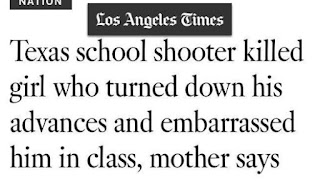
A couple of weeks ago a guy walked into Santa Fe High School in Texas and shot people, killing ten of them. Following an excellent suggestion that’s been passed around Twitter and Tumblr, I’m going to refer to the perpetrator as “Shooter #101” (this was the 101st mass shooting in the United States this year). The mother of one of the dead, Shana Fisher, has claimed that her daughter was repeatedly harassed by Shooter #101 for a date and ultimately turned him down publicly in front of the school, and that she was the first person he shot. Several articles on the incident have used this for a lede. Apparently it hasn’t been corroborated by witnesses – which is bad enough, but I’ve worked in journalism in a very small way, I can understand going ahead with the article on the assumption that the mother knew what she was talking about. What’s not forgivable is that this was how they framed this element of the case:

Spurned advances from [Shooter #101] provoked Texas shooting, says mother of girl killed (NZ Herald)Texas school shooter killed girl who turned down his advances and embarrassed him in class, mother says (LA Times)

And these are far from the worst. You see the narrative being put forward here? Men (overwhelmingly) do the shooting, but never fear, we can always find a way that it’s ultimately a woman’s fault. Women are put on earth to meet men’s needs, and men go astray when women fail to fulfill that function. Men’s sexual and romantic yearnings give them a proprietary right over women’s bodies, attention, and time. Most commentators would recoil from this position if it were stated openly; the danger of framing male violence as the headlines above do is precisely that this narrative sneaks under the radar as a tacit premise instead of being exposed to challenge as an explicit proposition. To men who do believe that women owe them sex, this subtextual confirmation helps that belief fit just that little bit more comfortably into their picture of the world.

Monday, 8 January 2018

I support Madeline Anello-Kitzmiller

There’s a news video from New Zealand going round the world at the moment. It was taken by a casual attendee at the Rhythm & Vines Festival in Gisborne for the New Year. Two women, one of them topless, are walking through a casual crowd; a man watches them pass, then sneaks up behind the topless woman, gropes her, and runs away. Both women turn around, walk over to the man, and hit him. The women are Madeline Anello-Kitzmiller and her friend Kiri-Ann Hatfield. The man who assaulted Anello-Kitzmiller hasn’t been named.

Why am I just telling you what happens in this video, instead of showing you? Because I wanted to show you Anello-Kitzmiller’s statement on the incident instead. I’ve never previously seen the ethical core of naturism and body-positive feminism stated so comprehensively and so succinctly.

...I would like to point out that I had that body art done at the festival. There was actually a stall selling the “glitter tits” get-up, and I paid to have it done, as well as many other girls I saw walking around with it. In addition to that, the waterslide at R&V was handing out $50 to the first man and woman to go down the slide naked, and another $50 to the next man and woman. I saw plenty of naked men that day getting absolutely no harassment for revealing themselves. There were naked men in the mosh; my best friends got naked and ran through the crowds; I saw plenty of guys walking around with no shirt on and a handful of girls as well.

So I want to ask you, what is the difference? Both men and women have nipples, although men’s nipples are seemingly useless and my breasts are there to feed children, should I ever choose to have them some day. The difference is that women have been over-sexualized for way too long and it needs to stop. I wanted to share my body because I think it’s an important step to normalizing the naked body and desexualizing [it]. The more often people see nudity, the more they realize... that it’s nothing to gape over. Nudity at festivals helps erase pornstar ideals of what our bodies “should” look like. My breasts are not sex toys. They are not an invitation. My body is beautiful, and no matter who says otherwise, it cannot and will not demean my own self-worth. Nor should it for anybody else.

I’ve been accused of “trying to turn New Zealand into America” in a few comments. This is a narrow-minded accusation. Besides, the similarities are there regardless. The amount of naked people running around at Splore in New Zealand would be severely overwhelming for those of you who couldn’t handle a few bouncy “glitter tits” at R&V. I will say that the majority of New Zealand has seemed to be more conservative than Portland, Oregon, but sexual harassment happens everywhere, all over the world. I have never experienced so much hostility at a festival before, but I don’t doubt that there are festivals in the States where the crowd is also less free-spirited than others.

I have been accused of “asking for it” too many times to count. It’s disappointing that people really believe that what you’re wearing has any connection to what you actually want. Comments stating that I was “asking for it” or that I “had it coming” are promoting rape culture. When you say something like that, you are justifying that man’s actions when he violated my rights to my own body, and you are telling other like-minded people that, should they ever want to sexually assault or rape another human being, it’s OK. It is never OK and we are never “asking for it”.

...The cool thing about being able to get naked at festivals and like-minded events is that you don’t have to get naked if you don’t want to. Do what you’re comfortable with and only do what makes you happy. I personally love being naked because it made me realize that I am indomitable. Nothing anybody says about me or my body could ever wound me. At Rhythm & Vines both men and women came up to me and told me that I was disgusting, that I should cover up, that I [should be] ashamed, that I was a slut, but I kept my top off all night and I danced until 6am and I had the best time of my life regardless.

On “trying to turn New Zealand into America”, I’m surprised that such an accusation was ever made, because I was under the impression that it was more the other way around. It’s American censoriousness in particular that nudists tend to blame for the restrictive nudity rules on social media platforms like Facebook and Instagram. The recent movement to banish breastfeeding from public spaces – a bizarre bit of prudery unheard-of even in Victorian times – is as far as I can tell very largely American, and doesn’t seem to have taken hold here. I think the truth is that the United States contains both the most and the least nudity-friendly places in the English-speaking world; Portland, Oregon, is evidently among the former.

[EDIT: A Tumblr mutual informs me that the last part of that sentence is sadly not true. However, the United States does contain San Francisco, where public nudity was temporarily legal, and Brattleboro, Vermont, where it still is. Also, I’m ashamed to report that my attention has been drawn to a recent incident in Auckland where a woman was evicted from a bus after a fellow passenger took offence at her breastfeeding. I still think this is far from the norm in New Zealand, but I can’t in all honesty maintain that it “hasn’t taken hold.”]

While New Zealand sadly doesn’t attain Brattleboro standards of body acceptance, our nudity taboo is far from absolute. My town hosts a nude rugby match most years, though they’re not doing it this year; the Kawarau Gorge bungy-jumping station used to let people jump naked for free until they found they were losing too much money; and the whole country had a “National Nude Day” (mostly pubs offering specials to naked customers) for a few years about a decade ago. I used to belong to a group that went walking nude in the bush around Dunedin, and most people we met responded positively. And, as Anello-Kitzmiller points out, nudity is at least tolerated at many New Zealand summer festivals – a tradition going back to Nambassa in the 1970s – and was specifically encouraged at Rhythm & Vines. Which means that everyone who’s commented to say her toplessness was “inappropriate” is simply wrong.

That is, however, a minor error compared to the premise that, if her nudity had been inappropriate, then it would have been OK for the man who harassed her to do what he did. Of course, personally I think that nudity ought to be acceptable everywhere it’s physically safe. But even given that we can’t snap our fingers and wish for society to outgrow all its repressive norms overnight, there is no way sexual harassment is an allowable means of enforcing those norms. If female toplessness had been banned at Rhythm & Vines, then the proper response would have been for a security team member to bring her a towel or spare shirt and explain their standards. The assailant would still be no more justified in his actions than a truck driver is justified in killing cyclists who stray into the wrong lane.

The other argument is of course that old chestnut “He’s a man, he couldn’t help himself.” There were half a dozen other men in that video and they somehow managed to help themselves (although they didn’t help Anello-Kitzmiller by doing anything like intervening). And it wasn’t as if he took one look at her breasts and zoned out or something; he waited until she had gone past and then made his move. The assault was a deliberate choice on his part. If he had genuinely been unable to help himself, then he should have been under restraint or at the very least in the care of a minder. Since he was able to help himself, deterrent action such as Anello-Kitzmiller and Hatfield took was the appropriate response.

Frankly, I think “He couldn’t help himself” and “Her nudity was inappropriate” are both smoke-screens for our society’s ugly underlying attitude. Both are nonsensical on the face of it, but both make sense if you make one abhorrent ethical assumption: “Men may act on any sexual impulse they feel towards women.” Then everything falls into place. Skimpy clothing becomes inappropriate anywhere sexual activity is inappropriate. The assailant couldn’t help how he felt about Anello-Kitzmiller’s breasts.

And no, you can’t take gender out of it by restating that as “People may act on any sexual impulse they feel towards anybody.” Our society does not condone women acting sexually, nor men acting sexually towards men. Accordingly, men are granted much broader freedom with our bodies in casual contexts like music festivals. The festival I go to at New Year’s doesn’t encourage nudity, yet there were plenty of men going shirtless in the heat this year. If I, a bisexual man, had sneaked up behind one of them and groped him, and he’d (rightly) hit me, how many people do you think would have defended my actions on the basis that he was “asking for it”?

(In case you’re wondering why I, a nudist, go to a New Year’s festival that doesn’t allow nudity, it’s partly a shortage of options down this end of the country but mainly about the music. I love traditional folk music and I have bigger autistic sensory issues with loud thumpy contemporary music than I do with clothing even in the summer heat. And I wear a kilt, which helps. And for the hottest days there’s a small swimming-hole upstream of the main one where hardly anyone goes.)

The same assumption again must be behind the frequent rejoinder: “Men are turned on by breasts. How do you intend to change that?” There’s no need to change men’s feelings. What needs to change is how men consider themselves entitled to act on their feelings. Suppose you’re hungry in the supermarket – I’ve used this analogy before – and you walk past a big bulk bin full of chocolate chips or something. Do you dig your hand in and grab? Not if you’re over the age of about four. Do you stand there staring and drooling? Not if you have any self-control at all. And chocolate doesn’t even have human rights. The problem is not that men think breasts are nice; the problem is that men think breasts are permission.

Which gives us good grounds for hope that men can change. Men do seem to have evolved to like the look of breasts – I’m afraid there’s not much evidence for the idea that this response is created by society or culture. But society and culture do determine what constitutes an acceptable or an unacceptable way to behave. Our culture needs to change, and it can change if we put in the work. I salute Madeline Anello-Kitzmiller for her contribution to that work, both by displaying her body and by penalizing that man for disrespecting it. Whether you join her in the former effort can only be your own personal choice; but we all need to contribute to the latter. Let’s build a zero-tolerance policy for sexual assault and harassment at every level of society we can influence, starting now.

Wednesday, 16 August 2017

Don’t let them defeat us

Well, as everyone in New Zealand already knows, Metiria Turei resigned from the co-leadership of the Green Party on Thursday. Apparently she and her family have been subjected to an unbearable invasion of their privacy since she confessed to having claimed more from WINZ than she was supposed to. Apparently, according to various commentators, this is no more than she should have expected, which is a more damning indictment on the state of the New Zealand public’s soul than anything Turei was accusing them of.

The original Dependent Parent Benefit (DPB) which Turei was collecting back in the ’90s was, designedly, not quite enough to live on. There have been all sorts of overhauls to the benefit system since then, but that hasn’t changed. Even so, it’s always been too much for a certain segment of the population to accept, and the National Party has ridden to many election victories on the promise of reducing benefits. The first explanation that springs to my mind is that New Zealanders are a pack of selfish, compassionless pricks, but this is not much more charitable than the attitude I’m trying to criticize. A few might perhaps be motivated by the belief that social welfare cannot be competently managed by government departments, and as a former long-time welfare beneficiary I have to say they’ve got a point; but this can’t account for the contempt and anger that pulses through public discourse whenever the subject reaches the headlines. Nor can it explain why welfare is consistently under-resourced – mere random incompetence would lead to over-funding as often as to under-funding. The real consensus New Zealand attitude must lie somewhere between this creditable theory and my jaundiced initial prejudice.

Actually, I think my initial prejudice is a clue. All I have to suppose is that a lot of people have the same knee-jerk indignant reaction to people getting benefits that I do to people cutting benefits. They see benefits as a form of theft; they see people like me or Turei as lazy bludgers stealing what rightfully belongs to hard-working taxpayers. The questionable assumptions underpinning this framework are too many to go through in depth here. There’s the idea that the number of people who choose not to work increases linearly with the value of the benefit entitlement, which makes for a nice straight line on a whiteboard in an economics classroom but doesn’t have much else going for it. There’s the idea that capitalist systems naturally reward hard work and ability, which is false, and the idea that there’s nothing wrong with inequality in and of itself, which is also false. And there’s the idea that the personal qualities which make someone a productive citizen rather than a parasite – diligence, perseverance, respect, etc. – can only instilled by hardship, not inspired by kindness.

(That is presumably the attitude that the National Party is appealing to with their recently-announced policy of sending teenage criminals to military boot-camps. The evidence – which I imagine National will, if they win the election, magically rediscover right about when they have to start putting their promises into practice – shows clearly that, absent stable positive relationships with caring adults, what boot-camps basically do is turn young criminals into young militarily-trained criminals.)

In Turei’s case of course all the class prejudice is aggravated by her gender, race, and marital status at the time of the offence. New Zealand culture shares with America the image of the “welfare queen”, in Ronald Reagan’s words, who repeatedly gets pregnant outside wedlock so she can collect more money from the government without having to work. Reagan didn’t have to specify outright that he meant African American single mothers; in New Zealand, you don’t have to specify that a “DPB bludger” is a Māori woman. That way, you can leverage racist stereotypes and then affect injured innocence when people call you on it. The bogey of the Bad Māori Mother has caused at least one serious miscarriage of justice in this country, in 2006, when a pair of twin babies were beaten to death and all the evidence pointed to their father but the jury acquitted him for apparently no better reason than that their mother had gone out for the night and entrusted them to his care. (I say “no better reason” because the defence’s alternative theory was that she had swung by the house, nipped in the window, murdered them, climbed out again, and headed off to a nightclub.)

Turei has not left the Green Party, nor is she standing down from Parliament; she’s running for the Te Tai Tonga electorate. I haven’t seen the new Green Party list rankings – obviously, having resigned the co-leadership, she can’t be at #1 any more. But I accept, painfully and reluctantly, that she is not going to be our first Māori Prime Minister now. I’m writing this to explain why, nevertheless, my resolve is stronger than ever to vote Green in September.

I am not here for bromides along the lines of “Yes, it’s a shame, but we don’t live in an ideal world.” Not living in an ideal world is why we need leaders like Turei. I’ve read multiple different analyses of exactly what she’s supposed to have done wrong, but none of them add up to anything but: she confronted New Zealand class prejudice head-on. Apparently she was supposed to do that without suggesting that there might be good reasons why people bend rules designed to starve them until their self-discipline is strong enough to conjure job opportunities out of thin air. I’m all for strategic compromise if it achieves more than direct opposition, but that’s a very situational “if”. Sometimes you have to plant your feet and tell the truth.

But even less time do I have for the opposite error – that voting is pointless because all politicians serve the same wealthy interest groups and “the master’s tools will never dismantle the master’s house”. That, I’ve always felt, is a singularly inept metaphor. My carpentry tools could quite easily be used to dismantle my house if I were so inclined. If voting doesn’t make any difference, why have the powerful fought tooth and nail against every extension of the franchise – to the working class, to women, to people of colour? The system may be stacked against us, but you don’t unstack a system by failing to take advantage of what handholds it does afford you. Yes, lobbyists have inveigled themselves into the electoral process – but why did they need to? Why did the New Zealand Right mount their disgraceful hate campaign against Turei this past month, except that they feared she was going to make a difference where it counted? Evidently the wealthy interest groups don’t think all politicians serve them equally.

I’ll freely confess that I didn’t vote in last year’s flag referendum, because neither ballot had any option I wanted. Thing about the flag referendum, though? None of the options had any bearing on homelessness, child poverty, climate change, corporate power, racism against Māori or immigrants, or the possibility of New Zealanders being sent to fight for Donald Trump. (Though, credit where it’s due, even National is shying back from getting involved in this president’s wars.) I didn’t vote because it didn’t matter. When it does matter, voting for the least-worst option is better than not voting.

Yes, parliamentary democracy requires compromise and occasional acceptance of defeat. I’ve got some bad news for you: so does every other political system that's ever been put into practice. I’ll grant, for instance, that no party is likely to eliminate child poverty. But suppose that the Red party’s policies will reduce it by 50% and the Blue party’s policies by only 10%, while the Yellow party’s are likely to increase it by 5%. Is there no difference between the three, just because none of them reach the finish-mark? Do the thousands more children who get lunch and shoes and school books under Red party policies count for nothing?

So here’s my message to my fellow Metiria fans. If this makes you decide not to vote, it strengthens the bullies who pushed her out. If you supported the Greens with Metiria Turei at the helm, support them now with your votes and your voices. Don’t let her sacrifice have been in vain. Show the wealthy and the powerful and their lobbyists how many people in this country do care about the poor and the disadvantaged.

Sunday, 2 October 2016

Why women are better than men

Once upon a time, people say, you could tell the plain truth about things and be admired for it. Now they make you shut up and call you, as it might be, racist, sexist, or homophobic. I’ve had my quarrels with these people before and I expect I will again. But today I share their experience. I have a truth to tell which will offend people because it upsets the illusion that we are all equal. Here it is:

Women are better than men.

This is not hyperbole, rhetorical or otherwise. Nor is it a joke, though I confess myself slightly amused to imagine the offended huffing and puffing it will cause among some who pride themselves on being immune to offended huffing and puffing. It is, I admit, a generalization; but it is, I insist, a valid generalization.

Consider, as a parallel, the statement “Women are shorter than men.” That’s a generalization, but a valid one. It doesn’t mean that women can walk upright under toilet stall doors while men frequently get their hair tangled in power lines. It doesn’t even mean that the tallest woman is shorter than the shortest man. You can’t falsify it by picking Gwendoline Christie as your exemplar of women and Peter Dinklage as your exemplar of men. No-one denies that the distributions overlap – that many men are shorter than many women. But you still know perfectly well that women, in general, are shorter than men, in general.

Likewise, I’m not claiming that all women are saints and all men are serial killers. I’m not claiming that the worst woman in the world is better than the best man. I am claiming that women, in general, are of better moral character than men, in general. This claim being a generalization, you can’t falsify it by picking, say, Ann Coulter as your woman versus William Kamkwamba as your man. And in case you didn’t believe me the first time, this is neither a hyperbole nor a joke. So you’re going to want some evidence, aren’t you?

Thursday, 25 August 2016

On rugby and sex work

Someday, I will figure out a way to blog fast enough to respond to things in real time instead of commenting on news from a month ago. Until then, this is what you get. Content note: sexual assault, misogyny, racism, slut-shaming.

Back at the beginning of August, the Waikato provincial rugby team, the Chiefs, hired a stripper for a social event in a place called Matamata. They sexually assaulted her and blocked her way when she tried to leave the venue. She has since lost her job, apparently for agreeing to let them touch her for an extra $50 – under some duress, by the sound of it, and she didn’t get the $50. There followed the predictable faux-scandalized response in the media and the usual nonsense about rugby-players being “role models”. I mean, they’re role models in the de facto sense that New Zealand males do, in fact, follow their example. It’s nonsense to recommend that anyone should follow their example.

Yes. Yes, it is absolutely a rugby problem. That is exactly what I’m saying. (OK, one qualification: it is a men’s rugby problem. I’d bet good money no women’s rugby team would ever do this.) I would expand on this, but while I was busy on the previous post two other bloggers did it for me:

Which is why the “Come on guys, we’re better than this” tone of much of the mainstream media response to the Chiefs’ sexual assault scandal rings so hollow. Rugby is not better than this. Rugby is this. Rugby is where boys will be boys, and gay people will be abused, and women will be assaulted. And if you don’t like it, that is because you and your PC mates are destroying Our Country, where whacking your kids and then leaving them in your car while you get pissed with The Boys is the only way to stop us turning into a society of “Male Mothers”...
Because on a very basic level we all know... that This Is What They Are Like, the ruggers. We all walked the school hall in fear of their approach, or sided with them so as not to fear... We all worked that hospitality job where The Boys descending on your bar / hotel / restaurant was the occasion for the spilling of blood and beer and piss and puke and the boss said to grin and bear it because it’s The Boys, and Boys Will Be Boys.
The incidents arising out of the Chiefs rugby team’s “Mad Monday” celebrations in the Waikato town of Matamata have been presented to the public as the deeply regretted failure of a number of young sportsmen to live up to the ideals of their code.
Alternatively, the behaviour in question, far from being aberrant, could be seen as entirely consistent with the values of twenty-first century professional sport. These young men are paid to live in a “hard” culture where the slightest indication of “softness” will be taken as proof of either femininity, or queerness, or both... It wasn’t an aberration – it was the norm.

Sunday, 1 May 2016

How should men respond to #freethenipple?

The #freethenipple movement is morally correct. Nipples harm no-one; therefore, it is censorious to ban them from public view, and unjust to discriminate by gender while doing so. I frankly don’t see much room for controversy here. Nevertheless, the issue is controversial. Many Western states have laws against toplessness. New Zealand is one that doesn’t, but we do have vaguely-worded offences like “breach of peace” and “offensive behaviour” to allow the police to enforce conservative norms without having to admit that that’s what they’re doing. I believe there is legal precedent here for topless protests being protected self-expression under the Bill of Rights Act, but I’m not a lawyer and you shouldn’t rely on my vague recollections in court.

So why haven’t I said anything about it before? It’s a feminist issue, and I have a lot to say about feminist issues. And it’s a body freedom issue and I have strong views on body freedom. Why have I kept all quiet about it? Well, because of the feminist thing. I’m male, and attracted (mainly but not exclusively) to women. There is a sarcastic hashtag #malefeminists for guys who try to dominate feminist spaces, and especially for guys who are enthusiastic about liberating women from their clothes and sexual inhibitions. It is not my business in the first place to tell women how to emancipate themselves, and on the specific topic of sexual liberation I have a conflict of interest. What I can do, what men who align with feminism need to do, is try and communicate feminist values to other men.

The basic principle here is: women are human beings and deserve the respect and consideration due to human beings, regardless of what they’re wearing. I don’t see that there are any limits on this principle in either direction. A naked woman is a human being, and a woman in a burqa is a human being, and if you meet either one in the street you should treat her exactly the same as if she were wearing jogging gear, smart casual attire, or a work uniform. Male responses to topless demonstrations tend to fall short of this ideal in one of two ways, both seen in the video above. One is to perve; the other is to try and make the women cover up. Let’s go through the justificatory arguments in turn.

With perving, of course, the argument we have to deal with is generally a post hoc rationalization. “If she didn’t want to be perved at,” men say, “she wouldn’t draw attention to herself like that.” If you see a woman in a clown suit, it’s OK to laugh at her, right? That’s what the clown suit is for, isn’t it? And if you see a woman in a ballet tutu, it’s OK to watch her dance, isn’t it? In each case the costume is intended to draw that reaction. On that basis, can’t we consider toplessness to be a costume intended to draw sexual attention?

Think again. Suppose the clown or ballerina is not performing on a stage, but waiting in front of you in the queue at the convenience store. Then it’s not polite to laugh or stare – the wise presumption is that she’s grabbing a bite to eat between performances and hasn’t had time to change. It’s not the costume that counts, it’s the performance. A woman dancing topless in a burlesque show can be presumed to be presenting her body for visual appreciation; a woman relaxing topless in a public park cannot.

To be sure, the Outdoor Co-ed Topless Pulp Fiction Appreciation Society are there to send a message as well as to enjoy the spring air. The shock value and clickbait appeal of breasts can draw the attention of passers-by, media, and the internet to one’s cause. If a protester lifts up her T-shirt for the news cameras to reveal the words No to the TPPA (as it might be) painted across her torso, it’s reasonable to assume that’s her intention. The obvious response – obvious unless you’re just waiting for the first excuse to ogle or grope – is to attend to the message she’s trying to convey. Especially if that message is Still Not “Asking For It”.

Such protests help falsify what’s often the first objection raised by those who want to make women cover up, namely that women are actually perfectly fine with having to cover up and #freethenipple is all a fantasy of a bunch of #malefeminists. I once overheard a woman remark very loudly to her companion (it was a windy day and they were walking right behind me) that she welcomed the prospect of a Hooters outlet in Dunedin because “then I could go topless and people wouldn’t judge me”. I have to say I doubt that that would be the outcome of having a Hooters here, but conversations I’ve seen online confirm that she was far from alone in wanting that freedom.

Wednesday, 3 February 2016

Can’t we just ban misogynist trolls?

Content note: misogyny, rape advocacy

The next post was going to be about who should pay for tertiary education in New Zealand, since that question has come up in the news in a couple of different ways. But then I heard that “Roosh” Valizadeh, of Return of Kings fame, is planning meet-ups of like-minded men in New Zealand, including here in Dunedin. To add insult to injury, they’re scheduled for 6 February, that is to say Waitangi Day, a day when New Zealanders remember that civilization is built on agreements and kept promises.

It’s hard to tell how much of Roosh’s platform he genuinely stands on, and how much is intended to make people angry so that he can feel important. The “Kings” have argued that women shouldn’t be allowed to vote and that men should be allowed to rape them, as long as it’s on private property for some reason. They value women by their bodies and men, Roosh claims, by their capabilities; I strongly suspect that the male value scales are weighted so as to make Roosh himself the world’s greatest man.

I don’t like Roosh or his ilk – perhaps you can tell. I must confess the thought of his pathetic followers turning up at their meeting point only to be marched off to the police station in handcuffs is amusing. But is the power of the state justified in this instance? It’s a rule too often forgotten on both sides of politics: before you grant the government a new power to interfere with people, imagine that power in the hands of your bitterest opponents.

Fine, let’s imagine it. I don’t want the police to be able to go around intimidating people for disagreeing with the government, something they have recently done. Of course, Roosh et al. don’t just disagree with government policy; they want to perform illegal activities. (Rape is still illegal here, despite ominous precedents.) But they’re not actually gathering to commit rape, they just want to change the law and make it legal. Well, I want certain illegal things to become legal too – cannabis and public nudity spring to mind – and I’d rather the police didn’t harass me or others who get together to push for those changes. Roosh’s political ideals call for major upheavals to society’s power structures, but again, so do some of mine.

Are there any kinds of speech that should not be tolerated? Of course there are. There’s fraudulent speech, where you make a false statement for money or other gain; that’s not relevant here. There’s slanderous speech, where you make a false statement that harms someone else’s reputation. There’s threatening speech, including incitement to violence. And then there’s hate speech, but that’s controversial. Many self-styled free speech advocates make a lot more noise about protecting hate speech than, say, political protest. But OK, I admit, there is an argument to be had.

“Hate speech” does not of course refer to statements like “I don’t like Roosh or his ilk”. Nor is it quite the same as offensive speech. As I use the term, “hate speech”, meaning the kind of speech I would be happy to see banned, is simply a form of the kinds of intolerable speech I’ve already mentioned: slander (of a group, such as women) and incitement to violence (against a group, such as women, where violence includes rape). Well, there you go. Roosh’s little cadre are outside the pale after all.

However, just because we would be within our rights to call the police on him doesn’t make it a good strategy. Roosh wants to make a splash and be noticed. We don’t want him bragging to his sympathizers “Look how important we are! We’re so threatening they felt the need to arrest us!” which is pretty much what he’s after to be holding these meet-ups in the first place. We don’t need to play his game.

New Zealand social justice activists have bigger fish to fry. The present government, with its usual attitude to democracy, are hosting the signing of the disastrous Trans-Pacific Partnership Agreement, also just in time for Waitangi Day. This weekend we need to make a big statement about who we are, what we aspire to, and how different that is from what’s being foisted on us. That could certainly include a few sidelong dismissals of Roosh’s little gatherings. We surely don’t need to dignify them with more of a response than that.

Because – Roosh, in the unlikely event that you’re reading this – you don’t deserve any more of a response than that. You’re a sad little man who thinks bringing other people down will make himself bigger. Your odious philosophy, were there any chance of it being put into practice, would ruin men’s lives as surely (though more subtly) as it would ruin women’s. I’m embarrassed to share a gender with you. You do not speak for me.

EDIT: About an hour after I posted this, Roosh cancelled the meet-ups.

Sunday, 24 January 2016

A better analogy

Content note: rape, victim-blaming

So we’ve had yet another terrible article, and surprise surprise it’s in the New Zealand Herald, telling women that when they get raped it’s their own fault for being fall-down drunk. Rather than link to the original and give them oxygen, here’s a DoNotLink. The only thing even slightly novel about it is the author, Liz Holsted: not only is she a woman, but she’s a member of the Sophie Elliott Foundation. Sophie Elliott was murdered in 2008 by a man she’d just broken up with; the Foundation’s stated aim is “to prevent violence against women by raising awareness about the signs of abuse in dating relationships.” Apparently Holsted thinks this goal is advanced by statements like the following:

Wise up, young women. You, and only you, have the ultimate responsibility to keep yourself safe, by behaving in a manner that signals that you are precious, special and deserve a man that is appreciative of you and your unique character. Please, you beautiful young women, do not downgrade yourself by behaving in a trashy manner – because you will attract trash.

You catch that? Not just “You have the ultimate responsibility to keep yourself safe” but “You, and only you”. Not the men to whom a few square inches of skin is a liability waiver and an unconscious woman is an opportunity. Not the men who think they’re owed something if they paid for the meal, not the men who think their own feelings of attraction give them usage rights over another person’s body. Not them. They’re not responsible, not according to Holsted. They may be “trash”, but they’re not responsible. That burden falls on “you and only you”.

Well, I guess it’s refreshing, in a way, that Holsted is being so direct. Most people making this kind of argument try and weasel their way out of being victim-blamers by using what’s now a rather tired analogy: “It’s just like advising someone to lock their car against thieves. Of course the thieves are doing a bad thing and of course it’s their fault, but locking your car is still sound advice.” The main problem with this analogy is that women are not cars. Women are people. And no, that isn’t missing the point of the analogy. Let me explain.

The reason why you lock your car boils down to this: it’s an inanimate object. If someone other than you opens it, it won’t know. It won’t make a fuss. Your belongings might be taken without you knowing anything about it. That’s why it’s an opportunity for theft. What’s more, an unlocked car looks the same as a locked one, unless you’re actively looking in the windows (and why would you be doing that, unless you’ve already decided to steal something?) It’s not putting out any kind of “signal” to “attract” thieves. The natural moral of the “Lock your car” analogy isn’t “Stay sober and dress modest”, it’s “Wear a chastity-belt”.

If you want to make the point Holsted intends to make – “Don’t put yourself on display or someone will take advantage of you” – then your analogy needs to be to something else that someone might display. Businesspeople, keep your goods safe from shoplifters: stop putting them on shelves where people might walk in and nick them! Well, it’s true. Sometimes people do that. And yet no-one, no-one, shakes their head and tut-tuts over the foolishness of the shopkeepers. Now that I think about it, that’s a much better analogy. Why do shopkeepers put things on display on shelves, despite the risk? Because they do actually want people to take them – with consent.

In retail, of course, the condition for consent is payment, but don’t get stuck on that. Lending libraries also display their goods on shelves so that people can take them consensually, but this time the condition for consent is that they’ll bring them back. Again, a few people don’t. Again, no-one calls the libraries foolish. Art galleries display goods and don’t consent to their being taken at all. No-one calls them foolish either. Consent is the critical point. Lack of consent is what makes theft theft. (Granted, some shops and galleries put physical barriers up to make theft difficult; but, as with the car analogy, that’s because their goods are inanimate and can’t object to being stolen.)

Holsted makes a distinction between nice men, who appreciate women’s character, and “trash”. The implication is that nice men are more particular than “trash” as to what kind of woman they’ll want to hook up with. As a man myself, I don’t think this is true. My sexual feelings quite frequently prompt me to do “trashy” things like stare at women’s bodies or make suggestive remarks. I don’t act on these promptings, not because I’m fussy about who I might wake up next to – I have an exclusive partner, I’m not in the market at all – but because I have learned that women are human beings and don’t deserve to be treated like that. And what’s more I know this is true regardless of how said women are dressed.

If men who commit sexual assault do so because they feel strong physical attraction towards people whose humanity they have no regard for, then they probably won’t be very picky, at the time, about their victims’ attire and comportment. Strong desires do that. But that has the opposite implication to what Holsted thinks. It means that no amount of “modesty” is going to dissuade them. You know who it will dissuade? People who take care to read other people’s signals, that’s who. People who respect other people’s boundaries. People who care about consent.

Not very long ago, the societal standard for sex was not “Is it consensual?” but “Are you married?” While the wedding ceremony as such no longer has quite this significance for most of us, there’s still a widespread attitude that a woman going out looking for casual sex is doing something disreputable. Maybe that’s what these supposed anti-rape warnings are really about; that would make more sense. Modesty won’t curb rape, but it will put a damper on casual consensual sex. But if that’s your ideal, then please have the honesty to say so.

Monday, 1 June 2015

How evolutionary psychology supports feminism

Yes, I know, that title could just about be my tag-line. Most of my blog these days seems to be about how various evo-psych concepts actually have feminist, rather than anti-feminist, implications. So I thought I’d gather it all together in one place for convenience of reference. (Indeed, parts of this post are directly copypasted from older ones.) Evolutionary biology is one of my persistent fascinations, and I really don’t like seeing misogynists using it as ammunition against social justice for women. Which is how it gets used a lot. Basically, if you get a guy on the internet mansplaining to you how oppression is due to biology and you should just accept it, please feel most free to link to this post.

Speaking of mansplainers, before I get into specifics: there’s a widespread double standard where, if something specific to women’s minds has a biological component, this means that women are irrational and their needs should be ignored, but if something specific to men’s minds has a biological component, this means that men can’t change and their needs should be pandered to. I’m making this explicit so you know that anyone trying to score that sort of point from what I say in this post is being deliberately dishonest, not just thoughtlessly inconsistent.

There’s another kind of dishonest quote-mining I’d like to forestall, too. Natural selection works on gene pools, that is populations of interbreeding individuals. “Women evolved to have trait X”, for instance, is a shorthand for “On average, women who had trait X had more surviving children than women who did not, and therefore trait X became more common in women of the next generation.” This does not mean to say that women who happen not to have trait X are therefore somehow not women, or not “proper” women, or any such nonsense. If you want to argue that, go do it on my previous post. Further, just because something is “natural” as in biological, that doesn’t mean it’s either desirable or unfixable. Actually, that’ll do for the first couple of points.

Thursday, 30 April 2015

How political correctness saved civilization

Last week, a woman who works as a waitress at an Auckland café told the left-wing Daily Blog that whenever Prime Minister John Key patronized her place of work he would come up behind her and pull her hair, and he had laughed off her discomfort until her manager backed her up, after which he presented her with two bottles of wine as an apology, apparently under the misapprehension that pulling someone’s hair when they don’t want you to constitutes some kind of relationship. A reporter from the NZ Herald rang her posing as the café company’s PR department, and the following day her name was published nationwide without her consent. I guess they were betting that, being young, female, a worker, a Daily Blog follower, and willing to call out harassment by a powerful person, her political views would be significantly leftward of the Prime Minister’s. This proved to be the case, and so they’ve been able to frame the whole thing as a politically-motivated smear campaign.

I would just like to point out, before we go any further, that there’s been a case recently where someone identifiable only as “a prominent New Zealander” has been caught sexually assaulting underage girls. He – the perpetrator, I think this needs emphasis – has been granted permanent name suppression, contrary to the wishes of his victims and their families. That means I can’t spell out his connection to the Prime Minister here, nor link you to someone who can. But Google around the Australian news sites and you should find him. New Zealand is now a place where sexual perpetrators get more legal protection than their victims, if they happen to have government connections.

Now a friend of a friend wrote a Note on Facebook explaining exactly what the problem is with the Prime Minister’s behaviour; it’s here, with permissions set to Public, so if you have a Facebook account you should be able to read it. I have little to add to what he says in the Note, but I do have a response to make to the person who (at the time I read it) was the most prolific commenter.

Friday, 6 March 2015

Ships that pass in the night

If I ever get my hands on a working time-machine, the first thing I shall do is organize a public debate between C. S. Lewis and Steven Pinker. Not (I’m sure they would both protest) that it would be an especially momentous encounter compared to what you could do with a time-machine. If all goes well, rest assured I will also talk to Shakespeare and Virgil and Homer and the author of Beowulf, document the Polynesian conquest of the Pacific and the first people in the Americas and Australia, film mammoths and indricotheres and dinosaurs in their natural habitat, witness the origin of life, and all that other guff. But the Lewis-Pinker debate will serve as a proof of concept.

Why those two in particular? Because they are so different and yet so similar. Both are fascinated by language, and by what it reveals about the mind. It seemed a little too good to be true, a few years ago, when a manuscript was discovered containing Lewis’s opening contribution to a planned collaborative work with J. R. R. Tolkien, to be entitled Language and Human Nature. Sadly, Seven magazine, which I gather printed the fragment, hasn’t uploaded it to the web. It was never completed because Tolkien was as bad at finishing things as I am, and also he was bogged down in The Lord of the Rings at the time the project began. But that tantalizing title could be the subtitle for most of Pinker’s popular works. On language, Pinker and Lewis nearly always agree.

Thursday, 29 January 2015

Sexism in the Bible

Look, I’m sorry about this. I don’t mean to pick on anybody, honest. But I’m trying to blog weekly if I possibly can, and that means I need to find something to comment on every week, and it’s much easier to comment on things I disagree with. And this is a topic on which I often encounter opinions I disagree with. So it will tend to come up. And Parliament wasn’t in session for the year when I began writing, and my only lecture over the summer is Chemistry, which doesn’t generate many disagreements. So it’s back to religion. My previous post discussed a conflict between Christianity and progressive politics, and that’s also the topic of this one. Sorry.

There was an argument on a friend’s Facebook over how sexist the Bible is. In my experience there are two ways these kinds of argument go, and this was the more common one, between Christians and non-Christians who agree that sexism is bad, disagreeing over whether the Bible is sexist (and therefore bad). The other way it goes is when Christians who think sexism is bad (and therefore the Bible can’t be sexist) argue with Christians who think the Bible is sexist (and therefore sexism can’t be bad). Either way, the non-sexist Christians always end up in a bit of a bind. You can get feminist messages out of the Bible if you wring it hard enough, of course, but then with sufficient verbal gymnastics you can get any message out of any text. Let me demonstrate, using a deliberately outrageous example.

Friday, 16 January 2015

Nerds, feminism, and privilege

Content note: rape, sexual entitlement, homophobia, suicidal thoughts

You know that thing the internet does, where comments inspire blog posts inspire articles inspire whole pop-cultural trends? It reminds me most of a drama-class exercise I once did (in preparation for my only stage performance ever, at Allen Hall Theatre), where everyone stands in a circle and you stare at the person opposite you, and any movement they might make, no matter how tiny or unintentional, you copy but make slightly larger. Gradually something that started as an involuntary twitch of a finger turns into a whole-body thrash. Anyway, it’s starting to do it again, and I find I have something to say on the issue.

It started with a guy called Scott Aaronson, who nearly a month ago wrote a short blog post on a physics teacher at MIT who’d been caught sexually harassing his students via e-mail. His comment section blossomed the way mine don’t, and about a week later the conversation had come around to the question of whether nerdy men are more creepy towards women than other men, or less, or about the same. And something someone said hit a nerve, and Aaronson gave a very personal response.

Wednesday, 15 October 2014

Why my gender sometimes embarrasses me

I want to be clear right from the get-go: this post is addressed to men. I have no intention of adding to the internet’s glutted store of earnest male advice to feminists about the delicate intricacies of men’s sexual feelings. They’ve heard it all before, a million times. No, I’m facing the other way. Men need to understand why their sexual feelings don’t impose any obligations on women. I doubt I’ll convince any MRAs or rapists. My target audience is guys who sincerely believe that mostly the genders are treated pretty much equally in our society, give or take a few institutional holdovers from the past. And I’m hoping (or wanting, at least, I’m not terribly optimistic) to reach some of those who draw the conclusion that all this “free and willing consent” stuff was thought up by angry lesbians who just don’t understand men’s Needs. Well, I understand men’s Needs, and I say free and willing consent is a moral necessity.
So there’s a secret group on Facebook, based at my place of work, where male students get signed up to share nude photos of their partners that the partners haven’t consented to have shared. That isn’t consent, if you’re wondering. That is sexual assault. What had me facepalming, though, was that apparently they framed this as a way to show “respect and appreciation” for women. At which, let me tell you, all the women I’ve heard mention it simply boggle. It’s unbelievable. You don’t show respect for someone by displaying their body to strangers without their consent. Well, it would be unbelievable, that is, if I hadn’t met similar attitudes before.

Thursday, 18 September 2014

Purity vs. consent

Content note: rape culture, victim-blaming, sexual entitlement
Seeing as you’re reading this on the internet, you are presumably already aware that somebody hacked into a whole bunch of well-known women’s electronic devices (most prominently Jennifer Lawrence’s), stole nude photos which were not intended for publication, and posted them on Reddit. No, I haven’t seen them. No, I won’t be looking for them. Yes, I’m aware that the theft has been given an offensive and puerile name online, and no, I won’t be using it. I’m not really here to talk about it anyway. I’m here to talk about an attitude I’ve seen coming through in people’s responses to it. If you are unclear at all as to what’s wrong with looking at nude pictures of people who haven’t given their permission for you to look at them, start here. Or here. Or here. Or here. Or, for some appropriately thunderous sarcasm, here (“It’s basic logic: If you don’t want your wallet stolen, don’t have money. If you don’t want to be strangled to death, stop breathing”).
I’m not a big risk-taker myself, but my faith in humanity must be, because I often read the comments on articles like that. Here are some excerpts.
I agree with your view and urge you to direct your obvious energy and intellect to the cause of banning pornography.

There are zero photos of me naked on the interweb. Know how I know this? I’ve never taken one (zero, coincidentally, is the number of people who would be interested in seeing said photos were they to exist, but I digress). Knowing they’re in the spotlight and knowing that predators like the criminal who hacked their accounts are out there, I do think they’re silly for taking the risk of sharing photos of this sort...

Just one question. Why did JLaw have nude pics done in the first place?

Can we have more articles supporting sending naked pictures to loved ones? I think any idiot should be allowed to electronically send their face atop their exposed body.
On the other hand, maybe people can learn from their mistakes, and not try to avoid the idea of deserving to have regrets. Is it perhaps possible that, though all rape is rape, girls can voluntarily do things with their body that they wish they never did?
Maybe, I’ll receive a scathing response from the public, who will tell me, “Even though this hacking has been happening for years, it is a woman’s choice if she wants to take that chance.”

If you’re an attractive female celebrity, you can be certain that at any point in time there are hundreds, if not thousands of people (some of them newspaper reporters), doing their absolute best to hack into any and all of your personal information. Hence, it would be prudent to restrict the amount of personal information you store in a digital form.

To be honest, I feel no sympathy for anyone affected by this hacking.
Anyone who allows their sensitive, personal, private information on the internet – no matter how “secure” the storage location – shouldn’t be at all surprised when that information is stolen. It’s unfortunate that there are people in our society willing to exploit others, particularly women... But ultimately, I cannot see anyone naïve enough to misuse technology in this manner as blameless.
Someone did point out to that last person that people’s medical history is stored in the Cloud, so that any new doctor they go to can access it quickly. Try the thought experiment: replace “nude photos” with any other kind of private information, and nobody would try to pretend that the hack was anything other than the nasty assault on personal autonomy that, indeed, it was. The “It was their own silly fault” stance makes no sense.
But you know me. I’m never content with “It makes no sense”. Let’s see if we can find a perspective from which it does make sense, and see if that teaches us anything.

Wednesday, 28 May 2014

A reply to Elliot Rodger

Yes, I know last time I said next time I would be doing something about social constructionism. It’s about halfway done, I guess. I may even have time to finish it soon. It’s becoming apparent that I need to change my blogging style, seeing as I’m now posting less than once a month. But then this thing happened where Elliot Rodger killed a bunch of women for not having sex with him (and also some men for having sex with them instead), and there’s something I have to say about it before it fades to just another entry on the long list of American mass killings. Elliot Rodger is dead now, but I feel I need to say this directly to him. Content note: violence, misogyny, suicidal thoughts.
Elliot, I’ve read some excerpts from your “manifesto”. I see that, at age 22, you’ve yet to have any romantic or sexual encounters, and that this is hurting you and making you feel twisted up inside and you’re desperately wondering what’s wrong with you. Your school years were a litany of bullying and rejection and loneliness, punctuated by scorn from attractive girls. As a teen you were scared and repulsed by your own sexual feelings, but you found you couldn’t block them by willpower. I gather also that you’ve been diagnosed with Asperger’s syndrome, or autism spectrum disorder (ASD) as they’re calling it now. And the first thing I want you to know is that every one of those things is true of me too – except my ASD wasn’t diagnosed until I was 27.
And the second thing I want you to know, Elliot, is that I’ve never killed anybody. I felt the same anger and despair you feel, and there was a point where I might quite likely have tried to kill myself except a favourite uncle of mine happened to die, in middle age, of a respiratory disease about that time, and I saw the grief death causes, and I knew it would be wrong to inflict that on my family again. Never, ever, ever did I want to punish innocent people for my suffering. Never. Not once. It never so much as crossed my mind to think that might improve any aspect of the situation.

Wednesday, 15 January 2014

The Magician’s Nephew

        
In the third region

Venus voyages...
but my voice falters;

Rude rime-making
wrongs her beauty,

Whose breasts and brow,
and her breath’s sweetness

Bewitch the worlds.
Wide-spread the reign

Of her secret sceptre,
in the sea’s caverns,

In grass growing,
and grain bursting,

Flower unfolding,
and flesh longing,

And shower falling
sharp in April.

The metal copper
in the mine reddens

With muffled brightness,
like muted gold,

By her fingers form’d.