Showing posts with label economics. Show all posts

Wednesday, 14 August 2019

Economics... again. (Sigh.)

Please sir, may I have some more?

In April, New Zealand’s Labour-led government raised the minimum wage from $16.50 to $17.70 per hour. Basic economic theory, which I have perforce become acquainted with over seven years of taking undergraduate notes in a far-flung range of subjects, would predict that the unemployment rate must rise proportionally. Being also acquainted with the methods by which economists arrive at basic economic theory, I am therefore entirely unsurprised to read that

New Zealand’s unemployment rate fell to 3.9 percent in the second quarter of 2019 from 4.2 percent in the previous period, compared to market expectations of 4.3 percent. That was the lowest jobless rate since the second quarter of 2008, when it was 3.8 percent. Unemployment rate in New Zealand averaged 5.99 percent from 1985 until 2019, reaching an all-time high of 11.20 percent in the third quarter of 1991 and a record low of 3.30 percent in the fourth quarter of 2007.

—Trading Economics

In case you’re wondering, yes, the second quarter of 2008 was towards the end of the Labour Party’s previous term in government, as was that record low in 2007, and 1991 was in the first term of the National government before them. Trading Economics has a graph of the New Zealand unemployment rate for the last thirty-three years, which I’ve taken the liberty of colour-coding rather crudely in Paint according to the leading party of government. (Note for Americans: in New Zealand as in most of the rest of the world, the left-leaning party is branded red and the conservative party blue.)

I don’t want to read more into this than is warranted. National took the reins of government from Labour twice during this period, and both times came shortly after worldwide financial crises, so I’d be cautious about blaming them for the big upticks in unemployment at those times. Crises aside, the longer-term trend is downward. What I do want to point out is that there is no sign of the upward drift that orthodox economic theory would lead us to expect during Labour’s tenures, despite the fact that they raise the minimum wage every year by much bigger increments than National does.

This semester I’m taking a first-year economics class, again. It’s struck me right from the start how much it’s re-treading ground I’ve been over and over since the first time round, seven years ago. If that doesn’t sound surprising, by contrast I’ve been assigned to papers in various health professions each semester since 2013, and every year there’s been a module on cancer, and every year there’s new insights about how cancer happens and what healthcare providers can do to fight it. That’s what progress looks like. That’s how you know a discipline is open to learning new truths.

In fairness, this semester’s lecturer has mentioned a few things which, in previous economics classes I’ve been to, have been skated over completely. He did take care to point out, for example, that sometimes people don’t buy certain goods or services not because they don’t want to pay the market price but because they can’t – the first time I’ve ever heard this distinction highlighted. (Unfortunately he seems to have missed some rather major implications of it, but we’ll get to that.) Also he’s promised an upcoming block of lectures on market failures, which up till now I haven’t heard economists talk about to students below third-year.

Still, as in previous years, the lecture material treats labour as just another good or service, which workers sell and employers buy. When you draw a supply-and-demand graph, the demand curve slopes downward, meaning that the more something costs, the fewer people will be willing to buy it and the less of it will get bought. Meanwhile the supply curve slopes upward, meaning the more it costs, the more people will be willing to sell it and the more of it will be available for sale. Where the two curves cross, the amount people are trying to buy equals the amount available for sale, and the price at which that happens is the market price or “equilibrium” price. They’re called “curves” but they’re usually graphed as straight diagonal lines. The slope of each curve is called its “elasticity”.

I’m not allowed to ask questions in lectures, and after any lecture there’s usually a few students wanting to talk to the lecturer and their practical need for information obviously takes precedence over my idle curiosity. But after the lecture introducing the concept of a supply curve, I had a rare opportunity for conversation.

Wednesday, 21 March 2018

What economic and government systems do you think function best?

Last week one of my Tumblr followers asked me the above question. I wrote down as many things as I could think of in the time I had, which wasn’t everything. I started putting down justifying arguments for each point, but found that this was making it far too long for a Tumblr post. So I’m repeating my answer here, with a few more points and some argumentation to back it up and hopefully a bit more coherence (but you be the judge of that).

I try to keep my thinking grounded in empirical evidence, but I only have so much time for doing research and what I do find is inevitably biased by being filtered through my own perspective, which is not neutral but was formed through many years of political involvement. I began my political life in 1996, at the age of 18, in a protest against Otago University raising tuition fees. It was a big protest, because at that point New Zealand tertiary institutions had only been charging tuition for a few years and it had caught a lot of people by surprise. So there were a lot of dedicated protesters involved. Many of them were Marxists, so I started off as a kind of Marxist camp follower leaning towards anarchism of sorts. I still feel loyalty to this crowd, and there are some social values that I still think Marxism captures better than most other politics. But looking at the empirical evidence I am unable to endorse the prototypical Marxist plan for achieving those values.

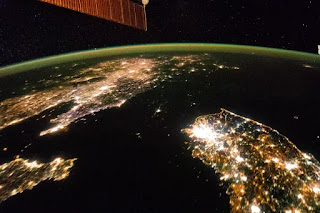
In particular, countries that remodel themselves from the ground up with armed Marxist revolutions always end up as repressive, poverty-stricken dictatorships. I know of no exceptions. Some are worse than others – if I had to choose, I’d much rather live under Fidel Castro or Muammar Gaddafi than Pol Pot – but none of them have ever produced the communist paradise, or even the socialist interim state, that Marx envisioned. In a few places in the world you can see a Marxist regime and a liberal regime side by side, with the same geopolitical and environmental conditions, and compare their socioeconomic outcomes; the liberals (West Germany, South Korea, Botswana) always do better than the Marxists (East Germany, North Korea, Zimbabwe). And really, Marx should have known better, given that the prime real-life event he used to exemplify his theories was the French Revolution, which had exactly the same effect in installing the Napoleonic Empire.

The Koreas from space at night

Empirically, the systems which function best, in the sense of facilitating human life, health, knowledge, freedom, prosperity, and equality, are those known as “mixed economies”, like those of Scandinavia and Japan and formerly New Zealand. These combine open but well-regulated markets with stable democratic government, progressive tax systems, state-owned infrastructure, and high public expenditure on social welfare, health, and education. But of course there are still a great many areas in which I believe progress could be made. And here they are.

Monday, 29 January 2018

Economics, the evidence-free discipline – from the horse’s mouth

If economists wished to study the horse, they wouldn’t go and look at horses. They’d sit in their studies and say to themselves, “What would I do if I were a horse?”
Ely Devons, British economist

Ever since I started working in a job that periodically puts me in economics lectures, I’ve noticed that economists have a very different idea of what constitutes evidence for their statements than what scientists do. And when I say “noticed”, I mean it’s been thunderingly obvious. The health sciences, in particular, spend hours upon hours drumming into their students’ heads how much it takes to call your practice “evidence-based”. In economics lectures I’ve heard lecturers say outright, “If your analysis of the data disagrees with economic theory, trust economic theory.” Economics is at about the stage medicine was at in the mid-nineteenth century, when blood-letting and cold showers were the go-to treatment for every ill because physicians knew how the body worked, damn it, and didn’t need jumped-up empiricists coming in telling them how to do their job thank you very much.

A nineteenth-century physician practising bloodletting

But I don’t think nineteenth-century physicians ever proudly declared that their theories were evidence-free and thought it a mark of superiority. Yet I encountered economists saying exactly that, in an article from only a year ago, in a debate with a libertarian on Tumblr recently. I’m referring to the Mises Institute’s “Ten Fundamental Laws of Economics”. The list includes some uncontroversial items, but also contentious ones such as “Productivity determines the wage rate”, “Labour does not create value”, and “Profit is the entrepreneurial bonus”. It ends with Law 10: “All genuine laws of economics are logical laws.” This is explicated as

Economic laws are synthetic a priori reasoning. One cannot falsify such laws empirically because they are true in themselves. As such, the fundamental economic laws do not require empirical verification.

Which basically translates to “Anyone who disagrees with us is wrong by definition.” This is not about economics being a “soft science” rather than a “hard science”. This statement makes economics as practised by the Mises Institute not a science at all.

The phrase “synthetic a priori” is, in this context, pure bafflegab, but unfortunately it’s going to take a bit of unpacking. The philosopher Immanuel Kant divided truths along two lines. First, they can be “synthetic” or “analytic”. An analytic truth is basically simply a definition of a word: the usual go-to example is “All bachelors are unmarried,” which is true because being unmarried is part of the definition of being a bachelor. A synthetic truth is one that can’t be derived from the definitions of words alone, such as “I have two cats.” Second, truths can be a priori or a posteriori – Latin for “from before” and “from after”, respectively. An a priori truth has to be true in any conceivable universe; you know it is true before you go investigating. “One plus one equals two” is an a priori truth. An a posteriori truth is one that might or might not be true, and that you therefore can’t know is true until somebody investigates, such as “I have eaten the last of the cheese.”

Two lines of distinction potentially divide a set into four subsets, in this case analytic a priori, analytic a posteriori, synthetic a posteriori, and the one we’re interested in, synthetic a priori. Three of these are uncontroversial. All philosophers agree there is no such thing as an analytic a posteriori truth, and most philosophers agree there are analytic a priori truths and synthetic a posteriori truths. The big disagreement over Kantian philosophy is over whether there is such a thing as a synthetic a priori truth – whether there is anything that has to be true in any conceivable universe, but that can’t be reduced to definitions of terms and logical deductions from such definitions. The Mises Institute puts economic principles in this category. What would this mean?

Kant himself populated the synthetic a priori category with mathematical truths like “One plus one equals two”. Personally I’m inclined to the school of thought that mathematics is in fact analytic. There are arguments to be had on both sides, and I won’t go into them. I suppose the four-colour map theorem might count as synthetic a priori – no-one has ever created a map that needed more than four colours to fill it without any two areas of the same colour touching, and somebody has proved that this is indeed impossible via a computer program, but the proof is too complex for a human mind to comprehend. The point is that no-one can even imagine such a map. It’s inconceivable. For the Mises Institute’s “laws” to be synthetic a priori, it would have to be the case that no-one could even imagine a world in which productivity did not determine the wage rate.

The Mises Institute might respond that someone who thinks they’re imagining a world in which productivity doesn’t determine the wage rate is kidding themselves, just as someone who thinks they’re imagining a five-colour map is kidding themselves (your mental picture is just a vague squiggle; you aren’t filling in the details). But it is not at all difficult to imagine a shareholder-profit-maximizing corporation deciding to funnel 100% of the profit margin from a productivity boost into shareholder dividends instead of wages. Nor is it hard to imagine every other firm in the market doing the same, thus leaving no competing employer to whom the employees could defect. The Mises Institute is committed to the claim that this scenario is not merely implausible but unimaginable. Either that, or the phrase “synthetic a priori” in their statement is bafflegab.

Of course, if economic principles are not synthetic a priori, then what the Mises Institute is doing is making up excuses for why their beliefs shouldn’t be exposed to empirical testing, and if you find someone doing that then they’re up to something dodgy. My Tumblr correspondent claimed that societies organized according to these theories could produce and distribute goods and services “way more [efficiently] than any Marxist or Keynesian society can.” Well, that’s an empirical question. I have sat through more than enough economics lectures to be well aware of the theories as to why the free market is meant to be the most efficient means possible of maximizing production and optimizing distribution of goods and services. But only empirical data can tell us whether it is the most efficient means possible. Any attempt to put it beyond the reach of empirical investigation, such as the Mises Institute is here guilty of, suggests that its proponents fear it would disappoint them.

And before someone asks, yes, for all the respect I have for the Marxist community for the work they do in activism towards social change, I do have to concede that Marxists are equally prone to shielding their theories from the possibility of being refuted by reality. I have written about that elsewhere on this blog, if you care to go looking. But Marxist theories don’t at present dominate the global economic system. Capitalist ones do. The point is that only reality can tell you what’s true. Nineteenth-century medicine wasn’t dislodged by some other theory-driven approach; it was corrected by recourse to empirical evidence. In economics as in medicine, when the “experts” cling to their pet theories over reality, people die. We need evidence-based economics and we need it yesterday.

Friday, 20 October 2017

I thought I would feel better about this than I do

As of when Winston Peters finally made up his mind who to go with yesterday, Jacinda Ardern is now Prime Minister of New Zealand, in a coalition government formed of Labour, New Zealand First, and the Green Party. I have mixed feelings about this. There was no big surprise in the special votes; as commentators evidently better-informed than me predicted, they took two seats off National and handed one to the Greens and one to Labour. And, as any New Zealander with half a brain could have told you, the prospect of a National-Green coalition (raised in all seriousness by some pundits evidently lacking that endowment) was a chimaera.

The good part of my mixed feelings is obviously that we’ve got a new government, which – if not for the presence of New Zealand First – would have been the left-most one of my lifetime. In concrete terms, this country’s decades-long trajectory towards Dickensian inequality and poverty might actually go into reverse. We might get a liveable minimum wage. We might get housing for homeless people. We might get unions strong enough to make a difference. We might get an economic strategy that doesn’t depend on turning our rivers into sewers and lying to the world about it.

The bad part starts with New Zealand First. I don’t think we’re in for a three-ring circus like the National-New Zealand First coalition government of 1997, because this time Winston hasn’t brought in a cadre of loudmouths with egos as big as his own. Jim Anderton’s old gibe, calling the party “Winston First”, is even truer now than when he made it in the 1990s. But I don’t know, and I’m not looking forward to finding out, how much of its left-wing promise the Labour-Greens bloc has had to concede in order to secure Winston’s support.

I do know, as I’ve said on this blog more than once, that Winston’s anti-immigrant stance is a cynical façade put on to garner votes. I also know that Winston is 72 years old, and likely to retire within a decade – possibly by next election, depending on how well his health weathers old age. What happens to New Zealand First then? Will it crumble, leaderless, into irrelevance? Or will Winston be succeeded by one of his many sincerely racist admirers? And then will New Zealand have its own Brexit, its own Trump, to deal with? These questions scare me.

Also not comforting is the fact that National still has two more seats than Labour and the Greens combined. I’m not confident enough in my expectation of a stable coalition not to worry about what that will mean if it does fall apart; and I’m bamboozled, frankly, by the fact that it happened at all. How does a government preside over as big a social and economic crisis as this one has and still attract more votes than its competitors? What does it say about my country’s soul that nearly half of us are prepared to shrug off the child poverty and homelessness we’re seeing now as long as the men in suits get to hang on to more cash come tax time? Are we all clones of Cersei Lannister?

I don’t like not understanding these things, I honestly don’t. It’s a cheap rhetorical trick to claim to be mystified by your opponents’ stupidity and malice, and more to the point it’s purely performative. It makes a good show if all you want is to assure people on your own side that you’re one of them, but it doesn’t budge your opponents an inch except to confirm their belief in your stupidity and malice. And if you really care about your political ideals, it’s your opponents you want to be shifting. The fact that I don’t understand what motivates people to vote National means I have no idea how we can motivate them to vote more leftward. Maybe that’s the real reason why this election result brings me so little joy.

Tuesday, 18 July 2017

Am I a benefit fraudster?

Campaigning is finally getting going in New Zealand in preparation for September’s general election. In the weekend, Metiria Turei, the co-leader of the Green Party and my first choice for Prime Minister, admitted that back in the ’90s she lied to Work & Income New Zealand (WINZ) in order to get enough money to keep her young child fed. The context was that she was announcing a new Green Party policy on the social welfare benefit intended to ensure that no-one has to go through the same thing again.

After five years I am still grateful every day to have a part-time, seasonal job that gives me – most of the time – enough money to save that I don’t have to go back on the benefit. (Living with a partner who bought her house before the pricing bubble is also a critical factor, and I don’t express my gratitude for that often enough either.) I’ve previously been employed as the editor of a very small monthly student magazine which then went out of circulation due to the present Government making student association membership opt-in instead of opt-out in their first term; I loved that job too, but even with full membership the students’ association couldn’t afford to pay me enough to live, and I had to supplement it with the sickness benefit and, for two of those years, the student allowance.

I didn’t start out on the sickness benefit. I borrowed my way through university hoping to become an academic, but I suffered depression and sleep disorders and couldn’t cope with the energy demands of graduate study, so I ended up on the unemployment benefit. Back then, and I think it’s only gotten worse since, that meant you had to apply for two different jobs per day and bring proof of it in to regular meetings with your case-worker. That was how I discovered that I have a social anxiety condition. I physically couldn’t do it. I had to get counselling later for the terror I came to feel just opening the automated e-mails I’d signed up to with lists of job vacancies. Besides, given my life history then, I didn’t believe anyone would ever want me to work for them, only “believe” is far too weak a word. I just wasn’t a person who could persuade someone to employ them, with the same certainty as that I wasn’t a person who could get pregnant and give birth.

That caused a misunderstanding which nearly lost me my benefit, actually. I had a blog back then on LiveJournal which was mostly me saying “Sorry, nothing to blog about today,” but one day I wrote something along the lines of “Oh well, back to pretending to look for work tomorrow,” and was very shortly called in for an urgent meeting with my case-worker. I managed to explain to her what I really meant that time. But the unemployment benefit had a strict time limit, and despite the mandatory “how to get a job” workshops they sent me to, I eventually ran over it. I got called in again and told I was going to lose my dole. I had prepared a bunch of counter-arguments to present, but instead I had a shutdown and couldn’t speak and I think I sat there sort of rocking and crying silently, which was when my case-worker referred me to the sickness benefit instead.

The process of getting the sickness benefit was slightly more complicated, but considerably more pleasant, than getting the unemployment benefit. You needed six-monthly medical certificates, which involved regular doctors’ visits, but doctors unlike WINZ staff are kind to their patients and will generally take your word that you’re not lying about your symptoms. (Some WINZ staff have worse attitudes than others, but all of them work in a system which rewards suspicion and punishes empathy.) You do have to be getting assistance with your condition if assistance is available, and that’s how I ended up getting referred to the graduate clinical psychology student who diagnosed me with Asperger’s syndrome – as it was still called in 2005 – and the succession of students who helped me learn ways to overcome some of the difficulties the condition presents.

Here’s the thing, though. To get the sickness benefit your doctor had to explain on the reapplication form, every six months, how your condition prevented you from working in full-time employment. I would tell them that I still suffered from depression and that I had time management issues. These statements weren’t false, but they also weren’t the real reason why I couldn’t get work. There wasn’t an option on the form for “This person is able to work but their social disabilities and anxieties prevent them from applying for jobs anywhere near as often as they would have to in order to stand a chance of actually landing one.” My depression is mild enough that I can keep it at bay nearly all the time without pharmaceutical assistance, which I know is better fortune than many people enjoy. With counselling I’ve learned to manage time well enough that I actually reliably turn up for the beginnings of lectures, an improvement which would astonish anyone who knew me as a student.

So what do you think? Should I have been kicked off the sickness benefit because the difficulties my condition actually caused fell between the cracks of the official criteria? Does that make me a benefit fraudster? Or is the problem an overly harsh, strict, and dismissive social welfare system? What does that imply for other welfare beneficiaries in New Zealand? We have a growing problem with poverty; what does this experience say about its causes? I think I have a pretty good idea. And I have a pretty good idea who to vote for this September.

Monday, 17 July 2017

A philosophical quibble to upend the global order

One thing I like about philosophy is how often I can find real-world applications for it. I guess that’s because it’s so abstract, compared with, say (to pick another of my interests), zoology. It is very unlikely that I will ever find a use for my knowledge that elephants have two distinct charging behaviours, one when they’re charging to threaten and the other when they intend to kill. Cats and dogs and rabbits just aren’t the same. On the other hand, it’s a rare week when I don’t have to think about essentialism, or game theory, or survivorship bias, or some other concept at the intersection of philosophy and mathematics, for some reason or another.

Recently I came across a singularly important philosophical paradox. Oh, its importance isn’t instantly obvious. To be honest, at first glance it looks footling, one of those little quibbles that just go to show philosophers need to get out in the fresh air a bit more. I’ll take you through it first, but let me assure you: the deepest, most fundamental question in global politics for the last thirty years hangs on the resolution to this paradox. But I have to tell you what the paradox is first, before I can explain how. It’s called the Mere Addition Problem, or alternatively the Repugnant Conclusion. Here to explain it is the philosopher Julia Galef (whose work I regret not discovering years ago):

In case you scrolled past that without playing it, the problem is the three contradictory premises, all of which seem reasonable, but which can’t all be true. Galef phrases them as follows:

  1. Creating new people with lives worth living doesn’t make things worse.
  2. Increasing total and average happiness makes things better.
  3. A smaller number of very happy people is preferable to a larger number of unhappy people.

Consider three possible worlds. First, a world with a small number of very, very happy people. Second, a world with that same number of very, very happy people, plus a similar number of other people who are just kind of contented, but not actively unhappy. Third, a world with the same total number of people as the second world, who are all just a little bet less happy than the very-very-happy people but a whole lot happier than the kind-of-contented people. Now according to premise (1), the first world is no better than the second world. According to premise (2), the third world is better than the second world. But that means the third world is also better than the first world – a larger number of less happy people is better than a smaller number of very happy people – which contradicts premise (3). Look, it all makes sense with Galef’s visual aids, I promise.

This is called the Mere Addition Paradox because all you’re doing with premise (1) is “merely adding” people to the world, who just happen not to be as happy as the people already in it. It’s called the Repugnant Conclusion because, if you go through the same reasoning several times over, you end up concluding that a world with a vast population so unhappy they have just one thing keeping them from suicide is better than a world with a tiny population whose lives are healthy, fulfilling, exciting, and blissful. Mind you, given only those premises, it is possible to cheat our way out of the paradox, because there are a couple of additional premises which are necessary for the Repugnant Conclusion to follow:

  1. The law of transitivity applies to goodness.
  2. There is no threshold of happiness (above the zero point of “I’d rather be dead”) at which this logic stops working.

I say “cheat our way out” because, although we can avoid the Repugnant Conclusion if either one of these is false, either way we end up not making much sense. To falsify premise (5), we would not only need to quantify a threshold of happiness below which the logic did stop working; we would also need to specify which of the other premises broke down at that threshold and why. So that gives us a whole lot of extra work figuring out how to quantify happiness, and gets us no closer to a solution than we already were.

Premise (4) looks more promising at first sight. “The law of transitivity” is a jargony, technical sort of term; it looks like it means something complicated and esoteric. Actually all it means is the simple rule that if Thing A is better than Thing B, and Thing C is not better than Thing B, then Thing A must also be better than Thing C – in whatever sense we might be using the word “better”. So, for instance, if democracy is better than absolute monarchy, and military dictatorship is not better than absolute monarchy, it follows that democracy is better than military dictatorship. If solar power is better than gas, and coal is not better than gas, it follows that solar power is better than coal. If Wonder Woman is better than Batman v. Superman, and Suicide Squad is not better than Batman v. Superman, then Wonder Woman is better than Suicide Squad. If teriyaki beef is better than cheese-on-toast, and baked beans are not better than cheese-on-toast, then teriyaki beef is better than baked beans. Without a rule like that, we’d have to compare every possible pair of alternatives independently to determine which was the better of the two. It would be impossible to generalize about what makes one thing better than another, and hence meaningless to compare hypotheticals like the made-up worlds in the Mere Addition Problem. Any attempt at reasoning about values would boggle. Premise (4) stands.

Let me now clear up a further red herring – an attack on the problem which does make a certain amount of sense but doesn’t remove the Repugnant Conclusion. It goes “I’m not a utilitarian. Morality isn’t the same as maximizing happiness.” I, for instance, think morality is about maximizing trust rather than happiness. The reason this doesn’t work here is that the Mere Addition Problem is about goodness rather than morality. These two concepts are related but not the same. Morality is an intensely practical matter; it poses questions of the form “What shall I do?” If I answer “Earn people’s trust,” well, the way to do that is to consistently do good for other people, so I’m still left asking “What counts as ‘good’?” – which is the question that the Repugnant Conclusion raises problems for.

If you don’t make the subtle distinction between goodness and morality, you might think you had found another way to disarm the Repugnant Conclusion: “Creating worlds and manipulating people’s happiness by way of experiment is deeply immoral anyway.” I’d be inclined to agree. You, the Manipulator of Worlds, might personally know that you would never intentionally use your power to create misery, but you can’t reasonably expect your subjects – who live or die, rejoice or suffer, at your merest whim – to have the same certainty. By holding that power at all you create a situation in which you cannot be trusted. But the Repugnant Conclusion doesn’t in fact depend on the supposition that you (or anyone) are responsible for the existence of the world, its people, or their happiness. The unfortunate language used, of “creating” worlds and “adding” people to them, is not necessary to the Problem. As long as the posited worlds and people could conceivably exist, we’re still faced with the question “Which one would be better?”

So we’re back to Galef’s three premises. Which one is wrong? I’m going to eliminate premise (3) from the get-go. If the words “good” and “better” mean anything at all, then a world with a small happy population is better than a world with a large miserable population. Premise (3) is true. The Repugnant Conclusion is false. To call misery better than happiness is to talk nonsense. If that’s goodness, give me evil.

There remain premises (1) and (2), and this is where things begin to get political. I maintain, and will demonstrate, that the great global political question of my lifetime comes down to which one of these premises is false. I believe that policy-makers have chosen the wrong one, and that the disasters of recent decades – global warming, the financial crisis, Donald Trump – are all partly, and some entirely, consequences of that choice.

Sunday, 5 March 2017

Jobs or wages: pick one

It’s getting to that time of year when the Government once again explains to the nation, with tears in their eyes, why they can’t raise the minimum wage to keep up with inflation. And it’s always the same excuse: employers can’t pay a cent more than they already do, so if the wage goes up there will be less jobs. Geez, you guys, you want steady jobs and livable wages? What rabbit do you want us to pull out of our hats next? Affordable education?

Well, they’d better be sure they’re right. Of all the reasons I’ve seen for why so much of the American working class voted for Donald Trump, the most convincing is that they were sick of the established order and Trump was a handy sledgehammer to bash it with, and the reason they were sick of the established order was that it kept telling them they had to choose between wages and jobs. Which doesn’t explain why they turned to the Right instead of the Left, but that’s an issue for another time.

They are sure they’re right, of course. In fact, to the National Party’s way of thinking it’s dangerously over-generous to have a minimum wage at all. It’s basic economics (and middle-level economics as well, come to that). A minimum wage is what economists call a “price distortion”. Here’s the theory. If the government sets a minimum price for any product which is above the natural market price of that product, some buyers can no longer pay for it – that’s what the natural market price is – so people buy less of it, the sellers have to compete to attract customers, and everybody ends up worse than before. Actually, in an economics class, any time the government lifts a finger you can pretty much jump straight to “everybody ends up worse than before”. And of course to economists labour is just another product, sold by the worker and bought by the employer.

There are several questionable assumptions here, but I’m going to focus on one key one, because without it the entire argument collapses. That’s the assumption that the employers are paying as much as they possibly can. This only follows if the workers have just as much power to turn down work as the employers have to set wages. If that’s not true, then the market will shift in the employers’ favour. By economic logic that would be a price distortion, which would reduce the wage below its natural market value.

So how good is that assumption? What indications might we look for? Here’s one. I’ve never gambled on the stock exchange or anywhere else, but you can’t sit through three semesters of finance lectures and not become familiar with the phrase “close of trading”. That basically means 5pm every weekday, local time, after which the stockbrokers all go home and do whatever stockbrokers do when they’re not broking stocks (I wouldn’t know). On Saturdays and Sundays they do no broking at all. Same as everybody else, right?

No, not everybody else. Before the National Government’s bold, exciting new job-creating economic policies forced it to close, the railway-carriage factory near my house was always busy. And I mean always. Didn’t matter what time of night you walked past it, you’d hear motors humming and sparks spitting, and there’d be lights in the windows. Factory workers work nights and weekends if they’re told to. Stockbrokers, despite the quadruple profit they’d get by trading all 168 hours of the week instead of just 40, don’t.

There are several possible explanations for this discrepancy. The one any economist will think of first is that factory work pays much better than stockbroking, with better bonuses and holidays, to encourage people to work nights and weekends. Or perhaps factory work attracts a demographic of people who love darkness and cold and closed shops during their free time, and sunlight and traffic noise when they’re trying to sleep. Or just possibly, and I really think this hypothesis might deserve some consideration, it’s that stockbrokers have more power than factory workers to determine their pay and conditions.

Now if some people have more power to influence the labour market than others, it necessarily follows that the less powerful people will end up getting less benefits than the more powerful people. If that’s the case, then the economic objection to raising the minimum wage is false. There is some slack in the rope. Employers could pay more than they do and still employ just as many people. They don’t because they don’t want to. The workers put up with it or lose their jobs.

In such a case the government would be well-advised to iron out the distortion, because not paying people enough is bad for the economy. Henry Ford (no friend to anything smelling of unions or socialism) paid his employees well and gave them the whole weekend off because he understood that they were also his customers. People who haven’t got much money can’t buy your stuff. Pretty basic principle, I’d have thought. Unlike the free-market apologetics above, I have yet to hear about it in an economics lecture.

The trouble with this is of course the free-rider problem. In an economy with lots of employers, each one can bet that nearly all their customers are other people’s employees, and pay their own ones less than anybody else. The first employer to do this will get big savings in labour costs and minimal loss of revenue. As more and more pile on, the whole system will go down the drain. But no matter how bad it gets, it will always be cheaper for any one person to pay just that little bit less. Rational self-interest won’t save us here.

Government intervention might – if we had a government that could be bothered to stand up to the employers. National obviously can’t, but there’s an election coming up in September. Just putting that out there.

Friday, 27 January 2017

What price progress?

Several of the blogs I follow, I follow because they frequently say things I disagree with, but say them reasonably enough that I don’t end up lying awake all night thinking of things to snap back at them. This is a delicate balance; I read things I disagree with because that’s what inspires me to write, but lying awake thinking of things to snap back at people on the internet vacuumed up a lot of valuable sleep hours in my 20s. Two of the blogs I’m talking about are David Brin’s Contrary Brin and the one which inspired this post, John Michael Greer’s Archdruid Report.

Brin and Greer are both further right, politically, than I am, but neither one is so far right as to think that people on welfare just need to grow a work ethic, that being the point at which I stop listening for insights and start listening for gotcha points. Which just goes to prove that there’s more than one dimension to politics, because on today’s topic they are polar opposites, and I’m somewhere in the middle. Today, with Greer’s recent post “The Embarrassments of Chronocentrism” as my launch-pad, I’m going to be talking about progress.

Yes, “chronocentrism” is a word Greer coined to make his point. It’s modelled on “ethnocentrism”, which is when someone thinks that every other culture is to be judged by their own. (Usually, in fact, what they think is that there is a Right Way to do things and a whole lot of Wrong Ways, and they’ve never thought about it enough to realize that the only thing Right about the Right Way is that it’s how their own culture happens to do things.) Greer replaces the ethno- element, meaning “culture”, with chrono-, “time”, to criticize the attitude that every other period in history is to be judged by our own.

Now I would be tempted to use this word mostly when my generation do the exact same tutting and sighing over Kids These Days that we used to roll our eyes at when we were Kids These Days. Did you know that when some teenager has their head bent over a smart-phone, they’re almost always using it either to gain knowledge or to communicate with another person somewhere? Mind-boggling, I know, but true. The way some people go on about Kids And Their Phones reminds me of nothing so much as William James’ (I think it was) speculation on what dogs think about their masters’ reading: what strange compulsion could drive you to stare at bits of paper for hours on end, when you could be doing something worthwhile like playing fetch? But I’d better get back on track before this tangent gets any longer.

What Greer takes issue with is the idea that society has some kind of natural drive to get better and better; and, correspondingly, that past societies should be considered inferior because they don’t live up to the standards that we have achieved. Which, when you think about it, is a paradox in itself. If society naturally gets better and better, shouldn’t we be especially forgiving of the faults of past societies? They couldn’t help being bad, could they, since they didn’t have the good fortune to be born in our time? We don’t blame children for being childish, do we?

Friday, 11 November 2016

Are you awake yet?

Politics as usual is over.

There are two questions on everyone’s mind, I’m sure. What the hell just happened? And what the hell’s going to happen now?

I’ll start with the second one. If the UK after the Brexit vote is any guide, before the new President is even sworn in there’ll be a groundswell of criminal violence against people of colour – Latin Americans and Muslims in particular, but I don’t imagine they’ll be too picky. The word will be “We just voted to kick you lot out.” That was, after all, Trump’s main platform.

(Just so you know: I wrote that paragraph before I read the innumerable news reports confirming it.)

You needn’t bother arguing with me on this part, by the way. You may have a different view of Trump’s character than I do; but I’m not going to drag you through a whole bunch of news items and political analyses you can Google for yourself and a discussion you won’t read, just to provide back-up evidence of who he is. Instead I’m going to make predictions, and the next few years will prove me right or wrong.

Trump will begin his Presidential career with an aggressive and vindictive purge of every high-ranking Republican who walked out on him. (“You’re fired.”) He will then issue an executive order to deport undocumented immigrants. Existing law enforcement and military will not be up to the job, so he will create a special taskforce and recruit the kind of people who were chanting his name at rallies to staff it – i.e. men who relish the chance to point guns at brown people with the government’s blessing. There will be deaths.

Work will begin on the Mexico border wall fairly early on. It will have to be financed. Even the President of the United States doesn’t have the power to make Mexico pay for it, as he promised. He will demand payment, and Mexico will say “No.” Most likely he’ll stump up the cash in the meantime by gutting some public service he doesn’t think important, like the unemployment benefit – hey, with all the lazy illegals gone who needs it, right? But he’ll also threaten Mexico with military action if they don’t pay up. He will eventually carry out that threat.

Yes, I know Trump has promised not to send more soldiers to war. Of all the promises he’s made, that’s the one I’m most sure he’ll break. He may only rattle sabres at Mexico, but there will definitely be another Middle East bloodbath. Trump is an over-confident man, and that’s the biggest risk factor there is both for starting wars and for escalating wars. The decision-makers on both sides in World War I were certain they’d be holding victory parades before Christmas 1914. That’s why there was a World War I.

Monday, 24 October 2016

Oh, the humanities

My employers’ employer, the University of Otago, has decided to cut staff positions in the humanities. Music is going to be hit the worst. As usual, the justification is money. It’s been suggested that maybe the University should ease off on its endless construction drive if it needs to free up some cash. (In twenty years I’ve never known the campus be without a big hole in the ground somewhere. Face it, Otago, the Richardson Building is a plug-ugly wodge of concrete and no amount of landscaping around it is going to change that.)

However, this wouldn’t fix the bigger problem, which is the government’s attitude. Statements from the Ministry make it clear – education is for fitting young people for the workforce; anything else is an indulgence. Here’s the official position in their Tertiary Education Strategy.

Skilled, knowledgeable individuals are essential to the success of businesses and other organizations. Access to skilled workers allows businesses to increase the value of their products and services and to pay higher wages. In turn, people are better off, healthier and happier, and New Zealand is a more attractive place to live and work.
For most young people, achieving a tertiary qualification is a crucial milestone towards a successful working career. Whether they study at a university, polytechnic, wānanga, private training establishment, or through an apprenticeship, a qualification gives them a concrete record of knowledge learned and skills gained that they can use to move up the employment ladder.

And in the Minister of Education’s own words, prefacing that document:

The new Tertiary Education Strategy 2014–19 has been developed to... contribute to the Government’s focus on improving New Zealand’s economic outcomes. The “Building Skilled and Safe Workplaces” programme of the Government’s Business Growth Agenda aims to materially lift New Zealand’s long-run productivity growth rate while maintaining our high rate of labour force participation. This requires tertiary education to better equip individuals with the skills and qualifications needed to participate effectively in the labour market and in an innovative and successful New Zealand.

Sure enough, Priority 1 in the Strategy is “delivering skills for industry”. There is nothing anywhere about developing insight or critical thinking. Public education, to this government, is solely a means of polishing up new cogs to slot into the commercial-industrial machine.

My instinctive response to this is a string of expletives, but that’s not the way to build a counter-argument. If you want rational debate, start by taking your opponent’s concerns seriously. Education costs society money; don’t we then have a responsibility to pay that money back? Granted that some people derive personal value from knowing all about, say, the anti-imperial politics encoded in the Book of Revelation or the practice of cannibalism in indigenous South American funerary rites, shouldn’t they stump up their own cash for it?

Monday, 12 September 2016

How to tell if you’re a racist

One evening a couple of years ago I was on the bus to go home, and this old guy got on at a stop in the middle of town, by an internet café. This was around the time that the Council updated the bus schedules, and the timetable at that particular stop had recently been taken off its post. According to the old guy, it was the café staff that had taken it down. Now you or I might see nothing sinister in that, but the old guy knew better. He knew what they were up to. They’d taken the timetable down so that people looking for parking spaces wouldn’t know it was a bus stop! Then they’d park there and use the internet café, and they wouldn’t realize their mistake until they got the traffic fine! Just as well there were sharp people around, like himself, who wouldn’t fall for tricks like that!

I was sitting several seats behind him, so I didn’t get a good look at the expression on the face of the younger guy he was talking to. From what I could see it looked very much like “From the sanity level of what you’ve just said I infer that any attempt to reason with you would be a waste of time, so I’m just going to smile and nod.” But I don’t actually know.

When I say “this old guy”, by the way, are you picturing someone wild-looking, unkempt, with teeth missing, muttering to himself and staring belligerently about? Don’t. This was a dignified-looking, affable elderly man; working-class accent and second-hand clothes, if I recall correctly, but if you were asked to spot a mentally ill person on that bus by their appearance you’d pick me over him. I don’t think his bizarre delusion arose from any kind of brain disorder. I think it had more to do with a small detail which he never felt the need to mention, and which I also haven’t said anything about so far. See if it makes it feel any more plausible to you. Are you ready?

The staff and management of the internet café are immigrants from East Asia.

If your answer was yes, that does make it more plausible, then you – like the old guy – are a racist.

Nowadays we all agree that it is very bad for someone to be a racist. Which of course is true, and don’t get me wrong, it’s a genuine moral advance since the days when newspapers printed editorial cartoons decrying the “Yellow Peril”. But the advance has been less than it might appear, because of one unfortunate side-effect of the new understanding. “Racists are bad,” people reason to themselves, “and I am not bad. Therefore, I am not a racist. Therefore, my belief that Muslims are terrorists and East Asians are amoral schemers and Polynesians are stupid lazy thieves is not racism.” Well, sorry, yes it is, and yes you are.

Monday, 15 August 2016

How to pour money down the drain

Ever commit yourself to something and then regret it? I’m starting to feel that way about this blog post. I realized something, you see, for whatever that’s worth, and I thought I might share it. But in order to explain it I first have to go over basic economic theory. Only, some people who are close to me in their politics have a very different economic theory, which doesn’t yield the same insight. So I have to start by explaining the two theories and why I think the first one has more explanatory power, and then I have to show that, although politics like ours traditionally uses the second theory, it doesn’t need it. I would rather just skip ahead and tell you my idea, but it doesn’t make sense if you haven’t sat through a few economics lectures. So here goes.

Where does profit come from? Capitalist economists explain with the trade theory. Suppose your old car is getting elderly and taking up space in your garage. You reckon that if someone nicked it you’d only be down $2500 all told. At the same time, I need a car for my work, doesn’t have to be flash or new, but I figure even an old banger will easily net me $4000 with the use I can make of it. So I offer you $3000, which is $1000 less than what I’m expecting to gain. You take it, because that’s $500 more than the car is now worth to you. This is what’s called a “positive-sum interaction”. You gain $500 in cash, and I gain $1000 worth of car. A total of $1500 has appeared out of nowhere. This $1500 is “surplus value”.

Economists apply this theory to all kinds of transactions, including labouring for a wage. The labourer is the seller and the employer is the buyer, and obviously the wage must be worth more to the worker than their time or they’d quit, while the labour done in that time must be worth more to the employer or they’d lay the worker off. Karl Marx disagreed. Goods don’t appear out of nowhere. Goods are made from raw materials when labourers put labour into them. Therefore, the labour is the source of the surplus value (measured as the price of the product minus the cost of the materials), and the labourer is the rightful owner of that value. According to the labour theory, an employer who then takes away the goods, sells them, pockets the profit, and doles out a fraction of it back to the worker, is nothing but a thief.

Which theory works? Another parable. Mr Miggs runs a back-shed factory making plastic coat-hooks that you can stick on a door. He sells them at $5 for a packet of three, but his cost to make those three, including labour, is only 50c. According to the labour theory, he’s robbing his staff of $4.50 per unit. But one day Mr Miggs buys a 3D printer, an automatic packet-sealing machine, and some drones to carry things around the factory. He sets up an automatic e-mail system to alert his courier when there’s a shipment ready. In short, Mr Miggs automates his process totally, and lays off all his employees. He can now make his coat-hooks at a cost of 10c per unit. He drops his price from $5 to $4.80, which raises his sales by 2%. Not only is he selling more units, but his profit per unit has gone up from $4.50 to $4.70. The trade theory easily accommodates this scenario; the labour theory boggles. Whose labour is Mr Miggs exploiting? Where is that $4.70 coming from?

Score one for the trade theory. But I would have to query whether Mr Miggs’ staff, back when he was employing staff, were genuinely free agents. When your only choice is between two bad alternatives (such as: break your back working for peanuts, or watch your children starve), then technically you could count as a gain the advantage that the lesser evil holds over the greater, but that seems awfully sophistical. If someone mugs you for your wallet, they get your money and you get to stay alive – it’s a win-win! The higher the stakes are for you, the smaller your bargaining power. The outcome might well be positive-sum, but if you can’t realistically negotiate your share of the benefits, they’ll be massively skewed in the other party’s favour. That sounds like exploitation to me.

Actually, “the higher the stakes” is not a good way of putting it. A speculator might lose millions in a day in a derivatives clearinghouse, whereas a drain-layer begging for a raise is only dropping a few hundred a week if their employer decides to fire them instead. That doesn’t mean the speculator is in direr straits. What constrains your bargaining power is how much you’ll be left with if things go sour. Back when I was taking my first semester of economics lectures, I wrote a post about what I saw as the major problems with economic theory as it is taught to university students. If I were writing it now I might moderate my tone in places, but I would not make any substantive changes. And the main point of that post is the proportionality issue I’m talking about here: some people can better afford to lose millions than others can afford to lose hundreds.

Now my realization is about the destruction of value, which the labour theory also doesn’t account for. If value can come out of thin air, it can also vanish into thin air. A simple example might be if you were competing with yourself. If that sounds like nonsense, think of professional sports. Their revenue comes from two sources: stadium seats and television ratings. These two are in direct competition with each other. The more people watch from the sofa, the emptier the stands are. Some portion, at least, of the advertising for either one shifts revenue around instead of increasing it. The money spent on that portion of advertising might as well be dumped into a shredder.

Thursday, 21 July 2016

Racism is crawling back out from under the rug

The world is changing. The last time the World News pages looked this unfamiliar was fifteen years ago, in September. Fortunately, this time the death toll has not been in the thousands. But Britain leaving the European Union is a much further-reaching geopolitical shift than the World Trade Centre attack – assuming it ends up happening. Since the referendum it’s become apparent that none of the people pushing the Leave campaign had a plan for what would happen if they won.

But there have already been very ugly consequences in Britain. Despite the denials coming from the Conservative section of the Leave campaign (less so from UKIP), it seems that at least a large minority of their supporters believed they were voting to expel immigrants and people of colour from the country. Content note: racism.

Monday, 18 April 2016

The social justice case for a sugar tax

There is currently a proposal before the New Zealand Government to put a tax on sugar as a public health measure. I’m afraid it’s unlikely to fly. Not only is it both a tax and a public health measure, neither of which will endear it to the National Party, but sugar and sugary products are imported goods, which means (since we’ve signed the TPPA) that if we do implement the tax we will be sued, most likely by Coca-Cola, to make us un-implement it again. Anything can be a “disguised restriction on trade” if you have good enough lawyers.

I’ve recently discovered Stephanie Rodgers’ blog Boots Theory. I put it on my reading list because I mostly find her perspective on New Zealand politics illuminating. However, as my regular readers both know, when I write it’s almost always because I’ve found something I disagree with. And I disagree with Rodgers on the sugar tax. Unfortunately, Boots Theory is a Wordpress blog, and as I’ve had occasion to mention before, I can’t comment on Wordpress blogs for some reason.

In a recent post, Rodgers did what I just did a couple of paragraphs ago and inserted a snarky little aside on one issue into her argument on another:

When we’re against slut-shaming but say Kim Kardashian should cover up; when we’re against government policing poor people’s choices but think a sugar tax will force them to “make better choices”; when we’re totally pro-choice but think three abortions is way too many...

I do understand how a sugar tax might be seen as “policing poor people’s choices”. I get what Rodgers is saying. Thing is, though, poor people don’t have many choices to start with; that’s what being poor means. They buy junk food and fizzy drinks because that’s all they can afford, not because they don’t know what’s good for them. When I was getting sent to “get a job you lazy bludger” workshops at WINZ, this was a point raised by other attendees who, unlike me at the time, had had jobs before and then lost them. They could feel their health deteriorating from the cheaper food they were having to settle for. I’ve noticed the same myself since, whenever I’ve had to cut back temporarily for one reason or another.

This is exactly the sort of thing that Rodgers is otherwise strong on. Her own blog’s title, Boots Theory, is derived from a Terry Pratchett quote that sums it up:

The reason that the rich were so rich, Vimes reasoned, was because they managed to spend less money.
Take boots, for example. He earned thirty-eight dollars a month plus allowances. A really good pair of leather boots cost fifty dollars. But an affordable pair of boots, which were sort of OK for a season or two and then leaked like hell when the cardboard gave out, cost about ten dollars. Those were the kind of boots Vimes always bought, and wore until the soles were so thin that he could tell where he was in Ankh-Morpork on a foggy night by the feel of the cobbles.
But the thing was that good boots lasted for years and years. A man who could afford fifty dollars had a pair of boots that’d still be keeping his feet dry in ten years’ time, while the poor man who could only afford cheap boots would have spent a hundred dollars on boots in the same time and would still have wet feet.
This was the Captain Samuel Vimes “Boots” theory of socio-economic unfairness.
Terry Pratchett, Men at Arms

The Vimes Theory answers another question that’s been raised lately – whether we should introduce a Universal Basic Income to replace welfare benefits. The answer is yes, because it would help get people out of the shoddy-goods poverty trap. Well, I contend that it also applies to the sugar-tax proposal. Poor people stay poor partly because they’re spending money mitigating the impact of illnesses such as Type II diabetes, coronary heart disease, and runaway dental caries, all caused at least in part by cheap, unhealthy food. We need to undercut the unfair advantage that sugar (and saturated fats, but one thing at a time) have at the checkout.

The idea goes like this. If you put a tax on sugar, businesses that sell sugary foods and drinks will have to put their prices up on those products. Then people will buy less of them. That means less money for the business, and businesses like money, so to bring their customers back they will drop the prices of other foods that aren’t subject to the tax. Hopefully these foods will, at least on average, be healthier.

Now, granted, it’s unlikely the prices on those healthier foods will drop all the way down to the present price of junk food. But this is where the health benefits come in. I’ve argued before that we should implement a rating scheme for rental housing, because what people will pay extra in rent they’ll make back in lower rates of childhood asthma and rheumatic fever – just as, when toilets were made compulsory a couple of centuries ago, the poor made back their increased rent costs in not dying of cholera.

Cholera is caused by faecal contamination of drinking water; asthma and rheumatic fever are caused by cold, damp, overcrowded housing. What diseases are caused by sugar? Well, dental caries to start with, which is painful, disfiguring, severely harms your chances in a job interview, and has never been adequately covered by public health funding for no better reason than that many people (including politicians) don’t like dentists. Untreated caries can spread into the bone, and these infections are sometimes known to trigger cancers or get into the airway or the blood-sinuses of the brain and kill.

Sugar is connected to atherosclerosis, hypertension, and Type II diabetes. This may be where Rodgers’ sore point with the sugar tax arises, because these conditions also correlate with body fat (especially the diabetes), and Rodgers rightly takes a firm stand against shaming people for their body fat. Fat-shaming, quite apart from being a nasty thing to do, emphatically does not “motivate people to do better”. In fact it discourages them – who’s going to want to jog or go to the gym if everyone’s giving them grossed-out looks? People in the real world have gotten fatter as people in advertising photos have gotten thinner.

Human nutrition is one of the less firmly-established health sciences, because it’s hard to do randomized controlled trials with your participants’ entire diet. Nevertheless, such indications as we do have all point in a consistent direction. We can’t say that obesity causes all these illnesses, but it definitely looks like what causes obesity also causes the illnesses, and one of the causes is nutrition. (No links because I got this from health science lectures, not websites – many separate health science lectures.) That’s one major reason why it’s the poor who suffer first, the other probably being that a work-week on the minimum wage doesn’t typically offer many opportunities for exercise. So no, I don’t accept the formulation that the sugar tax is about “forcing the poor to make better choices”. It’s about making better choices available.

But the point about the financial burden is well made; it will take time for retailers to adjust their pricing of other foods, and their first response will likely be to cheapen fatty ones like butter or chips. Therefore, rather than bring in a new sugar tax, I have an alternative suggestion. What say we remove, from foods made without sugar (and with a low saturated fat content), the 15% Goods and Services Tax (GST) that New Zealand currently levies on all retail products? Then we would have a sugar tax and we would have made things easier for people, not harder.

Oh, right. I forgot. We have a National government. Making things harder for poor people (to “motivate” them) is the point.

Wednesday, 9 March 2016

My submission on the TPPA

New Zealanders have one day left, as I write, to enter submissions on the TPPA to the Ministry of Foreign Affairs and Trade. This is mine. As you’ll see, I have been very, very polite about some of the crazy ideas the TPPA contains. And I certainly haven’t covered everything. Go on, make a submission. Speak now or forever hold your peace.

I submit that the Government of New Zealand should reject the Trans-Pacific Partnership Agreement, hereinafter referred to as the TPPA.

I believe in international cooperation. I believe that all people have the same fundamental rights. I firmly oppose any suggestion that the rights or freedoms a person enjoys, including economic freedoms, should depend on that person’s nationality. I acknowledge that trade and international agreements have been major contributors to the historic decline of interstate war since 1945. The TPPA’s own Preamble affirms several laudable goals of just governance which I gladly endorse, as when the Parties resolve to

strengthen the bonds of friendship and cooperation between them and their peoples;
recognise their inherent right to regulate and resolve to preserve the flexibility of the Parties to set legislative and regulatory priorities, safeguard public welfare, and protect legitimate public welfare objectives, such as public health, safety, the environment, the conservation of... natural resources, [and] the integrity and stability of the financial system...;
recognise further their inherent right to adopt, maintain or modify health care systems;
affirm that state-owned enterprises can play a legitimate role in the diverse economies of the Parties;
promote high levels of environmental protection, including through effective enforcement of environmental laws, and further the aims of sustainable development, including through mutually supportive trade and environmental policies and practices;
protect and enforce labour rights, improve working conditions and living standards, strengthen cooperation and the Parties’ capacity on labour issues;
promote transparency, good governance and the rule of law, and eliminate bribery and corruption in trade and investment;

and

recognise the importance of cultural identity and diversity among and within the Parties.

I reject the TPPA as a whole because I believe its provisions undermine these goals.

Sunday, 14 February 2016

Bring back free education

Recently, for the first time in my life, I considered voting for the New Zealand Labour Party. Oh, they’ll have to smarten up a long way if they want me to do more than consider. The Greens are still far and away the best option on the table. But after a thirty-two-year love affair with neoliberalism, Labour are finally returning to the sort of policies that a Labour party ought to be built around. They’re offering free tertiary education.

Well, to a very small and limited degree compared to what everyone in this country had until 1989. I would be remiss if I didn’t mention that Labour were the ones who first charged students fees for their education. The National Party were elected in 1990 on a promise to remove those fees, which they did – and then cut funding to universities and polytechs so that they were forced to charge much higher amounts to stay afloat.

When I started university in 1996, paying for education was still a new and shocking thing. Many families had been blindsided, with no chance to save up for it, so we all had to borrow massive amounts of money to get through, and that became the norm. National set up the student loans scheme, which has become an ever bigger asset on the government books with each year since. We student activists fought back with marches and occupations and letter campaigns and various other tactics.

In 1999 we sent delegations to every political candidate meeting in town, not to disrupt them in any way but to make sure that education always got a mention at question time. That, along with the protests, helped push education from #6 to #2 in the “issues of concern” polls, and I think that had, well, more than a negligible effect on the election that year, when National was voted out and Labour in.

Issue #1 was taxes. National MPs went about that year with tears in their eyes for the skilled youth of New Zealand, who were apparently leaving in droves for other shores due to financial hardship induced by taxes. They called it the “brain drain”. I was one of quite a few people, I think, who pointed out to them that student loan repayments were a bit more oppressive, and a bit more specific to skilled youth, than taxes. I had the satisfaction of flummoxing Bill English with that one.

Apparently National did take heed, because now that they’re back in office they’ve introduced legislation – such is National’s compassion for skilled youth in financial hardship – to detain people who go overseas and skip payments. Obviously they can only do that when the people come back to visit, and a couple of weeks ago the law claimed its first victim.

As if to demonstrate what neoliberalism does to a culture’s soul, the first comment on my Facebook feed was “No sympathy for the dude who didn’t pay his student loan.” The general feeling of the conversation was that if we have to work so hard to pay for our education, then how is it fair that some people get it handed to them for free by swanning off overseas? There have been similar remarks about Labour’s proposal. I guess I can understand that. But I think the indignation is misdirected.

Sunday, 11 October 2015

Cut the crap and give me my country back

(Shout-out to my friend Steve King, who wrote the protest song I’ve nicked the post title from.)

So last week, our beloved leaders signed up to the TPPA (Trans-Pacific Partnership Agreement). They were always going to, of course. Since this National Government was first elected in 2008 there have been three clear, consistent patterns to their behaviour. One is dismissing objections to their decisions, as with child poverty, charter school outcomes, river pollution from intensive dairy farming, and the revelations that the GCSB has spied on New Zealanders. Another is favouring business in any way they can, as in asset sales, tax cuts, 90-day “trial period” no-fault firings, and the various formerly protected parcels of land and seabed now opened to mining. And the third is undermining democracy, as with Environment Canterbury, students’ associations, tertiary education governing bodies, and the number of times they’ve used Parliamentary urgency – i.e. skipping the pesky “public submission” part of the legislative process – for controversial but non-urgent Bills.

All three of these patterns are perfectly embodied in the TPPA. Dismissing objections: the text of the TPPA has been kept strictly secret, which means nobody can object to anything specific (but Trade Minister Tim Groser gets to call us all “ignorant” and “fools” for not knowing what we have been expressly prevented from knowing). Favouring business: what we do know about the TPPA is that it’s about removing tariffs and price controls imposed by governments, while extending intellectual property rights. Undermining democracy: the TPPA will allow corporations to sue governments for imposing laws or regulations that hurt their profits.

It turns out that, despite all Groser’s prior reassurances, New Zealand actually gets a pretty crap deal out of the TPPA. The best we get is a small tariff reduction on dairy – dairy being the one great super-product that two successive governments have bet New Zealand’s future on, the thing we’re destroying our rivers and lying to the world about it for. All the rest is what Idiot/Savant over at No Right Turn calls “margin of error stuff”. Danyl McLauchlan at The DimPost notes that “the TPP will deliver the equivalent of a couple of months of growth in ten years time.” And yet we went ahead and signed it anyway, because it’s better than not being in a secretive trade partnership that could sue the crap out of us, right guys? Right, guys? What this tells me is that the cynical view of National’s motives is wrong. They’re not amoral manipulators just out to score cash for their CEO cronies; if they were, they would have turned this down. It’s much worse than that. They’re true believers with an ideology. No matter the evidence, no matter what actually happens, the way forward is always to boost business and remove impediments to it. No other option is on the table.

Thursday, 30 July 2015

A plague o’ both your houses

Years and years ago, I earned a bachelor’s degree in cultural anthropology. I thought at the time I might end up in academia, but graduate study didn’t work out. This past couple of weeks, I’ve taken a couple of sociology lectures for another note-taker who was away. Most of my classes in the last three years have been in dentistry or other clinical sciences, so I found the sudden familiarity a little jarring, like Temuera Morrison’s New Zealand accent in that Star Wars prequel. And kind of embarrassing, actually. Blimey (I thought), we humanities students really think we’re all that, don’t we?

Lest you think I’m solely ragging on sociology: last semester, I took one of the two weekly lectures in an economics paper, to which I had much the same reaction, although there it was more comfortable because, as a former humanities student active in politics, I have a long-established habit of looking down my nose at the Commerce Division. And Health Sci too, now I come to think about it – “medicalization” is a favourite tut-tut word in certain academic circles. Well, Commerce deserved it, Health Sci didn’t, and we in Humanities really weren’t holding the high ground we thought we were.

Let me try and explain what it’s like. When I was a kid, one of the many books knocking around our house was a shabby little paperback from about the 1960s entitled “100 puzzles for kids” or something, and I remember it because it actually had 101 puzzles but the last one was a trick one that didn’t have a proper answer. A hotel has fifty rooms, and one day fifty-one people turn up wanting accommodation. The hotelier thinks for a bit. He puts the first guest in the first room, then takes the second guest aside and says “If you could just wait here while we get this sorted out.” Then he puts guest number three in room number two, guest number four in room number three, and so on until guest number fifty-one is placed in room number fifty and the hotel is full.

Now this was one of the first hints I had that my brain doesn’t work quite like other people’s. According to the book, most people are bamboozled – they know there’s a flaw somewhere, but they can turn it over and over in their heads for hours before they suddenly go “Of course! The second person hasn’t got a room!” But to me, reading the puzzle, it was so obvious that the second person hadn’t got a room that I turned it over and over in my head for hours wondering what the mystery was supposed to be.

In economics and sociology, it’s not a guest who hasn’t got a room; it’s a foundational concept that hasn’t got a basis. You introduce that concept, and proceed to derive the rest of the course from it. It becomes a sort of base-camp assumption for the students’ thoughts, like mass-energy conservation for physics students or Darwinian natural selection for biology students. By the end of the first semester, it’s become so familiar that they assume anyone who questions it is simply ignorant.

Wednesday, 10 June 2015

Keeping the market honest

At least two people died last August due to New Zealand’s disgraceful lack of rental housing standards. And not in privately-owned rental accommodation either – these were both state houses. There is a Bill before Parliament to introduce “warrants of fitness” for houses like we already have for cars; I believe National have already voted it down once.

Here’s a comment from Facebook, representative of the National point of view:

Look at it from the other side: they voted against rising rents.

Maybe. But funnily enough, people seemed to manage in 18th-century England when – against exactly the same objection – a law was brought in mandating at least one toilet in every residence. Whatever extra the poor residents might have had to pay in rent, they gained back in not dying of cholera. Asthma is less often fatal than cholera, but the principle is the same.

I can hear the response now – “So what you’re saying is, people will willingly pay the higher rent if their family’s health is that important to them? Leave it to the market.” There are two problems with this. One is that these are state houses. They’re owned by Housing NZ, which dates back to the days when New Zealand’s government had a philosophy of actually doing something about things like homelessness. They’re not some middle-aged couple’s retirement fund. Housing NZ is not obliged to pass on refurbishment costs to its tenants. We wouldn’t even have to take more money off rich people whose houses aren’t giving their children asthma; we seem to have $27 million sitting around to change the national flag, for instance. I’m not enamoured of New Zealand’s current flag but children with asthma are more important.

The second problem is that the free-market model in economics assumes that both buyers and sellers have perfect market information. This assumption is behind a lot of the mismatches between economic theory and reality. In this particular case, imagine that landlords have the option of renting out both houses that meet the standard and houses that don’t. Now presumably it costs a certain amount of money to keep the houses patched up to standard, so those houses will have higher rents. But the tenant doesn’t know how much money it costs, so the landlord can whack the rent up by a good deal more than that and make a neat little profit on houses specifically advertised as “up to standard”. Tenants who can’t afford the higher price will have to be content with houses that are still substandard. If the standard is compulsory, on the other hand, then price-jacking like that will do nothing but lose you tenants. Regulations, in fact, fix the imperfect-information problem – and thereby keep the market honest.

Monday, 22 December 2014

Hegel has a lot to answer for

Writing this post is making me a little edgy. Most of the friends I’ve made since leaving high school, I met through student activism in one capacity or another. Which means a lot of my friends are people who hold Marxism dear. That makes criticizing Marxism a painful thing for me to do. And it’s not as if I have to do it, exactly, I could just meander to the back of the crowd and mumble insincerely when my political coalition voices opinions that I find problematic in support of the positions that I am trying to help them defend. But I don’t feel that that’s entirely honest, for one thing; and also, unexamined assumptions in my worldview niggle at me. They keep me awake at night. So before I even start on what the problems are, let me talk about the parts of Marxist theory which I do agree with.
In fact, I’ll start with one that will most clearly establish where my loyalties lie. With the Marxists, and against free-market economic theory, I think that profit in a capitalist economy depends largely or wholly on the exploitation of labour. But this is going to make me look like an economic naïf if I don’t explain a bit. Which I don’t mind doing, because although I’ve said it a few times before, I think it’s one of those things that needs to be said again and again until people get it.