Showing posts with label film. Show all posts

Sunday, 3 November 2019

Why you’re wrong about “Joker”

Joaquin Phoenix as Arthur Fleck in Joker

Crossposted from Dreamwidth

  • Joker is not a comic book movie, at least in the sense of giving you anything you would remotely expect from a comic book movie. It has some character names and place names the same as in the comics, and near the end there’s a scene which will be instantly familiar to anyone who knows anything about Batman, but there are no superpowers, no costumes, no heroes, no fantasy or science fiction elements at all. People who enjoy comic book movies but not bleak gritty character dramas won’t like it. People who enjoy bleak gritty character dramas but not comic book movies will find nothing objectionable in it.

    (Mild spoiler warning, by the way. I don’t get into specifics but you may find the edge of surprise dulled on some elements of the movie if you read this post before you see it.)

Wednesday, 31 July 2019

Love and thunder

Whosoever holds this hammer, if *she* be worthy, shall possess the power of Thor.

Crossposted from Dreamwidth

It’s official: in a couple of years’ time there’s going to be a fourth Thor movie in the MCU, and it’s going to be titled Thor: Love and Thunder, and it’s going to feature Natalie Portman as the Mighty Thor and be directed by Taika Waititi. I can’t wait.

There’s a contingent of YouTubers who see it as their bounden duty to pour vitriol on anything with the faintest whiff of “political correctness,” which in practice includes all female-led fantasy, science fiction, and superhero movies. Some disavow any misogyny and I guess quietly hope we won’t go look up what they’ve said about Captain Marvel and Mad Max: Fury Road and Rey in Star Wars and the latest Ghostbusters and the Thirteenth Doctor on Doctor Who. Others are louder and less coherent – “liberals are ruining my childhood, literally no-one asked for this, let’s burn Marvel to the ground!” style of thing.

I mean, one of the complaints is true: Portman isn’t anywhere near as big and muscular as the Mighty Thor. But if that’s your main problem, I have something devastating to tell you about Mark Ruffalo.

If you’re even less familiar with Marvel comics than I am and not clear how Natalie Portman can play Thor, what with him being male, here’s the basics. In the comics, unlike either the Norse myths before them or the movies after them, anyone who can lift Thor’s hammer Mjolnir gains not only his powers but his identity. The usual Thor is a guy called Donald Blake, but there have been several others, including an alien called Beta Ray Bill and a frog and, in a comics run in 2014–2015 titled The Mighty Thor, Blake’s on-again off-again love-interest Jane Foster, i.e. Natalie Portman’s character from the first two Thor movies.

The let’s burn political correctness to the ground! brigade of course hated The Mighty Thor and campaigned for it to be cut short, and some of them claim credit for it ending – which it did with the completion of its story arc, making that claim roughly as plausible as most of the other things these people say. They also say, for instance, that no-one liked Captain Marvel either, a movie which made over a billion dollars at the box-office; and that everyone hated the bit in Avengers: Endgame where all the female heroes band together, a scene which I’ve elsewhere seen criticized only for being too little too late.

So why am I looking forward so eagerly to Thor: Love and Thunder? Most people who write enthusiastically about the MCU seem to have started as comics fans. I suppose I might have been one if things had gone slightly differently, but in fact I never got into any comic as a kid; I was a Tolkien geek instead. And it’s not far to go from Tolkien to Norse mythology. So with most MCU characters the movies are my first sight of them – but not with Thor and his associates.

I did become aware, obviously, that Thor had been reinterpreted as a cartoon character, and I was enough of a purist (you’ll be shocked to hear) that I found this mostly annoying. It didn’t help that the cartoon character was blond, clean-shaven, and a bit of an airhead, where the god is supposed to be ginger-bearded and short-tempered. Worse, not all comics writers have any clue about Shakespearean English, and you’d get sentence constructions like “he didst goeth,” which to me is chalkboard-nails, microphone-feedback, corner-of-tabletop-in-the-elbow-nerve infuriating.

(Not that Thor should technically have been speaking Shakespearean English at all, of course, but even I can forgive comics writers for not filling their dialogue bubbles with Old Norse.)

Saturday, 13 April 2019

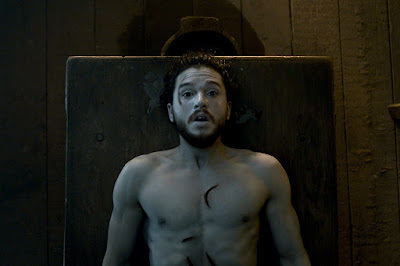
Game of Thrones: a pre-Season 8 thoughtdump

Jon Snow

Crossposted from Dreamwidth

To get this out of the way first: a large proportion of my family and close friends don’t watch Game of Thrones for various reasons. I gather this makes them feel a bit left out of some online conversations, since Game of Thrones has pervaded pop culture so thoroughly by now. I can relate. When I was a kid at primary school, we were the only household that didn’t have a TV. For context, in 1980s New Zealand there were exactly two TV channels, of which only one had children’s programming; so every day, every kid in the school had seen the exact same TV the previous afternoon, which made it ideal fodder for conversation icebreakers and small-talk. Every kid, except us. At the time I blamed this fact for the social difficulties which later turned out to be autism.

...annnd I’m already getting sidetracked in the first paragraph. What I was going to say was, I know how something just being popular with other people creates social pressure, even if it’s unintended, for you to join in and pretend you enjoy it as well. And honestly Game of Thrones is not for everybody. I’m going to be talking about its merits quite a bit, so I want to be clear from the get-go that if it isn’t your thing then it isn’t your thing and that’s fine. (Though I should warn you that I’m assuming my readers are familiar with the series, so this post will be both confusing and spoilery to those who aren’t.)

Indeed, you’ll notice as we go through that I’m not doing comparisons with the books very much, and the reason for that is that the books aren’t my thing. I’ve kind of skimmed through them and occasionally browsed a page or two in bookshops, but I haven’t read them properly, and that’s because I can’t. I understand (and I’ll get into) the reasoning behind the “any character can die” dynamic, and it works onscreen for me, but on the page I don’t get the intended effect. My emotional brain basically goes “Well, if I’m going to be punished for caring about these characters then I’m not going to care about them any more.”

I’m not entirely sure what difference the transition from page to screen makes. I used to think it was because the TV characters had faces and I couldn’t help empathizing with them, but the characters on The Walking Dead have faces too and I gave up on that a couple of seasons ago because I was disengaging from the characters for much the same reason I do with the Game of Thrones books.

Ahahahaha. Yes, yes, I mean the A Song of Ice and Fire books, A Game of Thrones being the title merely of Book I (roughly equivalent to Season 1 of the show). In this instance I’ll grant the book purists the point: A Song of Ice and Fire is a much more appropriate title for the series as a whole.

Whilst most fans as far as I can tell are loving the way things have developed in the later seasons, there’s also a dissatisfied contingent who argue that the whole thing started to go downhill as soon as the showrunners got ahead of George R. R. Martin’s published material. They seem to particularly dislike the way the characters have now fallen into some pretty solid coalitions of people who mostly trust each other, leaving behind all the politicking and betrayals and whisperings and jockeying for power – the game of thrones – that characterized the earlier seasons.

Not to be overly snarky, I think these people are missing the entire point of the series from start to finish. (This is as good a point as any to cut for spoilers.)

Friday, 8 March 2019

Captain Marvel: movie review

Captain Marvel movie poster, showing Brie Larson as Carol Danvers, Samuel L. Jackson as Nick Fury, and Jude Law as Yon-Rogg

Crossposted from my Dreamwidth blog

Just for fun, how many movies do you imagine fulfill all the following criteria?

  • Based on comic books, or about superheroes, or both
  • Released in cinemas
  • The title consists solely of the protagonist’s name and/or hero pseudonym
  • The title protagonist is female

Well, I can’t be bothered tracking down movies from every country in the world. But on Wikipedia’s lists of American movies there are, as of the release of Captain Marvel earlier this week, exactly six. The other five are, in order of release: Tank Girl (1995), Barb Wire (1996), Catwoman (2004), Elektra (2005), and Wonder Woman (2017). The 1984 movie Supergirl apparently was British, not American, but you can go ahead and include it if you like.

By contrast I count about 49 American movies which fulfill all the other conditions but have a male title protagonist. That’s being conservative, because I chose not to count titles containing epithets that refer to their heroes but aren’t their actual names, like “The Dark Knight” or “The First Avenger” or “Man of Steel”. If I had chosen to include those, that would have added at least another half-dozen to the male list and exactly one to the female list: My Super Ex-Girlfriend (2006). I also didn’t count sequels even when the title was just the character’s name and a number (e.g Deadpool 2), which would have lengthened the male list by another dozen or so and the female list not at all.

You could argue that manga should be counted as comic books, which adds exactly one more American movie to the female list, namely Alita: Battle Angel, again released only weeks ago. And if you want to include movies named for more than one character, that brings in things like Batman & Robin and Batman v. Superman on the male side, and one lone female character taking second place in the title of last year’s Ant-Man and the Wasp.

The YouTube comments on trailers for Captain Marvel are full of remarks like “Ooh, a strong female character, how novel” and “I don’t go to Marvel movies for the politics.”

Mind you, having now seen the movie, I can tell you there’s another strain of YouTube comments that’s even more ironic: the kind that go “I don’t need to see the movie now, they put the whole thing in the trailers.” The trailers are almost entirely taken from the first half-hour or so. The rest of the movie then takes the premise set up in that half-hour and unabashedly flips it upside-down to lie waggling its legs undignifiedly in the air.


Spoilers both great and small below the cut.

Thursday, 22 December 2016

The false meaning of Christmas

’Tis the season to be sappy. Twee cartoon reindeer and Santas, pointy trees and beribboned boxes, tinsel wreaths and spray-painted snow, and above all, inescapably, in every shop, that dreary treacly music that is the aural equivalent of sitting in a bath as it goes lukewarm. The fact that late December is midsummer in New Zealand gives all the doggedly wintry imagery an extra edge of falseness. You can tell that people are feeling it, because the other thing you get this time of year is movies and TV specials offering to reveal the true meaning of Christmas, which evidently is hard to find otherwise.

Well, if it’s hard to find, then the true meaning can’t be money worries and time pressure. Which is pretty much what Christmas is nowadays, if you’re an adult: a time to lavish gifts and food and hospitality on your friends and family or they’ll think you don’t love them. Even that wouldn’t be so bad, if only the gifts were things that were useful, beautiful, thought-provoking or informative. But no. As George Monbiot recently noted, businesses ravage the environment and sweat poor workers half to death so that we can present each other with

a solar-powered waving queen; a belly button brush; a silver-plated ice cream tub holder; a “hilarious” inflatable zimmer frame; a confection of plastic and electronics called Terry the Swearing Turtle... a Scratch Off World wall map... An electronic drum-machine t-shirt; a Darth Vader talking piggy bank; an ear-shaped iPhone case; an individual beer can chiller; an electronic wine breather; a sonic screwdriver remote control; bacon toothpaste; a dancing dog...

Monbiot’s right. These things amuse us for a day or two and then we compound the damage done in their manufacture by adding them to the world’s overflowing landfills. They end up in the ocean. Plastic doesn’t rot. Tools exist that we can use to clean it up, but not at the rate it keeps arriving. And once we’ve cleaned it up, what do we do with it? Burn it, and release the carbon to the atmosphere? Another bad idea. The best I can think of is to recycle it as building materials – say, underfloor insulation – since that’s at least something we would like to have last forever.

It’s become a kind of society-level addiction: better to buy cheap plastic crap than be that one guy who doesn’t give Christmas presents. And of course, the more people who behave like this, the more of a Scrooge you’ll look like if you don’t join in as well – ironically, considering Dickens’ original Scrooge was motivated by profit maximization just like the businesses foisting the cheap plastic crap on us. I don’t know how long the cycle of guilt and cheap plastic crap would go on if it weren’t regularly given a kick along by all the advertising.

This commercialism has even managed to infect the “true meaning” stories. Back in 1956, Ted Geisel (aka Dr Seuss) could write How the Grinch Stole Christmas!, in which the townsfolk of Whoville wake to find all their presents and decorations gone and still sing for joy that it’s Christmas. Contrast that with the 2011 movie Arthur Christmas, whose plot-driving problem is that a single present has fallen off the sleigh, destined for a child who already has lots of presents from her family but will apparently nevertheless be absolutely devastated if she doesn’t get something from Santa as well. Hear that, parents? Better nip out and buy one more just in case.

Wednesday, 9 March 2016

My submission on the TPPA

New Zealanders have one day left, as I write, to enter submissions on the TPPA to the Ministry of Foreign Affairs and Trade. This is mine. As you’ll see, I have been very, very polite about some of the crazy ideas the TPPA contains. And I certainly haven’t covered everything. Go on, make a submission. Speak now or forever hold your peace.

I submit that the Government of New Zealand should reject the Trans-Pacific Partnership Agreement, hereinafter referred to as the TPPA.

I believe in international cooperation. I believe that all people have the same fundamental rights. I firmly oppose any suggestion that the rights or freedoms a person enjoys, including economic freedoms, should depend on that person’s nationality. I acknowledge that trade and international agreements have been major contributors to the historic decline of interstate war since 1945. The TPPA’s own Preamble affirms several laudable goals of just governance which I gladly endorse, as when the Parties resolve to

strengthen the bonds of friendship and cooperation between them and their peoples;
recognise their inherent right to regulate and resolve to preserve the flexibility of the Parties to set legislative and regulatory priorities, safeguard public welfare, and protect legitimate public welfare objectives, such as public health, safety, the environment, the conservation of... natural resources, [and] the integrity and stability of the financial system...;
recognise further their inherent right to adopt, maintain or modify health care systems;
affirm that state-owned enterprises can play a legitimate role in the diverse economies of the Parties;
promote high levels of environmental protection, including through effective enforcement of environmental laws, and further the aims of sustainable development, including through mutually supportive trade and environmental policies and practices;
protect and enforce labour rights, improve working conditions and living standards, strengthen cooperation and the Parties’ capacity on labour issues;
promote transparency, good governance and the rule of law, and eliminate bribery and corruption in trade and investment;

and

recognise the importance of cultural identity and diversity among and within the Parties.

I reject the TPPA as a whole because I believe its provisions undermine these goals.

Sunday, 9 November 2014

Why couldn’t we have had a movie about Lúthien?

I gather the Tolkien family have put their foot down and said “no” to any more Middle-Earth movies after The Hobbit is completed. I’m disappointed, but only mildly. The days are now past when any attempt to depict high fantasy on screen was bound to fail ignominiously. I don’t begrudge the Tolkiens their decision – apparently their father’s fame has been the bane of their privacy for half a century, not to mention that the movie companies have been very stingy about passing any of their profits on to his estate. And I understand completely why Peter Jackson and Weta Workshop went for The Lord of the Rings and The Hobbit first. But I think Tolkien himself was a bit embarrassed by The Hobbit. It wasn’t originally supposed to be part of the mythos at all – he just helped himself to the name of a character (Elrond) and a place (the lost city of Gondolin) to give it a bit of atmosphere, and then filled out the connections over the twelve years it took to write The Lord of the Rings. (Which then took six more years to publish. And George R. R. Martin fans complain about waiting five for A Dance with Dragons.)
Those two were the only Middle-Earth books J. R. R. Tolkien got published in his lifetime. All right, those and a small collection of verse under the title The Adventures of Tom Bombadil. His son Christopher is still, I think, collecting and transcribing the giant mass of manuscripts he left when he died, some of them going right back to his time in the trenches of World War I. The first published was The Silmarillion, a collection of the whole mythos condensed down to one chapter per story, which many people understandably find tough going. Jackson has had to stretch and pad out The Hobbit to make three movies of it; The Silmarillion would fill at least a dozen.
Of all Jackson’s padding, the single element that has raised the most fan complaints so far is the most necessary one: the invention of the female elf-ranger Tauriel among Thranduil’s people in Mirkwood. I have a sneaking suspicion Jackson is going to kill her off in the third movie. The Hobbit was a boys’ adventure story, and like many boys’ adventure stories of the time it had no female characters. The Lord of the Rings has seven named female characters, eight if you count Shelob the spider. Two, Lobelia Sackville-Baggins and Ioreth of Minas Tirith, are old-lady stereotypes. One is Rosie Cotton, who doesn’t show up until Sam Gamgee needs a happy ending. The remaining four are all idealized models of femininity – Goldberry, Arwen Evenstar, Galadriel, and Éowyn of Rohan. Goldberry, like Tom Bombadil her husband, appears only in a disconnected episode near the beginning; her character is too sketchily drawn to tell us much about her author’s values. Arwen, Galadriel, and Éowyn each warrant further investigation.

Monday, 17 December 2012

Book to film

I confess. I caved. I went in to find out how long The Hobbit was sold out for, and it wasn’t. J. R. R. Tolkien was such a big part of my childhood that I’m afraid my disgust at the union-busting tactics Peter Jackson and the John Key government used him as an excuse for, didn’t beat my deep need to see more of Middle-Earth onscreen. My only (poor) defence is that I do want to support a New Zealand industry that doesn’t involve digging big holes in the wild country or fouling the rivers with excrement. However, I began writing this post before all that, and so this isn’t a post about The Hobbit, it’s a post about the Lord of the Rings movies. I’ll be able to judge The Hobbit properly when the new trilogy is complete.