Showing posts with label morality. Show all posts

Wednesday, 14 August 2019

Economics... again. (Sigh.)

Please sir, may I have some more?

In April, New Zealand’s Labour-led government raised the minimum wage from $16.50 to $17.70 per hour. Basic economic theory, which I have perforce become acquainted with over seven years of taking undergraduate notes in a far-flung range of subjects, would predict that the unemployment rate must rise proportionally. Being also acquainted with the methods by which economists arrive at basic economic theory, I am therefore entirely unsurprised to read that

New Zealand’s unemployment rate fell to 3.9 percent in the second quarter of 2019 from 4.2 percent in the previous period, compared to market expectations of 4.3 percent. That was the lowest jobless rate since the second quarter of 2008, when it was 3.8 percent. Unemployment rate in New Zealand averaged 5.99 percent from 1985 until 2019, reaching an all-time high of 11.20 percent in the third quarter of 1991 and a record low of 3.30 percent in the fourth quarter of 2007.

—Trading Economics

In case you’re wondering, yes, the second quarter of 2008 was towards the end of the Labour Party’s previous term in government, as was that record low in 2007, and 1991 was in the first term of the National government before them. Trading Economics has a graph of the New Zealand unemployment rate for the last thirty-three years, which I’ve taken the liberty of colour-coding rather crudely in Paint according to the leading party of government. (Note for Americans: in New Zealand as in most of the rest of the world, the left-leaning party is branded red and the conservative party blue.)

I don’t want to read more into this than is warranted. National took the reins of government from Labour twice during this period, and both times came shortly after worldwide financial crises, so I’d be cautious about blaming them for the big upticks in unemployment at those times. Crises aside, the longer-term trend is downward. What I do want to point out is that there is no sign of the upward drift that orthodox economic theory would lead us to expect during Labour’s tenures, despite the fact that they raise the minimum wage every year by much bigger increments than National does.

This semester I’m taking a first-year economics class, again. It’s struck me right from the start how much it’s re-treading ground I’ve been over and over since the first time round, seven years ago. If that doesn’t sound surprising, by contrast I’ve been assigned to papers in various health professions each semester since 2013, and every year there’s been a module on cancer, and every year there’s new insights about how cancer happens and what healthcare providers can do to fight it. That’s what progress looks like. That’s how you know a discipline is open to learning new truths.

In fairness, this semester’s lecturer has mentioned a few things which, in previous economics classes I’ve been to, have been skated over completely. He did take care to point out, for example, that sometimes people don’t buy certain goods or services not because they don’t want to pay the market price but because they can’t – the first time I’ve ever heard this distinction highlighted. (Unfortunately he seems to have missed some rather major implications of it, but we’ll get to that.) Also he’s promised an upcoming block of lectures on market failures, which up till now I haven’t heard economists talk about to students below third-year.

Still, as in previous years, the lecture material treats labour as just another good or service, which workers sell and employers buy. When you draw a supply-and-demand graph, the demand curve slopes downward, meaning that the more something costs, the fewer people will be willing to buy it and the less of it will get bought. Meanwhile the supply curve slopes upward, meaning the more it costs, the more people will be willing to sell it and the more of it will be available for sale. Where the two curves cross, the amount people are trying to buy equals the amount available for sale, and the price at which that happens is the market price or “equilibrium” price. They’re called “curves” but they’re usually graphed as straight diagonal lines. The slope of each curve is called its “elasticity”.

I’m not allowed to ask questions in lectures, and after any lecture there’s usually a few students wanting to talk to the lecturer and their practical need for information obviously takes precedence over my idle curiosity. But after the lecture introducing the concept of a supply curve, I had a rare opportunity for conversation.

Wednesday, 13 February 2019

Did I always know I was bisexual?

I am bisexual
Reposted from my Dreamwidth blog

How long have I known I’m bisexual? A simple question with no simple answer. Someone passed a meme around on Facebook last week saying “It’s fine if you haven’t always known,” which prompted me to reflect.

I have accepted it for seven or eight years, I suppose. But was it a matter of learning something about myself I didn’t previously know? Or was it just that I started to be honest with myself about something I’d always known? Neither of those sits quite right with my memory.

I didn’t come out to anyone but my partner for several years after this realization. Even now, although I openly identify as bisexual online, you wouldn’t guess it from my life in physical space. Primarily, of course, my partner and I were and are in an exclusive relationship and already had been for years before, so I’m not seeking romantic or sexual partners of any gender and have no intention of doing so.

(This is something people sometimes misunderstand, so in case this concept is new to you: no, that doesn’t mean I’m not really bisexual or that I’ve “chosen a side”. I’ve chosen a person.)

But it took years for me to summon up the courage to come out at all, even online. I’ve never taken part in any Pride event, publicly or otherwise, nor any other LGBT-related social activity. Last year a friend invited me to a “coming out stories” session as part of a campus LGBT awareness week; I chickened out.

I grew up Evangelical, which in New Zealand isn’t quite as tightly bound to conservative politics as it is in the US, but on some issues there is definitely a Godly side and a Satanic side, and at least back in the ’80s and ’90s sexual orientation was one of those issues. Meanwhile in the secular culture which I encountered at school, to be gay was the very depth of loserdom, the nadir towards which lesser losers such as geeks and nerds and the arty-farty were presumed to be drawn.

Once I entered an environment where I had to justify moral positions with reasoning, I quickly accepted (intellectually) that there was no justification for opposing same-sex relationships. With a personal history shaped by Evangelicalism and Kiwi-bloke toxic masculinity, however, my emotional reactions took over a decade to catch up – and indeed, acknowledging my own bisexuality was a late stage in that very process.

Nowadays my only contact with the Evangelical community is through my family and some old friends, and if they’re any indication then the norm seems to be shifting. But that’s only a few people, and those few might just as easily be drifting away from the norm as drifting along with it.

Anyway, my single biggest reason for delaying coming out publicly was that I felt a bit presumptuous suddenly identifying as a member of a community which I knew very little about and had a history of being uncomfortable with.

There existed in my teenage years a movement which called itself “Gay” and “Queer” – yes, “Queer” – with its own symbols and aesthetics and its proprietary words, including “bisexual”. This movement seemed entirely alien to everything that was familiar to me, and of course both sides of my cultural background actively encouraged that alienation. I didn’t see any connection between the rainbow flags and the pink triangles and the fishnets and sequins, on the one hand, and my own developing sexuality on the other.

Saturday, 12 January 2019

Why nudity is worth defending

Riders in the 2009 World Naked Bike Ride pause in front of the White House

Nudity ought to be legal and accepted everywhere it is physically safe. The fact that it is not is a societal injustice. I know most of you aren’t going to agree straight off the bat, so let me lay out my reasoning and see what you think.

Admittedly, it’s not a major societal injustice. There are other injustices with more dire consequences for more people, that more deeply undermine our ability to trust each other and are more urgent priorities. Relatively few people share my autistic sensory aversions to clothing, and those aversions don’t usually rise above the level of mild discomfort unless it gets very hot or the clothing in question is wet. (Swimming-togs feel like knives cutting me.) But most of the time, I think, struggles against different injustices help rather than hinder one another. Raising people’s awareness of one injustice makes them more alert to other injustices, not less. It isn’t a competition.

First point: People deserve a degree of respect simply on account of being people. That includes being able to go about one’s daily business without harassment from one’s fellow citizens. There is no amount of clothing one might wear or not wear that would make one deserve to be yelled at, ogled, pelted with rubbish, or chased off the streets. It is therefore unfair to yell at someone, ogle them, throw things at them, or chase them away because of what they might choose to wear or not to wear.

Second point: Injustice is fundamentally the same thing as unfairness. We just tend to reserve the weightier word for when there are graver consequences, such as when discrimination is enforced by the police or when it prevents people from participating fully in society. Therefore, if people are threatened with arrest or prevented from participating in society due to what they are wearing or not wearing, that is an injustice. If the law allows or prescribes for it, the law is unjust.

Third point: People are in fact harassed, arrested, and ejected from public places if they go nude. We’ve just agreed that this would be an injustice if it happened; well, it does happen, and therefore it is an injustice.

Finally, this particular injustice is enforced by society as a whole, not just by officers of the law. That makes it a societal injustice. The fact that nudity is not legal or acceptable is a societal injustice. There you go.

Somehow this is easier to see when the body taboo in question is that of a culture that isn’t our own – when it’s Arab police forcing women into hijab or French police forcing them out of it, Victorian missionaries imposing Western clothing on Pacific Islanders or that one group of Pacific Islanders (the Kwaio on Malaita in the Solomons) who impose toplessness on Western visitors. But an injustice is an injustice, and it is in the nature of societal injustices that they feel like ordinary common sense to enculturated members of the societies that enforce them. Which would include ours. Which means that just because wearing clothes feels like ordinary common sense to us, doesn’t mean that it’s not a societal injustice.


Now, how serious an injustice is it? Is anyone seriously hurt by having to wear clothes (obviously not counting us autistics and our autistic sensory issues which make us, as we are reminded daily, such a nuisance to normal people)? Well, there are a couple of problems that I think are bound up with it.

Thursday, 26 July 2018

Don’t let fascists steal free speech from us

Two “alt-right” speakers from Canada, Lauren Southern and Stefan Molyneux, have decided they will, after all, go ahead with their visit to New Zealand (temporarily cancelled) where they will espouse their views. The venue is, as I write, being kept secret. Previously, they wanted to speak in an Auckland venue called the Bruce Mason Centre, but were denied that opportunity at the instruction of Auckland Mayor Phil Goff. This has raised concerns about freedom of speech in New Zealand, and not just among those who agree with their position. Chris Trotter, New Zealand’s most respected Left blogger, has taken up the cause in several recent posts on his blog Bowalley Road.

I’ve been drafting this post for two years now; the issue keeps coming up and going away again, and I have to change the bits where I relate it to current events. It’s a bit bigger than I can really pin down in one post. I’m going to skip out some things I originally planned to say about particular progressive concerns that some believe constitute assaults on free speech – trigger warnings, safe spaces, cultural appropriation – because they just make the whole thing too unwieldy. I may devote more blog posts to them in future. Today my topics are: What is the ethical basis of the right to free speech? What sort of policies do we need to build around it? And what are its limits?

Political discussions frequently open with assertions of rights that the disputants hold to be incontrovertibly inviolable – endowed, in the famous words, by the Creator. But what makes a right a right? Why is it that some good things you might want are your “right” to enjoy, while others are merely privileges? What makes the difference? And what if one of your rights can’t be granted without breaching someone else’s rights? What do you do then? This sort of question is why I like to go back a bit further, behind the concept of rights to their basis in ethical philosophy.

In case you’re a new reader, I’ll just quickly run you through my basic moral philosophy. Morality isn’t something objective, not if by that you mean it’s something “out there” in the universe, independent of our minds. You can’t logically prove a “should” statement from an “is” statement without at least tacitly calling in another “should” statement, and if you try to prove that second “should” statement you just go around the circle again, and so on forever. And perhaps that’s just as well, because if morality was something “out there”, then any intersection between moral facts and human well-being would be coincidental. Appeals to moral authority, even cosmic moral authority, don’t help: “You should obey the authority” is just another “should” statement and another trip around the circle.

Hence, morality is subjective. But “subjective” is not the same as “arbitrary”. To call something “subjective” just means it’s an experience that people have rather than a thing in the universe – it’s “in here” rather than “out there”. Sweetness is subjective, but no-one disagrees as to which is the sweeter of maple syrup and grapefruit juice. You can justify a “should” statement; you just have to back it with an “I want” statement. (I want to be healthy, therefore I should exercise more than I do.) As a social species, pretty much anything we want requires cooperation with other people, and cooperation requires trust, so we evolved moral instincts to allow us to trust each other. Therefore, in my view, trust is the basis of all morality.

To earn trust, your actions must fulfill three conditions. They must be benevolent; they must be consistent; and both of these facts must be clear to other observers. Benevolence alone is not quite enough. Pure benevolence, the greatest good for the greatest number, is the moral philosophy known as utilitarianism. The harmonics of cold calculating efficiency that cling around that word somewhat misrepresent the idea; “utility” in the philosophical sense includes beauty and joy as well as usefulness. However, the “calculating” part is bang-on. Utilitarian philosophers spend a lot of time balancing harms and benefits and fretting about whether they’ve left something out. And I don’t know about you, but that makes me nervous. I can’t help worrying that they might end up putting the things I care about on the “sacrifice for the greater good” side of the equation.

When you factor in the consistency and the clarity, utilitarianism gives way to a couple of other moral schemas. One of them is virtue ethics – if you practise being a good person until it becomes habit, your actions will be clearly and consistently benevolent. This isn’t particularly relevant to today’s topic, and I mention it only for completeness. The other one, however, is the answer to our question: the origin of rights. To be clearly and consistently benevolent is to commit to doing some good things all the time for everybody while refraining from doing some bad things ever to anybody. When a society makes such a commitment, whether in law or custom, it thereby grants its members the right to enjoy the good things and the right not to suffer the bad things. That’s where rights come from.

And that helps us answer our other question. When you have to choose one right over another, you should honour the one that best serves the principle of trust. Suppose you’re a surgeon, and you have in your hospital five people urgently needing different organ transplants and also a healthy young person who’s come in for a sports injury. A utilitarian calculus might prompt you to at least consider killing the young person to harvest their organs, sacrificing one life to save five. But of course if you did that, no patient could ever trust you again not to kill them for their organs. The trust principle would therefore accord with what (I sincerely hope) your moral instincts tell you and render such a course of action unthinkable.

Since the seventeenth century most of the questions vexing Western political theorists have been variations of “What is the right balance between peace, justice, and freedom?” When you find yourself facing a trade-off between the three, how do you choose which to preserve and which to sacrifice? (This is not quite the same as the question actually driving social progress, which is “How many crumbs do we have to give these annoying poor people before they’ll shut up and go away?”) What’s often not noticed is that peace, justice, and freedom all have the same end-goal, i.e. not having to fear violence any more. Peace means you don’t have to fear violence from strangers. Justice means you don’t have to fear violence from your neighbours. Freedom means you don’t have to fear violence from the state.

But you can never have complete freedom in any society, because freedoms are necessarily in tension with each other. If you are free to do some particular thing, that means I am not free to stop you from doing that particular thing, and vice versa. So, for instance, you are free to play irritating contemporary music and there’s not much I can do about it, but I am not free to walk around in public wearing the amount of clothing I feel physically comfortable in. If I call the police and complain about your music I’ll be ignored, unless it’s very loud; if you call the police and complain about my nudity I’ll be arrested. Conversely, if I try and cut the power cord on your stereo I’ll be the one in trouble, whereas if you threaten me with assault unless I put some clothes on the authorities will probably agree I had it coming. (As you see, legal freedoms tend to get skewed towards majority cultural groups and away from, in this case, those of us who have autistic sensory issues.)


Now we can narrow in from freedom generally to freedom of speech in particular.

Friday, 1 June 2018

Against enforced monogamy

The issue of sexual violence has never gone away. The #metoo movement is just one more response to it, though so far one that’s been getting more notice than many. In the last, I don’t know, month or so, the media at large has at last started to notice the well-established connection between misogynistic violence and mass shootings, and the word “incel” – involuntarily celibate – has achieved a greater currency than it had before. I gather “incel” was first coined to describe the experience of being queer and unable to find someone of the gender you like who likes people of your gender, but it has now unfortunately been very firmly appropriated as a self-identifier for that subset of men who (a) aren’t getting sex and (b) believe they are owed sex. And this of course has led to suggestions that maybe mass shootings would be averted if more women would “take one for the team” and have sex with incels. Because, apparently, some people aren’t content with being horrible human beings in the privacy of their own homes.

I have seen it claimed, mind you, that incels aren’t real because it’s not actually hard to find someone to have sex with and these men must be just being needlessly picky (or obsessive) about their choice of partner. I can’t hold with this. For some people it may be easy to find people to have sex with, but there are many circumstances which make it difficult for others. One, as already noted, is being the only queer person in your offline circle. Various disabilities – physical and social – have similar effects. It’s not the not getting sex that makes incels horrible people, it’s the belief that they are owed it. Men who believe they’re owed sex are horrible people whether or not they’re getting it, which brings this digression nicely back to the point.

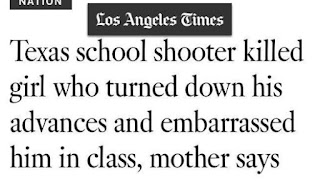
A couple of weeks ago a guy walked into Santa Fe High School in Texas and shot people, killing ten of them. Following an excellent suggestion that’s been passed around Twitter and Tumblr, I’m going to refer to the perpetrator as “Shooter #101” (this was the 101st mass shooting in the United States this year). The mother of one of the dead, Shana Fisher, has claimed that her daughter was repeatedly harassed by Shooter #101 for a date and ultimately turned him down publicly in front of the school, and that she was the first person he shot. Several articles on the incident have used this for a lede. Apparently it hasn’t been corroborated by witnesses – which is bad enough, but I’ve worked in journalism in a very small way, I can understand going ahead with the article on the assumption that the mother knew what she was talking about. What’s not forgivable is that this was how they framed this element of the case:

Spurned advances from [Shooter #101] provoked Texas shooting, says mother of girl killed (NZ Herald)Texas school shooter killed girl who turned down his advances and embarrassed him in class, mother says (LA Times)

And these are far from the worst. You see the narrative being put forward here? Men (overwhelmingly) do the shooting, but never fear, we can always find a way that it’s ultimately a woman’s fault. Women are put on earth to meet men’s needs, and men go astray when women fail to fulfill that function. Men’s sexual and romantic yearnings give them a proprietary right over women’s bodies, attention, and time. Most commentators would recoil from this position if it were stated openly; the danger of framing male violence as the headlines above do is precisely that this narrative sneaks under the radar as a tacit premise instead of being exposed to challenge as an explicit proposition. To men who do believe that women owe them sex, this subtextual confirmation helps that belief fit just that little bit more comfortably into their picture of the world.

Monday, 8 January 2018

I support Madeline Anello-Kitzmiller

There’s a news video from New Zealand going round the world at the moment. It was taken by a casual attendee at the Rhythm & Vines Festival in Gisborne for the New Year. Two women, one of them topless, are walking through a casual crowd; a man watches them pass, then sneaks up behind the topless woman, gropes her, and runs away. Both women turn around, walk over to the man, and hit him. The women are Madeline Anello-Kitzmiller and her friend Kiri-Ann Hatfield. The man who assaulted Anello-Kitzmiller hasn’t been named.

Why am I just telling you what happens in this video, instead of showing you? Because I wanted to show you Anello-Kitzmiller’s statement on the incident instead. I’ve never previously seen the ethical core of naturism and body-positive feminism stated so comprehensively and so succinctly.

...I would like to point out that I had that body art done at the festival. There was actually a stall selling the “glitter tits” get-up, and I paid to have it done, as well as many other girls I saw walking around with it. In addition to that, the waterslide at R&V was handing out $50 to the first man and woman to go down the slide naked, and another $50 to the next man and woman. I saw plenty of naked men that day getting absolutely no harassment for revealing themselves. There were naked men in the mosh; my best friends got naked and ran through the crowds; I saw plenty of guys walking around with no shirt on and a handful of girls as well.

So I want to ask you, what is the difference? Both men and women have nipples, although men’s nipples are seemingly useless and my breasts are there to feed children, should I ever choose to have them some day. The difference is that women have been over-sexualized for way too long and it needs to stop. I wanted to share my body because I think it’s an important step to normalizing the naked body and desexualizing [it]. The more often people see nudity, the more they realize... that it’s nothing to gape over. Nudity at festivals helps erase pornstar ideals of what our bodies “should” look like. My breasts are not sex toys. They are not an invitation. My body is beautiful, and no matter who says otherwise, it cannot and will not demean my own self-worth. Nor should it for anybody else.

I’ve been accused of “trying to turn New Zealand into America” in a few comments. This is a narrow-minded accusation. Besides, the similarities are there regardless. The amount of naked people running around at Splore in New Zealand would be severely overwhelming for those of you who couldn’t handle a few bouncy “glitter tits” at R&V. I will say that the majority of New Zealand has seemed to be more conservative than Portland, Oregon, but sexual harassment happens everywhere, all over the world. I have never experienced so much hostility at a festival before, but I don’t doubt that there are festivals in the States where the crowd is also less free-spirited than others.

I have been accused of “asking for it” too many times to count. It’s disappointing that people really believe that what you’re wearing has any connection to what you actually want. Comments stating that I was “asking for it” or that I “had it coming” are promoting rape culture. When you say something like that, you are justifying that man’s actions when he violated my rights to my own body, and you are telling other like-minded people that, should they ever want to sexually assault or rape another human being, it’s OK. It is never OK and we are never “asking for it”.

...The cool thing about being able to get naked at festivals and like-minded events is that you don’t have to get naked if you don’t want to. Do what you’re comfortable with and only do what makes you happy. I personally love being naked because it made me realize that I am indomitable. Nothing anybody says about me or my body could ever wound me. At Rhythm & Vines both men and women came up to me and told me that I was disgusting, that I should cover up, that I [should be] ashamed, that I was a slut, but I kept my top off all night and I danced until 6am and I had the best time of my life regardless.

On “trying to turn New Zealand into America”, I’m surprised that such an accusation was ever made, because I was under the impression that it was more the other way around. It’s American censoriousness in particular that nudists tend to blame for the restrictive nudity rules on social media platforms like Facebook and Instagram. The recent movement to banish breastfeeding from public spaces – a bizarre bit of prudery unheard-of even in Victorian times – is as far as I can tell very largely American, and doesn’t seem to have taken hold here. I think the truth is that the United States contains both the most and the least nudity-friendly places in the English-speaking world; Portland, Oregon, is evidently among the former.

[EDIT: A Tumblr mutual informs me that the last part of that sentence is sadly not true. However, the United States does contain San Francisco, where public nudity was temporarily legal, and Brattleboro, Vermont, where it still is. Also, I’m ashamed to report that my attention has been drawn to a recent incident in Auckland where a woman was evicted from a bus after a fellow passenger took offence at her breastfeeding. I still think this is far from the norm in New Zealand, but I can’t in all honesty maintain that it “hasn’t taken hold.”]

While New Zealand sadly doesn’t attain Brattleboro standards of body acceptance, our nudity taboo is far from absolute. My town hosts a nude rugby match most years, though they’re not doing it this year; the Kawarau Gorge bungy-jumping station used to let people jump naked for free until they found they were losing too much money; and the whole country had a “National Nude Day” (mostly pubs offering specials to naked customers) for a few years about a decade ago. I used to belong to a group that went walking nude in the bush around Dunedin, and most people we met responded positively. And, as Anello-Kitzmiller points out, nudity is at least tolerated at many New Zealand summer festivals – a tradition going back to Nambassa in the 1970s – and was specifically encouraged at Rhythm & Vines. Which means that everyone who’s commented to say her toplessness was “inappropriate” is simply wrong.

That is, however, a minor error compared to the premise that, if her nudity had been inappropriate, then it would have been OK for the man who harassed her to do what he did. Of course, personally I think that nudity ought to be acceptable everywhere it’s physically safe. But even given that we can’t snap our fingers and wish for society to outgrow all its repressive norms overnight, there is no way sexual harassment is an allowable means of enforcing those norms. If female toplessness had been banned at Rhythm & Vines, then the proper response would have been for a security team member to bring her a towel or spare shirt and explain their standards. The assailant would still be no more justified in his actions than a truck driver is justified in killing cyclists who stray into the wrong lane.

The other argument is of course that old chestnut “He’s a man, he couldn’t help himself.” There were half a dozen other men in that video and they somehow managed to help themselves (although they didn’t help Anello-Kitzmiller by doing anything like intervening). And it wasn’t as if he took one look at her breasts and zoned out or something; he waited until she had gone past and then made his move. The assault was a deliberate choice on his part. If he had genuinely been unable to help himself, then he should have been under restraint or at the very least in the care of a minder. Since he was able to help himself, deterrent action such as Anello-Kitzmiller and Hatfield took was the appropriate response.

Frankly, I think “He couldn’t help himself” and “Her nudity was inappropriate” are both smoke-screens for our society’s ugly underlying attitude. Both are nonsensical on the face of it, but both make sense if you make one abhorrent ethical assumption: “Men may act on any sexual impulse they feel towards women.” Then everything falls into place. Skimpy clothing becomes inappropriate anywhere sexual activity is inappropriate. The assailant couldn’t help how he felt about Anello-Kitzmiller’s breasts.

And no, you can’t take gender out of it by restating that as “People may act on any sexual impulse they feel towards anybody.” Our society does not condone women acting sexually, nor men acting sexually towards men. Accordingly, men are granted much broader freedom with our bodies in casual contexts like music festivals. The festival I go to at New Year’s doesn’t encourage nudity, yet there were plenty of men going shirtless in the heat this year. If I, a bisexual man, had sneaked up behind one of them and groped him, and he’d (rightly) hit me, how many people do you think would have defended my actions on the basis that he was “asking for it”?

(In case you’re wondering why I, a nudist, go to a New Year’s festival that doesn’t allow nudity, it’s partly a shortage of options down this end of the country but mainly about the music. I love traditional folk music and I have bigger autistic sensory issues with loud thumpy contemporary music than I do with clothing even in the summer heat. And I wear a kilt, which helps. And for the hottest days there’s a small swimming-hole upstream of the main one where hardly anyone goes.)

The same assumption again must be behind the frequent rejoinder: “Men are turned on by breasts. How do you intend to change that?” There’s no need to change men’s feelings. What needs to change is how men consider themselves entitled to act on their feelings. Suppose you’re hungry in the supermarket – I’ve used this analogy before – and you walk past a big bulk bin full of chocolate chips or something. Do you dig your hand in and grab? Not if you’re over the age of about four. Do you stand there staring and drooling? Not if you have any self-control at all. And chocolate doesn’t even have human rights. The problem is not that men think breasts are nice; the problem is that men think breasts are permission.

Which gives us good grounds for hope that men can change. Men do seem to have evolved to like the look of breasts – I’m afraid there’s not much evidence for the idea that this response is created by society or culture. But society and culture do determine what constitutes an acceptable or an unacceptable way to behave. Our culture needs to change, and it can change if we put in the work. I salute Madeline Anello-Kitzmiller for her contribution to that work, both by displaying her body and by penalizing that man for disrespecting it. Whether you join her in the former effort can only be your own personal choice; but we all need to contribute to the latter. Let’s build a zero-tolerance policy for sexual assault and harassment at every level of society we can influence, starting now.

Monday, 17 July 2017

A philosophical quibble to upend the global order

One thing I like about philosophy is how often I can find real-world applications for it. I guess that’s because it’s so abstract, compared with, say (to pick another of my interests), zoology. It is very unlikely that I will ever find a use for my knowledge that elephants have two distinct charging behaviours, one when they’re charging to threaten and the other when they intend to kill. Cats and dogs and rabbits just aren’t the same. On the other hand, it’s a rare week when I don’t have to think about essentialism, or game theory, or survivorship bias, or some other concept at the intersection of philosophy and mathematics, for some reason or another.

Recently I came across a singularly important philosophical paradox. Oh, its importance isn’t instantly obvious. To be honest, at first glance it looks footling, one of those little quibbles that just go to show philosophers need to get out in the fresh air a bit more. I’ll take you through it first, but let me assure you: the deepest, most fundamental question in global politics for the last thirty years hangs on the resolution to this paradox. But I have to tell you what the paradox is first, before I can explain how. It’s called the Mere Addition Problem, or alternatively the Repugnant Conclusion. Here to explain it is the philosopher Julia Galef (whose work I regret not discovering years ago):

In case you scrolled past that without playing it, the problem is the three contradictory premises, all of which seem reasonable, but which can’t all be true. Galef phrases them as follows:

  1. Creating new people with lives worth living doesn’t make things worse.
  2. Increasing total and average happiness makes things better.
  3. A smaller number of very happy people is preferable to a larger number of unhappy people.

Consider three possible worlds. First, a world with a small number of very, very happy people. Second, a world with that same number of very, very happy people, plus a similar number of other people who are just kind of contented, but not actively unhappy. Third, a world with the same total number of people as the second world, who are all just a little bet less happy than the very-very-happy people but a whole lot happier than the kind-of-contented people. Now according to premise (1), the first world is no better than the second world. According to premise (2), the third world is better than the second world. But that means the third world is also better than the first world – a larger number of less happy people is better than a smaller number of very happy people – which contradicts premise (3). Look, it all makes sense with Galef’s visual aids, I promise.

This is called the Mere Addition Paradox because all you’re doing with premise (1) is “merely adding” people to the world, who just happen not to be as happy as the people already in it. It’s called the Repugnant Conclusion because, if you go through the same reasoning several times over, you end up concluding that a world with a vast population so unhappy they have just one thing keeping them from suicide is better than a world with a tiny population whose lives are healthy, fulfilling, exciting, and blissful. Mind you, given only those premises, it is possible to cheat our way out of the paradox, because there are a couple of additional premises which are necessary for the Repugnant Conclusion to follow:

  1. The law of transitivity applies to goodness.
  2. There is no threshold of happiness (above the zero point of “I’d rather be dead”) at which this logic stops working.

I say “cheat our way out” because, although we can avoid the Repugnant Conclusion if either one of these is false, either way we end up not making much sense. To falsify premise (5), we would not only need to quantify a threshold of happiness below which the logic did stop working; we would also need to specify which of the other premises broke down at that threshold and why. So that gives us a whole lot of extra work figuring out how to quantify happiness, and gets us no closer to a solution than we already were.

Premise (4) looks more promising at first sight. “The law of transitivity” is a jargony, technical sort of term; it looks like it means something complicated and esoteric. Actually all it means is the simple rule that if Thing A is better than Thing B, and Thing C is not better than Thing B, then Thing A must also be better than Thing C – in whatever sense we might be using the word “better”. So, for instance, if democracy is better than absolute monarchy, and military dictatorship is not better than absolute monarchy, it follows that democracy is better than military dictatorship. If solar power is better than gas, and coal is not better than gas, it follows that solar power is better than coal. If Wonder Woman is better than Batman v. Superman, and Suicide Squad is not better than Batman v. Superman, then Wonder Woman is better than Suicide Squad. If teriyaki beef is better than cheese-on-toast, and baked beans are not better than cheese-on-toast, then teriyaki beef is better than baked beans. Without a rule like that, we’d have to compare every possible pair of alternatives independently to determine which was the better of the two. It would be impossible to generalize about what makes one thing better than another, and hence meaningless to compare hypotheticals like the made-up worlds in the Mere Addition Problem. Any attempt at reasoning about values would boggle. Premise (4) stands.

Let me now clear up a further red herring – an attack on the problem which does make a certain amount of sense but doesn’t remove the Repugnant Conclusion. It goes “I’m not a utilitarian. Morality isn’t the same as maximizing happiness.” I, for instance, think morality is about maximizing trust rather than happiness. The reason this doesn’t work here is that the Mere Addition Problem is about goodness rather than morality. These two concepts are related but not the same. Morality is an intensely practical matter; it poses questions of the form “What shall I do?” If I answer “Earn people’s trust,” well, the way to do that is to consistently do good for other people, so I’m still left asking “What counts as ‘good’?” – which is the question that the Repugnant Conclusion raises problems for.

If you don’t make the subtle distinction between goodness and morality, you might think you had found another way to disarm the Repugnant Conclusion: “Creating worlds and manipulating people’s happiness by way of experiment is deeply immoral anyway.” I’d be inclined to agree. You, the Manipulator of Worlds, might personally know that you would never intentionally use your power to create misery, but you can’t reasonably expect your subjects – who live or die, rejoice or suffer, at your merest whim – to have the same certainty. By holding that power at all you create a situation in which you cannot be trusted. But the Repugnant Conclusion doesn’t in fact depend on the supposition that you (or anyone) are responsible for the existence of the world, its people, or their happiness. The unfortunate language used, of “creating” worlds and “adding” people to them, is not necessary to the Problem. As long as the posited worlds and people could conceivably exist, we’re still faced with the question “Which one would be better?”

So we’re back to Galef’s three premises. Which one is wrong? I’m going to eliminate premise (3) from the get-go. If the words “good” and “better” mean anything at all, then a world with a small happy population is better than a world with a large miserable population. Premise (3) is true. The Repugnant Conclusion is false. To call misery better than happiness is to talk nonsense. If that’s goodness, give me evil.

There remain premises (1) and (2), and this is where things begin to get political. I maintain, and will demonstrate, that the great global political question of my lifetime comes down to which one of these premises is false. I believe that policy-makers have chosen the wrong one, and that the disasters of recent decades – global warming, the financial crisis, Donald Trump – are all partly, and some entirely, consequences of that choice.

Monday, 29 May 2017

Debating bigots: the role of allies

This post was originally published on my Tumblr about a week ago.

I’m autistic. I was diagnosed with Asperger’s syndrome back when it was still called that, in 2005; I was 27.

I like to think I can discuss most topics dispassionately and let my opinions be guided by the facts and reason rather than letting my feelings about it cloud my judgement. But I can’t stay calm when debating with anti-vaxxers. Well, I can as long as the debate stays within the bounds of “Do vaccines cause autism? Do they cause other health problems? Why should the mandate to vaccinate over-ride a parent’s personal choices about their children?”

When it gets into the realms of “Supposing vaccines might cause autism, are the benefits worth the risks?” – that’s my danger zone, because so many anti-vaxxers so quickly start saying things that I can’t help hearing as “I’d rather my child died of measles than ended up like you.” And I can’t debate that calmly. That person just told me I ought to be dead.

So I’ve learned to avoid those debates. But here’s the thing. I know perfectly well that just because I don’t get into those discussions, doesn’t mean they don’t happen. I know that there are people who think a child’s autism is a mitigating factor if that child’s parents murder them. I know there are people who think my neurological condition is a scourge on the Earth and humanity would be better off if people like me were eradicated.

I can’t engage those people in debate. So, allistic allies, I need you to do that for me.

Not necessarily to convince the bigots themselves; it’s extremely rare for someone to change their ethical or political belief for being confronted, no matter how rational the argument. Sometimes they go away and think about it and change their minds later and come back when they’ve figured out a way to save face. But far more importantly, the bigot isn’t the only one listening. I need you to demonstrate to people who haven’t made up their minds on the question, why the bigots are wrong. I need you to keep the bigots from expanding their numbers by converting impressionable outsiders.

I should not have to debate whether I have the right to exist. But because that debate is happening whether I join in or not, I need you, allies, to pitch in and take my side. Please don’t refuse to engage on the basis that there shouldn’t even be an argument. There shouldn’t, but that’s not how you stop bigotry.

Friday, 19 May 2017

Nudity: ethics and etiquette

In March I went with a local naturist group on an overnight retreat to Quarantine Island, in the middle of Otago Harbour. True to Dunedin’s weather – or maybe my life, I’m not sure – it was cloudy and cold all weekend and it was only comfortable to get naked in the lodge in the evening with the fire going. After we’d come home it was sunny every day for a week, of course.

I am a naturist, or nudist to use the more common word. I have two main reasons for this, both of them about equally important in my own life. One is purely personal. Presumably because I’m on the autistic spectrum, I suffer from a mild hyperaesthesia which makes clothes slightly but permanently uncomfortable. I’m told other people stop feeling their clothes after wearing them for a while; I don’t. Shoes in particular – conditions underfoot have to be very unpleasant indeed before it’s worse than squelching around in my own sweat, so I don’t wear shoes much. But there are no such things as comfortable clothes, not for me.

The other reason is ethical. A human body is a human being and vice versa. Everyone has one; indeed, everyone is one. It isn’t good for people to revile themselves as obscenities, and it’s worse to enforce that revulsion with the power of the state. And it’s dehumanizing to treat another person as an object for the purpose of sexual gratification. Human beings have the moral right to be treated as human beings regardless of what they wear, including if it’s nothing at all – which means not being arrested, fined, locked up, or subjected to any other legal penalty, if they’re not hurting anyone. In short, public nudity morally ought to be both legal and acceptable.

The word “naturism” obviously implies that the value of nudity lies in its naturalness, which is problematic in several different ways. Not all natural things are good, so being natural doesn’t automatically make nudity good. Also, it is arguably natural for humans to adorn themselves, since every culture does it. Naturists shave, style their hair, and wear jewellery, tattoos and piercings just like clothed people. But “naturism” is the name of the movement now, and there’s no point complaining about it. “Nudism” is a broader word; anyone who chooses not to wear clothes can call themselves a “nudist”, whereas to be a “naturist” implies alignment with the naturist ethos. Back in the early 2000s an Altavista search for naturis* would mostly filter out the voyeur sites that nudis* tended to dredge up, and that may have helped the spread of the term. Unfortunately the porn peddlers have gotten wise to this now.

Naturism is one of the more marginalized alternative lifestyles out there. Unlike those “lifestyles” which consist of opting out of various public health measures (like vaccines or water fluoridation), it doesn’t cause actual harm; yet it’s illegal to practise it in public almost everywhere in the world. I suppose we can at least be naturists in our own homes without police harassment, which makes us more fortunate than pot-smokers. On the other hand, there’s less restrictions on sharing pictures of pot-smoking than on sharing pictures of nudity. And ours is surely, bar none, the one lifestyle that is most sexualized by outsiders.

What does “sexualization” mean, and what’s wrong with it? I’m tempted to say “Ask any woman,” and leave it at that. I’ve seen confusion about this in other contexts as well. Does it make sense, for instance, to ask casual bloggers not to “sexualize” particular sexual orientations? Bisexuality is sexual, isn’t it? It’s right there in the name! How can you help “sexualizing” it if it’s already sexual? The answer is that “sexualizing” something doesn’t mean connecting it to sex as a topic; it means making it sexy (or trying to), which is not the same thing at all.

A medical lecture on the physiology of fertilization in humans will discuss sex in some detail, which makes it “sexual” in a reasonable, if technical, sense of the word. But it isn’t remotely sexy – trust me on this. That’s not sexualization. Conversely, I’m sure you’ve seen advertisements that associate all kinds of completely non-sexual things with revealingly-clad yet concealingly-posed women looking suggestively at the camera. I used to regularly walk past a local fish-shop van (I haven’t seen it in a few months now and I’m not inquiring after it) which was adorned with a head-and-shoulders photo of a young woman, apparently topless, caressing a dead fish whilst assuming what was admittedly a more successful attempt at a come-hither expression than I would have been able to muster in her position. That’s sexualization.

Now the foundation of the naturist platform is the proposition that nudity can, and should, be desexualized. I’ve seen a few blogs now – pretty much all on Tumblr, for some reason – claiming that naturist environments feature unrestrained public sex. If you find one of these, you should know it’s lying to you. It’s somebody’s sexual fantasy. There’s nothing wrong with having sexual fantasies, but there’s everything wrong with slandering a worldwide category of people in the course of expressing them. Again, ask any woman.

Monday, 10 April 2017

Syria: what I get and what I don’t get

So Donald Trump has fired missiles at Syria. So much for the theory that he was better than Hillary Clinton because he wasn’t a warmonger. I did tell you. If this isn’t the beginning of a war to dwarf Iraq and Afghanistan, I will publicly eat these words. I’m not betting either way on whether there will be a nuclear strike, but if there is it will be Trump’s doing.

At least some of the people who voted for Trump did so because they thought he wouldn’t do this. I get that. Clearly they were wrong, and frankly it should have been obvious that the reason he never voted for war was because he was never in politics. But I get why that would be your concern. What I don’t get is why some of his opponents are now suddenly calling him “presidential”. I mean, sure, yes, blowing people up in other countries without asking the people they’re pretending to try to help is something American presidents do, but that’s not supposed to be a good thing.

There’s so many conspiracy theories going around at the moment that it’s hard to get a handle on what’s true. I used to trust Wikileaks, but they’ve been so nakedly partisan for the last year or so that I’ve given up on them. The evidence for some kind of Russian interference with the American election continues to pile up, and denials from Wikileaks aren’t going to sweep it away. On the other hand, Putin is buddies with Assad, isn’t he? How is Trump’s attack on Syria supposed to advance a hidden Russian agenda? Or did Trump just get pissed off with everybody calling him Putin’s puppet? Is that what this is about?

The other thing I don’t get is why so many people who would proudly call themselves “radical” seem to support, or at least sympathize with, Putin and Assad. Putin is an aggressively homophobic dictator, and Assad is a lesser dictator with zero concern for human rights. I’ve seen a video of two journalists disagreeing over what’s happening in Syria, and the one who the viewer was supposed to agree with claimed that Assad was loved by his people because he got so many votes in Syria’s elections. How does an international journalist not know how elections work in dictatorships?

I think I do get why so many people think, “Well, the US has to do something.” I guess it’s like the recent trailer for Deadpool II, where the inept superhero title character tries to prevent a murder but can’t change into his superhero costume in time. The US with its giant military is the superhero, and superheroes are not supposed to sit around watching other people kill each other. Only, so far, the US’s record for solving problems with its powers is worse than Deadpool’s. Trump’s “rush in without a strategy” strategy will change that only for the worse.

I don’t know where the world goes from here. I don’t know how we solve this problem. I don’t know how we get rid of a dictator who kills lots of people without a war that kills lots of people and ends up installing a worse dictator who kills lots more people.

Trump doesn’t know either. But Trump will bring the whole world down around all our ears before he admits that.

Tuesday, 14 March 2017

Why abortion isn’t murder

A fertility clinic is on fire. In the storage area at the back of the building there’s a portable freezer unit containing 100 live human embryos. In the reception lounge at the front, trapped under a chair, there’s a screaming three-year-old child. You can save one, but as soon as you open the door and let in the oxygen the fire will take the building. Which one do you save?

You see where I’m going here, right? This sort of question is bread and butter for moral philosophers: think of a scenario where the answer is obvious, then extrapolate principles that can be applied to situations where the answer isn’t obvious. Most people choose to save the child. From this it must follow that they don’t value an embryo’s life the same as a child’s, or even at one-hundredth the price.

Try asking a pro-lifer this question and see how they respond. I’ll tell you how they don’t respond, or at least haven’t lately in my many arguments with them since joining Tumblr: they don’t answer “I would save the embryos, of course. It’s very sad about the one child in the reception lounge, but it would be immeasurably sadder to lose all the children in the freezer.” Instead the answer you repeatedly get is “I would probably save the one child, but that’s an emotional response and doesn’t have anything to do with right and wrong.” And you have to prod them to get even that much. Generally they evade the question until you’ve asked it three or four times.

First off, if morality isn’t about emotions, what is it about? Most moral philosophers will tell you that morality isn’t objective, because you can’t get from an “is” statement like (in this instance) “A child is in danger” to a “should” statement like “I should save the child” except by calling in another “should” statement like “One should always protect children”, and if you try and prove that second “should” statement you just go around the circle again, and so on forever. Without rational proofs or empirical backing, all you have to call on is your moral instincts. And here they’re pretty clear.

Pro-lifers, as a rule, seldom get their morality from philosophers, but they are disproportionately likely to pay at least lip service to a certain 1st-century populist rabbi who will be found to have said (following Rabbi Hillel) that morality is an expression of love and consists of doing for other people what you would want for yourself, and obviously love and empathy are both subjective emotional states. But religion doesn’t break the circle; “You should do what God says” is just another “should”.

Personally I think the philosophers are overly pessimistic. A “should” statement can, in fact, be objectively true if it rests on an “I want” statement; if I want functional teeth then I should cut back on sugar, if I want to sleep tonight then I should get off the internet. (To use more technical language, “should” statements may have no truth-value, but they do have utility-value.) Might there be some “should” statement that applies to any possible “I want”?

Well, if we’re really pedantic about what counts as “possible”, then no there won’t be, because for any “should”, someone can always say “I want to do the opposite of that.” But there are some “should”s that at least apply to any plausible “I want”, and one of them is “You should not destroy anything you might need”, and one thing you can count on always needing is other people’s trust. And it just so happens that our moral instincts evolved to allow us to trust one another. I have made a longer, but not necessarily clearer, case for trust-based morality here.

Now if you want to earn people’s trust, you can’t weigh every decision separately according to how much it’ll make them trust you, because then they have to worry that one day your calculations might tell you to harm them. You have to behave in a way that allows them to predict you won’t do that. Your actions must not only be benevolent, but clearly and consistently benevolent. For an individual, that means practising virtues – kindness, fairness, courtesy, charity, patience, and so on. For an institution or a society, it means treating people according to a consistent code of rights. And this is where we can start to buckle down to the abortion problem, because here it seems that one person’s right to life conflicts with another person’s right to bodily autonomy. It’s conflicts like this that send us looking for a deeper principle that can resolve them, and I say that principle is trust.

The pro-life position is that abortion is murder. Murder is the breach of the human right to life, and I do hope I don’t need to explain how that might erode trust between people. Two questions arise here. First, who or what has the right to life, and who or what does not? Where do you draw the boundary? And second, if you have to choose between one person’s right to life and another’s right to bodily autonomy, which one should win? Always life, always bodily autonomy, or sometimes one and sometimes the other?

Sunday, 19 February 2017

The question of punching Nazis

This blog tends to straggle a fortnight or so behind the news, but people haven’t stopped talking about this yet:

You know, if there were two propositions I’d always have thought were established beyond doubt, it’s that the world is round and that the Nazis were bad. But in the last year there have arisen fad movements questioning both. I imagine, though I admit I don’t have any data here, that there’s quite a large membership overlap between the two movements. I don’t intend to defend either proposition here. My question instead is whether it’s morally defensible to do what that guy in the GIF is doing, i.e., punching Richard Spencer in the face.

This is an interesting test case for the ethics around free speech; it’s so extreme, in two different ways. On the one hand, the usual defences for limiting speech do not apply. Spencer in that clip is not being argued with angrily, blocked from an internet forum, disinvited from a speaking engagement, or having a newspaper refuse to publish his letters – he’s getting punched in the face while trying to speak to a camera. We can’t say that he’s merely being “shown the door” or that the attacker is exercising his right to free speech. This was a violent act, an act of physical force. On that basis many people have condemned it, including Jerry Coyne:

If the Left is to keep the moral high ground, we simply can’t go around physically attacking those whose views we don’t like. In fact it’s ironic, because when progressives do this, they’re implicitly denying someone a real safe space: a space to be free to express your opinions and remain physically safe. “Safety” refers to freedom from physical attack or illegal harassment, not to freedom from hearing views you don’t like.
As a conscientious objector, I’ve always adhered to the nonviolent philosophies of Martin Luther King and Mahatma Gandhi, for if you start violence, you lose credibility.

But Coyne is misrepresenting the situation when he lumps Spencer under “those whose views we don’t like”. Elsewhere he has disputed the characterization of Spencer as a “Nazi”, since Spencer is not a formal member of a National Socialist party. Given that Spencer is on record as questioning whether Jews are people and proposing that Africans be exterminated, I’d call that hair-splitting. Coyne is Jewish; if he wants to forgive a man who denies his humanity, that’s his prerogative. But I think other Jewish and African people might want a say in the matter as well.

Spencer’s racist views constitute the second way in which this is an extreme case. The usual arguments for protecting offensive speech also do not apply here. Spencer is not speaking truth to power. He is not proposing a crackpot idea that just might be true, or even one whose falsehood offers us teaching opportunities in the effort of rebuttal. We already know what happens when the assumptions he is challenging cease to hold; that’s what the 1930s and 40s were all about. And the punch doesn’t set a precedent for violent state intervention against dissidents, because it wasn’t delivered by an agent of the state.

What about the moral high ground, as per Coyne’s objection? The moral high ground isn’t just a place to keep your own self-image squeaky-clean; it’s a critical strategic position which any resistance movement abandons at its peril. At some point, you must gain the support of the public or abandon your cause. To do that, you must inspire them either with sympathy or with fear. Fear has short-term advantages that make it tempting – not least that you control the media’s attention. But it is fatal in the long run. If the citizens sympathize, some of them may help you stay off the state’s radar; if they’re afraid, they’ll hold the state’s coat while it swats you like a fly. India is no longer a British colony because Gandhi didn’t terrorize people. Northern Ireland is still a British colony because the IRA did terrorize people.

(Worse still, you might buck the odds and win. The English Civil War, the French Revolution, and the Russian Revolution are examples. It’s no coincidence that these were followed by the tyrannies of, respectively, Oliver Cromwell, Napoleon Bonaparte, and Joseph Stalin. Power gained by fear can only be held by fear.)

But America is in an even sorrier state than I thought if one sucker-punch is all it’s going to take to divert the sympathy of the public to “alt-right” Nazis. Not many resistance movements can survive without being prepared to occasionally defend themselves, either. Martin Luther King didn’t riot, but he openly sympathized with those who did. The gay rights movement in the US began when the patrons of the Stonewall Inn fought back – yes, fought back – against police harassment. The boundary between sympathy and terror is not the same as the boundary between using force and not using force. Most people are not complete fools; they can tell the difference between hitting people to make them do what you say and hitting people to stop them kicking you around.

All in all, I can’t see that the person who punched Richard Spencer in the face did anything wrong. What does bother me is the idea some people seem to have that more punching is the way we’re going to win this thing. It’s not. This is one of the deep cognitive flaws in the human psyche: “Find out whose fault the problem is and hurt them until it goes away.” That very flaw is the core of Nazism and fascism, and for that reason Nazis and fascists are always going to be better at hurting people than we who oppose them. Force may sometimes be necessary, but if the decisive contest is our force against theirs, they will win.

What we’re better at doing than they are is telling the truth. (The Trump White House has already, in its first month, invented three non-existent terrorist attacks to justify Trump’s anti-Muslim measures.) The Nazis themselves are obviously not going to be listening, but other people are. They need to see that we have answers to every one of the fascists’ lies. I salute the brave scientists, reporters, judges, and bloggers who are standing up for the truth. We need more of you. Kia kaha.

Wednesday, 23 November 2016

We won’t defeat bigotry by ignoring it

“We really should just be completely ignoring Tamaki,” said a friend of mine (whose name is Andy) on Facebook last week. “I’m thoroughly sick of giving time and space to nonentities. Sign of the times unfortunately – lazy, sensationalistic journalism, and all that.”

Tamaki who? Well, my little country made international news a couple of days previously when we had a gigantic earthquake, which fortunately hit a rural area in the early hours of Tuesday morning with very few people in harm’s way, and I think the death toll stands at 2. Now Brian Tamaki, self-anointed Bishop of Destiny Church, had preached on Sunday that major earthquakes (such as those that devastated Christchurch, our second-largest city, back in 2011) are Nature crying out to God in grief at human sin – sin being murder, gay marriage, and Lloyd Geering. After Monday night’s events he put up a blog post claiming that the sermon had been a prophecy.

Maybe Andy is right in the specific case of Brian Tamaki. He gets media space because his Destiny Party was the second-latest in the ongoing series of attempts to forge authoritarian Christianity here in New Zealand into the kind of political force that it is in the US. The pattern is: rebuke sin, claim endorsement from God, announce a nationwide revival, fail to cross the 5% vote threshold required to get your party into Parliament, fall off the radar, surface a year or two later in a sex scandal. Except in Tamaki’s case it was a money scandal, and it didn’t sully his standing within the small group of devout followers who are his season-pass on the gravy train.

I can’t fault Andy’s opinion of current standards of journalism either. Objectionable behaviour from public figures gets clicks, and clicks get advertising dollars. But in the light of the recent US election, it’s now clear that the Left has catching up to do; and one thing we need to catch up on is convincing people that we have answers worth listening to. During my time in student political activism there was a general practice – nothing ever so concrete as a policy – of avoiding engaging with our opponents’ arguments directly so as not to give the impression we thought them worth bothering with. In effect we assumed that our target audience’s default position was to agree with us as long as they didn’t encounter opposing views. I believe a similar assumption was a big part of Hillary Clinton’s failure.

So if certain people blame earthquakes on deviant sexual activity, does that mean we need to go out and hold educational community seminars on plate tectonics? Not what I have in mind. Apart from anything else, we don’t know why earthquakes strike at one point on a fault rather than another, and for people who think like Tamaki, that sort of gap in our knowledge means there’s still room for God (or aggrieved Nature) as an explanatory factor. Anyway, the earthquakes per se aren’t the point. The point is whether being LGBT, or tolerating LGBT partnerships, is the sort of thing that makes a country deserve earthquakes. We progressives say “No.” Many people still say “Yes.” We have not worked hard enough at convincing them otherwise.

Sunday, 2 October 2016

Why women are better than men

Once upon a time, people say, you could tell the plain truth about things and be admired for it. Now they make you shut up and call you, as it might be, racist, sexist, or homophobic. I’ve had my quarrels with these people before and I expect I will again. But today I share their experience. I have a truth to tell which will offend people because it upsets the illusion that we are all equal. Here it is:

Women are better than men.

This is not hyperbole, rhetorical or otherwise. Nor is it a joke, though I confess myself slightly amused to imagine the offended huffing and puffing it will cause among some who pride themselves on being immune to offended huffing and puffing. It is, I admit, a generalization; but it is, I insist, a valid generalization.

Consider, as a parallel, the statement “Women are shorter than men.” That’s a generalization, but a valid one. It doesn’t mean that women can walk upright under toilet stall doors while men frequently get their hair tangled in power lines. It doesn’t even mean that the tallest woman is shorter than the shortest man. You can’t falsify it by picking Gwendoline Christie as your exemplar of women and Peter Dinklage as your exemplar of men. No-one denies that the distributions overlap – that many men are shorter than many women. But you still know perfectly well that women, in general, are shorter than men, in general.

Likewise, I’m not claiming that all women are saints and all men are serial killers. I’m not claiming that the worst woman in the world is better than the best man. I am claiming that women, in general, are of better moral character than men, in general. This claim being a generalization, you can’t falsify it by picking, say, Ann Coulter as your woman versus William Kamkwamba as your man. And in case you didn’t believe me the first time, this is neither a hyperbole nor a joke. So you’re going to want some evidence, aren’t you?

Sunday, 1 May 2016

How should men respond to #freethenipple?

The #freethenipple movement is morally correct. Nipples harm no-one; therefore, it is censorious to ban them from public view, and unjust to discriminate by gender while doing so. I frankly don’t see much room for controversy here. Nevertheless, the issue is controversial. Many Western states have laws against toplessness. New Zealand is one that doesn’t, but we do have vaguely-worded offences like “breach of peace” and “offensive behaviour” to allow the police to enforce conservative norms without having to admit that that’s what they’re doing. I believe there is legal precedent here for topless protests being protected self-expression under the Bill of Rights Act, but I’m not a lawyer and you shouldn’t rely on my vague recollections in court.

So why haven’t I said anything about it before? It’s a feminist issue, and I have a lot to say about feminist issues. And it’s a body freedom issue and I have strong views on body freedom. Why have I kept all quiet about it? Well, because of the feminist thing. I’m male, and attracted (mainly but not exclusively) to women. There is a sarcastic hashtag #malefeminists for guys who try to dominate feminist spaces, and especially for guys who are enthusiastic about liberating women from their clothes and sexual inhibitions. It is not my business in the first place to tell women how to emancipate themselves, and on the specific topic of sexual liberation I have a conflict of interest. What I can do, what men who align with feminism need to do, is try and communicate feminist values to other men.

The basic principle here is: women are human beings and deserve the respect and consideration due to human beings, regardless of what they’re wearing. I don’t see that there are any limits on this principle in either direction. A naked woman is a human being, and a woman in a burqa is a human being, and if you meet either one in the street you should treat her exactly the same as if she were wearing jogging gear, smart casual attire, or a work uniform. Male responses to topless demonstrations tend to fall short of this ideal in one of two ways, both seen in the video above. One is to perve; the other is to try and make the women cover up. Let’s go through the justificatory arguments in turn.

With perving, of course, the argument we have to deal with is generally a post hoc rationalization. “If she didn’t want to be perved at,” men say, “she wouldn’t draw attention to herself like that.” If you see a woman in a clown suit, it’s OK to laugh at her, right? That’s what the clown suit is for, isn’t it? And if you see a woman in a ballet tutu, it’s OK to watch her dance, isn’t it? In each case the costume is intended to draw that reaction. On that basis, can’t we consider toplessness to be a costume intended to draw sexual attention?

Think again. Suppose the clown or ballerina is not performing on a stage, but waiting in front of you in the queue at the convenience store. Then it’s not polite to laugh or stare – the wise presumption is that she’s grabbing a bite to eat between performances and hasn’t had time to change. It’s not the costume that counts, it’s the performance. A woman dancing topless in a burlesque show can be presumed to be presenting her body for visual appreciation; a woman relaxing topless in a public park cannot.

To be sure, the Outdoor Co-ed Topless Pulp Fiction Appreciation Society are there to send a message as well as to enjoy the spring air. The shock value and clickbait appeal of breasts can draw the attention of passers-by, media, and the internet to one’s cause. If a protester lifts up her T-shirt for the news cameras to reveal the words No to the TPPA (as it might be) painted across her torso, it’s reasonable to assume that’s her intention. The obvious response – obvious unless you’re just waiting for the first excuse to ogle or grope – is to attend to the message she’s trying to convey. Especially if that message is Still Not “Asking For It”.

Such protests help falsify what’s often the first objection raised by those who want to make women cover up, namely that women are actually perfectly fine with having to cover up and #freethenipple is all a fantasy of a bunch of #malefeminists. I once overheard a woman remark very loudly to her companion (it was a windy day and they were walking right behind me) that she welcomed the prospect of a Hooters outlet in Dunedin because “then I could go topless and people wouldn’t judge me”. I have to say I doubt that that would be the outcome of having a Hooters here, but conversations I’ve seen online confirm that she was far from alone in wanting that freedom.

Sunday, 28 February 2016

Whoever the “naked judge” is, I support him

I’m a nudist. It’s not something I’ve made much of on this blog, though I do mention it from time to time. But I am. If you see me with clothes on, it means I’ve made a compromise with either you or the weather today. I have very little liberty, most of the time, to live the way I would prefer. Even in my own house I have to hang net curtains in the windows if I don’t want complaints from the neighbours.

At least one other person in this country who shares my preference in this matter is a District Court judge. All I know about him beyond that is that he’s male and that he frequents the Pineglades Naturist Club near Christchurch, because those are the only personal details given in this Herald article.

Someone took a photo of this judge at Pineglades. Someone uploaded the photo to Pineglades’ website, apparently without his knowledge although he had given them written consent to use the photo – I’m not sure how that works but it isn’t the point. Someone else saw the photo and laid a complaint against the judge.

The Herald is keeping quiet about the identity of both the judge and the complainant, but the wording they report is suspiciously close to Rodney Hide’s opinion piece on the matter. Hide used to be the Parliamentary leader of the Act Party, who present themselves as champions of personal liberty. Of course in practice what they champion is personal liberty for rich white men, but judges tend to be those, so Hide’s hypocrisy demands further explanation.

Hide opens with the concession that nudists ought to be free to do as we wish as long as we do so in private on our own private property. But if you’re a judge, he says, you mustn’t appear in photos practising nudism. If you do that, you can’t do your job any more.

How... does he sit in judgement on sex cases, public indecency charges, or rule on the acceptability of pornography to minors?
To make a concrete example: how can he preside in judgement over a man accused of exposing himself to children?
Isn’t that exactly what he has done?

Um... no. No it isn’t. But this is a typical New Zealand attitude. We like to think we’re easy-going, tolerant, unprejudiced folks who accept people’s differences, who live and let live. We’re not.

Wednesday, 3 February 2016

Can’t we just ban misogynist trolls?

Content note: misogyny, rape advocacy

The next post was going to be about who should pay for tertiary education in New Zealand, since that question has come up in the news in a couple of different ways. But then I heard that “Roosh” Valizadeh, of Return of Kings fame, is planning meet-ups of like-minded men in New Zealand, including here in Dunedin. To add insult to injury, they’re scheduled for 6 February, that is to say Waitangi Day, a day when New Zealanders remember that civilization is built on agreements and kept promises.

It’s hard to tell how much of Roosh’s platform he genuinely stands on, and how much is intended to make people angry so that he can feel important. The “Kings” have argued that women shouldn’t be allowed to vote and that men should be allowed to rape them, as long as it’s on private property for some reason. They value women by their bodies and men, Roosh claims, by their capabilities; I strongly suspect that the male value scales are weighted so as to make Roosh himself the world’s greatest man.

I don’t like Roosh or his ilk – perhaps you can tell. I must confess the thought of his pathetic followers turning up at their meeting point only to be marched off to the police station in handcuffs is amusing. But is the power of the state justified in this instance? It’s a rule too often forgotten on both sides of politics: before you grant the government a new power to interfere with people, imagine that power in the hands of your bitterest opponents.

Fine, let’s imagine it. I don’t want the police to be able to go around intimidating people for disagreeing with the government, something they have recently done. Of course, Roosh et al. don’t just disagree with government policy; they want to perform illegal activities. (Rape is still illegal here, despite ominous precedents.) But they’re not actually gathering to commit rape, they just want to change the law and make it legal. Well, I want certain illegal things to become legal too – cannabis and public nudity spring to mind – and I’d rather the police didn’t harass me or others who get together to push for those changes. Roosh’s political ideals call for major upheavals to society’s power structures, but again, so do some of mine.

Are there any kinds of speech that should not be tolerated? Of course there are. There’s fraudulent speech, where you make a false statement for money or other gain; that’s not relevant here. There’s slanderous speech, where you make a false statement that harms someone else’s reputation. There’s threatening speech, including incitement to violence. And then there’s hate speech, but that’s controversial. Many self-styled free speech advocates make a lot more noise about protecting hate speech than, say, political protest. But OK, I admit, there is an argument to be had.

“Hate speech” does not of course refer to statements like “I don’t like Roosh or his ilk”. Nor is it quite the same as offensive speech. As I use the term, “hate speech”, meaning the kind of speech I would be happy to see banned, is simply a form of the kinds of intolerable speech I’ve already mentioned: slander (of a group, such as women) and incitement to violence (against a group, such as women, where violence includes rape). Well, there you go. Roosh’s little cadre are outside the pale after all.

However, just because we would be within our rights to call the police on him doesn’t make it a good strategy. Roosh wants to make a splash and be noticed. We don’t want him bragging to his sympathizers “Look how important we are! We’re so threatening they felt the need to arrest us!” which is pretty much what he’s after to be holding these meet-ups in the first place. We don’t need to play his game.

New Zealand social justice activists have bigger fish to fry. The present government, with its usual attitude to democracy, are hosting the signing of the disastrous Trans-Pacific Partnership Agreement, also just in time for Waitangi Day. This weekend we need to make a big statement about who we are, what we aspire to, and how different that is from what’s being foisted on us. That could certainly include a few sidelong dismissals of Roosh’s little gatherings. We surely don’t need to dignify them with more of a response than that.

Because – Roosh, in the unlikely event that you’re reading this – you don’t deserve any more of a response than that. You’re a sad little man who thinks bringing other people down will make himself bigger. Your odious philosophy, were there any chance of it being put into practice, would ruin men’s lives as surely (though more subtly) as it would ruin women’s. I’m embarrassed to share a gender with you. You do not speak for me.

EDIT: About an hour after I posted this, Roosh cancelled the meet-ups.

Wednesday, 16 December 2015

Why eugenics wouldn’t work

Further to my previous post, my friend Wolfboy wrote this in the comments:

I also detect a leftover whiff of eugenics in this line of thought – the idea that people who are “bad” represent a taint we need to clear from the gene pool. That seems to be in conflict with modern understanding of how genes work. I may be wrong here, but my understanding was that modern research showed that genes get turned on and off by environmental stimuli. If that’s the case then any genetic predisposition to be an awful person is better handled by stopping it from being triggered (by looking after people better in general) than by trying to breed it out.

Eugenics. That is presumably why the original inquiry was about the prevalence of sterilize-bad-parents views specifically “in the atheist / rationalist community”. Eugenics, the idea of breeding humans for qualities like intelligence or athletic performance, was proposed by Francis Galton as a practical application of the theories of his cousin Charles Darwin. Darwin himself went along with the idea, although never enthusiastically, and with reservations about the social justice implications. The support it enjoyed for the next seventy-odd years came from places all along the left-right political spectrum, but almost entirely from the atheist-materialist side of the religious divide. That is quite possibly the basis for the (otherwise absurd) notion that the Nazis were a scientific and rationalistic bunch.

The Nazis showed the world what it would take to actually implement a eugenics programme, and since then the idea has been anathema among people of conscience. And rightly so, but when a problematic idea or practice becomes unthinkable within a culture, it doesn’t get cut out cleanly. “Not only will we not do this any more,” people decide, “we won’t even go near it.” The classic example (see Steven Pinker’s The Better Angels of Our Nature, and yes, I know I cite that book a lot) is the odd little superstitions that have grown up around knives in European culture, such as not eating with them. Europeans used to use big sharp knives for all sorts of things, notably settling arguments. In Māori culture there are several prohibitions, like “never sit on a table”, which put together underline the point that people are not food. And in modern political discourse, ever since World War II people have been unduly chary of applying genetic science to Homo sapiens.