Showing posts with label artistic integrity. Show all posts

Sunday, 3 November 2019

Why you’re wrong about “Joker”

Joaquin Phoenix as Arthur Fleck in Joker

Crossposted from Dreamwidth

  • Joker is not a comic book movie, at least in the sense of giving you anything you would remotely expect from a comic book movie. It has some character names and place names the same as in the comics, and near the end there’s a scene which will be instantly familiar to anyone who knows anything about Batman, but there are no superpowers, no costumes, no heroes, no fantasy or science fiction elements at all. People who enjoy comic book movies but not bleak gritty character dramas won’t like it. People who enjoy bleak gritty character dramas but not comic book movies will find nothing objectionable in it.

    (Mild spoiler warning, by the way. I don’t get into specifics but you may find the edge of surprise dulled on some elements of the movie if you read this post before you see it.)

Wednesday, 31 July 2019

Love and thunder

Whosoever holds this hammer, if *she* be worthy, shall possess the power of Thor.

Crossposted from Dreamwidth

It’s official: in a couple of years’ time there’s going to be a fourth Thor movie in the MCU, and it’s going to be titled Thor: Love and Thunder, and it’s going to feature Natalie Portman as the Mighty Thor and be directed by Taika Waititi. I can’t wait.

There’s a contingent of YouTubers who see it as their bounden duty to pour vitriol on anything with the faintest whiff of “political correctness,” which in practice includes all female-led fantasy, science fiction, and superhero movies. Some disavow any misogyny and I guess quietly hope we won’t go look up what they’ve said about Captain Marvel and Mad Max: Fury Road and Rey in Star Wars and the latest Ghostbusters and the Thirteenth Doctor on Doctor Who. Others are louder and less coherent – “liberals are ruining my childhood, literally no-one asked for this, let’s burn Marvel to the ground!” style of thing.

I mean, one of the complaints is true: Portman isn’t anywhere near as big and muscular as the Mighty Thor. But if that’s your main problem, I have something devastating to tell you about Mark Ruffalo.

If you’re even less familiar with Marvel comics than I am and not clear how Natalie Portman can play Thor, what with him being male, here’s the basics. In the comics, unlike either the Norse myths before them or the movies after them, anyone who can lift Thor’s hammer Mjolnir gains not only his powers but his identity. The usual Thor is a guy called Donald Blake, but there have been several others, including an alien called Beta Ray Bill and a frog and, in a comics run in 2014–2015 titled The Mighty Thor, Blake’s on-again off-again love-interest Jane Foster, i.e. Natalie Portman’s character from the first two Thor movies.

The let’s burn political correctness to the ground! brigade of course hated The Mighty Thor and campaigned for it to be cut short, and some of them claim credit for it ending – which it did with the completion of its story arc, making that claim roughly as plausible as most of the other things these people say. They also say, for instance, that no-one liked Captain Marvel either, a movie which made over a billion dollars at the box-office; and that everyone hated the bit in Avengers: Endgame where all the female heroes band together, a scene which I’ve elsewhere seen criticized only for being too little too late.

So why am I looking forward so eagerly to Thor: Love and Thunder? Most people who write enthusiastically about the MCU seem to have started as comics fans. I suppose I might have been one if things had gone slightly differently, but in fact I never got into any comic as a kid; I was a Tolkien geek instead. And it’s not far to go from Tolkien to Norse mythology. So with most MCU characters the movies are my first sight of them – but not with Thor and his associates.

I did become aware, obviously, that Thor had been reinterpreted as a cartoon character, and I was enough of a purist (you’ll be shocked to hear) that I found this mostly annoying. It didn’t help that the cartoon character was blond, clean-shaven, and a bit of an airhead, where the god is supposed to be ginger-bearded and short-tempered. Worse, not all comics writers have any clue about Shakespearean English, and you’d get sentence constructions like “he didst goeth,” which to me is chalkboard-nails, microphone-feedback, corner-of-tabletop-in-the-elbow-nerve infuriating.

(Not that Thor should technically have been speaking Shakespearean English at all, of course, but even I can forgive comics writers for not filling their dialogue bubbles with Old Norse.)

Tuesday, 28 May 2019

Now our watch is ended

Daenerys Targaryen

Crossposted from Dreamwidth

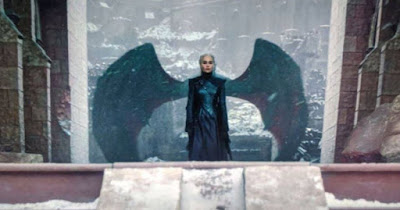
So everyone’s angry with the way Game of Thrones ended. Some people are being very rude about it. I gather someone’s started a petition to have the final season rewritten, and presumably to have watched Game of Thrones in the first place these people have to be over the age of seven. I haven’t heard for a fact that Dave Benioff and Dan Weiss have received death threats, but with all the entitlement and nerd-rage fizzing in social media right now it would be more surprising if they hadn’t.

I’m not completely happy with it myself, mind you. There are some things that I think went wrong, and I’ll get to some of those. I’m also aware that quite a few of the things I’m OK with a large number of other people aren’t, and I don’t feel like picking fights for no reason. But I feel the sweeping judgements people have made about Benioff & Weiss’s writing competence are unwarranted, especially considering how well they did for so many years before this. Also, you can’t watch anything Thrones-related on YouTube now without screeds of whinging in the comments, and it’s getting irritating.

Everybody’s saying the last season was “rushed”, and that’s true to an extent, but I don’t think it’s the root of the problem. The problem is that there’s a difference between advancing a narrative, which Benioff & Weiss have been doing solidly for years, and resolving a narrative, which they’ve just had to do without assistance from their source material. You can advance a story indefinitely given starting premises and a reasonably realistic imagination; but realism won’t resolve it for you, because reality, not being a story, never gets resolved.

Which may or may not be the underlying reason for the source material problem. It’s been eight years now since the last Song of Ice and Fire book came out, and George R. R. Martin has stopped making promises about when The Winds of Winter is due. And there’s at least one more book to come after that one. Supposedly. Apparently Martin gets a lot of personal remarks about his age and health in this context, which I think is uncalled-for. I think Martin could live to be three hundred years old, and fill a bookcase with A Song of Ice and Fire, and it would still be no nearer ending. I have seen no evidence that the writing of A Song of Ice and Fire is a process with an end-point. Seven-part stories don’t have whole new protagonists appearing and plot arcs blossoming in Part V.

I gather Martin wanted the show to run to ten seasons, and Benioff & Weiss pushed for seven, and what we ended up with – eight, with the last two shortened – was the compromise they settled on. It certainly did feel rushed, but I don’t know that lengthening seasons 7 and 8 out to ten episodes each would have fixed that. I think the series as a whole could have done with one or two less subplots; most of the Sand Snakes and Euron Greyjoy threads in particular could have been dropped without too much violence to the overarching story, and then we’d have had a bit of breathing room to resolve a few other things. (Bear in mind that Benioff & Weiss already cut a bunch of subplots out completely, to complaints from book fans.)

Now I’ll move on to the main specific complaints; some I agree with fully, some partially, some not at all. Here I really do need to cut for spoilers.

Saturday, 13 April 2019

Game of Thrones: a pre-Season 8 thoughtdump

Jon Snow

Crossposted from Dreamwidth

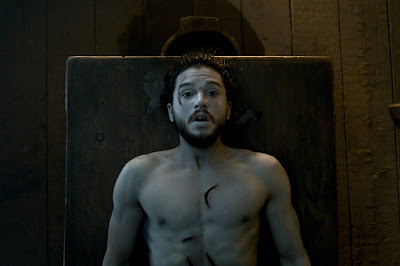
To get this out of the way first: a large proportion of my family and close friends don’t watch Game of Thrones for various reasons. I gather this makes them feel a bit left out of some online conversations, since Game of Thrones has pervaded pop culture so thoroughly by now. I can relate. When I was a kid at primary school, we were the only household that didn’t have a TV. For context, in 1980s New Zealand there were exactly two TV channels, of which only one had children’s programming; so every day, every kid in the school had seen the exact same TV the previous afternoon, which made it ideal fodder for conversation icebreakers and small-talk. Every kid, except us. At the time I blamed this fact for the social difficulties which later turned out to be autism.

...annnd I’m already getting sidetracked in the first paragraph. What I was going to say was, I know how something just being popular with other people creates social pressure, even if it’s unintended, for you to join in and pretend you enjoy it as well. And honestly Game of Thrones is not for everybody. I’m going to be talking about its merits quite a bit, so I want to be clear from the get-go that if it isn’t your thing then it isn’t your thing and that’s fine. (Though I should warn you that I’m assuming my readers are familiar with the series, so this post will be both confusing and spoilery to those who aren’t.)

Indeed, you’ll notice as we go through that I’m not doing comparisons with the books very much, and the reason for that is that the books aren’t my thing. I’ve kind of skimmed through them and occasionally browsed a page or two in bookshops, but I haven’t read them properly, and that’s because I can’t. I understand (and I’ll get into) the reasoning behind the “any character can die” dynamic, and it works onscreen for me, but on the page I don’t get the intended effect. My emotional brain basically goes “Well, if I’m going to be punished for caring about these characters then I’m not going to care about them any more.”

I’m not entirely sure what difference the transition from page to screen makes. I used to think it was because the TV characters had faces and I couldn’t help empathizing with them, but the characters on The Walking Dead have faces too and I gave up on that a couple of seasons ago because I was disengaging from the characters for much the same reason I do with the Game of Thrones books.

Ahahahaha. Yes, yes, I mean the A Song of Ice and Fire books, A Game of Thrones being the title merely of Book I (roughly equivalent to Season 1 of the show). In this instance I’ll grant the book purists the point: A Song of Ice and Fire is a much more appropriate title for the series as a whole.

Whilst most fans as far as I can tell are loving the way things have developed in the later seasons, there’s also a dissatisfied contingent who argue that the whole thing started to go downhill as soon as the showrunners got ahead of George R. R. Martin’s published material. They seem to particularly dislike the way the characters have now fallen into some pretty solid coalitions of people who mostly trust each other, leaving behind all the politicking and betrayals and whisperings and jockeying for power – the game of thrones – that characterized the earlier seasons.

Not to be overly snarky, I think these people are missing the entire point of the series from start to finish. (This is as good a point as any to cut for spoilers.)

Friday, 15 January 2016

Is there such a thing as “timeless” music?

Every New Year I go out to the Whare Flat Festival of Music and Dance, I think its current official name is, just outside of Dunedin. I think most attendees still call it the “Whare Flat Folk Festival”. It’s held at a Scout campsite and, though there are a few cabins, nearly everybody sleeps in tents. Which reminds me, I must see if I can find the receipt for the tent I bought a year ago and see if I can get the broken pole replaced.

I’m also in a small classical choir called the Southern Consort of Voices. We perform four or five concerts each year, the next one being with the New Zealand International Early Music Festival. We sing pieces from a wide range of periods, but I think if you were to tally them up over a couple of years you’d find that modern settings of sacred texts predominate. Last year we did a children’s concert, which was a surprise hit, so I’m guessing we’re going to do more, but no promises.

Once upon a time, all music was either folk or classical. Classical pieces were written in a single canonical version by a known composer, and were learned and played from printed scores; folk tunes existed in multiple related versions, their origins usually forgotten, and they were passed on from musician to musician by ear. Then sound-recording was invented, and a third division of music arose: contemporary music, in which the canonical version is the original recording.

An aside, because this is one of those little ironies that fascinate me. Photography has taken the creation of realistic visual images out of the hands of highly-trained professionals and made it something anybody can do. Sound-recording has had exactly the opposite effect on music. Once upon a time, if you wanted music you had to make it yourself, and so everybody learned to sing and whistle, if not to a high standard then at least enough to carry a tune. Nowadays most people think they “can’t sing” because they don’t sound like professionals – though of course many genuinely haven’t learned to carry a tune, because they’ve always had the radio.

Folk music does routinely get written down now, and there are a lot of well-recognised songwriters, but the basic difference in attitude persists. In classical music you’re expected to obey the composer’s instructions to the letter when playing their music. You’re allowed to deviate if you want to, but then you’re playing an “interpretation” of the piece rather than the piece itself. You so much as suggest any such pedantry among folkies, and you’ll have people muttering about “the folk police”. And of course in contemporary music, if you play another artist’s song at all then it’s not their song but your “cover” of it.

I’m a confirmed pedant myself, but I’m also a folkie, and I wondered for some time why classical musicians feel it’s so important to stick to the original composer’s instructions. Eventually, I came up with a metaphor. A classical piece is a time-portal that allows you to have a conversation (one-way, alas) with an identifiable person in another century. If you muck about with it, you’re snarling up that miraculous connection and talking over the person you should be listening to.

A folk-song, by the same analogy, is a time-tunnel, a long chain of singers and listeners stretching back into the mists of the past. That’s not something I’m making up – there are actual songs about the singers gone before us who’ll be singing once again when we sing the songs they sang. Each link in the chain is supposed to embellish the music a bit, to leave their own little mark in that long rich history.

Sunday, 9 November 2014

Why couldn’t we have had a movie about Lúthien?

I gather the Tolkien family have put their foot down and said “no” to any more Middle-Earth movies after The Hobbit is completed. I’m disappointed, but only mildly. The days are now past when any attempt to depict high fantasy on screen was bound to fail ignominiously. I don’t begrudge the Tolkiens their decision – apparently their father’s fame has been the bane of their privacy for half a century, not to mention that the movie companies have been very stingy about passing any of their profits on to his estate. And I understand completely why Peter Jackson and Weta Workshop went for The Lord of the Rings and The Hobbit first. But I think Tolkien himself was a bit embarrassed by The Hobbit. It wasn’t originally supposed to be part of the mythos at all – he just helped himself to the name of a character (Elrond) and a place (the lost city of Gondolin) to give it a bit of atmosphere, and then filled out the connections over the twelve years it took to write The Lord of the Rings. (Which then took six more years to publish. And George R. R. Martin fans complain about waiting five for A Dance with Dragons.)
Those two were the only Middle-Earth books J. R. R. Tolkien got published in his lifetime. All right, those and a small collection of verse under the title The Adventures of Tom Bombadil. His son Christopher is still, I think, collecting and transcribing the giant mass of manuscripts he left when he died, some of them going right back to his time in the trenches of World War I. The first published was The Silmarillion, a collection of the whole mythos condensed down to one chapter per story, which many people understandably find tough going. Jackson has had to stretch and pad out The Hobbit to make three movies of it; The Silmarillion would fill at least a dozen.
Of all Jackson’s padding, the single element that has raised the most fan complaints so far is the most necessary one: the invention of the female elf-ranger Tauriel among Thranduil’s people in Mirkwood. I have a sneaking suspicion Jackson is going to kill her off in the third movie. The Hobbit was a boys’ adventure story, and like many boys’ adventure stories of the time it had no female characters. The Lord of the Rings has seven named female characters, eight if you count Shelob the spider. Two, Lobelia Sackville-Baggins and Ioreth of Minas Tirith, are old-lady stereotypes. One is Rosie Cotton, who doesn’t show up until Sam Gamgee needs a happy ending. The remaining four are all idealized models of femininity – Goldberry, Arwen Evenstar, Galadriel, and Éowyn of Rohan. Goldberry, like Tom Bombadil her husband, appears only in a disconnected episode near the beginning; her character is too sketchily drawn to tell us much about her author’s values. Arwen, Galadriel, and Éowyn each warrant further investigation.

Saturday, 19 January 2013

Explaining the internet to C. S. Lewis

I always loved the Narnia series as a kid. It took a back seat when I read The Lord of the Rings, mind you, but it never fell off the bus altogether. I read the Cosmic Trilogy and the Screwtape Letters in due course. Then, as a teenager, being nerdy and a Christian, I got heavily into C. S. Lewis’s apologetic writings – I think his argument for the supernatural in Miracles (the relevant chapter is reproduced here, and I’ll deal with it in depth in an Imponderable some time) may have delayed my atheism by about five years. Lewis became one of my heroes, and I strove to emulate him. Various people have been kind enough, through the years, to praise my writing for its clarity; they have Lewis to thank.
During that time, I got into the habit of having imaginary conversations with C. S. Lewis. This isn’t so unusual. I tend to have imaginary conversations a lot with Richard Dawkins or Steven Pinker or whoever I’ve been reading lately (though mainly only non-fiction; I don’t do this with Terry Pratchett). But I read so much Lewis that it became ingrained. When I became an atheist, the conversations became distinctly more adversarial, but they continued.

Monday, 17 December 2012

Book to film

I confess. I caved. I went in to find out how long The Hobbit was sold out for, and it wasn’t. J. R. R. Tolkien was such a big part of my childhood that I’m afraid my disgust at the union-busting tactics Peter Jackson and the John Key government used him as an excuse for, didn’t beat my deep need to see more of Middle-Earth onscreen. My only (poor) defence is that I do want to support a New Zealand industry that doesn’t involve digging big holes in the wild country or fouling the rivers with excrement. However, I began writing this post before all that, and so this isn’t a post about The Hobbit, it’s a post about the Lord of the Rings movies. I’ll be able to judge The Hobbit properly when the new trilogy is complete.