Showing posts with label sex. Show all posts

Saturday, 13 April 2019

Game of Thrones: a pre-Season 8 thoughtdump

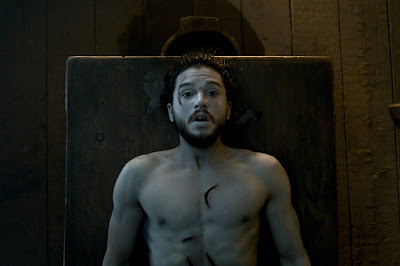
Jon Snow

Crossposted from Dreamwidth

To get this out of the way first: a large proportion of my family and close friends don’t watch Game of Thrones for various reasons. I gather this makes them feel a bit left out of some online conversations, since Game of Thrones has pervaded pop culture so thoroughly by now. I can relate. When I was a kid at primary school, we were the only household that didn’t have a TV. For context, in 1980s New Zealand there were exactly two TV channels, of which only one had children’s programming; so every day, every kid in the school had seen the exact same TV the previous afternoon, which made it ideal fodder for conversation icebreakers and small-talk. Every kid, except us. At the time I blamed this fact for the social difficulties which later turned out to be autism.

...annnd I’m already getting sidetracked in the first paragraph. What I was going to say was, I know how something just being popular with other people creates social pressure, even if it’s unintended, for you to join in and pretend you enjoy it as well. And honestly Game of Thrones is not for everybody. I’m going to be talking about its merits quite a bit, so I want to be clear from the get-go that if it isn’t your thing then it isn’t your thing and that’s fine. (Though I should warn you that I’m assuming my readers are familiar with the series, so this post will be both confusing and spoilery to those who aren’t.)

Indeed, you’ll notice as we go through that I’m not doing comparisons with the books very much, and the reason for that is that the books aren’t my thing. I’ve kind of skimmed through them and occasionally browsed a page or two in bookshops, but I haven’t read them properly, and that’s because I can’t. I understand (and I’ll get into) the reasoning behind the “any character can die” dynamic, and it works onscreen for me, but on the page I don’t get the intended effect. My emotional brain basically goes “Well, if I’m going to be punished for caring about these characters then I’m not going to care about them any more.”

I’m not entirely sure what difference the transition from page to screen makes. I used to think it was because the TV characters had faces and I couldn’t help empathizing with them, but the characters on The Walking Dead have faces too and I gave up on that a couple of seasons ago because I was disengaging from the characters for much the same reason I do with the Game of Thrones books.

Ahahahaha. Yes, yes, I mean the A Song of Ice and Fire books, A Game of Thrones being the title merely of Book I (roughly equivalent to Season 1 of the show). In this instance I’ll grant the book purists the point: A Song of Ice and Fire is a much more appropriate title for the series as a whole.

Whilst most fans as far as I can tell are loving the way things have developed in the later seasons, there’s also a dissatisfied contingent who argue that the whole thing started to go downhill as soon as the showrunners got ahead of George R. R. Martin’s published material. They seem to particularly dislike the way the characters have now fallen into some pretty solid coalitions of people who mostly trust each other, leaving behind all the politicking and betrayals and whisperings and jockeying for power – the game of thrones – that characterized the earlier seasons.

Not to be overly snarky, I think these people are missing the entire point of the series from start to finish. (This is as good a point as any to cut for spoilers.)

Wednesday, 13 February 2019

Did I always know I was bisexual?

I am bisexual
Reposted from my Dreamwidth blog

How long have I known I’m bisexual? A simple question with no simple answer. Someone passed a meme around on Facebook last week saying “It’s fine if you haven’t always known,” which prompted me to reflect.

I have accepted it for seven or eight years, I suppose. But was it a matter of learning something about myself I didn’t previously know? Or was it just that I started to be honest with myself about something I’d always known? Neither of those sits quite right with my memory.

I didn’t come out to anyone but my partner for several years after this realization. Even now, although I openly identify as bisexual online, you wouldn’t guess it from my life in physical space. Primarily, of course, my partner and I were and are in an exclusive relationship and already had been for years before, so I’m not seeking romantic or sexual partners of any gender and have no intention of doing so.

(This is something people sometimes misunderstand, so in case this concept is new to you: no, that doesn’t mean I’m not really bisexual or that I’ve “chosen a side”. I’ve chosen a person.)

But it took years for me to summon up the courage to come out at all, even online. I’ve never taken part in any Pride event, publicly or otherwise, nor any other LGBT-related social activity. Last year a friend invited me to a “coming out stories” session as part of a campus LGBT awareness week; I chickened out.

I grew up Evangelical, which in New Zealand isn’t quite as tightly bound to conservative politics as it is in the US, but on some issues there is definitely a Godly side and a Satanic side, and at least back in the ’80s and ’90s sexual orientation was one of those issues. Meanwhile in the secular culture which I encountered at school, to be gay was the very depth of loserdom, the nadir towards which lesser losers such as geeks and nerds and the arty-farty were presumed to be drawn.

Once I entered an environment where I had to justify moral positions with reasoning, I quickly accepted (intellectually) that there was no justification for opposing same-sex relationships. With a personal history shaped by Evangelicalism and Kiwi-bloke toxic masculinity, however, my emotional reactions took over a decade to catch up – and indeed, acknowledging my own bisexuality was a late stage in that very process.

Nowadays my only contact with the Evangelical community is through my family and some old friends, and if they’re any indication then the norm seems to be shifting. But that’s only a few people, and those few might just as easily be drifting away from the norm as drifting along with it.

Anyway, my single biggest reason for delaying coming out publicly was that I felt a bit presumptuous suddenly identifying as a member of a community which I knew very little about and had a history of being uncomfortable with.

There existed in my teenage years a movement which called itself “Gay” and “Queer” – yes, “Queer” – with its own symbols and aesthetics and its proprietary words, including “bisexual”. This movement seemed entirely alien to everything that was familiar to me, and of course both sides of my cultural background actively encouraged that alienation. I didn’t see any connection between the rainbow flags and the pink triangles and the fishnets and sequins, on the one hand, and my own developing sexuality on the other.

Thursday, 27 December 2018

The imminent and well-deserved demise of Tumblr

Truth Coming Out Of Her Well to Shame Mankind

On 3 December Tumblr announced it was getting rid of adult content, starting in two weeks from the announcement. Tumblr management has never been competent at the best of times, but this takes the cake. This will kill the site.

Those of you who don’t have Tumblr accounts will scarcely imagine what a dumpster-fire this is. Just to start with, the main draw of Tumblr was that it was the one social media site that allowed adult content. What Tumblr has just done is basically what I’ve seen a couple of local hospitality businesses do – a pub on the Otago University campus years ago, and a café in Port Chalmers more recently. Both had quirky art-work that gave them an alternative vibe; both were bought by new owners who removed the quirky art-work and tried to rebrand them as bland mainstream venues; both promptly went out of business. The campus pub was eventually revived by a competent proprietor; the Port café is currently sitting empty, a monument to the folly of erasing a successful enterprise’s main point of distinctiveness. The same fate awaits Tumblr.

I was on Tumblr for nearly two years. My original hope, when I joined, was to spread this blog a little further, since after six years I have exactly two followers here. This was not to be, because Tumblr’s search software passes over posts that contain links to other sites – far from the only way in which Tumblr fails its users – which meant that the links to this blog were only seen by those few of my followers who happened to be online at the moment I posted the links. Additionally, I gained Tumblr followers relatively slowly; I think my peak following, after two years, was 182 including spambots. I think this may have been because I declared on my blog header that I was a nudist but didn’t intend to post any nude photos, which lost me both the people who think nudism is skeevy and the people who want to see nude photos. But I can’t be sure.

(Tumblr advertises itself as being good for artists. How are they any good for artists if they make posts with external links non-searchable, you might wonder, so that artists can either get their art seen or link to places where people can pay them for it, but not both? Well, they aren’t, that’s how. And yet, so many of us put up with them, until now.)

The announcement came in the form of an official letter from the Tumblr staff account, which I would go through and point out all the lies except that it’s all lies. The new guidelines ban, and I quote, “images, videos, or GIFs that show real-life human genitals or female-presenting nipples,” in case you were wondering why the phrase “female-presenting nipples” became a commonly repeated joke in early December. So Tumblr is apparently enlightened enough to talk in terms of gender “presentation”, and yet reactionary enough to frame femaleness as inherently more sexual than maleness. Remember, this is not an old policy. This is a policy devised in 2018 by the curators of one of the internet’s biggest platforms for feminist and LGBT content.

Most of us first knew something was going wrong on 16 November, when the Tumblr app disappeared from Apple’s App Store. For those like me who used Tumblr on our computers rather than on mobile, the first sign was when Tumblr responded by suddenly making huge numbers of posts non-searchable, based on their tags – not just things like #NSFW and #nudity but hundreds more, some quite inexplicable. I never did find out why we suddenly couldn’t search for #chronic pain. Meanwhile, posts tagged with things like #white supremacy and #white genocide continued to pop up in search results.

Our first thought was that this was a ham-fisted attempt to deal with the exponentially-increasing nuisance of pornographic spambots. Any post on any subject at all whose count of responses reached five digits would suddenly start getting reblogged by porn-themed accounts with generic comments like “Cool, see my site here.” You could report and block, report and block, report and block, and new bots would keep on coming. They weren’t intended to attract the eyes of the bloggers they were harassing, but to piggyback off them to hoist their coders’ porn sites up the Google search rankings. You see, the way Tumblr works, if you reblog a post and add a caption, then there is now a link to your blog from every other blog that has also reblogged that post. If thousands of people have reblogged it then that’s thousands of links, all from legitimate content-bearing webpages that real people read, and that’s what Google’s search algorithms look for. So our first response was: well, yay that the staff are doing something about this at last, but they need to get a lot smarter about it, please.

Of course we were quite mistaken to think Tumblr management had suddenly started caring about their users’ experience of the site. The pornbot coders wised up within a week or two and reprogrammed their bots to use the tag #SFW and no unsearchable tags, which it turned out was all it took to get past the algorithms. Those of us who conscientiously tagged Pre-Raphaelite paintings as #nudity (so people could filter them out on their work computer just in case their boss looking over their shoulder got the wrong idea) continued to be punished for our honesty.

The next hypothesis was that it was about the child porn, and that does seem to be what sparked Apple’s ire. Tumblr’s strategy for dealing with paedophiles was exactly the same as their strategy for dealing with Nazis, to wit “have a Block function and let the users do all the work”. I’m glad to say I never saw any myself, but many other users had been making complaints to the staff about the problem for years, with the same results as every other complaint to the staff. Getting dropped from the App Store, now that was something they cared about.

But while the App Store incident undoubtedly fast-tracked the adult content ban, the truth is it had been coming for months. Like many other social media platforms, Tumblr’s business plan is to hire out their users’ eyeballs to advertisers. They evidently noticed that their site was getting popular with the social justice crowd and in particular the Black Lives Matter movement, and they apparently had a big plan in the works to capitalize on that. And many advertisers baulk at the idea of people seeing their ads right next to GIFs of sex acts. So the nudity had to go. We used to think that if Tumblr had just one virtue, it was that they understood that not all nudity is sexual and not everything sexual is degrading; now it turns out they just didn’t care about being degrading until there was money in it.

On top of all that, there’s a draconian piece of legislation coming into force in the United States next year called SESTA/FOSTA – I can’t be bothered looking up the acronyms but the ST in both halves stands for “sex trafficking”. Nobody with any human decency could oppose stopping sex trafficking, which makes it the perfect pretext for interest groups pushing less creditable agendas. Under the new law, social media hosts based in the US will be liable for allowing sexual solicitation on their sites, even unknowingly, even if it’s just one ad. This is why Facebook, from next month on, is going to start cracking down on anything that could remotely be interpreted as a sexual invitation, up to and including posts consisting of “looking for a good time tonight ;)”. This legislation will incidentally stifle discussion of sexuality or sexual orientation in social media; I’m pretty sure that’s a plus as far as its originators are concerned, but it might come as an unpleasant surprise for some of its more liberal supporters.

How deleting Facebook posts saying “looking for a good time tonight ;)” will contribute to stopping sex trafficking is: it won’t. But at least Facebook understands that you need human intervention to make this sort of thing work. Tumblr think they’re going to accomplish it with software, and indeed with ludicrously simplistic software. They’ve promised that nude paintings and breastfeeding photos and news articles about nude protests will be safe once they get their programs properly trained, but the algorithm they’re using could not possibly make such fine distinctions even if you trained them on all the data on the internet for a thousand years. You may have seen funny Facebook posts about the photo-captioning AI, trained on pictures of fields of sheep, that tagged all fields as “sheep” and failed to recognise sheep in any other context. It’s the same algorithm.


Nude images follow.
Friday, 1 June 2018

Against enforced monogamy

The issue of sexual violence has never gone away. The #metoo movement is just one more response to it, though so far one that’s been getting more notice than many. In the last, I don’t know, month or so, the media at large has at last started to notice the well-established connection between misogynistic violence and mass shootings, and the word “incel” – involuntarily celibate – has achieved a greater currency than it had before. I gather “incel” was first coined to describe the experience of being queer and unable to find someone of the gender you like who likes people of your gender, but it has now unfortunately been very firmly appropriated as a self-identifier for that subset of men who (a) aren’t getting sex and (b) believe they are owed sex. And this of course has led to suggestions that maybe mass shootings would be averted if more women would “take one for the team” and have sex with incels. Because, apparently, some people aren’t content with being horrible human beings in the privacy of their own homes.

I have seen it claimed, mind you, that incels aren’t real because it’s not actually hard to find someone to have sex with and these men must be just being needlessly picky (or obsessive) about their choice of partner. I can’t hold with this. For some people it may be easy to find people to have sex with, but there are many circumstances which make it difficult for others. One, as already noted, is being the only queer person in your offline circle. Various disabilities – physical and social – have similar effects. It’s not the not getting sex that makes incels horrible people, it’s the belief that they are owed it. Men who believe they’re owed sex are horrible people whether or not they’re getting it, which brings this digression nicely back to the point.

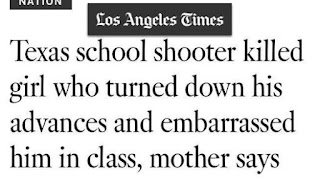
A couple of weeks ago a guy walked into Santa Fe High School in Texas and shot people, killing ten of them. Following an excellent suggestion that’s been passed around Twitter and Tumblr, I’m going to refer to the perpetrator as “Shooter #101” (this was the 101st mass shooting in the United States this year). The mother of one of the dead, Shana Fisher, has claimed that her daughter was repeatedly harassed by Shooter #101 for a date and ultimately turned him down publicly in front of the school, and that she was the first person he shot. Several articles on the incident have used this for a lede. Apparently it hasn’t been corroborated by witnesses – which is bad enough, but I’ve worked in journalism in a very small way, I can understand going ahead with the article on the assumption that the mother knew what she was talking about. What’s not forgivable is that this was how they framed this element of the case:

Spurned advances from [Shooter #101] provoked Texas shooting, says mother of girl killed (NZ Herald)Texas school shooter killed girl who turned down his advances and embarrassed him in class, mother says (LA Times)

And these are far from the worst. You see the narrative being put forward here? Men (overwhelmingly) do the shooting, but never fear, we can always find a way that it’s ultimately a woman’s fault. Women are put on earth to meet men’s needs, and men go astray when women fail to fulfill that function. Men’s sexual and romantic yearnings give them a proprietary right over women’s bodies, attention, and time. Most commentators would recoil from this position if it were stated openly; the danger of framing male violence as the headlines above do is precisely that this narrative sneaks under the radar as a tacit premise instead of being exposed to challenge as an explicit proposition. To men who do believe that women owe them sex, this subtextual confirmation helps that belief fit just that little bit more comfortably into their picture of the world.

Monday, 8 January 2018

I support Madeline Anello-Kitzmiller

There’s a news video from New Zealand going round the world at the moment. It was taken by a casual attendee at the Rhythm & Vines Festival in Gisborne for the New Year. Two women, one of them topless, are walking through a casual crowd; a man watches them pass, then sneaks up behind the topless woman, gropes her, and runs away. Both women turn around, walk over to the man, and hit him. The women are Madeline Anello-Kitzmiller and her friend Kiri-Ann Hatfield. The man who assaulted Anello-Kitzmiller hasn’t been named.

Why am I just telling you what happens in this video, instead of showing you? Because I wanted to show you Anello-Kitzmiller’s statement on the incident instead. I’ve never previously seen the ethical core of naturism and body-positive feminism stated so comprehensively and so succinctly.

...I would like to point out that I had that body art done at the festival. There was actually a stall selling the “glitter tits” get-up, and I paid to have it done, as well as many other girls I saw walking around with it. In addition to that, the waterslide at R&V was handing out $50 to the first man and woman to go down the slide naked, and another $50 to the next man and woman. I saw plenty of naked men that day getting absolutely no harassment for revealing themselves. There were naked men in the mosh; my best friends got naked and ran through the crowds; I saw plenty of guys walking around with no shirt on and a handful of girls as well.

So I want to ask you, what is the difference? Both men and women have nipples, although men’s nipples are seemingly useless and my breasts are there to feed children, should I ever choose to have them some day. The difference is that women have been over-sexualized for way too long and it needs to stop. I wanted to share my body because I think it’s an important step to normalizing the naked body and desexualizing [it]. The more often people see nudity, the more they realize... that it’s nothing to gape over. Nudity at festivals helps erase pornstar ideals of what our bodies “should” look like. My breasts are not sex toys. They are not an invitation. My body is beautiful, and no matter who says otherwise, it cannot and will not demean my own self-worth. Nor should it for anybody else.

I’ve been accused of “trying to turn New Zealand into America” in a few comments. This is a narrow-minded accusation. Besides, the similarities are there regardless. The amount of naked people running around at Splore in New Zealand would be severely overwhelming for those of you who couldn’t handle a few bouncy “glitter tits” at R&V. I will say that the majority of New Zealand has seemed to be more conservative than Portland, Oregon, but sexual harassment happens everywhere, all over the world. I have never experienced so much hostility at a festival before, but I don’t doubt that there are festivals in the States where the crowd is also less free-spirited than others.

I have been accused of “asking for it” too many times to count. It’s disappointing that people really believe that what you’re wearing has any connection to what you actually want. Comments stating that I was “asking for it” or that I “had it coming” are promoting rape culture. When you say something like that, you are justifying that man’s actions when he violated my rights to my own body, and you are telling other like-minded people that, should they ever want to sexually assault or rape another human being, it’s OK. It is never OK and we are never “asking for it”.

...The cool thing about being able to get naked at festivals and like-minded events is that you don’t have to get naked if you don’t want to. Do what you’re comfortable with and only do what makes you happy. I personally love being naked because it made me realize that I am indomitable. Nothing anybody says about me or my body could ever wound me. At Rhythm & Vines both men and women came up to me and told me that I was disgusting, that I should cover up, that I [should be] ashamed, that I was a slut, but I kept my top off all night and I danced until 6am and I had the best time of my life regardless.

On “trying to turn New Zealand into America”, I’m surprised that such an accusation was ever made, because I was under the impression that it was more the other way around. It’s American censoriousness in particular that nudists tend to blame for the restrictive nudity rules on social media platforms like Facebook and Instagram. The recent movement to banish breastfeeding from public spaces – a bizarre bit of prudery unheard-of even in Victorian times – is as far as I can tell very largely American, and doesn’t seem to have taken hold here. I think the truth is that the United States contains both the most and the least nudity-friendly places in the English-speaking world; Portland, Oregon, is evidently among the former.

[EDIT: A Tumblr mutual informs me that the last part of that sentence is sadly not true. However, the United States does contain San Francisco, where public nudity was temporarily legal, and Brattleboro, Vermont, where it still is. Also, I’m ashamed to report that my attention has been drawn to a recent incident in Auckland where a woman was evicted from a bus after a fellow passenger took offence at her breastfeeding. I still think this is far from the norm in New Zealand, but I can’t in all honesty maintain that it “hasn’t taken hold.”]

While New Zealand sadly doesn’t attain Brattleboro standards of body acceptance, our nudity taboo is far from absolute. My town hosts a nude rugby match most years, though they’re not doing it this year; the Kawarau Gorge bungy-jumping station used to let people jump naked for free until they found they were losing too much money; and the whole country had a “National Nude Day” (mostly pubs offering specials to naked customers) for a few years about a decade ago. I used to belong to a group that went walking nude in the bush around Dunedin, and most people we met responded positively. And, as Anello-Kitzmiller points out, nudity is at least tolerated at many New Zealand summer festivals – a tradition going back to Nambassa in the 1970s – and was specifically encouraged at Rhythm & Vines. Which means that everyone who’s commented to say her toplessness was “inappropriate” is simply wrong.

That is, however, a minor error compared to the premise that, if her nudity had been inappropriate, then it would have been OK for the man who harassed her to do what he did. Of course, personally I think that nudity ought to be acceptable everywhere it’s physically safe. But even given that we can’t snap our fingers and wish for society to outgrow all its repressive norms overnight, there is no way sexual harassment is an allowable means of enforcing those norms. If female toplessness had been banned at Rhythm & Vines, then the proper response would have been for a security team member to bring her a towel or spare shirt and explain their standards. The assailant would still be no more justified in his actions than a truck driver is justified in killing cyclists who stray into the wrong lane.

The other argument is of course that old chestnut “He’s a man, he couldn’t help himself.” There were half a dozen other men in that video and they somehow managed to help themselves (although they didn’t help Anello-Kitzmiller by doing anything like intervening). And it wasn’t as if he took one look at her breasts and zoned out or something; he waited until she had gone past and then made his move. The assault was a deliberate choice on his part. If he had genuinely been unable to help himself, then he should have been under restraint or at the very least in the care of a minder. Since he was able to help himself, deterrent action such as Anello-Kitzmiller and Hatfield took was the appropriate response.

Frankly, I think “He couldn’t help himself” and “Her nudity was inappropriate” are both smoke-screens for our society’s ugly underlying attitude. Both are nonsensical on the face of it, but both make sense if you make one abhorrent ethical assumption: “Men may act on any sexual impulse they feel towards women.” Then everything falls into place. Skimpy clothing becomes inappropriate anywhere sexual activity is inappropriate. The assailant couldn’t help how he felt about Anello-Kitzmiller’s breasts.

And no, you can’t take gender out of it by restating that as “People may act on any sexual impulse they feel towards anybody.” Our society does not condone women acting sexually, nor men acting sexually towards men. Accordingly, men are granted much broader freedom with our bodies in casual contexts like music festivals. The festival I go to at New Year’s doesn’t encourage nudity, yet there were plenty of men going shirtless in the heat this year. If I, a bisexual man, had sneaked up behind one of them and groped him, and he’d (rightly) hit me, how many people do you think would have defended my actions on the basis that he was “asking for it”?

(In case you’re wondering why I, a nudist, go to a New Year’s festival that doesn’t allow nudity, it’s partly a shortage of options down this end of the country but mainly about the music. I love traditional folk music and I have bigger autistic sensory issues with loud thumpy contemporary music than I do with clothing even in the summer heat. And I wear a kilt, which helps. And for the hottest days there’s a small swimming-hole upstream of the main one where hardly anyone goes.)

The same assumption again must be behind the frequent rejoinder: “Men are turned on by breasts. How do you intend to change that?” There’s no need to change men’s feelings. What needs to change is how men consider themselves entitled to act on their feelings. Suppose you’re hungry in the supermarket – I’ve used this analogy before – and you walk past a big bulk bin full of chocolate chips or something. Do you dig your hand in and grab? Not if you’re over the age of about four. Do you stand there staring and drooling? Not if you have any self-control at all. And chocolate doesn’t even have human rights. The problem is not that men think breasts are nice; the problem is that men think breasts are permission.

Which gives us good grounds for hope that men can change. Men do seem to have evolved to like the look of breasts – I’m afraid there’s not much evidence for the idea that this response is created by society or culture. But society and culture do determine what constitutes an acceptable or an unacceptable way to behave. Our culture needs to change, and it can change if we put in the work. I salute Madeline Anello-Kitzmiller for her contribution to that work, both by displaying her body and by penalizing that man for disrespecting it. Whether you join her in the former effort can only be your own personal choice; but we all need to contribute to the latter. Let’s build a zero-tolerance policy for sexual assault and harassment at every level of society we can influence, starting now.

Friday, 19 May 2017

Nudity: ethics and etiquette

In March I went with a local naturist group on an overnight retreat to Quarantine Island, in the middle of Otago Harbour. True to Dunedin’s weather – or maybe my life, I’m not sure – it was cloudy and cold all weekend and it was only comfortable to get naked in the lodge in the evening with the fire going. After we’d come home it was sunny every day for a week, of course.

I am a naturist, or nudist to use the more common word. I have two main reasons for this, both of them about equally important in my own life. One is purely personal. Presumably because I’m on the autistic spectrum, I suffer from a mild hyperaesthesia which makes clothes slightly but permanently uncomfortable. I’m told other people stop feeling their clothes after wearing them for a while; I don’t. Shoes in particular – conditions underfoot have to be very unpleasant indeed before it’s worse than squelching around in my own sweat, so I don’t wear shoes much. But there are no such things as comfortable clothes, not for me.

The other reason is ethical. A human body is a human being and vice versa. Everyone has one; indeed, everyone is one. It isn’t good for people to revile themselves as obscenities, and it’s worse to enforce that revulsion with the power of the state. And it’s dehumanizing to treat another person as an object for the purpose of sexual gratification. Human beings have the moral right to be treated as human beings regardless of what they wear, including if it’s nothing at all – which means not being arrested, fined, locked up, or subjected to any other legal penalty, if they’re not hurting anyone. In short, public nudity morally ought to be both legal and acceptable.

The word “naturism” obviously implies that the value of nudity lies in its naturalness, which is problematic in several different ways. Not all natural things are good, so being natural doesn’t automatically make nudity good. Also, it is arguably natural for humans to adorn themselves, since every culture does it. Naturists shave, style their hair, and wear jewellery, tattoos and piercings just like clothed people. But “naturism” is the name of the movement now, and there’s no point complaining about it. “Nudism” is a broader word; anyone who chooses not to wear clothes can call themselves a “nudist”, whereas to be a “naturist” implies alignment with the naturist ethos. Back in the early 2000s an Altavista search for naturis* would mostly filter out the voyeur sites that nudis* tended to dredge up, and that may have helped the spread of the term. Unfortunately the porn peddlers have gotten wise to this now.

Naturism is one of the more marginalized alternative lifestyles out there. Unlike those “lifestyles” which consist of opting out of various public health measures (like vaccines or water fluoridation), it doesn’t cause actual harm; yet it’s illegal to practise it in public almost everywhere in the world. I suppose we can at least be naturists in our own homes without police harassment, which makes us more fortunate than pot-smokers. On the other hand, there’s less restrictions on sharing pictures of pot-smoking than on sharing pictures of nudity. And ours is surely, bar none, the one lifestyle that is most sexualized by outsiders.

What does “sexualization” mean, and what’s wrong with it? I’m tempted to say “Ask any woman,” and leave it at that. I’ve seen confusion about this in other contexts as well. Does it make sense, for instance, to ask casual bloggers not to “sexualize” particular sexual orientations? Bisexuality is sexual, isn’t it? It’s right there in the name! How can you help “sexualizing” it if it’s already sexual? The answer is that “sexualizing” something doesn’t mean connecting it to sex as a topic; it means making it sexy (or trying to), which is not the same thing at all.

A medical lecture on the physiology of fertilization in humans will discuss sex in some detail, which makes it “sexual” in a reasonable, if technical, sense of the word. But it isn’t remotely sexy – trust me on this. That’s not sexualization. Conversely, I’m sure you’ve seen advertisements that associate all kinds of completely non-sexual things with revealingly-clad yet concealingly-posed women looking suggestively at the camera. I used to regularly walk past a local fish-shop van (I haven’t seen it in a few months now and I’m not inquiring after it) which was adorned with a head-and-shoulders photo of a young woman, apparently topless, caressing a dead fish whilst assuming what was admittedly a more successful attempt at a come-hither expression than I would have been able to muster in her position. That’s sexualization.

Now the foundation of the naturist platform is the proposition that nudity can, and should, be desexualized. I’ve seen a few blogs now – pretty much all on Tumblr, for some reason – claiming that naturist environments feature unrestrained public sex. If you find one of these, you should know it’s lying to you. It’s somebody’s sexual fantasy. There’s nothing wrong with having sexual fantasies, but there’s everything wrong with slandering a worldwide category of people in the course of expressing them. Again, ask any woman.

Tuesday, 14 March 2017

Why abortion isn’t murder

A fertility clinic is on fire. In the storage area at the back of the building there’s a portable freezer unit containing 100 live human embryos. In the reception lounge at the front, trapped under a chair, there’s a screaming three-year-old child. You can save one, but as soon as you open the door and let in the oxygen the fire will take the building. Which one do you save?

You see where I’m going here, right? This sort of question is bread and butter for moral philosophers: think of a scenario where the answer is obvious, then extrapolate principles that can be applied to situations where the answer isn’t obvious. Most people choose to save the child. From this it must follow that they don’t value an embryo’s life the same as a child’s, or even at one-hundredth the price.

Try asking a pro-lifer this question and see how they respond. I’ll tell you how they don’t respond, or at least haven’t lately in my many arguments with them since joining Tumblr: they don’t answer “I would save the embryos, of course. It’s very sad about the one child in the reception lounge, but it would be immeasurably sadder to lose all the children in the freezer.” Instead the answer you repeatedly get is “I would probably save the one child, but that’s an emotional response and doesn’t have anything to do with right and wrong.” And you have to prod them to get even that much. Generally they evade the question until you’ve asked it three or four times.

First off, if morality isn’t about emotions, what is it about? Most moral philosophers will tell you that morality isn’t objective, because you can’t get from an “is” statement like (in this instance) “A child is in danger” to a “should” statement like “I should save the child” except by calling in another “should” statement like “One should always protect children”, and if you try and prove that second “should” statement you just go around the circle again, and so on forever. Without rational proofs or empirical backing, all you have to call on is your moral instincts. And here they’re pretty clear.

Pro-lifers, as a rule, seldom get their morality from philosophers, but they are disproportionately likely to pay at least lip service to a certain 1st-century populist rabbi who will be found to have said (following Rabbi Hillel) that morality is an expression of love and consists of doing for other people what you would want for yourself, and obviously love and empathy are both subjective emotional states. But religion doesn’t break the circle; “You should do what God says” is just another “should”.

Personally I think the philosophers are overly pessimistic. A “should” statement can, in fact, be objectively true if it rests on an “I want” statement; if I want functional teeth then I should cut back on sugar, if I want to sleep tonight then I should get off the internet. (To use more technical language, “should” statements may have no truth-value, but they do have utility-value.) Might there be some “should” statement that applies to any possible “I want”?

Well, if we’re really pedantic about what counts as “possible”, then no there won’t be, because for any “should”, someone can always say “I want to do the opposite of that.” But there are some “should”s that at least apply to any plausible “I want”, and one of them is “You should not destroy anything you might need”, and one thing you can count on always needing is other people’s trust. And it just so happens that our moral instincts evolved to allow us to trust one another. I have made a longer, but not necessarily clearer, case for trust-based morality here.

Now if you want to earn people’s trust, you can’t weigh every decision separately according to how much it’ll make them trust you, because then they have to worry that one day your calculations might tell you to harm them. You have to behave in a way that allows them to predict you won’t do that. Your actions must not only be benevolent, but clearly and consistently benevolent. For an individual, that means practising virtues – kindness, fairness, courtesy, charity, patience, and so on. For an institution or a society, it means treating people according to a consistent code of rights. And this is where we can start to buckle down to the abortion problem, because here it seems that one person’s right to life conflicts with another person’s right to bodily autonomy. It’s conflicts like this that send us looking for a deeper principle that can resolve them, and I say that principle is trust.

The pro-life position is that abortion is murder. Murder is the breach of the human right to life, and I do hope I don’t need to explain how that might erode trust between people. Two questions arise here. First, who or what has the right to life, and who or what does not? Where do you draw the boundary? And second, if you have to choose between one person’s right to life and another’s right to bodily autonomy, which one should win? Always life, always bodily autonomy, or sometimes one and sometimes the other?

Sunday, 2 October 2016

Why women are better than men

Once upon a time, people say, you could tell the plain truth about things and be admired for it. Now they make you shut up and call you, as it might be, racist, sexist, or homophobic. I’ve had my quarrels with these people before and I expect I will again. But today I share their experience. I have a truth to tell which will offend people because it upsets the illusion that we are all equal. Here it is:

Women are better than men.

This is not hyperbole, rhetorical or otherwise. Nor is it a joke, though I confess myself slightly amused to imagine the offended huffing and puffing it will cause among some who pride themselves on being immune to offended huffing and puffing. It is, I admit, a generalization; but it is, I insist, a valid generalization.

Consider, as a parallel, the statement “Women are shorter than men.” That’s a generalization, but a valid one. It doesn’t mean that women can walk upright under toilet stall doors while men frequently get their hair tangled in power lines. It doesn’t even mean that the tallest woman is shorter than the shortest man. You can’t falsify it by picking Gwendoline Christie as your exemplar of women and Peter Dinklage as your exemplar of men. No-one denies that the distributions overlap – that many men are shorter than many women. But you still know perfectly well that women, in general, are shorter than men, in general.

Likewise, I’m not claiming that all women are saints and all men are serial killers. I’m not claiming that the worst woman in the world is better than the best man. I am claiming that women, in general, are of better moral character than men, in general. This claim being a generalization, you can’t falsify it by picking, say, Ann Coulter as your woman versus William Kamkwamba as your man. And in case you didn’t believe me the first time, this is neither a hyperbole nor a joke. So you’re going to want some evidence, aren’t you?

Sunday, 1 May 2016

How should men respond to #freethenipple?

The #freethenipple movement is morally correct. Nipples harm no-one; therefore, it is censorious to ban them from public view, and unjust to discriminate by gender while doing so. I frankly don’t see much room for controversy here. Nevertheless, the issue is controversial. Many Western states have laws against toplessness. New Zealand is one that doesn’t, but we do have vaguely-worded offences like “breach of peace” and “offensive behaviour” to allow the police to enforce conservative norms without having to admit that that’s what they’re doing. I believe there is legal precedent here for topless protests being protected self-expression under the Bill of Rights Act, but I’m not a lawyer and you shouldn’t rely on my vague recollections in court.

So why haven’t I said anything about it before? It’s a feminist issue, and I have a lot to say about feminist issues. And it’s a body freedom issue and I have strong views on body freedom. Why have I kept all quiet about it? Well, because of the feminist thing. I’m male, and attracted (mainly but not exclusively) to women. There is a sarcastic hashtag #malefeminists for guys who try to dominate feminist spaces, and especially for guys who are enthusiastic about liberating women from their clothes and sexual inhibitions. It is not my business in the first place to tell women how to emancipate themselves, and on the specific topic of sexual liberation I have a conflict of interest. What I can do, what men who align with feminism need to do, is try and communicate feminist values to other men.

The basic principle here is: women are human beings and deserve the respect and consideration due to human beings, regardless of what they’re wearing. I don’t see that there are any limits on this principle in either direction. A naked woman is a human being, and a woman in a burqa is a human being, and if you meet either one in the street you should treat her exactly the same as if she were wearing jogging gear, smart casual attire, or a work uniform. Male responses to topless demonstrations tend to fall short of this ideal in one of two ways, both seen in the video above. One is to perve; the other is to try and make the women cover up. Let’s go through the justificatory arguments in turn.

With perving, of course, the argument we have to deal with is generally a post hoc rationalization. “If she didn’t want to be perved at,” men say, “she wouldn’t draw attention to herself like that.” If you see a woman in a clown suit, it’s OK to laugh at her, right? That’s what the clown suit is for, isn’t it? And if you see a woman in a ballet tutu, it’s OK to watch her dance, isn’t it? In each case the costume is intended to draw that reaction. On that basis, can’t we consider toplessness to be a costume intended to draw sexual attention?

Think again. Suppose the clown or ballerina is not performing on a stage, but waiting in front of you in the queue at the convenience store. Then it’s not polite to laugh or stare – the wise presumption is that she’s grabbing a bite to eat between performances and hasn’t had time to change. It’s not the costume that counts, it’s the performance. A woman dancing topless in a burlesque show can be presumed to be presenting her body for visual appreciation; a woman relaxing topless in a public park cannot.

To be sure, the Outdoor Co-ed Topless Pulp Fiction Appreciation Society are there to send a message as well as to enjoy the spring air. The shock value and clickbait appeal of breasts can draw the attention of passers-by, media, and the internet to one’s cause. If a protester lifts up her T-shirt for the news cameras to reveal the words No to the TPPA (as it might be) painted across her torso, it’s reasonable to assume that’s her intention. The obvious response – obvious unless you’re just waiting for the first excuse to ogle or grope – is to attend to the message she’s trying to convey. Especially if that message is Still Not “Asking For It”.

Such protests help falsify what’s often the first objection raised by those who want to make women cover up, namely that women are actually perfectly fine with having to cover up and #freethenipple is all a fantasy of a bunch of #malefeminists. I once overheard a woman remark very loudly to her companion (it was a windy day and they were walking right behind me) that she welcomed the prospect of a Hooters outlet in Dunedin because “then I could go topless and people wouldn’t judge me”. I have to say I doubt that that would be the outcome of having a Hooters here, but conversations I’ve seen online confirm that she was far from alone in wanting that freedom.

Sunday, 24 January 2016

A better analogy

Content note: rape, victim-blaming

So we’ve had yet another terrible article, and surprise surprise it’s in the New Zealand Herald, telling women that when they get raped it’s their own fault for being fall-down drunk. Rather than link to the original and give them oxygen, here’s a DoNotLink. The only thing even slightly novel about it is the author, Liz Holsted: not only is she a woman, but she’s a member of the Sophie Elliott Foundation. Sophie Elliott was murdered in 2008 by a man she’d just broken up with; the Foundation’s stated aim is “to prevent violence against women by raising awareness about the signs of abuse in dating relationships.” Apparently Holsted thinks this goal is advanced by statements like the following:

Wise up, young women. You, and only you, have the ultimate responsibility to keep yourself safe, by behaving in a manner that signals that you are precious, special and deserve a man that is appreciative of you and your unique character. Please, you beautiful young women, do not downgrade yourself by behaving in a trashy manner – because you will attract trash.

You catch that? Not just “You have the ultimate responsibility to keep yourself safe” but “You, and only you”. Not the men to whom a few square inches of skin is a liability waiver and an unconscious woman is an opportunity. Not the men who think they’re owed something if they paid for the meal, not the men who think their own feelings of attraction give them usage rights over another person’s body. Not them. They’re not responsible, not according to Holsted. They may be “trash”, but they’re not responsible. That burden falls on “you and only you”.

Well, I guess it’s refreshing, in a way, that Holsted is being so direct. Most people making this kind of argument try and weasel their way out of being victim-blamers by using what’s now a rather tired analogy: “It’s just like advising someone to lock their car against thieves. Of course the thieves are doing a bad thing and of course it’s their fault, but locking your car is still sound advice.” The main problem with this analogy is that women are not cars. Women are people. And no, that isn’t missing the point of the analogy. Let me explain.

The reason why you lock your car boils down to this: it’s an inanimate object. If someone other than you opens it, it won’t know. It won’t make a fuss. Your belongings might be taken without you knowing anything about it. That’s why it’s an opportunity for theft. What’s more, an unlocked car looks the same as a locked one, unless you’re actively looking in the windows (and why would you be doing that, unless you’ve already decided to steal something?) It’s not putting out any kind of “signal” to “attract” thieves. The natural moral of the “Lock your car” analogy isn’t “Stay sober and dress modest”, it’s “Wear a chastity-belt”.

If you want to make the point Holsted intends to make – “Don’t put yourself on display or someone will take advantage of you” – then your analogy needs to be to something else that someone might display. Businesspeople, keep your goods safe from shoplifters: stop putting them on shelves where people might walk in and nick them! Well, it’s true. Sometimes people do that. And yet no-one, no-one, shakes their head and tut-tuts over the foolishness of the shopkeepers. Now that I think about it, that’s a much better analogy. Why do shopkeepers put things on display on shelves, despite the risk? Because they do actually want people to take them – with consent.

In retail, of course, the condition for consent is payment, but don’t get stuck on that. Lending libraries also display their goods on shelves so that people can take them consensually, but this time the condition for consent is that they’ll bring them back. Again, a few people don’t. Again, no-one calls the libraries foolish. Art galleries display goods and don’t consent to their being taken at all. No-one calls them foolish either. Consent is the critical point. Lack of consent is what makes theft theft. (Granted, some shops and galleries put physical barriers up to make theft difficult; but, as with the car analogy, that’s because their goods are inanimate and can’t object to being stolen.)

Holsted makes a distinction between nice men, who appreciate women’s character, and “trash”. The implication is that nice men are more particular than “trash” as to what kind of woman they’ll want to hook up with. As a man myself, I don’t think this is true. My sexual feelings quite frequently prompt me to do “trashy” things like stare at women’s bodies or make suggestive remarks. I don’t act on these promptings, not because I’m fussy about who I might wake up next to – I have an exclusive partner, I’m not in the market at all – but because I have learned that women are human beings and don’t deserve to be treated like that. And what’s more I know this is true regardless of how said women are dressed.

If men who commit sexual assault do so because they feel strong physical attraction towards people whose humanity they have no regard for, then they probably won’t be very picky, at the time, about their victims’ attire and comportment. Strong desires do that. But that has the opposite implication to what Holsted thinks. It means that no amount of “modesty” is going to dissuade them. You know who it will dissuade? People who take care to read other people’s signals, that’s who. People who respect other people’s boundaries. People who care about consent.

Not very long ago, the societal standard for sex was not “Is it consensual?” but “Are you married?” While the wedding ceremony as such no longer has quite this significance for most of us, there’s still a widespread attitude that a woman going out looking for casual sex is doing something disreputable. Maybe that’s what these supposed anti-rape warnings are really about; that would make more sense. Modesty won’t curb rape, but it will put a damper on casual consensual sex. But if that’s your ideal, then please have the honesty to say so.

Friday, 2 October 2015

Obsessed

Dear Adam Ford, we need to talk about one of your recent comics.

Well, no, we don’t need to. But I’ve been struggling to come up with blog posts lately and you were an easy target. As a webcomic artist I know you understand.

No, I’m not talking about any of the recent ones where you’ve breached the Ninth Commandment and borne false witness against thy neighbour, thy neighbour in this instance being Planned Parenthood. I’m talking about this one:

Cartoon strip, three panels: a dialogue between two people, one wearing a T-shirt saying “Culture”, the other a sweatshirt saying “Christian”. “Culture” is surrounded by posters, and holds a megaphone in one hand and several placards in the other.
The mouse-over text at Ford’s site reads: “Agree with me, you intolerant savage! demands Culture, gun trained on Christian.”

“Culture”: SEX IS LIFE!  Every kind of sex!  All kinds of sex!  Having sex with lots of people is pretty much the meaning of life, you know!  The only people who are not promiscuous are weird sad losers!  Woo yay sex!  And porn!  Love it!  More porn pls!  Also, homosexuality!  It’s like the greatest thing ever, period end of story!  Gay gay gay gay yay for gay!  And transgenderism!  So beautiful!  So heroic!  So perfect in every way!  Don’t you agree with everything I’m saying?  DON’T YOU?  Oh wait you don’t have a choice!  LOL! —Signs read: – SEX – SEX!  Every imaginable variety!  All up in ur face!  All day every day!  Woo! – [partially obscured] ...hyperse[xual] homosexual transsexual – [Picture of bald bearded face] Say this is a woman.  Say this woman is beautiful.  Do it now. – Roses are red.  Violets are blue.  You should have sex with tons of people.

“Culture”: Sex is life! Every kind of sex! All kinds of sex! Having sex with lots of people is pretty much the meaning of life, you know! The only people who are not promiscuous are weird sad losers! Woo yay sex! And porn! Love it! More porn pls! Also, homosexuality! It’s like the greatest thing ever, period end of story! Gay gay gay gay yay for gay! And transgenderism! So beautiful! So heroic! So perfect in every way! Don’t you agree with everything I’m saying? Don’t you? Oh wait you don’t have a choice! LOL!
Signs read:
SEX
Sex! Every imaginable variety! All up in ur face! All day every day! Woo!
[partially obscured] ...hyperse[xual] homosexual transsexual
[Picture of bald bearded face] Say this is a woman. Say this woman is beautiful. Do it now.
Roses are red. Violets are blue. You should have sex with tons of people.

“Christian”: I, uh, I disagree with you.  About that sex stuff.  I don’t agree.

“Christian”: I, uh, I disagree with you. About that sex stuff. I don’t agree.

“Culture” [ugly angry face]: Ugh why are Christians so OBSESSED with sex???

“Culture” [ugly angry face]: Ugh why are Christians so obsessed with sex???

Well, you’re upholding the proud old tradition of substituting visual stereotyping for argument, but there’s an element of that in most editorial cartoons so I won’t dwell on it. I picked this cartoon because I have a keen taste for irony. Why does the majority culture think your particular subculture is obsessed with sex? Largely because of the bizarre hallucinations your subculture promulgates about the majority culture’s sexual ethics, as demonstrated in your first panel.

Let’s start with the most minor point and work up from there. I’m sure you’ve seen those lists of terms for different sexual and gender identities that queer advocacy groups put about. I’m sure, because you tried to copy one – that placard at the back that says “hypersexual, homosexual, transsexual”. Did you realize you didn’t get even one of those words right? Nobody says “hypersexual”. Nobody. And for the other two, the words are “gay” and “transgender” in queer-friendly parlance. “Homosexual” and “transsexual” are words used by people who aren’t au fait with sexual or gender diversity. Already I’m getting the impression you couldn’t be bothered taking two seconds to Google anything.

Tuesday, 7 July 2015

Why we don’t celebrate “straight pride”

A few days ago, around when the US Supreme Court made marriage equality constitutional, an old friend posted this on Facebook:

Straight Pride — Funny thing... I’ve seen others post this and they are attacked viciously.  Apparently it is now intolerant and bigoted to be straight and proud in this upside down, politically correct society we live in.  I invite everyone who is straight and unashamed to post this on your wall.

The quickest way to see the problem with this is to take the word “straight” each time it occurs in the image and replace it with “white”. There’s nothing wrong with being white any more than there is with being straight, but the phrase “white pride” is disturbing nonetheless, and for good reason. See, “black pride” and “queer pride” both have a history behind them: a history of disempowerment, marginalization, humiliation; a history of being “lesser” in the eyes of society. The “pride” movements are about defying that humiliation and that disempowerment, about refusing to be “lesser”. They’re about raising oneself up to the level of the white or straight majority and demanding to be treated like a fellow human being. Now, the white people and the straight people are already on the higher level, being treated as human beings; if they raise themselves higher than they already are, the result is that we once again have a two-tier society, with white / straight people on top and everyone else a step down. That’s why “straight pride” is a bad thing, even though being straight isn’t.

It’s entirely possible that this simply didn’t occur to my friend. It happens. If I had a dollar for every time I’ve hurt people or crossed boundaries without meaning to, I would be cringing in retrospective shame in a much fancier house. But intention, as I’ve been told a couple of those times, isn’t magic. Harm done by mistake is still harm. If someone stands on your toe completely by accident, it hurts just as much as if it was on purpose. You’ll still probably yell out in pain and ask them to move their foot. It’s not that whether they intended to hurt you doesn’t matter, but that it matters because of how it drives their response to your pain. Let’s suppose someone’s trodden on you; you’ve yelled “Ow! You’re on my toe!”; and they make one of the following possible responses. I think you’ll agree with me that only one of these is acceptable.

  1. [hastily removes foot] “Oh! I’m so sorry! Are you badly hurt? I hope I haven’t broken anything. Can you walk? If it’s serious I’ll take you to the emergency doctor. I’m so sorry.”
  2. [still standing on you] “Well, I didn’t do it with the intention of hurting you. It’s not my fault your foot got in my way. How dare you accuse me of being the kind of person who stomps on people’s toes on purpose! Maybe you need stronger shoes.”
  3. [silence, aims another stomp at your toes]

Now let’s switch roles: you’ve stood on someone else’s foot by mistake. It’s natural to want them to be very clear that you are not in category C, so even people who are genuinely in category A usually mix in a lot of “I didn’t mean to!”s with their apologies. But if that’s your primary concern, and especially if you think that your innocent intentions excuse you from the effort of repairing the harm you’ve done, then – sorry – you are in category B.

Only I’m not sure that’s what’s actually going on here. Look again at the wording on the Straight Pride image: the writer thinks the widespread rejection of “straight pride” shows our society to be “upside-down” and “politically correct”. In discussions of sexual diversity, these are red flags that someone is in category C: that is, they act harmfully towards non-conforming genders and sexualities, if only in terms of public expression. Well, there are highly specific situations in which an otherwise harmful act is an appropriate response, and it’s my bet that the writer thought the Supreme Court decision was one of them. Some examples might be

  • smacking a toddler away from a hot stove
  • performing the Heimlich manoeuvre on someone who’s choking
  • amputating a gangrenous foot

These acts all have something fairly obvious in common: a context of imminent, severe danger, which justifies drastic steps to counteract it. Imagine smacking a toddler away from a harmless cupboard, or doing the Heimlich on someone who’s not choking, or amputating a healthy foot. It wouldn’t be enough to plead that you sincerely believed there was danger; you have to have a compelling reason to believe there was danger. Precisely because you’re trying to do the right thing and help somebody, it’s crucial to get the facts right. Granted, a “straight pride” meme doesn’t do very serious harm compared to some other things people do to those who don’t conform to gender norms; but those other things are motivated by the same attitude, which therefore needs to be confronted wherever it appears.

Only, when I say “attitude”, you’re picturing someone nasty, right? My mental image is of the boys at my schools who called me “poofter” and “fag” and various other synonyms (pretty sure they weren’t detecting my actual bisexuality, which I was in ironclad denial about; I just fit their stereotype of what a gay person was like). But there’s a reason why no-one admits to being one of the Nasty People, and it’s the paragraph above this one. Occasionally, harmful acts are genuinely justified by the context – and the sincere belief that one of those occasions has arrived is the state of mind in which approximately 90% of violence is committed. Mostly, when people hurt other people, it’s through trying to do the right thing. Hatred, from the inside, feels like “I am a good person and this has to stop.”

Which is why I am not remotely impressed by this webcomic, which also crossed my Facebook feed in the day or two after the Supreme Court decision. A guy called Adam Ford is opposed to gay marriage, and what’s more he thinks gay sex is evil, but he wants gay people to be very clear that he doesn’t hate them, he loves them. What really gets me is when he insists that he is not trying to do this:

“My way is better than your way!”

but rather this:

“God’s way is better than our way!”

See what’s wrong here? Ford, here represented by the guy on the left, believes certain things about God – at minimum, that (s)he exists, that (s)he disapproves of gay sex and gay marriage, that her/his approval is a sound basis for moral judgement. The generic gay person represented by the guy on the right presumably disbelieves at least one of these things. Ford presents no argument whatever in favour of any of them. So the second cartoon still amounts to no more than “My way (of thinking about God) is better than your way.” As the comic proceeds Ford starts citing the Bible, but again with no explanation of why the Bible would be a better moral guide than, say, the works of Shakespeare. His claims still don’t exceed “My way (of assessing the value of the Bible) is better than your way.”

For all his self-professed love of gay people, Ford offers no assurance that they will not be stigmatized, dehumanized, or made “lesser” if they stop having sex with the people they’re attracted to, like he wants. All he has to offer is a feeling. Here’s the thing, though: I don’t think love is the ultimate social value. I think trust is. I only need a dozen or so people in my life to love me; I need to be able to trust everyone I meet. I need to be sure they won’t harm me. If their interests clash with mine, which is what happens when you put independent individuals in a space with finite resources, I need to be able to enter a rational conversation with them to resolve the clash. There might be a good reason why they should get their way and I shouldn’t, but if so then both of us will be able to see that reason, because the truth is the truth for everybody. Whether it’s a selfish reason or a selfless one isn’t the point.

We humans have evolved part of the way to understanding the importance of trust. That’s where our moral instincts come from in the first place. Unfortunately, we’re adapted for survival in the world of the first 90% of human existence, which was like The Walking Dead with animal predators instead of zombies. You live in a small group of close friends and family, and if you meet strangers you can never be certain they aren’t planning to kill you and take your stuff – or on a hair-trigger in case you were planning to kill them and take their stuff.

We therefore have a flaw woven into our moral sense, which says that only people who do things our way deserve full respect as human beings. Except we don’t think of it as “our way”, or we’d see what an unjust attitude this is. We think of it as the “proper” way, like the three-year-old who, told to say “Spasibo” to a Russian visitor who was giving her an apple, haughtily replied “No. I will say ‘Thank you’ properly.” And sometimes, we can become morally outraged when people do things “improperly”, and harm them – all the while thinking we’re being especially upright. This is not conducive to mutual trust. Morality must be rational, or it is prejudice.

Monday, 1 June 2015

How evolutionary psychology supports feminism

Yes, I know, that title could just about be my tag-line. Most of my blog these days seems to be about how various evo-psych concepts actually have feminist, rather than anti-feminist, implications. So I thought I’d gather it all together in one place for convenience of reference. (Indeed, parts of this post are directly copypasted from older ones.) Evolutionary biology is one of my persistent fascinations, and I really don’t like seeing misogynists using it as ammunition against social justice for women. Which is how it gets used a lot. Basically, if you get a guy on the internet mansplaining to you how oppression is due to biology and you should just accept it, please feel most free to link to this post.

Speaking of mansplainers, before I get into specifics: there’s a widespread double standard where, if something specific to women’s minds has a biological component, this means that women are irrational and their needs should be ignored, but if something specific to men’s minds has a biological component, this means that men can’t change and their needs should be pandered to. I’m making this explicit so you know that anyone trying to score that sort of point from what I say in this post is being deliberately dishonest, not just thoughtlessly inconsistent.

There’s another kind of dishonest quote-mining I’d like to forestall, too. Natural selection works on gene pools, that is populations of interbreeding individuals. “Women evolved to have trait X”, for instance, is a shorthand for “On average, women who had trait X had more surviving children than women who did not, and therefore trait X became more common in women of the next generation.” This does not mean to say that women who happen not to have trait X are therefore somehow not women, or not “proper” women, or any such nonsense. If you want to argue that, go do it on my previous post. Further, just because something is “natural” as in biological, that doesn’t mean it’s either desirable or unfixable. Actually, that’ll do for the first couple of points.

Thursday, 30 April 2015

How political correctness saved civilization

Last week, a woman who works as a waitress at an Auckland café told the left-wing Daily Blog that whenever Prime Minister John Key patronized her place of work he would come up behind her and pull her hair, and he had laughed off her discomfort until her manager backed her up, after which he presented her with two bottles of wine as an apology, apparently under the misapprehension that pulling someone’s hair when they don’t want you to constitutes some kind of relationship. A reporter from the NZ Herald rang her posing as the café company’s PR department, and the following day her name was published nationwide without her consent. I guess they were betting that, being young, female, a worker, a Daily Blog follower, and willing to call out harassment by a powerful person, her political views would be significantly leftward of the Prime Minister’s. This proved to be the case, and so they’ve been able to frame the whole thing as a politically-motivated smear campaign.

I would just like to point out, before we go any further, that there’s been a case recently where someone identifiable only as “a prominent New Zealander” has been caught sexually assaulting underage girls. He – the perpetrator, I think this needs emphasis – has been granted permanent name suppression, contrary to the wishes of his victims and their families. That means I can’t spell out his connection to the Prime Minister here, nor link you to someone who can. But Google around the Australian news sites and you should find him. New Zealand is now a place where sexual perpetrators get more legal protection than their victims, if they happen to have government connections.

Now a friend of a friend wrote a Note on Facebook explaining exactly what the problem is with the Prime Minister’s behaviour; it’s here, with permissions set to Public, so if you have a Facebook account you should be able to read it. I have little to add to what he says in the Note, but I do have a response to make to the person who (at the time I read it) was the most prolific commenter.

Friday, 20 March 2015

“Drives” and human behaviour

So I’ve been having a conversation with my friend Wolfboy in the comments to my recent post about Richard Dawkins – or rather, about the Drive Threshold Model that Dawkins discovered and what it teaches us about rape culture, i.e. that even if rapists are motivated by sex desire, “not dressing like a slut” still isn’t going to be an effective precaution against rape. And I was just on the point of writing another big reply as an addendum to my existing reply, when it occurred to me that the points I wanted to talk about could make their own blog post, which I’m accordingly writing now. Well, when I say “writing”, a lot of it is copypasted from that conversation.

In the original post I made a slightly misleading analogy:

It turns out all kinds of human drives and desires fit the Drive Threshold Model. So if it’s been an hour or two since lunch you may find yourself hungry for chocolate, say, or salted peanuts, or something specific. If you’ve got children you’ll know how often they’re “only hungry for pudding”. But if you haven’t eaten since the day before yesterday I’ll wager you’ll be happy with stale cheese and wilting lettuce.

The misleading bit was where I linked one’s level of hunger to how long it’s been since they’ve had food. That is how hunger works, more or less, but it’s not how sexual desire works. I mean, OK, there is a sort of urgent edge of feeling that builds up over time like that, but it can be discharged by, shall we say, taking matters into one’s own hands. Your level of attraction to other people doesn’t drop down when you have sex and then steadily build up again.

Wolfboy made a cogent response:

I think the complicating factor with sex drives and rape as compared to hunger and food is that a) without food you’ll die, so the drive is a bit more fundamental and b) you don’t need to have any sort of relationship with your food while you do need to decide what sort of relationship you want with a sex partner.

Morally and rationally, Wolfboy is correct. The problem is, we’re talking about drives here.

Sunday, 8 March 2015

Richard Dawkins’ biggest contribution to feminism

No, it’s not “nothing”. Look, hear me out, OK? Yes, as a public figure Dawkins has said a lot of bigoted things in the last few years about women and sexual assault. In his books he discusses sexism every so often; it seems he thinks that prejudice about people’s gender is an equally big mistake regardless of which gender one is prejudiced against. Which is perhaps true purely in terms of whether your judgement of an individual person is likely to be right or wrong, but our society is heavily biased towards some kinds of gender prejudice and away from others, with moral and political consequences that can’t be ignored – except he does ignore them. (He also, disturbingly regularly, comments sympathetically on paedophilia. I devoutly hope the reason he gives in his autobiography is the real one: that he feels guilty about having been party to driving the teacher who molested him in boyhood to suicide.)

But before Dawkins was a public figure or a popular writer, he was a scientist. His research was on animal behaviour. And his big discovery, back in the late 1960s, is called the Drive Threshold Model. He tested it in chicks, which apparently show a definite colour preference when pecking at small objects: blue is preferred to red and red to green. Now you might think that this means a chick will always choose to peck a blue object when there’s one available, and a red one when there isn’t, and a green one only if there’s nothing else. But apparently not. Rather, when a chick’s drive to peck is low, it will only peck at blue objects; if it gets higher, it will peck randomly at either blue or red objects and ignore green; at the heights it will peck at any colour indiscriminately. Hence the term “drive threshold”.

If this only applied to chicks it would be pretty pointless me repeating it. But Dawkins applied the mathematics to a wide range of psychological studies on humans, measuring preferential behaviour towards flavours, colours, vegetables, handwriting styles, and composers. It turns out all kinds of human drives and desires fit the Drive Threshold Model. So if it’s been an hour or two since lunch you may find yourself hungry for chocolate, say, or salted peanuts, or something specific. If you’ve got children you’ll know how often they’re “only hungry for pudding”. But if you haven’t eaten since the day before yesterday I’ll wager you’ll be happy with stale cheese and wilting lettuce.

Now here comes the point. Women want to keep themselves safe from rape. And lots of people, not all of them men, have a helpful suggestion: maybe women should not “dress like sluts”, especially when out after dark. And this, funnily enough, makes a lot of women angry, because it places the responsibility on women not to be raped instead of on men not to rape. To which those giving the warnings reply that it’s no different from warning people to keep their cars locked in areas prone to theft, which is hardly taking responsibility away from the thieves, is it? In fact it is different, as New Zealand discovered in 2013, when a man was acquitted of a sexual assault that he had confessed to committing, on the grounds that his two female victims were “foolish” to have been crossing a park at night while “dressed as they were”.

But setting aside the ethics of such precautions – do they work? Let’s suppose that most sexual assaults are committed by men trying to satisfy their own sexual desires (obviously in a predatory, totally objectifying way). Let’s also suppose that in general men have a sexual preference for some styles of dress over others. Both these suppositions seem plausible enough at first glance, but I don’t know what the actual evidence is for either one. Obviously if one of them is not true then the whole thing is moot, the precautions don’t work. The point is that you still can’t conclude that dressing down will make a woman safe, because of what happens above drive thresholds. If a man is prepared to sexually assault strangers at night to satisfy his sex drive, it’s a reasonable guess that he must have a high sex drive at the time – way over the threshold where his preferences about clothing make any difference. The Drive Threshold Model therefore predicts that his choice of victim will have nothing to do with the way she’s dressed.

From which I draw three conclusions. In ascending order of importance—

For social justice people: the findings of science are not biased, or at least not hopelessly biased, by the scientists’ ideology. Biology is not the enemy.

For evo psych buffs: feminism will usually turn out to be right. Go ahead and bet on it.

For everyone: stop freaking telling women not to dress like sluts and they’ll be safe from rape. It doesn’t work.

Friday, 16 January 2015

Nerds, feminism, and privilege

Content note: rape, sexual entitlement, homophobia, suicidal thoughts

You know that thing the internet does, where comments inspire blog posts inspire articles inspire whole pop-cultural trends? It reminds me most of a drama-class exercise I once did (in preparation for my only stage performance ever, at Allen Hall Theatre), where everyone stands in a circle and you stare at the person opposite you, and any movement they might make, no matter how tiny or unintentional, you copy but make slightly larger. Gradually something that started as an involuntary twitch of a finger turns into a whole-body thrash. Anyway, it’s starting to do it again, and I find I have something to say on the issue.

It started with a guy called Scott Aaronson, who nearly a month ago wrote a short blog post on a physics teacher at MIT who’d been caught sexually harassing his students via e-mail. His comment section blossomed the way mine don’t, and about a week later the conversation had come around to the question of whether nerdy men are more creepy towards women than other men, or less, or about the same. And something someone said hit a nerve, and Aaronson gave a very personal response.

Sunday, 9 November 2014

Why couldn’t we have had a movie about Lúthien?

I gather the Tolkien family have put their foot down and said “no” to any more Middle-Earth movies after The Hobbit is completed. I’m disappointed, but only mildly. The days are now past when any attempt to depict high fantasy on screen was bound to fail ignominiously. I don’t begrudge the Tolkiens their decision – apparently their father’s fame has been the bane of their privacy for half a century, not to mention that the movie companies have been very stingy about passing any of their profits on to his estate. And I understand completely why Peter Jackson and Weta Workshop went for The Lord of the Rings and The Hobbit first. But I think Tolkien himself was a bit embarrassed by The Hobbit. It wasn’t originally supposed to be part of the mythos at all – he just helped himself to the name of a character (Elrond) and a place (the lost city of Gondolin) to give it a bit of atmosphere, and then filled out the connections over the twelve years it took to write The Lord of the Rings. (Which then took six more years to publish. And George R. R. Martin fans complain about waiting five for A Dance with Dragons.)
Those two were the only Middle-Earth books J. R. R. Tolkien got published in his lifetime. All right, those and a small collection of verse under the title The Adventures of Tom Bombadil. His son Christopher is still, I think, collecting and transcribing the giant mass of manuscripts he left when he died, some of them going right back to his time in the trenches of World War I. The first published was The Silmarillion, a collection of the whole mythos condensed down to one chapter per story, which many people understandably find tough going. Jackson has had to stretch and pad out The Hobbit to make three movies of it; The Silmarillion would fill at least a dozen.
Of all Jackson’s padding, the single element that has raised the most fan complaints so far is the most necessary one: the invention of the female elf-ranger Tauriel among Thranduil’s people in Mirkwood. I have a sneaking suspicion Jackson is going to kill her off in the third movie. The Hobbit was a boys’ adventure story, and like many boys’ adventure stories of the time it had no female characters. The Lord of the Rings has seven named female characters, eight if you count Shelob the spider. Two, Lobelia Sackville-Baggins and Ioreth of Minas Tirith, are old-lady stereotypes. One is Rosie Cotton, who doesn’t show up until Sam Gamgee needs a happy ending. The remaining four are all idealized models of femininity – Goldberry, Arwen Evenstar, Galadriel, and Éowyn of Rohan. Goldberry, like Tom Bombadil her husband, appears only in a disconnected episode near the beginning; her character is too sketchily drawn to tell us much about her author’s values. Arwen, Galadriel, and Éowyn each warrant further investigation.