Showing posts with label identity. Show all posts

Wednesday, 13 February 2019

Did I always know I was bisexual?

I am bisexual
Reposted from my Dreamwidth blog

How long have I known I’m bisexual? A simple question with no simple answer. Someone passed a meme around on Facebook last week saying “It’s fine if you haven’t always known,” which prompted me to reflect.

I have accepted it for seven or eight years, I suppose. But was it a matter of learning something about myself I didn’t previously know? Or was it just that I started to be honest with myself about something I’d always known? Neither of those sits quite right with my memory.

I didn’t come out to anyone but my partner for several years after this realization. Even now, although I openly identify as bisexual online, you wouldn’t guess it from my life in physical space. Primarily, of course, my partner and I were and are in an exclusive relationship and already had been for years before, so I’m not seeking romantic or sexual partners of any gender and have no intention of doing so.

(This is something people sometimes misunderstand, so in case this concept is new to you: no, that doesn’t mean I’m not really bisexual or that I’ve “chosen a side”. I’ve chosen a person.)

But it took years for me to summon up the courage to come out at all, even online. I’ve never taken part in any Pride event, publicly or otherwise, nor any other LGBT-related social activity. Last year a friend invited me to a “coming out stories” session as part of a campus LGBT awareness week; I chickened out.

I grew up Evangelical, which in New Zealand isn’t quite as tightly bound to conservative politics as it is in the US, but on some issues there is definitely a Godly side and a Satanic side, and at least back in the ’80s and ’90s sexual orientation was one of those issues. Meanwhile in the secular culture which I encountered at school, to be gay was the very depth of loserdom, the nadir towards which lesser losers such as geeks and nerds and the arty-farty were presumed to be drawn.

Once I entered an environment where I had to justify moral positions with reasoning, I quickly accepted (intellectually) that there was no justification for opposing same-sex relationships. With a personal history shaped by Evangelicalism and Kiwi-bloke toxic masculinity, however, my emotional reactions took over a decade to catch up – and indeed, acknowledging my own bisexuality was a late stage in that very process.

Nowadays my only contact with the Evangelical community is through my family and some old friends, and if they’re any indication then the norm seems to be shifting. But that’s only a few people, and those few might just as easily be drifting away from the norm as drifting along with it.

Anyway, my single biggest reason for delaying coming out publicly was that I felt a bit presumptuous suddenly identifying as a member of a community which I knew very little about and had a history of being uncomfortable with.

There existed in my teenage years a movement which called itself “Gay” and “Queer” – yes, “Queer” – with its own symbols and aesthetics and its proprietary words, including “bisexual”. This movement seemed entirely alien to everything that was familiar to me, and of course both sides of my cultural background actively encouraged that alienation. I didn’t see any connection between the rainbow flags and the pink triangles and the fishnets and sequins, on the one hand, and my own developing sexuality on the other.

Wednesday, 6 December 2017

TERFs are wrong – why that’s a problem for the Left

“TERF” stands for “transgender-exclusionary radical feminist”. The term is very, very familiar to anyone who follows LGBT and feminist issues on social media, and probably quite obscure elsewhere. For what’s supposed to be a network for mutual support and protection, the online LGBT community spends an extraordinary amount of server space debating who belongs in it and who doesn’t. Nowadays it’s generally accepted that transgender people do belong; the big debate, online, is over whether asexual people do. But “generally accepted” isn’t the same as “universally accepted”, and the ones who don’t accept it can get pretty nasty sometimes.

TERFs don’t accept transgender people’s identifying gender, and in particular they don’t accept that trans women are women. Like other transphobes, TERFs read transgender women as “men pretending to be women” – a misframing which does real harm (an identity is not a pretence), but fundamentally a matter of perception rather than of fact. What distinguishes TERFs from other transphobes is the motive they ascribe to transgender women for this alleged pretence, namely “...so they can rape lesbians.” That is a matter of fact, and the facts are clear. Transgender identities are not motivated by a desire to rape lesbians. TERFs are wrong. I’m not debating this point any further. I’m not going to waste space rehashing here what I’ve already written about gender identity, when trans people are far more worth listening to on the subject than I am; and the rape accusation is preposterous, but the people who need convincing of that aren’t likely to listen to me.

So why am I writing this? Because, preposterous as it is, TERF ideology is a necessary logical consequence of three propositions which the Left today holds dear. Since TERFs are wrong, one or more of the three propositions must be false. We need to find out which one and stop using it – even at the cost of having to mince words like moderate liberals instead of making bold sweeping proclamations about overthrowing oppressors and remaking society. The three propositions are

  1. Feminism. Women do not yet enjoy basic rights equal to men. This is due to men’s actions, and social structures upheld by men’s actions.
  2. Social constructionism. Most, if not all, things we perceive as enduring realities are in fact products of societal roles and institutions – gender most pertinently.
  3. Dialectical materialism. Institutions such as the state exist to allow powerful classes to exploit powerless ones. Classes are distinguished by having divergent material interests, and individuals act in their class’s interests, so the exploitation can only end if the powerless class overthrow the institutions.

See what follows when you put these together? Men, the powerful class, materially exploit women, the powerless class, by impregnating them. A woman is someone who can get pregnant and a man is someone who can make a woman pregnant; those are the material interests by which alone the two classes are meaningfully distinguished. Any other distinction is merely a gender role, socially constructed to maintain the power of men over women. If someone who can make women pregnant adopts womanly roles and calls themself a woman, it must be somehow a subterfuge to advance the interests of men, and the only way that makes anything remotely resembling sense is if they are trying to infiltrate the ranks of those women who have refused to act as brood-stock – i.e., lesbians. Hence TERF ideology. If we agree that the conclusion is preposterous (and if you don’t, please take the debate to a different post) then one or more of the premises must be false. Our remaining task is to find out which. Let’s examine them one by one.

Thursday, 21 July 2016

Racism is crawling back out from under the rug

The world is changing. The last time the World News pages looked this unfamiliar was fifteen years ago, in September. Fortunately, this time the death toll has not been in the thousands. But Britain leaving the European Union is a much further-reaching geopolitical shift than the World Trade Centre attack – assuming it ends up happening. Since the referendum it’s become apparent that none of the people pushing the Leave campaign had a plan for what would happen if they won.

But there have already been very ugly consequences in Britain. Despite the denials coming from the Conservative section of the Leave campaign (less so from UKIP), it seems that at least a large minority of their supporters believed they were voting to expel immigrants and people of colour from the country. Content note: racism.

Friday, 8 April 2016

What really happened to Jesus?

Easter came early this year, which is my excuse for why this blog post about it is late. In accordance with tradition, I made hot cross buns on the Friday and waited until Sunday before consuming any Easter eggs. You might think that I wouldn’t have much time for a tradition based on something I no longer believe, but somehow the buns and eggs both taste more meaningful this way. Also, this semester I’m taking notes for a New Testament Greek class, who are reading their way through the Book of Revelation. So I can’t help speculating, from time to time, on what may have really happened one Passover in Roman Jerusalem to inspire the world’s most popular faith.

Thanks to my personal history, I know a lot of people whose sense of self-worth and identity hangs on the answer to that question. Indeed, they themselves would go further – their eternal destiny hangs on it. That being the case, my putting forward an alternative answer might be seen as something of a red rag to a bull. What do I hope to achieve by doing this, except to make those people angry? Well, for one thing, I don’t think I should have to shut up about my own opinions just because they differ from other people’s. Like I said, personal history. I researched this for over a year in my early twenties, not to annoy people but because I needed to know the truth. I wrote it up rather hurriedly and incoherently and put it on my first website, which may or may not still be knocking around somewhere. It’s important to me too.

I no longer believe in either God or miracles. This necessarily implies that I think people who do believe in God and miracles are wrong. It does not imply, and I want to be very clear about this, that I think those people are fools, or dishonest, or cowards. There is a school of thought among atheists that religious people will sooner acknowledge the wrongness of their beliefs if we just mock, belittle, and insult them enough – the beliefs, not the people, but that distinction blurs all too easily, especially on the internet. I think those atheists are also wrong.

However, that doesn’t mean I hold with the opposing school of atheist thought either – that we should never criticize religious beliefs because they are so important to the people who believe them. Speaking as a former believer, that’s a deeply patronizing attitude. “Oh, of course we who are mature rational adults can handle the world without gods, miracles, or an afterlife, but these poor little lambs couldn’t cope with the nasty truth. We must be gentle with them.” That might apply to anyone in limited circumstances, such as bereavement; as a classifier, it’s insulting.

Atheists of the first school are often referred to these days as “atheist fundamentalists”. Mostly, I don’t think this is helpful. Often it seems “fundamentalist” means nothing more than “anyone who thinks it’s a matter of fact whether God exists or not” (or any other religious proposition), which tars an awful lot of moderate religious people with the “fundamentalist” brush.

That being said, there is a cast of mind I remember from my Christian past and recognise in some atheist discourse now. It’s related to what has recently been dubbed “virtue-signalling”. Basically, you take a question that your group takes a firm stance on, and you take a slightly further-out version of that stance, and you proclaim it loudly so that if your fellow group-members disagree they look like a bunch of compromisers. Then someone else steps still further out, and of course you have to agree or you look like a compromiser. And so on.

Humans are human regardless of our beliefs, and this behaviour is common to us all. From the outside it looks either competitive – “I’m more Christian / atheistic than you!” – or fawning – “I really do belong in the Christian / atheist club with you guys!” But from inside it’s often prompted by sincere enthusiasm, with a wash of pity for those unlucky enough not to have seen the light. I see it just as often in groups that I happen to agree with as groups that I don’t. I presume I indulge in it myself more often than my own (equally humanly common) self-serving cognitive biases allow me to recognise.

Among atheists (this is where all this becomes relevant to the Easter question) this insidership-signalling sometimes takes the form of a conspiracy theory. Not only was Jesus of Nazareth not the Messiah, the Son of God, the Saviour of Mankind, the Prince of Peace, the King of Kings, or any of the rest of it – he didn’t even exist! He was made up out of whole cloth by the early Church, or St Paul, or the Council of Nicaea, or some such. Take that, Christians!

Tuesday, 15 March 2016

Flags

New Zealanders are currently voting in a referendum on the national flag. A lot of us are not happy about it. Last year some of us voted (I didn’t) to pick one of five replacement flags, and now we’re voting on whether we want to go with the replacement flag or stick with the old one. After much thought, I have decided not to vote. I hate them both. I think there is one clear best choice, with more apt symbolism and a greater weight of tradition behind it than either, but it was never on the ballot. I’ll show you what I’m talking about at the end of this post.

The story of the flag begins with St Andrew, one of the Twelve Apostles, who tradition has it was crucified on an X-shaped cross at his own request because he didn’t want to upstage Jesus. A similar story is told of St Peter, who to this day enjoys heart-warming loyalty in the Goth crowd – he was crucified upside down. Given what we know of the mechanics of crucifixion, both stories were probably made up in the Middle Ages to sell hagiographic icons. But anyway, that’s the tradition.

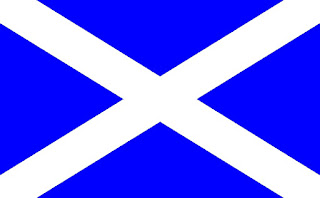
Fast forward to 9th-century Scotland, when the Picts and Scots were trying out the idea of merging their kingdoms for mutual defence against nasties like the Vikings and the English. The Pictish King Óengus II prayed to St Andrew for victory on the battlefield. Why St Andrew in particular instead of any other saint I’m not sure. A cloud in the shape of a diagonal cross appeared in the sky and Óengus’s forces were duly victorious. From then on the Cross of St Andrew became the national symbol of Scotland. It looks like this:

The “blazon” or heraldic description for this is Azure a saltire argent – that is to say “Blue, with a white diagonal cross.” Heraldry is a much-overlooked chapter in the history of Western art and graphic design. If you’re unfamiliar with it, think of the House sigils on Game of Thrones and you’ve got the general idea. I remember finding a comprehensive book on heraldry in the library at my high school and being captivated by all the archaic words and images. Here was a system, centuries old, for capturing complex images in a verbal formula which could be repeated exactly and used to reproduce them.

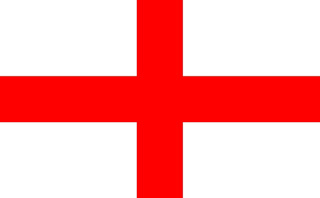
England also has a cross emblem belonging to a saint from the opposite end of the Roman Empire. St George is of course best known for saving a maiden from a dragon, a story likely derived from the Greek legend of Perseus and Andromeda. The detail of the dragon’s demand for sacrifices in return for access to the town’s only well was almost certainly added to the story during the Crusades to stand for the Saracen tax on Christian pilgrimage to Jerusalem. The red cross on white was the prime symbol of the Crusades, and it’s not surprising it became associated with St George, though exactly when and how or what either one has to do with England isn’t clear. The Cross of St George’s blazon is Argent a cross gules.

Sunday, 20 September 2015

Identity politics and its limits

First up, sorry it’s been so long between blog posts. What happens sometimes is I get a post past the planning stage and I think, OK, I’m nearly done, I’ll have it finished tomorrow. Only the next day it’s not done, but it’s so close to done that I know I’ll have it finished the day after that, no big drama, no need to find something else to post about while I’m working on it. Sometimes, and this was one of those times, this can go on for weeks. And then just as I was finishing I came down with an unusually virulent upper respiratory tract infection, which kept me at home, away from the internet, for nearly a week. Content note: I discuss racism, homophobia, and ableism below, including repeating some slurs.

If you ever need confirmation that there’s more to politics than Left versus Right, utter the word “transphobia” in a reasonably broad left-wing forum and stand back and watch. (I’m not sure what the equivalent would be in a right-wing space; libertarians and conservatives take different views on how many gender identities and sexual orientations are legitimate, but they seem to agree that oppression only counts if it’s the government doing it.) If you do try the experiment, you can probably then count down under your breath how long it takes until somebody starts muttering about “identity politics”.

I don’t know. Maybe this was more of a thing five or six years ago, at least in this country, when the Left was still busy looking for something to blame the Right’s then-recent victory on. One thing a lot of people fixed on was the prominence of queer and feminist interests in the broad Left portfolio, which many claimed was a fatal distraction from the real troubles of the poor and the working class. Because, apparently, only bourgeois women mind being hit on by creepy men, and only the bourgeoisie ever feel attracted to their own gender or identify as a gender that doesn’t match their genital anatomy at birth.

But I think that was one manifestation of a wider political trope that goes: “Social justice struggles A, B, and C were about equal rights for everybody, but social justice struggles X, Y, and Z are about special rights for a bunch of whiners.” Struggles A, B, and C aren’t always in the past tense, at least not among the Left, but that’s the usual pattern. The “special rights” part is where “identity politics” comes into it. The idea is that the social justice movement gives people special rights according to their identity as women, or as people of colour, or as queer people or as trans people or disabled people or whichever one it might be today. And that, say the critics, isn’t justice. Lady Justice wears a blindfold.

Yes, but Lady Justice also carries a pair of scales. If one person misses out on a benefit that others are enjoying, when they’ve made no less effort to deserve it than those others, then that’s unfair. If the benefit is a basic human right, then that’s injustice. And if lots of people are missing out on it because of some aspect of their identity – be it cultural identity, gender identity, sexual identity, whatever – then Lady Justice’s blindfold has slipped. Fixing it will be measured by whether people of that identity are still missing out, and if you didn’t realize they were missing out then fixing it will look like “identity politics” to you.

Sunday, 17 May 2015

What kind of construct is gender?

I have told you this story once before, but it was buried deep in my screed on evo psych and I wouldn’t blame you if you missed it. At the age of three, one of my nephews announced to my mother (his grandmother) that girls have blue eyes and boys have brown eyes. About nine out of ten for observation, there; only one member of our local family group breaks this rule, and he must not have looked in a mirror that day.

When his mother and I were that age – we’re twins – we had a magnetic letter tray, with plastic letters in four colours. We spontaneously came up with a treaty to avoid precedence disputes over letters: green and blue were boys’ colours, whereas red and yellow were girls’ colours. The convention was readily extended to the crayons and felt pens. Girls’ colours also included pink, purple, and white, while boys’ colours extended to orange, brown, black and grey. Why orange was a boys’ colour when red and yellow were girls’ colours, I could not for the life of me tell you now. But we both agreed that it was. Sadly, when we graduated to a larger set of felts, that overlooked inconsistency proved the downfall of the system. I think the disputatious item may have had the word “vermilion” printed on the side.

I repeat these charming vignettes, I think the word is, to draw your attention to three common features. First, as you’ve surely picked already, both involve gender binaries. Second, both binaries are false to the point of silliness, such that you only excuse their proponents because we were all preschoolers. And third, just so’s you know, both were spontaneous. Neither was endorsed by the authorities in our lives. In our case, admittedly, we may very well have heard from on high that pink was a girls’ colour, and probably also our toothbrushes and hairbrushes and what not would have been colour-coded just so our parents could remember which to use on whom. But, whenever they overheard us negotiating settlements, those same adults also told us in so many words that the notion of girls’ colours and boys’ colours in general was daft. We ignored them. We weren’t about to give up any cultural convention that had proved such a powerful force for peace.

Friday, 13 February 2015

Atheism is not a vaccine against bigotry

The three victims of the Chapel Hill shooting

A couple of days ago in Chapel Hill, North Carolina, a guy called Craig Hicks walked into the house shared by his newly-married neighbours Deah Barakat and Yusor Mohammad and shot them and Mohammad’s visiting sister Razan, killing all three. Hicks’ immediate inspiration for the act seems to have been a parking dispute. Would he have done the same over a disagreement with his white neighbours, his neighbours with north-western European names, or his neighbours whose ancestors had lived more than two generations in the US? If so, it would break the nauseously familiar pattern that so far his crime seems to instantiate. Us-and-Them thinking cannot be uprooted from the human psyche; all the more urgent that its shoots be plucked off at first sight.

There’s a twist. As well as their skin colour, ethnicity, and provenance, the victims were all Muslim. That’s not the twist. Hicks advocates right-wing politics and opposes gun control. That’s not the twist either. The twist is that Hicks is an atheist, indeed a “New Atheist”, a devotee of Richard Dawkins, Sam Harris, and Christopher Hitchens. It’s looking like his atheism was part of the parcel that led him to think shooting someone is OK if they’re Muslim and nick your parking space.

New Atheism is one of multiple crowds that I hang out on the fringes of. I’m not a big fan of Harris or Hitchens and my opinion of Dawkins has taken a pounding in the last couple of years, but I still admire Daniel C. Dennett and Steven Pinker, and I applaud Stephen Fry’s stance on God in the recent viral YouTube video. I could distance myself from Hicks by doing some Us-and-Themmery of my own – redneck! gun-nut! libertarian! patriarch! – but that wouldn’t be honest. His crime has no bearing on the existence or otherwise of God, but it has punctured the protective bubble of self-praise that New Atheists have blown up around ourselves, part of which was that New Atheists don’t blow that sort of bubble.

So here goes. No, violent aggression against people seen as “other” did not come into the world with religion. Most of today’s major religions became major by harnessing it, but it predates them and, if Hicks is anything to go by, will survive their demise. No, rejecting supernatural beliefs does not make you immune to it. Yes, reason is one of the antidotes, but for that to work you have to commit yourself to the use of reason as your sole means of persuasion. Using the word “reason” as a badge of superiority won’t cut it.

Yes, Islam is a religion, not a race. Yes, some of Islam’s sternest critics are former Muslims. Yes, they include leftists like Maryam Namazie as well as neocons like Ayaan Hirsi Ali. Yes, one can leave Islam through mental effort. No, that doesn’t make it OK to harass Muslims for being Muslims. Yes, everyone should have the right to free speech. No, that doesn’t mean Muslims have to stop complaining when people trash-talk them. Actually that’s kind of the opposite of what it means, when you think about it. Yes, false beliefs can be harmful. Yes, clinging to beliefs beyond the warrant of the evidence is therefore dangerous. No, that doesn’t mean it should be punished, except insofar as rational debate constitutes punishment.

No, Islam does not contain qualitatively nastier ideas than Christianity, Judaism, or Hinduism. Yes, there is historical contingency as well as present geopolitics in the tangle of contributing factors that help explain why majority-Muslim countries nowadays are trailing the rest of the world on violence and human rights. Yes, particular readings of the Qur’an are part of the tangle. No, there is no sense in which they are “core beliefs” of Islam but the phobia of Jews, heresy, and Satan were not “core beliefs” of Christianity well into modern times.

Yes, 9/11 and the Charlie Hebdo shootings were committed in the name of Islam. No, that doesn’t mean every single Muslim is more violent than every single non-Muslim, even by a tiny degree. It means, at most, that (at present) the proportion of people who are violent is slightly larger in Muslim populations than in other populations. If that justifies shooting Muslims, then the same logic mandates the extermination of men; the prevalence of violence among men is orders of magnitude greater than the prevalence of violence among women (and chronically so). No, Muslim immigrants into non-Muslim countries are not all sleeper agents of the global caliphate waiting for a signal to convert everyone by the sword. Not even mostly.

No, Muslims are not responsible for what other Muslims do just because they’re Muslims. That Enlightenment humanism stuff? That stuff we talk about, where you get judged by your individual actions, not the characteristics of a set that you happen to be a member of? That applies here too.

Sunday, 27 July 2014

My submission to Statistics New Zealand on gender identity

Statistics New Zealand are asking for submissions on a new standard for doing statistics on people’s gender identity. There’s a submission form here. I filled it out, and this is what I said – being very brief because I didn’t spot the link where you could send Word documents as submissions until I’d already started filling in my answers in the text fields, which only allow 512 characters per question. The one-word answers on the first couple of questions are where I just ticked a checkbox. Italics are where I quote their words.
Do you agree with the proposed concept of gender identity? [Gender identity is defined as a person’s internal, deeply felt sense of being male or female or something other or in between. A person’s gender identity may or may not correspond with their sex (HRC, 2008). Gender identity is subjective and is self-defined.] Yes.
Do you agree with the proposed definitions of related terms? No. If not, please state the definitions you have concerns about, and how you think they could be improved.
I disagree with the definition of “sex” [the distinction between males and females based on the biological differences in sexual characteristics]. I don’t claim to speak for trans people, but I understand that trans women see themselves as female, not “male but feminine”, and likewise, mutatis mutandis, for trans men. Minds merit more attention than genitals in most contexts. And “biological” is too broad and vague a term. Since humans are living things, everything about us is in a sense “biological”.
Are there any other terms you would like to see included in relation to gender identity?
Rather than simply “sex” I would use the terms “anatomical gender”, “physiological gender” or “reproductive gender” when it is necessary to compile statistics on such things (as it might be for medical purposes). “Gender” and “sex” should both, by default, refer to a person’s identity.
The background paper provides some examples of the approaches different countries have taken to collect gender identity information. Do any of these approaches stand out to you as being suitable for use in New Zealand?
No. The simplest and least cisnormative way to collect information on gender would be to remove the tick-boxes entirely, and instead provide a text field for a short written answer.
Is there any other information relevant to the concept of gender identity that you feel is missing from the background paper?
I feel there should be a discussion on the inappropriacy of “biological” essentialism. Genital configuration and the sex chromosomes do correlate with many other features of human anatomy, physiology and psychology, but that does not make either one definitive of a person’s essential nature – any more than any of those said other features.
If you have any further comments about the concept of gender identity or the information in the paper, please add them here.
Should anyone object to the concept of subjective gender identity on Biblical grounds (Deuteronomy 22:5 “The woman shall not wear that which pertaineth unto a man...”), please draw their attention to I Samuel 16:7 – “...man looketh on the outward appearance, but the Lord looketh on the heart.”
A couple of things I would have said but there wasn’t space:
  • In most contexts I can think of where it is necessary to distinguish behavioral or identity gender (or linguistic gender) from anatomical or physiological gender, one also from time to time wishes to discuss sexual intercourse. If you reserve the word “sex” for physiological gender, you can then run into ambiguities due to the fact that “sex” in common parlance means sexual intercourse.
  • Obviously I don’t think it appropriate for Government departments to incorporate the Bible in their documentation. However Biblical fundamentalism is probably the second-biggest source of opposition to getting past the gender binary, after that weird combination of male entitlement and homophobia that says “I should have the right to contemplate having sex with anyone I find attractive, without facing the horrible possibility that she might be in some sense ‘male’ and thus make me in some sense (oh, the horror, the horror!) ‘gay’.” So I decided to include a counter-argument that would give those people pause for thought.

Tuesday, 17 December 2013

Imponderable III: The Self

I was a curious kid. I wouldn’t have been more than eight years old when I learned that green things are green because they absorb the light that isn’t green. Not that I’m claiming I understood it fully. For some time I was mystified as to why green cellophane didn’t make things look red when you looked through it, because I thought absorption was basically light going into the object while reflection was basically light bouncing off the object, so that light going through the object was more like absorption than reflection, because it didn’t bounce off, so if green objects absorbed red light then how come...?
In case you are puzzled by this yourself, absorption isn’t about light “going in”, it’s about light going in and stopping (because its energy has been captured and redirected elsewhere, always at least partly into raising the object’s temperature). The primary distinction is between light that stops and light that keeps going; the latter category is secondarily divided into light that passes through and light that bounces off.
However, at least some of my high-school chemistry classmates had evidently missed this information, because when our teacher explained how the red dyes in a plastic ANZAC Day poppy absorbed shorter wavelengths because the electrons in the iron atoms jumped up a couple of valence shells, or something, one of them exclaimed “So it’s not really red? It’s just that it absorbs the other light?”
This isn’t the Imponderable on consciousness, that’s still to come, so I won’t here speculate on why our experience of colour feels so removed from the Newtonian interpretation of light wavelength and frequency. The point here is this idea that photon absorption is somehow cheating – that there must be a “real red” somewhere which isn’t faked up out of all that physics-y stuff. Because people who have got past that, and are perhaps even now chortling at my sixteen-year-old classmate, are still susceptible to the idea that there might be “real” fear, “real” anger, or “real” love floating around in amongst their synapses and neurotransmitters.