Showing posts with label John Key. Show all posts

Monday, 5 December 2016

A big news day

Whoa. I should write to world leaders more often!

Yesterday there were two big, startling pieces of news, and for a change both of them were good news – if you happen to share my political views. The Dakota Access Pipeline has been stopped at Standing Rock. And John Key has resigned as Prime Minister of New Zealand.

I don’t imagine, of course, that the e-mail I sent to President Obama and posted on this blog last week had anything to do with the first piece of news. (Well, that’s not technically true. I do imagine it, because it’s a nice little ego boost, but I don’t seriously imagine it.) The people who won this fight are the Water Protectors who stood their ground so long and so bravely. If you asked me to guess what changed the state’s mind, my best guess is the army veterans who pledged to stand with the protesters. Armies are held together by honouring loyalty and bravery, and you can’t honour loyalty and bravery and also point weapons at veterans from your own side.

The Standing Rock news is cause for celebration – for now. It’s not the end of the war. The Pipeline will be put somewhere else, not scrapped altogether, which is good news for the Lakota people and their water supply but not great for stopping climate change. And there will be more pipelines to come. This time, Donald Trump didn’t get his hands on the situation. Next time will be on his watch. It will be worse than this one. But for now, we can celebrate.

John Key’s resignation I’m not so positive about. Don’t get me wrong, it’s good news for my side. Not that Key is an unpleasant person as National leaders go; he’s always presented himself as a cheerful, friendly, down-to-earth Kiwi bloke. That’s why his resignation is good news, because that persona – I’m not committing myself to any hypothesis about how genuine it was – has been the cornerstone of the National Party’s election strategy for over a decade, and now they’re going to have to come up with a new one. One lecturer a couple of years ago pointed out that whenever the Government was getting criticized in the news it was always some other minister facing the cameras, but whenever they were getting praised it would be John Key we saw. The lecture in question was on Machiavelli. I’m just putting that out there.

No, what concerns me about John Key resigning is the why. All indications up till now, including Key’s own public statements, were that he intended to run for a fourth National term in Government and, if he got it, to lead it through. The only reason he gave yesterday was that he wanted to spend more time with his family, which if you’ve watched any political dramas you will recognise as Politician Blackmail Avoidance 101. But what kind of pending scandal would spook the man who, in 2014, won an election with a book about him titled Dirty Politics fresh off the press?

It surely can’t be coincidence that National just lost a by-election to Labour in Mt Roskill, by a landslide comparable to those we recently had in Canterbury – and that National apparently had no plan for winning it. But that just compounds the mystery. What happened in Mt Roskill? Why has the National Party suddenly lost its will to fight? There is something going on here that we haven’t seen yet. And, much as I want National out next year, it bugs me that my country’s government can be thrown off balance by things that the public don’t get to see.

Monday, 12 September 2016

How to tell if you’re a racist

One evening a couple of years ago I was on the bus to go home, and this old guy got on at a stop in the middle of town, by an internet café. This was around the time that the Council updated the bus schedules, and the timetable at that particular stop had recently been taken off its post. According to the old guy, it was the café staff that had taken it down. Now you or I might see nothing sinister in that, but the old guy knew better. He knew what they were up to. They’d taken the timetable down so that people looking for parking spaces wouldn’t know it was a bus stop! Then they’d park there and use the internet café, and they wouldn’t realize their mistake until they got the traffic fine! Just as well there were sharp people around, like himself, who wouldn’t fall for tricks like that!

I was sitting several seats behind him, so I didn’t get a good look at the expression on the face of the younger guy he was talking to. From what I could see it looked very much like “From the sanity level of what you’ve just said I infer that any attempt to reason with you would be a waste of time, so I’m just going to smile and nod.” But I don’t actually know.

When I say “this old guy”, by the way, are you picturing someone wild-looking, unkempt, with teeth missing, muttering to himself and staring belligerently about? Don’t. This was a dignified-looking, affable elderly man; working-class accent and second-hand clothes, if I recall correctly, but if you were asked to spot a mentally ill person on that bus by their appearance you’d pick me over him. I don’t think his bizarre delusion arose from any kind of brain disorder. I think it had more to do with a small detail which he never felt the need to mention, and which I also haven’t said anything about so far. See if it makes it feel any more plausible to you. Are you ready?

The staff and management of the internet café are immigrants from East Asia.

If your answer was yes, that does make it more plausible, then you – like the old guy – are a racist.

Nowadays we all agree that it is very bad for someone to be a racist. Which of course is true, and don’t get me wrong, it’s a genuine moral advance since the days when newspapers printed editorial cartoons decrying the “Yellow Peril”. But the advance has been less than it might appear, because of one unfortunate side-effect of the new understanding. “Racists are bad,” people reason to themselves, “and I am not bad. Therefore, I am not a racist. Therefore, my belief that Muslims are terrorists and East Asians are amoral schemers and Polynesians are stupid lazy thieves is not racism.” Well, sorry, yes it is, and yes you are.

Tuesday, 15 March 2016

Flags

New Zealanders are currently voting in a referendum on the national flag. A lot of us are not happy about it. Last year some of us voted (I didn’t) to pick one of five replacement flags, and now we’re voting on whether we want to go with the replacement flag or stick with the old one. After much thought, I have decided not to vote. I hate them both. I think there is one clear best choice, with more apt symbolism and a greater weight of tradition behind it than either, but it was never on the ballot. I’ll show you what I’m talking about at the end of this post.

The story of the flag begins with St Andrew, one of the Twelve Apostles, who tradition has it was crucified on an X-shaped cross at his own request because he didn’t want to upstage Jesus. A similar story is told of St Peter, who to this day enjoys heart-warming loyalty in the Goth crowd – he was crucified upside down. Given what we know of the mechanics of crucifixion, both stories were probably made up in the Middle Ages to sell hagiographic icons. But anyway, that’s the tradition.

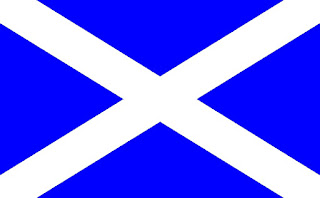
Fast forward to 9th-century Scotland, when the Picts and Scots were trying out the idea of merging their kingdoms for mutual defence against nasties like the Vikings and the English. The Pictish King Óengus II prayed to St Andrew for victory on the battlefield. Why St Andrew in particular instead of any other saint I’m not sure. A cloud in the shape of a diagonal cross appeared in the sky and Óengus’s forces were duly victorious. From then on the Cross of St Andrew became the national symbol of Scotland. It looks like this:

The “blazon” or heraldic description for this is Azure a saltire argent – that is to say “Blue, with a white diagonal cross.” Heraldry is a much-overlooked chapter in the history of Western art and graphic design. If you’re unfamiliar with it, think of the House sigils on Game of Thrones and you’ve got the general idea. I remember finding a comprehensive book on heraldry in the library at my high school and being captivated by all the archaic words and images. Here was a system, centuries old, for capturing complex images in a verbal formula which could be repeated exactly and used to reproduce them.

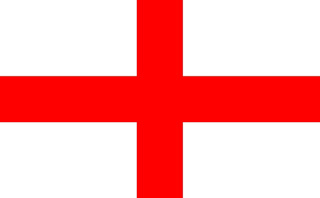
England also has a cross emblem belonging to a saint from the opposite end of the Roman Empire. St George is of course best known for saving a maiden from a dragon, a story likely derived from the Greek legend of Perseus and Andromeda. The detail of the dragon’s demand for sacrifices in return for access to the town’s only well was almost certainly added to the story during the Crusades to stand for the Saracen tax on Christian pilgrimage to Jerusalem. The red cross on white was the prime symbol of the Crusades, and it’s not surprising it became associated with St George, though exactly when and how or what either one has to do with England isn’t clear. The Cross of St George’s blazon is Argent a cross gules.

Thursday, 30 April 2015

How political correctness saved civilization

Last week, a woman who works as a waitress at an Auckland café told the left-wing Daily Blog that whenever Prime Minister John Key patronized her place of work he would come up behind her and pull her hair, and he had laughed off her discomfort until her manager backed her up, after which he presented her with two bottles of wine as an apology, apparently under the misapprehension that pulling someone’s hair when they don’t want you to constitutes some kind of relationship. A reporter from the NZ Herald rang her posing as the café company’s PR department, and the following day her name was published nationwide without her consent. I guess they were betting that, being young, female, a worker, a Daily Blog follower, and willing to call out harassment by a powerful person, her political views would be significantly leftward of the Prime Minister’s. This proved to be the case, and so they’ve been able to frame the whole thing as a politically-motivated smear campaign.

I would just like to point out, before we go any further, that there’s been a case recently where someone identifiable only as “a prominent New Zealander” has been caught sexually assaulting underage girls. He – the perpetrator, I think this needs emphasis – has been granted permanent name suppression, contrary to the wishes of his victims and their families. That means I can’t spell out his connection to the Prime Minister here, nor link you to someone who can. But Google around the Australian news sites and you should find him. New Zealand is now a place where sexual perpetrators get more legal protection than their victims, if they happen to have government connections.

Now a friend of a friend wrote a Note on Facebook explaining exactly what the problem is with the Prime Minister’s behaviour; it’s here, with permissions set to Public, so if you have a Facebook account you should be able to read it. I have little to add to what he says in the Note, but I do have a response to make to the person who (at the time I read it) was the most prolific commenter.

Friday, 24 April 2015

Remembrance and hypocrisy

One hundred years ago the Australian and New Zealand Army Corps (ANZAC) landed on the coast of Gallipoli in Turkey, their mission being to take out the Ottoman artillery which had held back the Allied navy from securing the region. The immediate objective was to allow military traffic between the West and Russia, while closing it off for the Austria-Hungarian and Ottoman Empires; in the longer term, the British Empire hoped to gain privileged access to Middle Eastern oil, having recently upgraded their navy from coal-powered to oil-powered ships. Reconnaissance of the area had been grossly inadequate, and the Anzacs found themselves facing a steep slope and a well-prepared enemy. The Ottoman army couldn’t stop the landing but easily prevented the Anzacs from advancing past the beach. A classic war of attrition followed, with corpses mounting on both sides for very little strategic gain.

New Zealand and Australia commemorate the anniversary every year on what we call Anzac Day. It’s become a bigger and bigger thing recently as the centenary approaches. Red poppies appear all over the place like Santa Clauses at Christmas, phrases like “Honour the Fallen” and “We Will Remember Them” being the equivalent of “Season’s Greetings”. Predictably, our cultural gatekeepers seem to have decided that the Fallen are best honoured by sanctifying the lies that got them killed. But they’ve revised and updated them, because “freedom and democracy” are more appealing causes nowadays than “king and country”. I suppose that’s progress of a sort. (World War II, at least the European arena of it, could reasonably be called a war for freedom and democracy; World War I cannot.)

At least the Anzacs at Gallipoli were all volunteer soldiers, not conscripts. The following year New Zealand passed an Act of Parliament drastically reducing the permissible grounds of conscientious objection – you only got out of military service if you belonged to one of three small religious groups who believed God forbade it. Otherwise, you were arrested and shipped to the front by force. Then you were punished like any disobedient soldier, which as flogging had recently been banned typically meant you were tied to something and left there for hours, often in places likely to come under enemy fire. Deserters were shot, and in some places advancing troops were followed by squads called “file closers” with orders to kill straggling men of their own side.

I wear a white poppy on Anzac Day, not a red one. I don’t do it to disrespect the soldiers who have died in war, though that accusation was certainly levelled at the white poppy when it first came into the public eye a few years ago. The thing is, wars kill more than just soldiers. We in the West are in the privileged position of losing only soldiers to war, because in the last seventy-odd years we’ve always been the invaders, and it’s been Johnny Foreign across the sea whose civilians get the pointy end. It is a terrible thing to be sent into harm’s way by your government, but it is also a terrible thing to be cluster-bombed, napalmed, mined, or drone-struck. Those who call my concern for the latter an insult to the former will get no respect from me.

Prime Ministers Tony Abbott and John Key, having zero sense of irony, have decided that the centenary of Gallipoli is a good time to have Australian and New Zealand military personnel headed for a conflict in the Middle East. This is particularly poignant for New Zealand, since we proudly abstained from George Bush’s Iraq War. OK, sure, ISIS are very bad people, and they are killing lots of people. That actually doesn’t make it OK to go around killing just as many people ourselves just in the hope that some of them will be ISIS.

ISIS may be doing things that are as bad as what the Nazis did, but they are not the threat that the Nazis were. They don’t have the industrial infrastructure to produce armaments, they don’t have productive land to feed soldiers on. Cut off their supply of weapons and they’ll be stuck. I’m no military strategist, but wouldn’t a moratorium on the arms trade be just a little bit helpful here? As for the human rights violations, surely the least the West could do is open our arms to refugees from the conflict. If we’re going to go in there at all, let it be to help smuggle innocent people out. Well, New Zealand isn’t increasing our refugee intake this year, and – look, just go and Google “Australia refugees”, OK? I’ll wait.

Wednesday, 15 April 2015

Science: you don’t get to pick and choose

Earlier this week, Australia’s Prime Minister Tony Abbott announced a new policy: people on welfare benefits will lose their payments if they don’t get their children vaccinated. New Zealand’s Prime Minister John Key responded with a statement that we will not be following suit, thus demonstrating that he is a wiser and better man than Tony Abbott. (This is such a low bar to clear that the fact that it needs pointing out actually reflects badly on Key. There are things growing on the bottom of ponds that are wiser and better than Tony Abbott.)

I am pro-vaccination – strongly so – and I think this is a terrible idea. I’m pro-vaccination because there are some children who can’t be vaccinated for legitimate medical reasons, and their only hope of escaping diseases like measles or polio is if the children around them have all been vaccinated and hence are guaranteed not to be carriers. This policy will not help those children. It will harm them.

Since the announcement a couple of New Zealand public figures have stood up in support of Abbott. One is the Act party’s sole Member of Parliament, David Seymour. Another, I’m afraid, is a doctor. Now doctors have to clean up after the anti-vaxxers, so I guess I can understand why he would feel like something has to be done. While to a certain extent parents have to make medical decisions on their children’s behalf, children are human beings with rights too – including the right not to be needlessly exposed to the risk of horrible infections. But although something does indeed have to be done, this isn’t it.

Please, my fellow science enthusiasts on the internet, do not go holding up Tony Abbott as a role model for your own politicians. He supports punishing poor people if they don’t get vaccinations, but he is also an active climate change denier. Yes, a climate change denier in charge of a country. To Abbott, it appears, the measure of whether science is good or bad is whether policies derived from it inconvenience the poor or the rich. And that, folks, is the attitude we have to fight, if we ever want to live in a world not destined for a disastrous collision with reality.

Monday, 27 October 2014

And so it begins

Just over a month since the election, and National are making the labour laws on things like tea-breaks more “flexible”. This doesn’t mean the workers will be able to flex them, obviously. Only the employer. Oh, but it’s all right, they can only take your tea-break away if you agree to it. No coercion there. After all, it’s not like they control your weekly wage or can hold the veiled threat of dismissal over your head or anything, is it?
I can see how they’ll argue it from here. It’ll be “Let the market sort it out” – the idea that if you don’t like the conditions your employer offers you can go find another job somewhere else. It’s Economics 101. And, like Economics 101, it ignores the fact that labour supply is negatively elastic. People work more hours when their pay is low, so they can be sure they’ve got enough cash to cover their needs; they take time off when it’s high and they can afford it. That means the employer gets more work out of them by offering less in exchange for it, which means that the law of supply and demand will always push wages and conditions straight down to the bottom. I’ve argued this before, more than once. It is something that those who run this country, and those who vote for them, urgently need to understand.
What’s the alternative? For now, I’ll settle for keeping the government-mandated regulations we have, or used to have, on what wages and conditions are acceptable. In the long term, however, the problem is that while “flexible” very easily (as here) becomes a weasel word for “exploitative”, it does refer to something real as well. Different workplaces operate under different constraints. No one size fits all. So if the market won’t fix the problem, what will? Dare I suggest democracy might? I don’t mean democracy via parliament, I mean direct democracy. I mean workers owning equal shares in the company, setting company policy, voting executives in and out.
Yes, if you are the kind of person to whom a company is something you own rather than something that tells you what to do, this would be a bit of a shock to the system. By all means argue against the idea. But let’s be clear: what you stand to lose is neither more nor less nor other than your personal power over a bunch of other people’s lives. If you think that makes you sound like the bad guy, you might want to think very carefully about that. Don’t come complaining to me. You hold your employees’ well-being, present and future, in the palm of your hand. You don’t want that? Give it back to them.

Tuesday, 30 September 2014

What I’d need not to have known, to have voted National

I spent quite a while tweaking that title. I’m still a little angry over the way the election went. I don’t think I’m going to be less angry any time in the next three years. But it’s become undeniable that this isn’t like 1999, when most of the country had just plain had enough of the National Party’s bullshit, and our main concern was to make sure Labour didn’t slide too far to the right. Come to that, most of the country had had enough of National’s bullshit by 1996, it’s just that a critical minority made the mistake of trusting Winston Peters. This time, we need to try and understand what’s going wrong for the Left in New Zealand. We can’t retreat into comfortingly aggressive slogans about how our opponents are just pigs and their voters just sheep.
I want to be very clear about one thing from the start. When I talk about the Left, I’m referring to a certain cluster of political theories and attitudes; I do not mean a particular party or parties within New Zealand’s parliamentary system. I was six years old the last time Labour could say they stood for workers and the poor without people coughing behind their hands. I am not interested in Labour returning to 40% of the vote if it has to abandon the struggle for equality (again) to do so. My vision is not of a country where National is pretty much still in government only they wear red ties instead of blue. But on the other hand it’s vital we learn something from this. We’re going to need to have some very forthright conversations about what is and what is not essential to the Left. And we’re going to need to reach a general consensus. And after that, anything that turns out to be a secondary concern is going to need to be sidelined unless it’s a means for achieving the primary concerns, and that question is going to need to be settled on the basis of evidence.

Friday, 19 September 2014

Election rant (this is how I write when I have a time limit)

My plan, you see, was to finish the previous post within the week and then run a short series of posts on election issues coming up to polling day. But no, somehow I just couldn’t either marshal my thoughts in a timely fashion, nor give up on it and leave it as a draft and write other stuff in the meantime. Note to self: that is how you maintain a blogging schedule, it isn’t going to work otherwise. Now polling day is tomorrow. And by law you can’t publish anything between midnight and 7pm on polling day that might influence someone’s vote. So I have to get this finished in the next seven hours. And you all get to see how I write when I haven’t got time to go back and edit.
As usual I have to be conscious that a lot of my readers are not New Zealanders. Recently I seem to have been oddly popular in Turkey, and a while back it was the Ukraine. So I guess I have to tell you about all the parties as well. I could link you to them, but frankly that seems like more work than just writing, especially because whenever I wander away from this editor page to look something up it takes me ten minutes to get back. I should perhaps mention that I am a little bit medicated right now as well. Actually, no, first I have to explain New Zealand’s electoral system, for New Zealanders as well as non-New Zealanders, as you’ll see.
Back in the days of First Past the Post National and Labour were the only realistic options going. Back then we voted the way I think Americans still do, that is, we cast a single vote each for the local electorate candidate, and the government was whichever party had a majority of the seats in Parliament. Now imagine what happens if you have a lot of electorates with a small preference for National, and one or two electorates with an overwhelming preference for Labour, and you can see why this doesn’t necessarily end up representing the country. And you can imagine how likely it would be that a new party would break into more than one electorate at a time. So we had a two-party system. A vote for any other party was a wasted vote and, if you and your partner both happened to favour different parties, you might form a pact not to vote at all, because your votes would just cancel each other out. Which unless you spend the entire election day at home seems to me to be a highly exploitable situation, but whatever.
I feel like shouting very loudly at this point because we changed this in 1993. 1993. I’ve been saying “we” but in reality I have never voted under this system. Never. Not in my life. I turned 18 in 1996, and cast my first vote under the new system, which is called MMP – Mixed Member Proportional. There will be New Zealanders voting in this election who weren’t born last time we were still using First Past the Post. And I am still seeing people on Facebook talking about “wasting votes” by voting for the minor parties. Or asking people to make sure a Labour electorate candidate got in “so that we have one more Labour MP in Parliament.” Or even talking about their votes “cancelling out”. And while I deplore violence, I must in honesty report that talk like this gives rise to images in my brain involving grabbing people by their jackets and head-butting them while yelling “It doesn’t! Work! That! Way! Any! More!”

Thursday, 21 August 2014

The case for clean(er) politics

New Zealand is buzzing right now about Nicky Hager’s new book Dirty Politics. Buzzing so hard, in fact, that it’s sold out, and I can’t see myself getting hold of a copy before the election. (There have been rumours of it being bought up and destroyed by National supporters, but I haven’t seen these substantiated and they seem implausible, given the financial and political costs such actions would incur.) So I can’t quote word for word. But there are plenty of summaries and synopses and juicy tidbits being shared all over the net. For non-New-Zealanders, and New Zealanders currently living under a rock, I gather the basic gist is this:
Right-wing blogger Cameron Slater, he of “Whale Oil Beef Hooked”, has been covertly getting fed information, in various forms, from the very highest levels of government, which he’s been using to smear and slur and manipulate both the National Party’s political opponents and anybody nominally on their own side who they wanted rid of. Among other things, he’s been given Labour Party membership data obtained by hacking their database, and he’s been tipped off when potentially embarrassing Official Information Act requests are being processed, so that he can request the same information, get it first, and blog it himself with a pro-National spin. There’s a summary of the major allegations here.
Details that have been quoted or scanned on blogs and tweets and Facebook reveal a consistently nasty mindset, from calling Canterbury earthquake survivors “useless pricks” to a fundamental disrespect for the rights of young women. Prime Minister John Key has of course dismissed the whole thing as a left-wing conspiracy theory and put Judith Collins, the National Party minister who has worked most closely with Slater, on what I think is her third or fourth final warning by now.
Not having seen the book itself, I can’t comment on it directly. What I wanted to talk about was a much more humane blogger’s take on the situation. Chris Trotter is New Zealand’s foremost representative of what I guess you’d call the Old Left. His response is captured in the title of the piece: Dirty Politics – Is There Any Other Kind? My response to that is: There had better be.

Thursday, 7 August 2014

Election graffiti: anger is one thing, hate speech is another

Content note: racism, NSFW language
It’s election season here in New Zealand. We vote in six weeks. There are election billboards going up all over the place, and naturally some people are taking matters into their own hands.
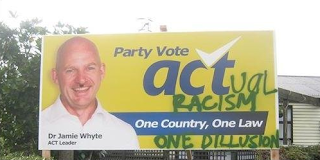
Party Vote Act(ual Racism): One Country, One Law (One Dillusion)
(Ab)Use Your Party Vote to keep the government on a short leash: Vote Conservative
Vote (Batman) Labour
There’s a collection of them over at Vandalized NZ Political Billboards on Tumblr, which is where I found these images. It’s dominated by attacks on National Party billboards,
Nicky Wagner (Muppets) Christchurch Central: Party Vote National
Working for (Rich People): Party Vote National
some comparatively subtle,
Carter, Port Hills: Party Vote National (The Rich Deserve More)
some very much not.