Showing posts with label history. Show all posts

Wednesday, 24 July 2019

The summer of ’69

Trick photo shows a person appearing to lay their hand on the Moon

When I was three years old, my father tried to trick me into believing a tall tale – or so I concluded at the time. He told me that a man named Neil Armstrong had stepped onto the Moon twelve years before, and had said “That’s one small step for a man, one giant leap for mankind.” Now it had not escaped my notice that my mother called my father Neil instead of Daddy, whereas “Arm-Strong” sounded like the name of a story-book giant; and also, somewhat crucially, Dad neglected to mention anything about a spaceship. I therefore pictured a world-bestriding Titan with Dad’s face and beard (because of the name) lifting up one monstrous foot into the heavens. Even to three-year-old me, this seemed a bit beyond the bounds of physical possibility. Yet Dad kept an utterly straight face and clearly expected me to believe him.

What did Neil Armstrong and his companions actually accomplish? What has humanity gained that we wouldn’t have gained without going to the Moon? Was it merely an “unlikely piece of art”, albeit a “triumph of our aesthetic instincts” constituting “the culmination of the Romantic cult of the sublime”, but “undertaken for no meaningful scientific purpose”, as a recent opinion piece would have it? Not according to at least one astrophysicist:

In case you didn’t play the video for whatever reason, Dr Smethurst identifies five pieces of scientific knowledge we wouldn’t have had without the Apollo missions. One, surprisingly to me, is the distance to the Moon. One is an explanation of a phenomenon called solar wind. More as you’d expect, we learned what stuff the Moon is made of and how that stuff is arranged, which then allowed us to figure out how the Moon was originally formed. (Turns out to be quite dramatic, if you haven’t seen it before.)

NASA nowadays gets about an eighth the proportion of the US budget that it did back then – from 4% down to 0.5% – and yet you still see people arguing that space research should be defunded to pay for hospitals. Guys, there’s vastly more money being sunk into corporate subsidies and the military; why not complain about those instead of squabbling over the tiny scrapings they leave behind? The thing about science, the point of acquiring knowledge for knowledge’s sake, is that you cannot know what that knowledge is going to turn out to be useful for until you’ve got it. You like hospitals? It would be a pretty poor hospital that didn’t have an X-ray machine, but X-ray machines could never have been invented if people hadn’t been doing purely curiosity-driven research on radiation decades before. As far as I know space research hasn’t turned out anything quite that directly useful for human health. Yet.

Also, let me be direct: people want to know stuff. Quite a lot of debates in ethical philosophy become a whole lot easier if you allow that happiness is about knowing fortunate truths as well as having pleasant sensations. That’s why it wouldn’t be ethical to make everybody happy by spiking the water-supply with some euphoriant drug, or to euthanize an old lady’s pet when she moves into palliative care and tell her for the remainder of her life that it’s being looked after. People want to know the truth. We’ve always wanted to understand what the Moon is and how it got there. Finding the answers was a service to humanity.

All the same, it seems kind of a small return for the phenomenal amount of money that the American taxpayer poured into Apollo throughout the 1960s. Come to think of it, the government’s commitment to the project is remarkable in itself. Public support for Apollo was far from unanimous, given the many other social and economic concerns facing the country at the time. It had been pushed along for seven years by Lyndon B. Johnson through his Vice-Presidency under John F. Kennedy and his own term as President. Then in 1968 the Republican Richard Nixon was elected (Kennedy and Johnson having been Democrats). Nowadays the story would end with Nixon cancelling Apollo on a promise to free up the money for social rejuvenation, then actually spending it on a massive tax-cut for the top income brackets. Apparently Presidents didn’t disrespect their predecessors’ legacies quite that much in the ’60s.

Three other names help to explain why Apollo had to go ahead come what might: Sputnik, Yuri Gagarin, and Lee Harvey Oswald. Sputnik, the first artificial satellite, made it undeniable that the Soviets could pull their weight in science and technology, a field in which the US had previously been rather complacent. Gagarin, the first man in space, showed it hadn’t been a one-off. And when Oswald shot Kennedy dead in 1963, Johnson’s Presidency stood or fell on how well he was seen to honour Kennedy’s aspirations. In fact a month or two before his death Kennedy had decided to scrap Apollo in favour of a joint Soviet-American Moon endeavour, but that never became public knowledge.

Unfortunately Kennedy also left another legacy: the Vietnam War. Not that he started it, exactly – there had been conflict there, and the United States had been meddling in it, for years before – but Kennedy was the President who committed the US to military intervention. It raged on, dividing the American public, throughout the ’60s, and ended up outlasting the Apollo programme by several years. Odious and expensive though it was, neither Kennedy nor Johnson nor Nixon wanted to be the first American president ever to lose a war. It has been speculated (and is repeated as fact in some quarters) that the real purpose of Apollo was to distract Americans from what was happening in Vietnam.

Whilst a certain degree of cynicism is warranted and indeed necessary in political studies, I don’t find that the rule “Always assume the worst possible motivation” generates much better predictions of government policy than “Always give the benefit of the doubt,” except insofar as it errs on the side of vigilance. Better is “Politicians are no more altruistic, honest, or intelligent than anyone else, and to get things done they have to placate millions of people with conflicting priorities.” A much cheaper way to distract the public from Vietnam would have been to distribute psychedelic drugs en masse. As things turned out, psychedelics became identified with the anti-war subculture shortly before getting banned, but that wasn’t inevitable in the mid-’60s.

Looking at the period from fifty years’ distance, it’s hard not to see a certain congruence between the psychedelics and the Apollo programme. Both were motivated to cross the boundaries of the very world and see things no-one had ever seen. It doesn’t feel coincidental that the ’60s was also the decade of the Civil Rights movement and the Sexual Revolution and, a month or so before the first Moon landing, the Stonewall riot. The phrase “To boldly go where no man has gone before” predates “One giant leap for mankind” by less than three years.

So then what happened? The science fiction writers who were bold enough to foresee a Moon landing before 1970 also all thought we’d be on Mars by 2000. It’s always easy to think up ways that problems and disappointments are one’s political opponents’ fault, so it won’t surprise you that I place a large chunk of the blame on Reaganism. You can’t slash taxes for decades and still fund an Apollo. The Space Shuttle programme that was meant to follow it was plagued by the characteristically Reaganistic combination of cutting corners on safety measures and requiring conspicuous success from every project, with predictably disastrous consequences.

Maybe that op-ed piece wasn’t completely off the mark: Apollo’s primary significance is as a work of art rather than a scientific venture. It became a symbol, a sign showing future generations forever after that we are not stuck in the world we know, that just because something hasn’t been done before doesn’t mean it can’t be done – like, say, allowing people of the same gender to marry, or electing an African American to the White House. It takes commitment and care and perseverance and the humility to listen to criticism and learn from past mistakes, but it can be done. Every giant leap is actually a concatenation of small steps.

Just in case you were wondering – the time interval from the launch of Sputnik to Armstrong’s one small step was roughly as long as we now have to solve climate change. Worth thinking about.

I still look up at the Moon every so often and think about it – this thing so familiar and so remote, this alien planet that every generation of humanity has known from infancy. Contrary to some people’s fears at the time (C. S. Lewis, for instance), knowing that humans have touched it for me deepens the wonder rather than deadens it, because it brings the Moon out of the backdrop and onto the stage. Maybe we’ll go there again one day; maybe we need to let our wisdom catch up with our hope before that can happen. But we know it can be done, and that’s never going away.

Friday, 1 June 2018

Against enforced monogamy

The issue of sexual violence has never gone away. The #metoo movement is just one more response to it, though so far one that’s been getting more notice than many. In the last, I don’t know, month or so, the media at large has at last started to notice the well-established connection between misogynistic violence and mass shootings, and the word “incel” – involuntarily celibate – has achieved a greater currency than it had before. I gather “incel” was first coined to describe the experience of being queer and unable to find someone of the gender you like who likes people of your gender, but it has now unfortunately been very firmly appropriated as a self-identifier for that subset of men who (a) aren’t getting sex and (b) believe they are owed sex. And this of course has led to suggestions that maybe mass shootings would be averted if more women would “take one for the team” and have sex with incels. Because, apparently, some people aren’t content with being horrible human beings in the privacy of their own homes.

I have seen it claimed, mind you, that incels aren’t real because it’s not actually hard to find someone to have sex with and these men must be just being needlessly picky (or obsessive) about their choice of partner. I can’t hold with this. For some people it may be easy to find people to have sex with, but there are many circumstances which make it difficult for others. One, as already noted, is being the only queer person in your offline circle. Various disabilities – physical and social – have similar effects. It’s not the not getting sex that makes incels horrible people, it’s the belief that they are owed it. Men who believe they’re owed sex are horrible people whether or not they’re getting it, which brings this digression nicely back to the point.

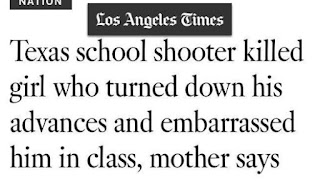
A couple of weeks ago a guy walked into Santa Fe High School in Texas and shot people, killing ten of them. Following an excellent suggestion that’s been passed around Twitter and Tumblr, I’m going to refer to the perpetrator as “Shooter #101” (this was the 101st mass shooting in the United States this year). The mother of one of the dead, Shana Fisher, has claimed that her daughter was repeatedly harassed by Shooter #101 for a date and ultimately turned him down publicly in front of the school, and that she was the first person he shot. Several articles on the incident have used this for a lede. Apparently it hasn’t been corroborated by witnesses – which is bad enough, but I’ve worked in journalism in a very small way, I can understand going ahead with the article on the assumption that the mother knew what she was talking about. What’s not forgivable is that this was how they framed this element of the case:

Spurned advances from [Shooter #101] provoked Texas shooting, says mother of girl killed (NZ Herald)Texas school shooter killed girl who turned down his advances and embarrassed him in class, mother says (LA Times)

And these are far from the worst. You see the narrative being put forward here? Men (overwhelmingly) do the shooting, but never fear, we can always find a way that it’s ultimately a woman’s fault. Women are put on earth to meet men’s needs, and men go astray when women fail to fulfill that function. Men’s sexual and romantic yearnings give them a proprietary right over women’s bodies, attention, and time. Most commentators would recoil from this position if it were stated openly; the danger of framing male violence as the headlines above do is precisely that this narrative sneaks under the radar as a tacit premise instead of being exposed to challenge as an explicit proposition. To men who do believe that women owe them sex, this subtextual confirmation helps that belief fit just that little bit more comfortably into their picture of the world.

Thursday, 29 June 2017

Were Māori the first New Zealanders?

(Spoilers: Yes. Yes, they were. Unequivocally, yes.)

In this time of resurgent racism and “alternative facts”, I suppose we should have expected to see yet another version of the “Māori Were Not Here First” myth bob up to the surface. And so it has. First, a couple of months ago, one Jaylene Cook posed nude for photos high up Mt Taranaki, which is sacred to the local Māori people, and so sparked a comment-war on Instagram. I’m not going to pass judgement on the photoshoot – I haven’t seen the photos and don’t know how sexual or otherwise disrespectful they were. I mention it because, during the comment-war, Cook stated that “Maori are not indigenous you ignorant t...” (redaction by Stuff).

Not long after that, some guy called Noel Hilliam dug up some Māori skulls and reportedly sent them to an Edinburgh University pathologist, who told him they were three thousand years old and Welsh. Whether he told the pathologist where they came from is a critical, and unanswered, question. See, if I were a pathologist and somebody sent me a skull, I’d assume they’d found it somewhere near my place of work and contacted me because I was local, and I’d start my search for matching features in nearby collections. To determine the age, you might first think of carbon-dating, but bones can easily be contaminated with ancient carbon and no archaeologist trusts an uncorroborated carbon-date anyway. I’d most likely look at the teeth, get some idea of what the person ate, and match it to a place and period when people seemed to be eating a similar diet – to a standard of “close as we’re going to get, probably”. So even if the nameless pathologist was an actual qualified pathologist (Edinburgh University denies having had any such contact), Hilliam’s ignorance of scientific procedure would pretty much guarantee a worthless result.

But, being so demonstrably ignorant of scientific procedure, Hilliam of course drew sweeping conclusions about New Zealand’s prehistory from this one piece of data. Or rather, he had already drawn those conclusions and desecrated a Māori burial site merely to confirm them. He went public with a “reconstruction” of one of the skulls:

Sketch of a woman’s face, showing white skin, blond hair, narrow nose and thin lips, with a very wide jaw-line and solid cheek-bones.

There is of course no such thing as a distinctive “Welsh skull”, but there are some characteristic features you can use, if you come across a skeleton in the South Pacific, to tell whether it belonged to an Islander or an early European visitor. In this case, I have to say those are an awfully wide, rounded jaw-line and robust cheek-bones for a European woman; they would be entirely unremarkable in a Polynesian face. The hair, skin tone, nose profile and thin lips are all guesses on the part of the sketch artist. I gather Hilliam claims his “expert” told him this person had blond hair, which means that either he or the “expert” are talking nonsense. You can’t tell hair colour from a skull.

Hilliam didn’t get his notion of white pre-Māori New Zealanders from the facts, but he didn’t get it out of the blue either. These “alternative prehistory” ideas have been going around since at least the 1990s in certain sectors of the Pākehā (white New Zealander) population. No surprise, they’re closely correlated with racist politics. Hypothetically, it should be possible to believe that someone else settled New Zealand before the Māori did and still support Māori rights under the Treaty of Waitangi, since nothing in the Treaty is predicated on Māori being indigenous. But no-one actually seems to take that position. Conversely, people who publicly maintain that Māori are unfairly privileged by the Treaty disturbingly often turn out, in unguarded conversation, to also believe that Māori are a bunch of primitive savages who couldn’t possibly have navigated the oceans by themselves.

Friday, 9 June 2017

A lesson for the Left

Would Sanders have beat Trump? We’ll never know for sure. The polls seemed to say he would, but then the polls also seemed to say that Clinton would, and for that matter they also said that the UK would stay in the EU. Actually, given the parallels between this election and the Brexit vote, we might have a test for that. The UK’s Labour Party is currently led by Jeremy Corbyn, who is very similar in both politics and temperament to Bernie Sanders. If the UK were to hold a general election next year and Corbyn won convincingly, that might be an indication that Sanders could have beaten Trump. Unfortunately the UK’s next general election is not until 2020, by which time things will have changed a lot and it won’t be much of an indication either way.

That’s what I said seven months ago after Donald Trump won the US presidential election. Well, a couple of days ago the UK did hold a general election. Corbyn can’t exactly be said to have “won convincingly” – the result was a hung Parliament (no party holding a majority). On the other hand, given that only weeks ago the polls had Labour riding towards the biggest trouncing in a century, I think this result does strengthen the case for Sanders’ beating Trump if only he had been nominated. Assuming of course, as before, that the US and UK are riding on broadly the same political currents.

What happens now for the UK? Too early to say. Clearly Prime Minister Theresa May’s hope of negotiating Britain’s exit from the European Union with an improved mandate has gone to pot. Will her Conservatives and Northern Ireland’s Democratic Unionist Party manage to form a stable enough government to hold a majority in the House? I wouldn’t bet money on it. The DUP’s beef with Labour is purely due to Corbyn having entered talks with Sinn Féin and the Irish Republican Army decades ago to end the chronic violence between Catholic separatists and Protestant unionists in Northern Ireland, apparently successfully as it turned out, rather than – well, rather than what? Wiping Irish Catholics from the face of the Earth? You’d have to ask the DUP.

I’m not as surprised as most commentators seem to be by Corbyn’s success; in a country ravaged by unending austerity and stale promises of improvement just around the corner, promising to stop austerity politics was always going to be popular. The biggest surprise to me is Scotland. What has the Conservative Party done for Scotland lately, and how has the Scottish National Party failed it, that so many votes swung from the latter to the former? Did Scots see the SNP’s renewed calls for independence after Brexit as cynical opportunism? I don’t know how to answer that question. If, as seems likely, May loses her position as Conservative leader and it all triggers yet another election in a few months’ time, Scotland would be the place to watch. In any case, my prediction that the United Kingdom will cease to be United within a decade so that Scotland can remain European appears presently to have been wrong.

You wouldn’t know it yet to look at our news media, but New Zealand has a general election of our own coming up in a few months. Should any Labour or Green politician happen to read this post, I would urge them to take the lessons of the UK to heart. For a generation, nominally Left parties throughout the English-speaking world have put all their energy into winning centrist voters away from the Right. This strategy is not going to work any more. Business as usual is over. You need to get young people voting again, and to do that you need to provide them with a bold and credible alternative to the status quo. You are competing with the seductive, poisonous notion that immigrants and brown people are the cause of our economic struggles and we need to kick them all out. You won’t counter that with “Everything is fine, let’s just keep on the way we’re going.” Hillary Clinton, David Cameron, and Theresa May all tried that, and look where it’s got them. Please don’t deliver us into the hands of racists and bigots like they did. Please be strong.

Sunday, 19 February 2017

The question of punching Nazis

This blog tends to straggle a fortnight or so behind the news, but people haven’t stopped talking about this yet:

You know, if there were two propositions I’d always have thought were established beyond doubt, it’s that the world is round and that the Nazis were bad. But in the last year there have arisen fad movements questioning both. I imagine, though I admit I don’t have any data here, that there’s quite a large membership overlap between the two movements. I don’t intend to defend either proposition here. My question instead is whether it’s morally defensible to do what that guy in the GIF is doing, i.e., punching Richard Spencer in the face.

This is an interesting test case for the ethics around free speech; it’s so extreme, in two different ways. On the one hand, the usual defences for limiting speech do not apply. Spencer in that clip is not being argued with angrily, blocked from an internet forum, disinvited from a speaking engagement, or having a newspaper refuse to publish his letters – he’s getting punched in the face while trying to speak to a camera. We can’t say that he’s merely being “shown the door” or that the attacker is exercising his right to free speech. This was a violent act, an act of physical force. On that basis many people have condemned it, including Jerry Coyne:

If the Left is to keep the moral high ground, we simply can’t go around physically attacking those whose views we don’t like. In fact it’s ironic, because when progressives do this, they’re implicitly denying someone a real safe space: a space to be free to express your opinions and remain physically safe. “Safety” refers to freedom from physical attack or illegal harassment, not to freedom from hearing views you don’t like.
As a conscientious objector, I’ve always adhered to the nonviolent philosophies of Martin Luther King and Mahatma Gandhi, for if you start violence, you lose credibility.

But Coyne is misrepresenting the situation when he lumps Spencer under “those whose views we don’t like”. Elsewhere he has disputed the characterization of Spencer as a “Nazi”, since Spencer is not a formal member of a National Socialist party. Given that Spencer is on record as questioning whether Jews are people and proposing that Africans be exterminated, I’d call that hair-splitting. Coyne is Jewish; if he wants to forgive a man who denies his humanity, that’s his prerogative. But I think other Jewish and African people might want a say in the matter as well.

Spencer’s racist views constitute the second way in which this is an extreme case. The usual arguments for protecting offensive speech also do not apply here. Spencer is not speaking truth to power. He is not proposing a crackpot idea that just might be true, or even one whose falsehood offers us teaching opportunities in the effort of rebuttal. We already know what happens when the assumptions he is challenging cease to hold; that’s what the 1930s and 40s were all about. And the punch doesn’t set a precedent for violent state intervention against dissidents, because it wasn’t delivered by an agent of the state.

What about the moral high ground, as per Coyne’s objection? The moral high ground isn’t just a place to keep your own self-image squeaky-clean; it’s a critical strategic position which any resistance movement abandons at its peril. At some point, you must gain the support of the public or abandon your cause. To do that, you must inspire them either with sympathy or with fear. Fear has short-term advantages that make it tempting – not least that you control the media’s attention. But it is fatal in the long run. If the citizens sympathize, some of them may help you stay off the state’s radar; if they’re afraid, they’ll hold the state’s coat while it swats you like a fly. India is no longer a British colony because Gandhi didn’t terrorize people. Northern Ireland is still a British colony because the IRA did terrorize people.

(Worse still, you might buck the odds and win. The English Civil War, the French Revolution, and the Russian Revolution are examples. It’s no coincidence that these were followed by the tyrannies of, respectively, Oliver Cromwell, Napoleon Bonaparte, and Joseph Stalin. Power gained by fear can only be held by fear.)

But America is in an even sorrier state than I thought if one sucker-punch is all it’s going to take to divert the sympathy of the public to “alt-right” Nazis. Not many resistance movements can survive without being prepared to occasionally defend themselves, either. Martin Luther King didn’t riot, but he openly sympathized with those who did. The gay rights movement in the US began when the patrons of the Stonewall Inn fought back – yes, fought back – against police harassment. The boundary between sympathy and terror is not the same as the boundary between using force and not using force. Most people are not complete fools; they can tell the difference between hitting people to make them do what you say and hitting people to stop them kicking you around.

All in all, I can’t see that the person who punched Richard Spencer in the face did anything wrong. What does bother me is the idea some people seem to have that more punching is the way we’re going to win this thing. It’s not. This is one of the deep cognitive flaws in the human psyche: “Find out whose fault the problem is and hurt them until it goes away.” That very flaw is the core of Nazism and fascism, and for that reason Nazis and fascists are always going to be better at hurting people than we who oppose them. Force may sometimes be necessary, but if the decisive contest is our force against theirs, they will win.

What we’re better at doing than they are is telling the truth. (The Trump White House has already, in its first month, invented three non-existent terrorist attacks to justify Trump’s anti-Muslim measures.) The Nazis themselves are obviously not going to be listening, but other people are. They need to see that we have answers to every one of the fascists’ lies. I salute the brave scientists, reporters, judges, and bloggers who are standing up for the truth. We need more of you. Kia kaha.

Friday, 27 January 2017

What price progress?

Several of the blogs I follow, I follow because they frequently say things I disagree with, but say them reasonably enough that I don’t end up lying awake all night thinking of things to snap back at them. This is a delicate balance; I read things I disagree with because that’s what inspires me to write, but lying awake thinking of things to snap back at people on the internet vacuumed up a lot of valuable sleep hours in my 20s. Two of the blogs I’m talking about are David Brin’s Contrary Brin and the one which inspired this post, John Michael Greer’s Archdruid Report.

Brin and Greer are both further right, politically, than I am, but neither one is so far right as to think that people on welfare just need to grow a work ethic, that being the point at which I stop listening for insights and start listening for gotcha points. Which just goes to prove that there’s more than one dimension to politics, because on today’s topic they are polar opposites, and I’m somewhere in the middle. Today, with Greer’s recent post “The Embarrassments of Chronocentrism” as my launch-pad, I’m going to be talking about progress.

Yes, “chronocentrism” is a word Greer coined to make his point. It’s modelled on “ethnocentrism”, which is when someone thinks that every other culture is to be judged by their own. (Usually, in fact, what they think is that there is a Right Way to do things and a whole lot of Wrong Ways, and they’ve never thought about it enough to realize that the only thing Right about the Right Way is that it’s how their own culture happens to do things.) Greer replaces the ethno- element, meaning “culture”, with chrono-, “time”, to criticize the attitude that every other period in history is to be judged by our own.

Now I would be tempted to use this word mostly when my generation do the exact same tutting and sighing over Kids These Days that we used to roll our eyes at when we were Kids These Days. Did you know that when some teenager has their head bent over a smart-phone, they’re almost always using it either to gain knowledge or to communicate with another person somewhere? Mind-boggling, I know, but true. The way some people go on about Kids And Their Phones reminds me of nothing so much as William James’ (I think it was) speculation on what dogs think about their masters’ reading: what strange compulsion could drive you to stare at bits of paper for hours on end, when you could be doing something worthwhile like playing fetch? But I’d better get back on track before this tangent gets any longer.

What Greer takes issue with is the idea that society has some kind of natural drive to get better and better; and, correspondingly, that past societies should be considered inferior because they don’t live up to the standards that we have achieved. Which, when you think about it, is a paradox in itself. If society naturally gets better and better, shouldn’t we be especially forgiving of the faults of past societies? They couldn’t help being bad, could they, since they didn’t have the good fortune to be born in our time? We don’t blame children for being childish, do we?

Wednesday, 11 January 2017

Why 2017 will probably be no better than 2016

Yes, I know, downer of a title. Let’s start with the good news: 2016 wasn’t actually as uniformly bad as some of us made it out to be. The last remaining war in the Americas finally ended. Renewable energy overtook coal. The world tiger population rose. Giant pandas are officially no longer endangered; nor are humpback whales or green sea turtles. Ebola was eradicated from West Africa. World hunger reached a 25-year low. Equally good things may happen in 2017 – or they may not.

The whole “2016 hates us” meme got started on 10 January, when David Bowie died aged 69. Actually, no, make that 14 January, when Alan Rickman died, also aged 69, and people found the coincidence eerie. After that, whenever somebody famous died, the word was “2016 strikes again.” 69 is far too young to die nowadays, of course; a few of 2016’s victims were even younger, like Prince (57) or George Michael (53) or, when people had already started to say “Thank God 2016’s over”, Carrie Fisher (60). But far more of them were in their 80s and 90s: Gene Wilder was 83; Leonard Cohen was 82; John Glenn was 95; Zsa Zsa Gabor was an incredible 99. I’m sure every one will be dearly missed by those who loved them. But there’s nothing inexplicable about dying at that age. Nor did it suddenly begin in 2016. Have we all so soon forgotten Terry Pratchett, Leonard Nimoy, and Christopher Lee?

So what happened, then? I can think of a couple of entirely non-sinister possibilities. One is that there’s been no increase in the frequency of celebrity deaths at all, that they just happen to have fallen into a cluster as random events do. It’ll be harder to quantify than you might think, because how famous do you have to be to count as a “celebrity”? Who decides? I would certainly want to include the great New Zealand singer-songwriter and television presenter Marcus Turner, a man whose wide circle of friends and acquaintances I was proud and a little overawed to inhabit, who died on 2 February a couple of weeks shy of his 60th birthday. But I didn’t see him on the lists of 2016 casualties I pulled up from Google to write the previous paragraph.

Given the reputation 2016 now suffers, the temptation will be to count people as “celebrities” who happened to die in 2016, who we wouldn’t have considered “celebrities” if they were still alive or if they had died in some earlier year. So there may be nothing in it at all. If, on the other hand, there really have been more of them dying lately, the other possibility is that they’re all getting old. The Baby Boomers who embodied the radical cultural shift of the 1960s were in their teens; the rock- and pop-stars who led it were in their 20s. “Never trust anyone over thirty,” remember? The Boomers themselves in their turn contributed to the wave of new stars as the ’60s gave way to the ’70s, which must have further swelled the number of stars merely because there were so many Boomers.

It’s now the 2010s; the ’60s happened fifty years ago. Plausibly, what we’re now seeing is that cohort of stars approaching their average life expectancy. (Perhaps I’m over-fond of bitter irony, but I can’t help smiling just a little at the thought that the Boomer cult of youth might have given direct rise to society’s new-found consciousness of mortality.) If that’s the case, then the frequency of celebrity deaths will certainly continue to rise over the next few years before levelling off at a new, higher norm. Get used to it.

The other shock 2016 brought, in two goes – the Brexit referendum and the election of Donald Trump – is far more ominous. The soupçon of schadenfreude I confess I feel to think of the complacency of the neoliberals immediately beforehand dissipates when I remember that the Left was also completely unprepared for what should have been our fight to win. We’re supposed to have the solutions to inequality, poverty, and corporate dominance, aren’t we? How did the fascists convince so many voters that bigotry was the answer? Important as these questions are, right now we need to contain the consequences. And whether or not my predictions turn out right in detail, it’s safe to say that those consequences are going to be negative.

If there’s a sliver of good news, current indications are that I overestimated Donald Trump’s intelligence considerably when I made those predictions. Impeachment might be an easy road after all. The cloud to that silver lining? Farewell, President Donald Trump – hello, President Mike Pence.

Wednesday, 23 November 2016

We won’t defeat bigotry by ignoring it

“We really should just be completely ignoring Tamaki,” said a friend of mine (whose name is Andy) on Facebook last week. “I’m thoroughly sick of giving time and space to nonentities. Sign of the times unfortunately – lazy, sensationalistic journalism, and all that.”

Tamaki who? Well, my little country made international news a couple of days previously when we had a gigantic earthquake, which fortunately hit a rural area in the early hours of Tuesday morning with very few people in harm’s way, and I think the death toll stands at 2. Now Brian Tamaki, self-anointed Bishop of Destiny Church, had preached on Sunday that major earthquakes (such as those that devastated Christchurch, our second-largest city, back in 2011) are Nature crying out to God in grief at human sin – sin being murder, gay marriage, and Lloyd Geering. After Monday night’s events he put up a blog post claiming that the sermon had been a prophecy.

Maybe Andy is right in the specific case of Brian Tamaki. He gets media space because his Destiny Party was the second-latest in the ongoing series of attempts to forge authoritarian Christianity here in New Zealand into the kind of political force that it is in the US. The pattern is: rebuke sin, claim endorsement from God, announce a nationwide revival, fail to cross the 5% vote threshold required to get your party into Parliament, fall off the radar, surface a year or two later in a sex scandal. Except in Tamaki’s case it was a money scandal, and it didn’t sully his standing within the small group of devout followers who are his season-pass on the gravy train.

I can’t fault Andy’s opinion of current standards of journalism either. Objectionable behaviour from public figures gets clicks, and clicks get advertising dollars. But in the light of the recent US election, it’s now clear that the Left has catching up to do; and one thing we need to catch up on is convincing people that we have answers worth listening to. During my time in student political activism there was a general practice – nothing ever so concrete as a policy – of avoiding engaging with our opponents’ arguments directly so as not to give the impression we thought them worth bothering with. In effect we assumed that our target audience’s default position was to agree with us as long as they didn’t encounter opposing views. I believe a similar assumption was a big part of Hillary Clinton’s failure.

So if certain people blame earthquakes on deviant sexual activity, does that mean we need to go out and hold educational community seminars on plate tectonics? Not what I have in mind. Apart from anything else, we don’t know why earthquakes strike at one point on a fault rather than another, and for people who think like Tamaki, that sort of gap in our knowledge means there’s still room for God (or aggrieved Nature) as an explanatory factor. Anyway, the earthquakes per se aren’t the point. The point is whether being LGBT, or tolerating LGBT partnerships, is the sort of thing that makes a country deserve earthquakes. We progressives say “No.” Many people still say “Yes.” We have not worked hard enough at convincing them otherwise.

Sunday, 2 October 2016

Why women are better than men

Once upon a time, people say, you could tell the plain truth about things and be admired for it. Now they make you shut up and call you, as it might be, racist, sexist, or homophobic. I’ve had my quarrels with these people before and I expect I will again. But today I share their experience. I have a truth to tell which will offend people because it upsets the illusion that we are all equal. Here it is:

Women are better than men.

This is not hyperbole, rhetorical or otherwise. Nor is it a joke, though I confess myself slightly amused to imagine the offended huffing and puffing it will cause among some who pride themselves on being immune to offended huffing and puffing. It is, I admit, a generalization; but it is, I insist, a valid generalization.

Consider, as a parallel, the statement “Women are shorter than men.” That’s a generalization, but a valid one. It doesn’t mean that women can walk upright under toilet stall doors while men frequently get their hair tangled in power lines. It doesn’t even mean that the tallest woman is shorter than the shortest man. You can’t falsify it by picking Gwendoline Christie as your exemplar of women and Peter Dinklage as your exemplar of men. No-one denies that the distributions overlap – that many men are shorter than many women. But you still know perfectly well that women, in general, are shorter than men, in general.

Likewise, I’m not claiming that all women are saints and all men are serial killers. I’m not claiming that the worst woman in the world is better than the best man. I am claiming that women, in general, are of better moral character than men, in general. This claim being a generalization, you can’t falsify it by picking, say, Ann Coulter as your woman versus William Kamkwamba as your man. And in case you didn’t believe me the first time, this is neither a hyperbole nor a joke. So you’re going to want some evidence, aren’t you?

Thursday, 21 July 2016

Racism is crawling back out from under the rug

The world is changing. The last time the World News pages looked this unfamiliar was fifteen years ago, in September. Fortunately, this time the death toll has not been in the thousands. But Britain leaving the European Union is a much further-reaching geopolitical shift than the World Trade Centre attack – assuming it ends up happening. Since the referendum it’s become apparent that none of the people pushing the Leave campaign had a plan for what would happen if they won.

But there have already been very ugly consequences in Britain. Despite the denials coming from the Conservative section of the Leave campaign (less so from UKIP), it seems that at least a large minority of their supporters believed they were voting to expel immigrants and people of colour from the country. Content note: racism.

Friday, 8 April 2016

What really happened to Jesus?

Easter came early this year, which is my excuse for why this blog post about it is late. In accordance with tradition, I made hot cross buns on the Friday and waited until Sunday before consuming any Easter eggs. You might think that I wouldn’t have much time for a tradition based on something I no longer believe, but somehow the buns and eggs both taste more meaningful this way. Also, this semester I’m taking notes for a New Testament Greek class, who are reading their way through the Book of Revelation. So I can’t help speculating, from time to time, on what may have really happened one Passover in Roman Jerusalem to inspire the world’s most popular faith.

Thanks to my personal history, I know a lot of people whose sense of self-worth and identity hangs on the answer to that question. Indeed, they themselves would go further – their eternal destiny hangs on it. That being the case, my putting forward an alternative answer might be seen as something of a red rag to a bull. What do I hope to achieve by doing this, except to make those people angry? Well, for one thing, I don’t think I should have to shut up about my own opinions just because they differ from other people’s. Like I said, personal history. I researched this for over a year in my early twenties, not to annoy people but because I needed to know the truth. I wrote it up rather hurriedly and incoherently and put it on my first website, which may or may not still be knocking around somewhere. It’s important to me too.

I no longer believe in either God or miracles. This necessarily implies that I think people who do believe in God and miracles are wrong. It does not imply, and I want to be very clear about this, that I think those people are fools, or dishonest, or cowards. There is a school of thought among atheists that religious people will sooner acknowledge the wrongness of their beliefs if we just mock, belittle, and insult them enough – the beliefs, not the people, but that distinction blurs all too easily, especially on the internet. I think those atheists are also wrong.

However, that doesn’t mean I hold with the opposing school of atheist thought either – that we should never criticize religious beliefs because they are so important to the people who believe them. Speaking as a former believer, that’s a deeply patronizing attitude. “Oh, of course we who are mature rational adults can handle the world without gods, miracles, or an afterlife, but these poor little lambs couldn’t cope with the nasty truth. We must be gentle with them.” That might apply to anyone in limited circumstances, such as bereavement; as a classifier, it’s insulting.

Atheists of the first school are often referred to these days as “atheist fundamentalists”. Mostly, I don’t think this is helpful. Often it seems “fundamentalist” means nothing more than “anyone who thinks it’s a matter of fact whether God exists or not” (or any other religious proposition), which tars an awful lot of moderate religious people with the “fundamentalist” brush.

That being said, there is a cast of mind I remember from my Christian past and recognise in some atheist discourse now. It’s related to what has recently been dubbed “virtue-signalling”. Basically, you take a question that your group takes a firm stance on, and you take a slightly further-out version of that stance, and you proclaim it loudly so that if your fellow group-members disagree they look like a bunch of compromisers. Then someone else steps still further out, and of course you have to agree or you look like a compromiser. And so on.

Humans are human regardless of our beliefs, and this behaviour is common to us all. From the outside it looks either competitive – “I’m more Christian / atheistic than you!” – or fawning – “I really do belong in the Christian / atheist club with you guys!” But from inside it’s often prompted by sincere enthusiasm, with a wash of pity for those unlucky enough not to have seen the light. I see it just as often in groups that I happen to agree with as groups that I don’t. I presume I indulge in it myself more often than my own (equally humanly common) self-serving cognitive biases allow me to recognise.

Among atheists (this is where all this becomes relevant to the Easter question) this insidership-signalling sometimes takes the form of a conspiracy theory. Not only was Jesus of Nazareth not the Messiah, the Son of God, the Saviour of Mankind, the Prince of Peace, the King of Kings, or any of the rest of it – he didn’t even exist! He was made up out of whole cloth by the early Church, or St Paul, or the Council of Nicaea, or some such. Take that, Christians!

Tuesday, 15 March 2016

Flags

New Zealanders are currently voting in a referendum on the national flag. A lot of us are not happy about it. Last year some of us voted (I didn’t) to pick one of five replacement flags, and now we’re voting on whether we want to go with the replacement flag or stick with the old one. After much thought, I have decided not to vote. I hate them both. I think there is one clear best choice, with more apt symbolism and a greater weight of tradition behind it than either, but it was never on the ballot. I’ll show you what I’m talking about at the end of this post.

The story of the flag begins with St Andrew, one of the Twelve Apostles, who tradition has it was crucified on an X-shaped cross at his own request because he didn’t want to upstage Jesus. A similar story is told of St Peter, who to this day enjoys heart-warming loyalty in the Goth crowd – he was crucified upside down. Given what we know of the mechanics of crucifixion, both stories were probably made up in the Middle Ages to sell hagiographic icons. But anyway, that’s the tradition.

Fast forward to 9th-century Scotland, when the Picts and Scots were trying out the idea of merging their kingdoms for mutual defence against nasties like the Vikings and the English. The Pictish King Óengus II prayed to St Andrew for victory on the battlefield. Why St Andrew in particular instead of any other saint I’m not sure. A cloud in the shape of a diagonal cross appeared in the sky and Óengus’s forces were duly victorious. From then on the Cross of St Andrew became the national symbol of Scotland. It looks like this:

The “blazon” or heraldic description for this is Azure a saltire argent – that is to say “Blue, with a white diagonal cross.” Heraldry is a much-overlooked chapter in the history of Western art and graphic design. If you’re unfamiliar with it, think of the House sigils on Game of Thrones and you’ve got the general idea. I remember finding a comprehensive book on heraldry in the library at my high school and being captivated by all the archaic words and images. Here was a system, centuries old, for capturing complex images in a verbal formula which could be repeated exactly and used to reproduce them.

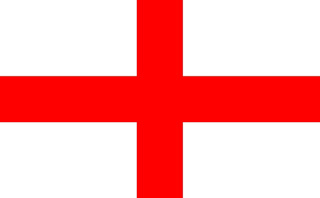
England also has a cross emblem belonging to a saint from the opposite end of the Roman Empire. St George is of course best known for saving a maiden from a dragon, a story likely derived from the Greek legend of Perseus and Andromeda. The detail of the dragon’s demand for sacrifices in return for access to the town’s only well was almost certainly added to the story during the Crusades to stand for the Saracen tax on Christian pilgrimage to Jerusalem. The red cross on white was the prime symbol of the Crusades, and it’s not surprising it became associated with St George, though exactly when and how or what either one has to do with England isn’t clear. The Cross of St George’s blazon is Argent a cross gules.

Friday, 24 April 2015

Remembrance and hypocrisy

One hundred years ago the Australian and New Zealand Army Corps (ANZAC) landed on the coast of Gallipoli in Turkey, their mission being to take out the Ottoman artillery which had held back the Allied navy from securing the region. The immediate objective was to allow military traffic between the West and Russia, while closing it off for the Austria-Hungarian and Ottoman Empires; in the longer term, the British Empire hoped to gain privileged access to Middle Eastern oil, having recently upgraded their navy from coal-powered to oil-powered ships. Reconnaissance of the area had been grossly inadequate, and the Anzacs found themselves facing a steep slope and a well-prepared enemy. The Ottoman army couldn’t stop the landing but easily prevented the Anzacs from advancing past the beach. A classic war of attrition followed, with corpses mounting on both sides for very little strategic gain.

New Zealand and Australia commemorate the anniversary every year on what we call Anzac Day. It’s become a bigger and bigger thing recently as the centenary approaches. Red poppies appear all over the place like Santa Clauses at Christmas, phrases like “Honour the Fallen” and “We Will Remember Them” being the equivalent of “Season’s Greetings”. Predictably, our cultural gatekeepers seem to have decided that the Fallen are best honoured by sanctifying the lies that got them killed. But they’ve revised and updated them, because “freedom and democracy” are more appealing causes nowadays than “king and country”. I suppose that’s progress of a sort. (World War II, at least the European arena of it, could reasonably be called a war for freedom and democracy; World War I cannot.)

At least the Anzacs at Gallipoli were all volunteer soldiers, not conscripts. The following year New Zealand passed an Act of Parliament drastically reducing the permissible grounds of conscientious objection – you only got out of military service if you belonged to one of three small religious groups who believed God forbade it. Otherwise, you were arrested and shipped to the front by force. Then you were punished like any disobedient soldier, which as flogging had recently been banned typically meant you were tied to something and left there for hours, often in places likely to come under enemy fire. Deserters were shot, and in some places advancing troops were followed by squads called “file closers” with orders to kill straggling men of their own side.

I wear a white poppy on Anzac Day, not a red one. I don’t do it to disrespect the soldiers who have died in war, though that accusation was certainly levelled at the white poppy when it first came into the public eye a few years ago. The thing is, wars kill more than just soldiers. We in the West are in the privileged position of losing only soldiers to war, because in the last seventy-odd years we’ve always been the invaders, and it’s been Johnny Foreign across the sea whose civilians get the pointy end. It is a terrible thing to be sent into harm’s way by your government, but it is also a terrible thing to be cluster-bombed, napalmed, mined, or drone-struck. Those who call my concern for the latter an insult to the former will get no respect from me.

Prime Ministers Tony Abbott and John Key, having zero sense of irony, have decided that the centenary of Gallipoli is a good time to have Australian and New Zealand military personnel headed for a conflict in the Middle East. This is particularly poignant for New Zealand, since we proudly abstained from George Bush’s Iraq War. OK, sure, ISIS are very bad people, and they are killing lots of people. That actually doesn’t make it OK to go around killing just as many people ourselves just in the hope that some of them will be ISIS.

ISIS may be doing things that are as bad as what the Nazis did, but they are not the threat that the Nazis were. They don’t have the industrial infrastructure to produce armaments, they don’t have productive land to feed soldiers on. Cut off their supply of weapons and they’ll be stuck. I’m no military strategist, but wouldn’t a moratorium on the arms trade be just a little bit helpful here? As for the human rights violations, surely the least the West could do is open our arms to refugees from the conflict. If we’re going to go in there at all, let it be to help smuggle innocent people out. Well, New Zealand isn’t increasing our refugee intake this year, and – look, just go and Google “Australia refugees”, OK? I’ll wait.

Wednesday, 4 February 2015

Whakamanatia te Tiriti

Imagine with me that you’ve got new neighbours, and they’ve offered you some kind of contract to let them use part of your property. Let’s say, just for the sake of the example, that your house has a garage and theirs doesn’t, but they have a car and you get by with a motorbike. So when they move in they knock on the door and ask if they can use your garage. You’re a bit dubious at first, but they come back the next day with a contract all drawn up that says they’ll give you regular payments for maintenance, they’ll always leave you room to store your motorbike in there, and if you need the garage for anything bigger all you need to do is ask and they’ll park on the street that day. You check and double-check the small print and it’s all legit, so you sign.

The following morning you awake to the sound of your neighbours converting your garage to a sleep-out for their teenage son. You run out, waving your copy of the contract and shouting angrily. They smile indulgently and produce their original version of the contract, with your signature impressed on it through carbon-paper. It’s written in their native language, and in translation (they explain) it gives them complete right of ownership over your garage in exchange for a small weekly payment. They apologize for having badly translated it when they gave it to you. But you signed, and they’ve started the weekly payments, they say, so the garage is theirs now.

Morally, you’ve been swindled. How about legally? If you took them to court, what would you argue? Supposing – at this point the analogy gets a little frayed, but we’re approaching the real thing a bit closer – supposing it turned out they belonged to a completely separate jurisdiction, so that you had to recourse to international law. What then?

As a matter of fact, international law has a well-recognised principle devised for this exact situation. After all, when two nations sign a treaty it’s quite likely that the signatories will be seeing it in two different languages. The principle that has been adopted in all such disputes is called contra proferentem, which is Latin for “against the one bringing it forth”. What this means in our analogy is that since you didn’t have any input into formulating the terms of the contract, the version you signed in your language is the only official version. The other one is null and void; you never signed that one! The fact that it was older, and contained the drafters’ true intention, is legally irrelevant.

Monday, 22 December 2014

Hegel has a lot to answer for

Writing this post is making me a little edgy. Most of the friends I’ve made since leaving high school, I met through student activism in one capacity or another. Which means a lot of my friends are people who hold Marxism dear. That makes criticizing Marxism a painful thing for me to do. And it’s not as if I have to do it, exactly, I could just meander to the back of the crowd and mumble insincerely when my political coalition voices opinions that I find problematic in support of the positions that I am trying to help them defend. But I don’t feel that that’s entirely honest, for one thing; and also, unexamined assumptions in my worldview niggle at me. They keep me awake at night. So before I even start on what the problems are, let me talk about the parts of Marxist theory which I do agree with.
In fact, I’ll start with one that will most clearly establish where my loyalties lie. With the Marxists, and against free-market economic theory, I think that profit in a capitalist economy depends largely or wholly on the exploitation of labour. But this is going to make me look like an economic naïf if I don’t explain a bit. Which I don’t mind doing, because although I’ve said it a few times before, I think it’s one of those things that needs to be said again and again until people get it.

Wednesday, 22 October 2014

The “context” doesn’t always make it better

When Libby Anne of Love, Joy, Feminism wrote this post about being an atheist but not working against religion, I started drafting a reply. But that was three weeks ago, and other things have taken up my attention in the meantime. Then Sam Harris posted this complaint about having his words (from The End of Faith) taken out of context in an image meme. And he provided what he considered to be the necessary context. The thing is, the context doesn’t actually make him look much better. I do think that religion in general is something that should be opposed, and some day I’ll get around to explaining why. But it is much more important that Sam Harris’s kind of atheism be opposed. I’ll give you the full passage, with the offending sentence in bold. Content note: violence, casual reference to torture, fear tactics targeting a non-Western religion.
The power that belief has over our emotional lives appears to be total. For every emotion that you are capable of feeling, there is surely a belief that could invoke it in a matter of moments. Consider the following proposition:
Your daughter is being slowly tortured in an English jail.
What is it that stands between you and the absolute panic that such a proposition would loose in the mind and body of a person who believed it? Perhaps you do not have a daughter, or you know her to be safely at home, or you believe that English jailors are renowned for their congeniality. Whatever the reason, the door to belief has not yet swung upon its hinges.
The link between belief and behavior raises the stakes considerably. Some propositions are so dangerous that it may even be ethical to kill people for believing them. This may seem an extraordinary claim, but it merely enunciates an ordinary fact about the world in which we live. Certain beliefs place their adherents beyond the reach of every peaceful means of persuasion, while inspiring them to commit acts of extraordinary violence against others. There is, in fact, no talking to some people. If they cannot be captured, and they often cannot, otherwise tolerant people may be justified in killing them in self-defense. This is what the United States attempted in Afghanistan, and it is what we and other Western powers are bound to attempt, at an even greater cost to ourselves and to innocents abroad, elsewhere in the Muslim world. We will continue to spill blood in what is, at bottom, a war of ideas.

Note on the above:
We do not have to bring the membership of al-Qaeda “to justice” merely because of what happened on Sept 11, 2001. The thousands of men, women, and children who disappeared in the rubble of the World Trade Centre are beyond our help – and successful acts of retribution, however satisfying they may be to some people, will not change this fact. Our subsequent actions in Afghanistan and elsewhere are justified because of what will happen to more innocent people if members of al-Qaeda are allowed to go on living by the light of their peculiar beliefs. The horror of Sept 11 should motivate us, not because it provides us with a grievance that we now must avenge, but because it proves beyond any possibility of doubt that certain twenty-first-century Muslims actually believe the most dangerous and implausible tenets of their faith.
Sam Harris, The End of Faith, cited by the author in On the Mechanics of Defamation
I hadn’t read The End of Faith before. Otago University’s copy is housed in a special collection of books on religious topics which for historical reasons is outside the campus and bothersome to get to. If I had read this passage before now, I would have held Harris in much lower esteem than I did up until he blogged it. Honestly, I’m mystified as to what part of the “context” he provides is supposed to make it any better to suggest it might ever be OK to kill people for their beliefs. Granted that a person’s beliefs motivate their action to an extent that nothing else does; still, belief in turn is contingent upon circumstances, as the gratuitously horrifying analogy Harris himself opens with should have demonstrated (what would have been wrong with Steven Pinker’s illustration of the same point, “Your car is being towed”?). One way belief can change is through rational conversation, albeit usually some time after the fact, but I can think of no strategy better designed to close the doors on rational conversation than to suggest you might be justified in killing your interlocutor for their beliefs. A more common reason for belief to change is that the new belief makes better sense of the believer’s life experience than the old one, but if the old one is “Westerners are evil and must be destroyed”, then a pronouncement like Harris’s is only going to confirm it.
There was a time when it was generally accepted that it was reasonable to kill someone for their beliefs. Then people changed their minds about that, and there’s a reason why that change of mind was called “the Enlightenment”. Yes, I know that Europeans used the gains they enjoyed from killing each other less to consolidate their power and go and harass the rest of the world. Nevertheless, Enlightenment sceptics didn’t go around killing Christians. Or suggesting killing Christians. Or saying it would be ethical to kill Christians if they couldn’t capture them. Considering what Catholics and Protestants as groups at that time earnestly believed they needed to do to sceptics, as well as to “witches” and each other, by Harris’s standards the sceptics’ conduct was needlessly and indeed foolhardily restrained. Does Harris – does anyone – think civilization would have been better advanced if they’d taken up arms?
Harris might answer that those are pragmatic considerations, bearing on the wisdom of saying that it’s ethical to kill some people for their beliefs rather than on whether it’s true. Harris and I have different views of what constitutes the ethical, of course. I agree with him that the basic measure of goodness is subjective well-being. And my view on subjective consciousness allows at least the theoretical possibility of aggregating and comparing well-being across multiple subjects (Harris’s view, that consciousness is irreducibly and unfathomably mysterious, would rule this out). But ethics is not just about what circumstances would, in theory, be best, if only they could happen. It’s about what actions on our part will bring about the best result. For this purpose there is no getting around the fact that you can’t measure well-being in practice. You have to factor your uncertainty, and other people’s uncertainty about you, into your calculations. In the end it works out to maximizing trust and minimizing fear. If someone is actively trying to kill you or other innocent people, killing them might in many tragic cases be the best you can do; but attacking first creates fear, not trust, and is therefore unethical. I can’t quite believe that actually needed saying.

Monday, 4 August 2014

What have we learned?

A hundred years and a month or so ago, Serbian nationalist Gavrilo Princip shot dead Archduke Franz Ferdinand of Austria in Sarajevo. This triggered a wave of anti-Serb violence across the Austro-Hungarian Empire, because apparently what one Serb did every Serb was responsible for. As he was a minor, Princip got twenty years in prison instead of the death penalty. He died of tuberculosis just a fifth of the way through his sentence. The Empire demanded that Serbia suppress all anti-Imperial actions and publications and accept Austrian control of their police force. Serbia said “OK,” but they didn’t say “OK” to every single demand, and Austria-Hungary declared war.
Some bits of what happened next, I’m not clear on. The Russians felt obliged to intervene on Serbia’s behalf. The Germans had been itching for a war with both Serbia and Russia for some time. Germany and Austria-Hungary had an alliance with the Ottoman Empire. France and Britain stepped in to help Russia. I don’t know why any of that was the case. I do know that one hundred years ago yesterday, Britain declared war on Germany. At that time, white New Zealanders and Australians identified as British, so from that point on “we” were at war. Which I guess is why my local newspaper dedicated its front page yesterday to the centennial.
Get used to this kind of thing. You’ll be seeing it a lot in the next four years. Thought for the day: World War I was rich countries invading rich countries. Nowadays you don’t see that, “nowadays” here meaning since 1945. Why not? What changed? Why, for the last seventy years, has it only been poor countries being invaded? What trick have rich countries learned in that time for avoiding being warred upon? (It’s certainly not that rich countries no longer go to war.) Steven Pinker’s The Better Angels of Our Nature is required reading here, but has he got it right? He dismisses the popular “nuclear deterrent” theory; I have no problem with that. He also claims that global trade has been a major force for peace, which sits most uncomfortably with my politics but Pinker’s data and logic are persuasive. Basic idea: if country A is a source of trade goods for country B, country B has an incentive not to want country A’s economy disrupted by war.
Something’s missing. One lucrative set of trade goods is armaments, which reverse the incentive structure. If you’re selling guns, you want your customers threatened by wars, so that they’ll buy your guns. Also, protecting trade ships and trade zones has become a major raison d’etre for military deployments. And then look at the protests at all the big free trade conferences; look at the violence governments are prepared to deploy against their own citizens in defence of commerce. Free-trade apologists might reply that the protesters are mistaken or misguided in their choice of political goals, and that trade is a powerful enough force for peace to justify suppressing dissent. But even if trade is a force for peace, so too – taking my information from The Better Angels of Our Nature once again – are democracy and the free exchange of information. Trade deals like the Trans-Pacific Partnership Agreement threaten both.
I take Pinker’s point. Economic interdependence links nations together, it helps people put a value on each other’s lives who otherwise didn’t have a reason to care. Yes, that sounds awful, but the reality is no human being could care about every single other one of their seven billion fellow human beings. We care about the couple of hundred people we know personally, and we can have our consciences and our compassion stung by stories and images of a few more, but there comes a point at which it’s just too much. So we can’t hang our plans for world peace on everybody caring, personally, about everybody else. That’s not going to happen.
But granted that economic ties between nations are a good idea per se, is this really the best we can do? Do we have to sign our democracy and our freedoms over to giant corporations and their neoliberal running-dog enforcers? Corporate capitalism is addicted to fossil fuels, which has historically caused shortage crises as well as global warming, and to dirt-cheap labour, which has historically caused large-scale political unrest. Fuel crises and political unrest are both causes of violence. Being better than 1914 is not much to congratulate ourselves on.

Thursday, 7 November 2013

This is how I write when I have a word limit

Earlier this year the Labour History Project held a competition calling for essays on people’s vision for New Zealand. I entered this, but – as you can tell from the fact that I’m blogging it – I didn’t win. My title was “We Can Do Better”, because I’d spent all the time available on the essay itself and had to come up with something vaguely snappy-ish at the last minute. Because it was written for an audience of politically conscious New Zealanders, I mention quite a few things in passing which I would have had to sit down and explain for an international audience. I’ve put in links that hopefully should be helpful there. I wrote this all before the recent revelations about the Auckland rape gang and the beyond-incompetent police response to it, or that would have been the major focus of the essay.
Yes, this is how I write when there’s a word limit. When I worked at a local student magazine my style was described as “brisk”. I guess it makes for quicker reading but I hate not being able to explain all the nuances.


We humans are very good at coming up with solutions to our problems. Unfortunately, the solutions tend to create more problems. Plumbing means cleaner cities but dirtier oceans. Literacy means less ignorance but more squinting. The best we can hope for is that the new problems are smaller than the old ones. Then we can solve those ones, and so on.
So if you want to know what the future looks like, don’t look at the people celebrating existing ideas. Look at the naysayers, the people picking holes in them. Look at the Earth Hour people, not the “Human Achievement Hour” people. They’re where the next wave of improvements will come from.
That’s why I don’t take a Utopian approach to politics – any more than to housework. I’m never going to make the house perfectly clean, and it wouldn’t last long if I did. Instead my philosophy is what’s called meliorist, from the Latin for “better”. You see something that needs fixed, you fix it. You see something that needs cleaned up, you clean it up. You make things better than they were before.

Sunday, 5 May 2013

What’s wrong with economics

When you take lecture-notes for students with disabilities, you learn all kinds of interesting things. Well, it depends on the subject, of course. Fourth-year dentistry is of limited application, given I have no intention of ever becoming a dentist. But last year I took a first-year Economics paper – OK, I only took half of the lectures for that one, the other half went to some other note-taker, but it has given me considerable insight into how and why Western society is so screwed-up. (I also took several ecology-themed papers, so now I know both what we’re doing to our food supply and why we’re not going to change course until it’s too late.)
Lots of things have been suggested to explain what’s wrong with economics, so first of all let me say what the problem isn’t. The problem isn’t that economics models complex real-world situations with mathematical abstractions. Plenty of sciences do that; simplifying complexity is how we come to understand it. The problem isn’t that economics puts a money value on everything. Money is basically a measure of how much of a crap people really give about things, as opposed to wishing other people gave a crap about them; consider the saying “put your money where your mouth is”. The problem isn’t that economists don’t recognise the “intrinsic value” of natural systems (in the landscape, the biosphere, or the body). Value is about choices, priorities, and meanings, and those are people things, not world things. The problem isn’t that the models require people to act “selfishly”. People do act selfishly quite often – that’s why moralists everywhere have always had to tell us not to – but, more to the point, the logic of making and saving money applies regardless of whether it’s for you or for someone else. The problem isn’t that economists are all bourgeois intellectuals seeking to maintain the class structure that upholds their power. That might explain why errors have been made and not corrected, but not what the errors are. And the problem isn’t that economics assumes rational actors whereas people are in fact stupid – but that’s getting closer, except for the “stupid” part. People don’t behave the way economics presupposes they should. I’m going to have to go into a bit more detail here.

Monday, 24 September 2012

What is patriarchy?

After quite a series of Notes on my Facebook on sexuality and feminism, none of which went anywhere very much, I wrote a couple of enormously long ones to try and tie it all together.  Here's the first one, which I published as a Note on 6 August 2012.
I've been reading Steven Pinker's The Better Angels of our Nature a lot, as you'll see; the central argument of this essay is owed to it, though framed differently from how Pinker would see it.  Throughout what follows, I endorse or critique various points in that book.  Exactly which points, I encourage you to find out by reading it for yourself. 
Also, I know much more about Western history than other parts of the world, which unfortunately means I've had to focus on Western patriarchy.  This doesn't mean there haven't been, or aren't still, other patriarchal civilizations; it just means I can't discuss in depth how their patriarchal systems evolved over time. Trigger warning: I discuss rape.