Showing posts with label colonization. Show all posts

Friday, 8 March 2019

Captain Marvel: movie review

Captain Marvel movie poster, showing Brie Larson as Carol Danvers, Samuel L. Jackson as Nick Fury, and Jude Law as Yon-Rogg

Crossposted from my Dreamwidth blog

Just for fun, how many movies do you imagine fulfill all the following criteria?

  • Based on comic books, or about superheroes, or both
  • Released in cinemas
  • The title consists solely of the protagonist’s name and/or hero pseudonym
  • The title protagonist is female

Well, I can’t be bothered tracking down movies from every country in the world. But on Wikipedia’s lists of American movies there are, as of the release of Captain Marvel earlier this week, exactly six. The other five are, in order of release: Tank Girl (1995), Barb Wire (1996), Catwoman (2004), Elektra (2005), and Wonder Woman (2017). The 1984 movie Supergirl apparently was British, not American, but you can go ahead and include it if you like.

By contrast I count about 49 American movies which fulfill all the other conditions but have a male title protagonist. That’s being conservative, because I chose not to count titles containing epithets that refer to their heroes but aren’t their actual names, like “The Dark Knight” or “The First Avenger” or “Man of Steel”. If I had chosen to include those, that would have added at least another half-dozen to the male list and exactly one to the female list: My Super Ex-Girlfriend (2006). I also didn’t count sequels even when the title was just the character’s name and a number (e.g Deadpool 2), which would have lengthened the male list by another dozen or so and the female list not at all.

You could argue that manga should be counted as comic books, which adds exactly one more American movie to the female list, namely Alita: Battle Angel, again released only weeks ago. And if you want to include movies named for more than one character, that brings in things like Batman & Robin and Batman v. Superman on the male side, and one lone female character taking second place in the title of last year’s Ant-Man and the Wasp.

The YouTube comments on trailers for Captain Marvel are full of remarks like “Ooh, a strong female character, how novel” and “I don’t go to Marvel movies for the politics.”

Mind you, having now seen the movie, I can tell you there’s another strain of YouTube comments that’s even more ironic: the kind that go “I don’t need to see the movie now, they put the whole thing in the trailers.” The trailers are almost entirely taken from the first half-hour or so. The rest of the movie then takes the premise set up in that half-hour and unabashedly flips it upside-down to lie waggling its legs undignifiedly in the air.


Spoilers both great and small below the cut.

Thursday, 23 August 2018

In defence of multiculturalism

“This is the future that liberals want”: a woman in full-face hijab sitting next to a transgender woman on public transport

Though this blog could very well be retitled Stuff I Disagree With, I try not to argue with the same person two posts in a row, especially when it’s someone who is mostly on the same side as me. So I’m sorry to have to pick on Chris Trotter again. But his recent Bowalley Road post “Checkmate In Two Years?” needs a response. I’m not debating its major thesis – I don’t know whether the present media flap over free speech for “alt-right” bigots will or will not blow up into an electoral defeat for Jacinda Ardern’s Labour-Greens government in 2020. I can’t see it myself, but Trotter has historically been better at predicting New Zealand election outcomes than I have. But I have some things to say about the points Trotter raises along the way.

Let’s start with this:

There’s a saying, often attributed to Voltaire, which declares: “To learn who rules over you, simply find out who you are not allowed to criticize.” The free speech controversy, by identifying multiculturalism as the concept Kiwis are not allowed to critique without drawing down the unrelenting wrath of its state-sanctioned and supported defenders, has caused many citizens to wonder when and how “nationalism” and “biculturalism” became dirty words.

Do I have to pull out that xkcd cartoon again? When did Southern and Molyneux get arrested? Because I don’t remember seeing that bit on the news. People protested against them, yes. That is to say, people criticized them loudly and angrily. There’s a saying, often attributed to Voltaire, which declares—

OK, cheap shot. Again, I’m not here to rehash my previous post. I’m here to talk about “multiculturalism” and “nationalism”, and in New Zealand that means giving biculturalism a look-in as well. Trotter’s post makes as good a springboard as any.

First up, either Trotter or I must be confused about what “nationalism” means. Trotter says

A country whose elites have signed up to an economic philosophy based on the free movement of goods, capital and labour – the three fundamental drivers of globalization – is more or less obliged to adopt multiculturalism as it core social philosophy.
Old fashioned New Zealand nationalism, and its more recent offshoot “biculturalism”, were products of a country which saw itself as offering something uniquely and positively its own to the rest of the world. It is probable that a substantial majority of Kiwis still subscribe to this notion (although a significant minority still struggle with the concept of biculturalism).
What the free speech controversy of the past four weeks revealed to New Zealanders was that too forthright an expression of cultural nationalism can result in the persons advocating such notions being branded xenophobic or racist – and even to accusations of being a white supremacist, fascist or Nazi.
The battle for free speech cannot, therefore, be prevented from extending out into a broader discussion over whether or not New Zealanders have the right to reject the downsides of neoliberalism, globalization and multiculturalism. Is it any longer possible to advance the radically nationalistic idea that the nature and future of New Zealand is a matter which New Zealanders alone must decide, without finding oneself pilloried on Twitter or banned from the nation’s universities?

Abstractions are always fuzzy around the edges, and “nationalism” shades into “racism” along one edge and “patriotism” along another. Still, Trotter is here giving the term a usage that I do not recognise. As I understand the word, the central concept of nationalism is to connect political sovereignty within a given state to membership of some particular ethnicity, understood as being the rightful owners (in some sense) of that state. Foreigners and immigrants, except for expatriates of the favoured ethnicity, are to be excluded from the political process. Typically this exclusion is to be accomplished by exclusion from the territory, sometimes with the alternative option of cultural and linguistic assimilation into the favoured ethnicity. It is not about “offering something uniquely and positively our own to the rest of the world”. It’s about keeping something uniquely and positively our own all to ourselves and the rest of the world can naff off.

What does Trotter mean by “the nature and future of New Zealand is a matter which New Zealanders alone must decide”? Is the “New Zealand” whose future is being decided exactly the same entity as the “New Zealanders” doing the deciding? Is there a concern that the New Zealand electorate might start accepting votes from citizens of Sri Lanka, Ghana, or Luxembourg? Or does the sentence mean “People of Pākehā and Māori ethnicity have a special right to exert political control over the lives of anyone, of any ethnicity, resident in the territory governed from Wellington”? (That’s insofar as “Pākehā” is a distinct ethnicity, of course. I’m not clear what we white New Zealanders have, as Pākehā, that’s “uniquely and positively our own” and couldn’t just as readily be found among, say, white Australians or English-speaking white South Africans.)

A lot of the opposition to global neoliberal capitalism is framed in terms of the threat it poses to the “national sovereignty” of individual countries over their own economies and ecologies. If this is where Trotter is coming from, then my only quarrel with him is his choice of words. I don’t like the idea of land or other local resources being owned and controlled by people who don’t live or pay taxes or buy goods and services in the area. But I also don’t like the “national sovereignty” framing. It doesn’t bother me that the people who own the farms or mines or whatever aren’t New Zealanders; it bothers me that the feedback loop between cause and effect is severed, that a small group of powerful people can wreak extensive damage on the landscape and economy without experiencing any consequences to discourage such behaviour. If some corporation is polluting rivers in Otago, it’s not important to me whether their headquarters are located in Auckland or Beijing.

But at least Trotter does offer some explication of his use of the term “nationalism”, however incomplete. That gives me some idea what he’s talking about. Not so “multiculturalism”. That word he never unpacks. It is evidently associated with “neoliberalism” and “globalization”, but more than that is hard to discern. So I genuinely don’t know whether what I will defend for the rest of this post under the name “multiculturalism” is the same thing as what Trotter is opposing, or at least lending support to the opponents of, under that same name. Bear that in mind as we proceed.

Monday, 23 April 2018

Science belongs to every culture

I submitted this to Stuff Nation after this piece by one Bob Brockie, complaining about the New Zealand Royal Society’s choice to officially acknowledge the Treaty of Waitangi, came across my Facebook feed. They haven’t published it, so I guess I’m free to put it here.

Bob Brockie thinks that the Treaty of Waitangi is irrelevant to the scientific endeavour, and the Royal Society of New Zealand ought therefore to ignore it. I think he’s wrong, and I’ll show you why.

First of all, while the phrase “the principles of the Treaty” does sound worryingly vague, its twenty-year history in legal usage has pinned down its precise meaning. I don’t think Brockie is aware of this. The principles of the Treaty are often summed up as: partnership; protection; and participation. Partnership would mean granting Māori people and Māori institutions equal say with Pākehā in decision-making around science, such as what areas of research should be given priority over others. Protection would mean respecting Māori cultural sensibilities just as much as Pākehā ones in ethical deliberations over research on human subjects. Participation would mean ensuring that Māori and Pākehā have equal opportunities to become scientists and to benefit from science and technology. I can’t imagine that Brockie would object to any of that; so I presume he just didn’t know what “the principles of the Treaty” are.

Second, Brockie is simply wrong to assert that, in the humanities, “everybody’s opinions or beliefs can be of equal value and should never be challenged.” Of course, many humanities academics make the equal and opposite error of claiming that the sciences do not teach critical thinking, and therefore the humanities ought to be in charge. Nor are science and the humanities “parallel universes” with little to say to each other. To take just a couple of examples: history and archaeology greatly enrich each other, while literature and the arts contain a goldmine of long-term information about the human mind that can benefit psychology.

Personally I would go so far as to say that the humanities themselves constitute a science as rigorous and empirical as any other. As geology is the science of rocks, and astronomy the science of stars, the humanities are the science of meaning. I do share Brockie’s suspicion of postmodernist ideology, which in my opinion has greatly hampered progress in the humanities. But other scientific fields have also had their fads and fancies, such as behaviourism in psychology, or group selection in evolutionary biology.

Finally, while Brockie is strictly correct that traditional Māori belief “has its roots in the supernatural and vitalism”, he is mistaken if he thinks that this in any way distinguishes it from traditional Pākehā belief, with its heavens and its hell, its angels and devils and immortal souls, and its fixed Platonic or Aristotelian essences. I think Brockie here falls prey to a common confusion between two related, but distinct, meanings of the word “science".

If by “science” we mean any systematic endeavour to understand the world through strictly empirical investigation, then I quite agree with Brockie that this is the only source of reliable knowledge. But “science” in this sense does not exclude the knowledge of non-Western cultures, of which the traditional navigation methods that brought the ancestors of the Māori across the Pacific Ocean to these shores are a shining example.

If on the other hand by “science” we mean the body of knowledge that the West has gradually accumulated since Francis Bacon and Copernicus, then of course this tradition has drawn more heavily on European thought than on other cultures’. But “science” in this sense has no especial claim to be more reliable than other systematic, empirical traditions of knowledge.

I don’t claim to know very much about traditional Māori lore, and yet I can name four points on which it beat the West to the scientific punch off the top of my head:

  • Western tradition gives the universe an eternally pre-existing God; Māori lore states that it began from nothing (Te Kore).
  • Western tradition has God create plants and animals in separate kinds from the beginning; Māori lore acknowledges the familial kinship of all life.
  • Western tradition puts the seat of consciousness and will in the heart; Māori lore puts it in the head.

And on a more mundane but practical note,

  • When Western doctors were still cross-infecting patients left, right, and centre, Māori practitioners had long been guarding against sickness by washing their hands after dealing with blood.

I imagine it’s this sort of thing that the President of the Royal Society had in mind in recommending that scientists “embrace the research methodologies of multiple knowledge systems”, as Brockie complains. I can report that pharmacists are only now beginning to investigate traditional Māori healing practices (rongoā); an initial study found that many of the plants used contain pharmacologically useful substances – and that’s as far as they’ve got.

Obviously more progress needs to be made, and obviously it won’t be made by uncritically accepting whatever cultural traditions tell us. But it won’t be made by uncritically throwing them out either. Nor will it be made by walling off the different fields of knowledge from each other. “Sticking to one’s knitting” is not the way to go.

Friday, 6 October 2017

Mass shootings are not a mental health problem

A few days ago, an old white man fired a lot of guns into a crowd of people at a music festival in Las Vegas. Apparently he also shot at a nearby fuel storage site in a failed attempt to cause an explosion. You can find his name on the news sites; in the distant hope of setting some kind of example with the ultimate goal of cutting off the notoriety that motivates others to emulate these killers, I’m not going to repeat it. He killed 59 people, I think the current count is, and wounded a number estimated at over 500. Some people are calling this the biggest mass shooting in US history, which of course has prompted others to bring up bigger ones, like the Greenwood Massacre of 1921 and the “Battle” of Wounded Knee in 1890. Perhaps they mean the biggest mass shooting by a single shooter.

Last month I said the following about the politics of climate change in the hurricane-torn US, and it goes treble for gun control and mass shootings:

More often, however, “Don’t politicize this problem” means “Your politics offer a better way of fixing it than mine do, and I’d rather people didn’t figure that out.” I can sympathize with a preference for peace over contention, but politics can be operationally defined as the set of problems which are more important than not being contentious.

Gun control laws work. They don’t prevent every single possible shooting, but they cut them down dramatically. Here in New Zealand, we have civilized gun laws. You cannot buy a gun in The Warehouse here like you can in Walmart in the US. You can’t open-carry in New Zealand. Nobody keeps a handgun for “protection” – you don’t need one, because you know other people don’t have them either. The last time anyone shot and killed members of the public here was in 1990, when I was twelve, at Aramoana north of Dunedin. (There have been a handful of incidents since when angry men shot their family members.) In Australia thirty-five people were killed at a place called Port Arthur in 1996, so they tightened up their gun laws and the government bought everybody’s guns off them, and they haven’t had a mass shooting since. You can Google other countries and their gun laws and mass-shooting prevalences for yourself. You’ll find the pattern holds.

Yes, there have been scary incidents in my life when I was exceedingly grateful that the person confronting me wasn’t allowed a gun; and no, they weren’t carrying guns illegally. Turns out our firearms licensing laws actually do make it difficult for dangerous people to get hold of them. So not many people in New Zealand want American-style gun “freedom”. But I’ve met one or two who do, enough to have figured out what’s wrong with their arguments. First up: no, America, you do not have more freedoms or better-functioning democracy as a result of your guns. New Zealand has the same freedom of expression that you do, rather better freedom of religion in practice, a much more representative electoral system, far less gerrymandering, automatic voter registration, and vastly more time to vote when elections roll around. Your idea that your guns keep dictatorship and corruption at bay is a peculiarly American fantasy.

The guy I’m thinking of reckoned the whole problem with American mass shootings was that they let people have guns without taking a mental health exam. He was recommending target-shooting as, he said, a tremendously calming sport. Apparently it’s meditative to squeeze a trigger and see a hole appear in the centre of a target. I told him this wouldn’t work for me because I have terrible, terrible aim. I can’t skip a stone over a lake or win a game of pool against a three-year-old or get past level 1 of a first-person-shooter video game. I didn’t add that I would fail his mental health criterion, that I have exactly the same psychiatric diagnosis as the guy who killed six people in Santa Barbara in 2014 – and also, at his age, the same difficulties with romance and sexuality that he was so enraged about.

Now if you’re wondering, no, I’ve never killed anybody, and no, I don’t think I would have done if only I’d had access to a gun at age 22. Which just goes to show: mental health is not the problem. Though hyperbolic, Michel Foucault’s assertion that mental health diagnoses are primarily a method of social control isn’t completely off the mark. I’ve seen an otherwise pleasant-seeming person try to get library security to eject another library user who was making a bit of noise, not because of the noise primarily but because – in a harsh, horrified whisper – “She’s a handicap!” As a funny-looking person myself (my fashion options are basically “deliberate eccentric” or “aimed at normal and missed”), I occasionally get things thrown at me in the street: usually water-balloons, once an egg, once a lighted cigarette. One acquaintance, when I mentioned this, responded with sympathetic incredulity “I guess some people just have mental problems.” No. This is how people treat people with mental problems. This is the behaviour of a mentally normal human being towards someone they feel entitled to disrespect.

I’d be remiss if I didn’t concede that like most laws, in practice if not on paper, gun restrictions disproportionately target people of colour. That has certainly been the case in New Zealand, from 1869 when selling guns to Māori became a crime to 2007 when armed police stopped traffic and raided people’s homes and arrested seventeen people, most of them Māori, on dodgy charges under the Terrorism Suppression Act. It’ll be the tenth anniversary in about a week, and I don’t think we should let them forget. But to suggest that Americans of colour are better off with their on-paper right to bear arms would be a joke in very poor taste. Ask Tamir Rice or Philando Castile how that worked out for them.

There’s always a lot of discourse about either race or mental illness after mass killings, depending on whether the killer was white. You don’t hear so much about gender, despite the fact that it’s a better predictor of deadly violence than either. I know of only one mass shooting by a woman ever, that being the one that inspired the Boomtown Rats song I Don’t Like Mondays. What does seem to come out repeatedly when people analyse these killers’ backgrounds after the police have shot them dead is anger, hatred, possessiveness, and entitlement, and especially towards women. It’s entirely unsurprising to me that people remember the Las Vegas killer pushing his girlfriend around.

Anger and possessiveness are going to take a lot of time and work to expunge from the culture. In the meantime, the quickest way to make a difference is to prevent these people from getting their hands on the means to kill dozens from a distance. In the longer term I can’t help thinking that the American sanctification of the right to bear arms – that is, the right to have the power to kill – itself encourages the attitude that deadly violence is an appropriate response to perceived social wrongs. Either way, America, you’re never going to fix this problem you have without gun control.

Thursday, 29 June 2017

Were Māori the first New Zealanders?

(Spoilers: Yes. Yes, they were. Unequivocally, yes.)

In this time of resurgent racism and “alternative facts”, I suppose we should have expected to see yet another version of the “Māori Were Not Here First” myth bob up to the surface. And so it has. First, a couple of months ago, one Jaylene Cook posed nude for photos high up Mt Taranaki, which is sacred to the local Māori people, and so sparked a comment-war on Instagram. I’m not going to pass judgement on the photoshoot – I haven’t seen the photos and don’t know how sexual or otherwise disrespectful they were. I mention it because, during the comment-war, Cook stated that “Maori are not indigenous you ignorant t...” (redaction by Stuff).

Not long after that, some guy called Noel Hilliam dug up some Māori skulls and reportedly sent them to an Edinburgh University pathologist, who told him they were three thousand years old and Welsh. Whether he told the pathologist where they came from is a critical, and unanswered, question. See, if I were a pathologist and somebody sent me a skull, I’d assume they’d found it somewhere near my place of work and contacted me because I was local, and I’d start my search for matching features in nearby collections. To determine the age, you might first think of carbon-dating, but bones can easily be contaminated with ancient carbon and no archaeologist trusts an uncorroborated carbon-date anyway. I’d most likely look at the teeth, get some idea of what the person ate, and match it to a place and period when people seemed to be eating a similar diet – to a standard of “close as we’re going to get, probably”. So even if the nameless pathologist was an actual qualified pathologist (Edinburgh University denies having had any such contact), Hilliam’s ignorance of scientific procedure would pretty much guarantee a worthless result.

But, being so demonstrably ignorant of scientific procedure, Hilliam of course drew sweeping conclusions about New Zealand’s prehistory from this one piece of data. Or rather, he had already drawn those conclusions and desecrated a Māori burial site merely to confirm them. He went public with a “reconstruction” of one of the skulls:

Sketch of a woman’s face, showing white skin, blond hair, narrow nose and thin lips, with a very wide jaw-line and solid cheek-bones.

There is of course no such thing as a distinctive “Welsh skull”, but there are some characteristic features you can use, if you come across a skeleton in the South Pacific, to tell whether it belonged to an Islander or an early European visitor. In this case, I have to say those are an awfully wide, rounded jaw-line and robust cheek-bones for a European woman; they would be entirely unremarkable in a Polynesian face. The hair, skin tone, nose profile and thin lips are all guesses on the part of the sketch artist. I gather Hilliam claims his “expert” told him this person had blond hair, which means that either he or the “expert” are talking nonsense. You can’t tell hair colour from a skull.

Hilliam didn’t get his notion of white pre-Māori New Zealanders from the facts, but he didn’t get it out of the blue either. These “alternative prehistory” ideas have been going around since at least the 1990s in certain sectors of the Pākehā (white New Zealander) population. No surprise, they’re closely correlated with racist politics. Hypothetically, it should be possible to believe that someone else settled New Zealand before the Māori did and still support Māori rights under the Treaty of Waitangi, since nothing in the Treaty is predicated on Māori being indigenous. But no-one actually seems to take that position. Conversely, people who publicly maintain that Māori are unfairly privileged by the Treaty disturbingly often turn out, in unguarded conversation, to also believe that Māori are a bunch of primitive savages who couldn’t possibly have navigated the oceans by themselves.

Wednesday, 30 November 2016

An open letter to President Obama regarding the Standing Rock crisis

To: president@whitehouse.gov

Dear President Obama,

I am writing to express my deep and urgent concern regarding the crisis presently unfolding at Standing Rock.

I am not (and have never been) an American citizen. My concern is that of a citizen of the world, and it is fourfold. First, for the injustice the Dakota Access Pipeline represents to the indigenous people of Standing Rock, whose trust with the United States it will violate. Second, for the acceleration of global warming by the use of fossil fuels, which the Pipeline is designed to facilitate. Third, for the precious water supplies it endangers. And fourth, for the human rights abuses which have been perpetrated, contrary to the First Amendment of your Constitution, against those exercising their sovereign right to oppose it.

I have been given to understand that the State intends to bring military force to bear on the activists within four days of this writing. I ask you, Mr President, to exercise your power, as perhaps the final act for which your Presidency will be remembered, to bring about a resolution to the crisis that is favourable with respect to the fourfold concerns I have outlined.

As a private citizen who cannot vote in the United States I have no inducement to offer. I implore you, however, to consider what your successor is likely to make of the situation if it remains unresolved when he takes office; and what precedent it will provide for him if it is resolved by the use of military force against a legitimate, peaceful demonstration.

Yours with the greatest and most urgent of sincerity,

Daniel Copeland

Monday, 24 October 2016

Oh, the humanities

My employers’ employer, the University of Otago, has decided to cut staff positions in the humanities. Music is going to be hit the worst. As usual, the justification is money. It’s been suggested that maybe the University should ease off on its endless construction drive if it needs to free up some cash. (In twenty years I’ve never known the campus be without a big hole in the ground somewhere. Face it, Otago, the Richardson Building is a plug-ugly wodge of concrete and no amount of landscaping around it is going to change that.)

However, this wouldn’t fix the bigger problem, which is the government’s attitude. Statements from the Ministry make it clear – education is for fitting young people for the workforce; anything else is an indulgence. Here’s the official position in their Tertiary Education Strategy.

Skilled, knowledgeable individuals are essential to the success of businesses and other organizations. Access to skilled workers allows businesses to increase the value of their products and services and to pay higher wages. In turn, people are better off, healthier and happier, and New Zealand is a more attractive place to live and work.
For most young people, achieving a tertiary qualification is a crucial milestone towards a successful working career. Whether they study at a university, polytechnic, wānanga, private training establishment, or through an apprenticeship, a qualification gives them a concrete record of knowledge learned and skills gained that they can use to move up the employment ladder.

And in the Minister of Education’s own words, prefacing that document:

The new Tertiary Education Strategy 2014–19 has been developed to... contribute to the Government’s focus on improving New Zealand’s economic outcomes. The “Building Skilled and Safe Workplaces” programme of the Government’s Business Growth Agenda aims to materially lift New Zealand’s long-run productivity growth rate while maintaining our high rate of labour force participation. This requires tertiary education to better equip individuals with the skills and qualifications needed to participate effectively in the labour market and in an innovative and successful New Zealand.

Sure enough, Priority 1 in the Strategy is “delivering skills for industry”. There is nothing anywhere about developing insight or critical thinking. Public education, to this government, is solely a means of polishing up new cogs to slot into the commercial-industrial machine.

My instinctive response to this is a string of expletives, but that’s not the way to build a counter-argument. If you want rational debate, start by taking your opponent’s concerns seriously. Education costs society money; don’t we then have a responsibility to pay that money back? Granted that some people derive personal value from knowing all about, say, the anti-imperial politics encoded in the Book of Revelation or the practice of cannibalism in indigenous South American funerary rites, shouldn’t they stump up their own cash for it?

Tuesday, 15 March 2016

Flags

New Zealanders are currently voting in a referendum on the national flag. A lot of us are not happy about it. Last year some of us voted (I didn’t) to pick one of five replacement flags, and now we’re voting on whether we want to go with the replacement flag or stick with the old one. After much thought, I have decided not to vote. I hate them both. I think there is one clear best choice, with more apt symbolism and a greater weight of tradition behind it than either, but it was never on the ballot. I’ll show you what I’m talking about at the end of this post.

The story of the flag begins with St Andrew, one of the Twelve Apostles, who tradition has it was crucified on an X-shaped cross at his own request because he didn’t want to upstage Jesus. A similar story is told of St Peter, who to this day enjoys heart-warming loyalty in the Goth crowd – he was crucified upside down. Given what we know of the mechanics of crucifixion, both stories were probably made up in the Middle Ages to sell hagiographic icons. But anyway, that’s the tradition.

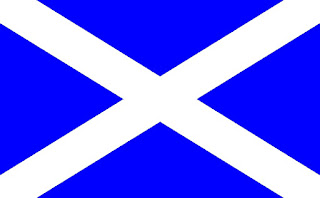
Fast forward to 9th-century Scotland, when the Picts and Scots were trying out the idea of merging their kingdoms for mutual defence against nasties like the Vikings and the English. The Pictish King Óengus II prayed to St Andrew for victory on the battlefield. Why St Andrew in particular instead of any other saint I’m not sure. A cloud in the shape of a diagonal cross appeared in the sky and Óengus’s forces were duly victorious. From then on the Cross of St Andrew became the national symbol of Scotland. It looks like this:

The “blazon” or heraldic description for this is Azure a saltire argent – that is to say “Blue, with a white diagonal cross.” Heraldry is a much-overlooked chapter in the history of Western art and graphic design. If you’re unfamiliar with it, think of the House sigils on Game of Thrones and you’ve got the general idea. I remember finding a comprehensive book on heraldry in the library at my high school and being captivated by all the archaic words and images. Here was a system, centuries old, for capturing complex images in a verbal formula which could be repeated exactly and used to reproduce them.

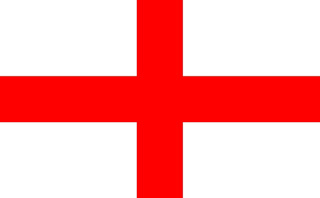
England also has a cross emblem belonging to a saint from the opposite end of the Roman Empire. St George is of course best known for saving a maiden from a dragon, a story likely derived from the Greek legend of Perseus and Andromeda. The detail of the dragon’s demand for sacrifices in return for access to the town’s only well was almost certainly added to the story during the Crusades to stand for the Saracen tax on Christian pilgrimage to Jerusalem. The red cross on white was the prime symbol of the Crusades, and it’s not surprising it became associated with St George, though exactly when and how or what either one has to do with England isn’t clear. The Cross of St George’s blazon is Argent a cross gules.

Monday, 23 November 2015

Reason is not the property of the West

The University of Otago’s second semester ends in October. I knew there were Summer School classes in January and February, because I’ve taken notes in them. I never knew there were also classes in November and December. But here I am. Turns out there’s a five-week course on titled “Introduction to the Māori World”, and one of the students taking it wants notes. My first class was last Tuesday. The lecture was about fundamental concepts in Māori culture, such as tapu and mana, and the polytheistic cosmology which underpins them.

A quick summary of that class. Tapu is of course the origin of the English word taboo, but it’s pronounced differently – both syllables are short and the stress is on the first one. Tapu is the presence or influence of an atua, a god. The gods are present everywhere, and one must treat them with deference and caution. But sometimes it is necessary to lift the tapu so that we humans can go about our ordinary lives without having to worry about it. Then, it becomes noa, which is simply the converse of tapu.

Which gods? On Tuesday we were introduced to four: Papa-tū-ā-nuku, Mother Earth; Tāne-mahuta, god of light and life and the forest; Tangaroa, god of all water, including the water in people’s bodies; and Ranginui, the Sky, Papa-tū-ā-nuku’s lover, who was separated from her by Tāne-mahuta to create the world of light. The gods are the ancestors of all life, including human beings. Most iwi (chiefdom-nations, though the word is usually translated “tribe”) trace their genealogy back to Tāne-mahuta. The chiefs belong to the elder line in each case.

Tangaroa’s dominion over water seems to be responsible for the tapu of blood, which in turn explains why women have a special power over tapu. A man can lift tapu by saying an incantation (a karakia) or using water, but a woman can lift it simply by virtue of being a woman, because women handle blood every month. When you enter or leave a marae – the space built at the hub of every Māori community to house formal gatherings – you pass through a gateway that symbolizes a woman’s legs, so that you don’t bring in any tapu you may have picked up on the outside.

Having just come back from Japan, I can’t help noticing the parallels with Shintō. There again, the kami are immanent in water, earth, and forests. Again, the kami are ancestors rather than creators of the human race, and the Imperial Family is the elder line of descent. And again you have that detail of the symbolic gateway, the torī in front of the shrine, through which you enter or leave the presence of divine power.

But there’s also a big difference. Japan is much more centralized than traditional Māori society, and you might expect to see that reflected in their religions – that Māoritanga would have lots of local spirits and Shintō would have a few big, important gods, like the pre-Christian Greek or Norse pantheons. In fact it’s the other way around. Each mountain, lake, river, and ancient tree in Japan has its own personal kami, but in tikanga Māori it is Tāne-mahuta in every patch of bush and Tangaroa in every body of water.

Mana is the other Māori word, besides tapu / taboo, that has been borrowed into English outside of New Zealand. Both syllables are short, so that to a New Zealand English speaker it sounds like “munna” – “monna” to an American. It’s been appropriated in crap fantasy books and games to denote a limiting resource for magic-users, like pixie-dust but slightly more badass. In fact mana is prestige, charisma, honour, dignity, authority; social power, not magical power. It’s about one’s standing with the gods. Duties and privileges in Māori culture are doled out entirely according to who has what kind of mana.

Friday, 19 June 2015

“Reverse racism” yet again turns out not to be

Apparently South Auckland police have been instructed not to ticket Māori drivers caught driving without a licence. Instead they’re to refer them to community services for support. Predictably, New Zealand political Facebook groups have gone ballistic. At least one of them banned people from discussing this topic just because the comments were coming in too thick, fast, and nasty.

This wasn’t a Government policy release, by the way. For a rare wonder a New Zealand news outfit actually seems to have done some digging; less encouragingly, they’ve pounced on a point guaranteed to get the Anti-PC Brigade frothing at the mouth about “Mowreys” getting “special treatment”. Those of us who have the patience to read past the headline soon encounter the sentence

And police say they have the discretion to do the same for non-Māori drivers, but that’s not spelt [out] in the document.

Which makes the statement a few paragraphs down all the more puzzling:

So how do police determine if a driver is in fact Māori? Police whom One News has spoken to in South Auckland say they find this confusing and they have not been with singling out Māori [sic] in the first place. They say they’ve raised concerns with their bosses but have been told it’s a new policy and they have to get used to it.

Well, here’s a hint, guys: you have the discretion to do the same for non-Māori drivers, so how about you go ahead and act on the new policy whenever you’re in doubt? (The Equal Justice Project reports that the policy has been in place for over ten years, it’s just that this one document happened to mention Māori in particular.)

One News didn’t follow up the bit where the police said the aim was to “reduce Māori offending”. I was never exactly a professional journalist even by the standards of student magazines, but I would have known enough to ask how the police thought that was going to work. Since they didn’t ask, we can only guess. Is it naïve to hope that the police are twigging on to the fact that people who can’t trust them aren’t likely to listen to them? Probably.

See, there was a time when my partner kept getting pulled over for licence checks when she was driving. After this had happened several times she asked one cop why he’d picked on her. He answered “General condition of the car.” And that car was in pretty shabby condition – she got rid of it soon after. You see the logic: drivers of shabby cars are more likely to be unlicensed, or committing some other crime that you can bust them for (such as cannabis possession), than the population average. Therefore, pulling shabby cars over will net them more arrests than randomly sampling the driving population.

Thing is, you can get rid of a shabby car. Unfortunately, exactly the same logic applies if you replace “shabby car” with “brown driver”. It’s not that there’s an especially strong correlation between being brown and being unlicensed or criminal; a weak correlation would be enough. What makes brownness a tempting criterion for profiling is that it’s visible at a glance, whereas more relevant variables like one’s degree of economic desperation or anger towards society are even harder to detect than the crimes themselves.

The problem, of course, is that this isn’t fair. And its unfairness causes two major problems, which together come back around and create a vicious circle. One is that people denied justice by the state are often left no choice but to pursue it themselves, a phenomenon which accounts for the great majority of violent crime. The other is that when a visibly different minority group are often seen in handcuffs or the dock, this creates a certain impression about them in the minds of the majority, which throws obstacles in the path of innocent members of the group whenever they seek employment, rental accommodation, bank loans, or what-have-you; and that, as well as being unjust, further undermines the minority group’s incentive to trust the system or obey its rules. I would confidently bet that these two conditions fully account for whatever real correlation there might be between brown skin and criminal behaviour.

So if South Auckland police have figured this out, and are trying to redress the balance that their own profiling practices have thrown off-kilter – well, better late than never. But good luck trying to get this country’s media to present that side of the story honestly.

Wednesday, 4 February 2015

Whakamanatia te Tiriti

Imagine with me that you’ve got new neighbours, and they’ve offered you some kind of contract to let them use part of your property. Let’s say, just for the sake of the example, that your house has a garage and theirs doesn’t, but they have a car and you get by with a motorbike. So when they move in they knock on the door and ask if they can use your garage. You’re a bit dubious at first, but they come back the next day with a contract all drawn up that says they’ll give you regular payments for maintenance, they’ll always leave you room to store your motorbike in there, and if you need the garage for anything bigger all you need to do is ask and they’ll park on the street that day. You check and double-check the small print and it’s all legit, so you sign.

The following morning you awake to the sound of your neighbours converting your garage to a sleep-out for their teenage son. You run out, waving your copy of the contract and shouting angrily. They smile indulgently and produce their original version of the contract, with your signature impressed on it through carbon-paper. It’s written in their native language, and in translation (they explain) it gives them complete right of ownership over your garage in exchange for a small weekly payment. They apologize for having badly translated it when they gave it to you. But you signed, and they’ve started the weekly payments, they say, so the garage is theirs now.

Morally, you’ve been swindled. How about legally? If you took them to court, what would you argue? Supposing – at this point the analogy gets a little frayed, but we’re approaching the real thing a bit closer – supposing it turned out they belonged to a completely separate jurisdiction, so that you had to recourse to international law. What then?

As a matter of fact, international law has a well-recognised principle devised for this exact situation. After all, when two nations sign a treaty it’s quite likely that the signatories will be seeing it in two different languages. The principle that has been adopted in all such disputes is called contra proferentem, which is Latin for “against the one bringing it forth”. What this means in our analogy is that since you didn’t have any input into formulating the terms of the contract, the version you signed in your language is the only official version. The other one is null and void; you never signed that one! The fact that it was older, and contained the drafters’ true intention, is legally irrelevant.

Thursday, 7 November 2013

This is how I write when I have a word limit

Earlier this year the Labour History Project held a competition calling for essays on people’s vision for New Zealand. I entered this, but – as you can tell from the fact that I’m blogging it – I didn’t win. My title was “We Can Do Better”, because I’d spent all the time available on the essay itself and had to come up with something vaguely snappy-ish at the last minute. Because it was written for an audience of politically conscious New Zealanders, I mention quite a few things in passing which I would have had to sit down and explain for an international audience. I’ve put in links that hopefully should be helpful there. I wrote this all before the recent revelations about the Auckland rape gang and the beyond-incompetent police response to it, or that would have been the major focus of the essay.
Yes, this is how I write when there’s a word limit. When I worked at a local student magazine my style was described as “brisk”. I guess it makes for quicker reading but I hate not being able to explain all the nuances.


We humans are very good at coming up with solutions to our problems. Unfortunately, the solutions tend to create more problems. Plumbing means cleaner cities but dirtier oceans. Literacy means less ignorance but more squinting. The best we can hope for is that the new problems are smaller than the old ones. Then we can solve those ones, and so on.
So if you want to know what the future looks like, don’t look at the people celebrating existing ideas. Look at the naysayers, the people picking holes in them. Look at the Earth Hour people, not the “Human Achievement Hour” people. They’re where the next wave of improvements will come from.
That’s why I don’t take a Utopian approach to politics – any more than to housework. I’m never going to make the house perfectly clean, and it wouldn’t last long if I did. Instead my philosophy is what’s called meliorist, from the Latin for “better”. You see something that needs fixed, you fix it. You see something that needs cleaned up, you clean it up. You make things better than they were before.

Monday, 15 July 2013

The right kind of equality

Nine years ago almost to the day as I write this, the Māori Party was formally established in this country. Many people, most prominently its co-founder Tariana Turia, were dissatisfied with the then-governing Labour Party’s stance on various issues affecting Māori; the final straw was the Foreshore and Seabed Act. The point is that recently, a bunch of dopey munters have set up a Facebook page and called themselves “the Pakeha Party”, because isn’t it racist to have a Māori Party and no Pākehā Party? Er, since people in other countries do occasionally seem to visit this blog, though judging by my comments filter you’re all spambots, I need to explain that “Pākehā” is the Māori word for the European-descended majority culture of New Zealand.
The other thing that happened recently has been dubbed “the Man-Ban” by the New Zealand media, because the New Zealand media is apparently a fourteen-year-old kid. The Labour Party was considering implementing a quota to ensure equal numbers of male and female MPs, and allowing some electorate offices to seek only female Parliamentary candidates. Read that again: they were considering the idea, and (had they not backed down in the face of the media) some electorates would have been allowed to seek only female candidates. Nothing had been decided for sure, and it wouldn’t have been mandatory. But that was enough to spark a nationwide whinge-storm from people who would never have dreamed of running for Parliament for Labour.
You see the common thread here, right? In both cases the complaints are about what has been called “affirmative action” and “reverse discrimination”. If it’s sexist to keep women out of office, isn’t it sexist to keep men out of office? If it’s racist to give white people special treatment just because they’re white, isn’t it racist to give Māori people special treatment just because they’re Māori?

Sunday, 31 March 2013

Prince Caspian

        
But other country

Dark with discord
dims beyond him [Sol],

With noise of nakers,
neighing of horses,

Hammering of harness.
A haughty god

Mars mercenary,
makes there his camp

And flies his flag;
flaunts laughingly

The graceless beauty,
grey-eyed and keen,

– Blond insolence –
of his blithe visage

Which is hard and happy.
He hews the act,

The indifferent deed
with dint of his mallet

And his chisel of choice;
achievement comes not

Unhelped by him;
– hired gladiator

Of evil and good.
All’s one to Mars,

The wrong righted,
rescued meekness,

Or trouble in trenches,
with trees splintered

And birds banished,
banks fill’d with gold

And the liar made lord.
Like handiwork

He offers to all –
earns his wages

And whistles the while.
White-feathered dread

Mars has mastered.
His metal’s iron

That was hammered through hands
into holy cross,

Cruel carpentry.
He is cold and strong,

Necessity’s son.