- Joker is not a comic book movie, at least in the sense of giving you anything you would remotely expect from a comic book movie. It has some character names and place names the same as in the comics, and near the end theres a scene which will be instantly familiar to anyone who knows anything about Batman, but there are no superpowers, no costumes, no heroes, no fantasy or science fiction elements at all. People who enjoy comic book movies but not bleak gritty character dramas wont like it. People who enjoy bleak gritty character dramas but not comic book movies will find nothing objectionable in it.
(Mild spoiler warning, by the way. I dont get into specifics but you may find the edge of surprise dulled on some elements of the movie if you read this post before you see it.)
My name is Daniel Copeland. Immanuel Kant was a real... I like quirky humour, Im incurably philosophical, and I hail from the Antipodes (New Zealand rather than Australia, but still). For my living, I take notes in lectures at the University of Otago on behalf of students with disabilities.
Sunday, 3 November 2019
Why you’re wrong about “Joker”
Wednesday, 14 August 2019
Economics... again. (Sigh.)
In April, New Zealands Labour-led government raised the minimum wage from $16.50 to $17.70 per hour. Basic economic theory, which I have perforce become acquainted with over seven years of taking undergraduate notes in a far-flung range of subjects, would predict that the unemployment rate must rise proportionally. Being also acquainted with the methods by which economists arrive at basic economic theory, I am therefore entirely unsurprised to read that
New Zealands unemployment rate fell to 3.9 percent in the second quarter of 2019 from 4.2 percent in the previous period, compared to market expectations of 4.3 percent. That was the lowest jobless rate since the second quarter of 2008, when it was 3.8 percent. Unemployment rate in New Zealand averaged 5.99 percent from 1985 until 2019, reaching an all-time high of 11.20 percent in the third quarter of 1991 and a record low of 3.30 percent in the fourth quarter of 2007.
In case youre wondering, yes, the second quarter of 2008 was towards the end of the Labour Partys previous term in government, as was that record low in 2007, and 1991 was in the first term of the National government before them. Trading Economics has a graph of the New Zealand unemployment rate for the last thirty-three years, which Ive taken the liberty of colour-coding rather crudely in Paint according to the leading party of government. (Note for Americans: in New Zealand as in most of the rest of the world, the left-leaning party is branded red and the conservative party blue.)
I dont want to read more into this than is warranted. National took the reins of government from Labour twice during this period, and both times came shortly after worldwide financial crises, so Id be cautious about blaming them for the big upticks in unemployment at those times. Crises aside, the longer-term trend is downward. What I do want to point out is that there is no sign of the upward drift that orthodox economic theory would lead us to expect during Labours tenures, despite the fact that they raise the minimum wage every year by much bigger increments than National does.
This semester Im taking a first-year economics class, again. Its struck me right from the start how much its re-treading ground Ive been over and over since the first time round, seven years ago. If that doesnt sound surprising, by contrast Ive been assigned to papers in various health professions each semester since 2013, and every year theres been a module on cancer, and every year theres new insights about how cancer happens and what healthcare providers can do to fight it. Thats what progress looks like. Thats how you know a discipline is open to learning new truths.
In fairness, this semesters lecturer has mentioned a few things which, in previous economics classes Ive been to, have been skated over completely. He did take care to point out, for example, that sometimes people dont buy certain goods or services not because they dont want to pay the market price but because they cant the first time Ive ever heard this distinction highlighted. (Unfortunately he seems to have missed some rather major implications of it, but well get to that.) Also hes promised an upcoming block of lectures on market failures, which up till now I havent heard economists talk about to students below third-year.
Still, as in previous years, the lecture material treats labour as just another good or service, which workers sell and employers buy. When you draw a supply-and-demand graph, the demand curve slopes downward, meaning that the more something costs, the fewer people will be willing to buy it and the less of it will get bought. Meanwhile the supply curve slopes upward, meaning the more it costs, the more people will be willing to sell it and the more of it will be available for sale. Where the two curves cross, the amount people are trying to buy equals the amount available for sale, and the price at which that happens is the market price or equilibrium price. Theyre called curves but theyre usually graphed as straight diagonal lines. The slope of each curve is called its elasticity.
Im not allowed to ask questions in lectures, and after any lecture theres usually a few students wanting to talk to the lecturer and their practical need for information obviously takes precedence over my idle curiosity. But after the lecture introducing the concept of a supply curve, I had a rare opportunity for conversation.
Sunday, 24 March 2019
The challenge of weeding out racism
Like many New Zealanders, I was inspired by our Prime Minister Jacinda Arderns declaration in the wake of the terror in Christchurch that This is not us. I took it as a signal of our intentions for the immediate future. From now on, from this day forward, this is not us. From now on we are vigilant for the early warning signs of white supremacist violence. From this day forward we reject every expression of racism and hatred and stop it in its tracks. To this promise we pledge ourselves. So say we all.
Taken as a statement of New Zealands past and present the comfortable bubble we were all living in up until that Friday Im afraid it was inaccurate, as many other New Zealanders have sad cause to know intimately. We are a nation where cries of Go home! follow brown-skinned people down the street. We are a nation that elects anti-Muslim racists to Parliament and appoints their party leader to the second-highest position in the land. We are a nation whose primary political divide in our most recent election was between those who were racist against Māori and Pacific Islanders and those who were racist against Asians.
I happen to have the tremendous good fortune of being a white man; the only racism Ive had come my way was a couple of the half-dozen occasions when Ive been mistaken for Jewish. And yet even from this position of privilege Ive seen plenty of racism directed at others. How much more visible must it be to those on the pointy end?
(Content note: If racism in New Zealand is the last thing you need to be reminded of just now, Id advise not reading any further.)There was the guy in the supermarket who yelled Come on, [racial epithet]! when a South Asian worker, busy arranging trolleys, briefly got in his way. There was the guy who expressed regret, in tones of deep distaste, at how his country was being taken over by persons of a yellow persuasion. There was the guy on the bus who hypothesized that the East Asian owners of the internet café next to the bus stop had taken down the bus timetables to fool potential customers into parking there. There was the guy who, having come off his bike to avoid a car rounding the corner, shouted not Watch where youre going! nor Ive got a right to use the road too! but Bloody Asians!
Ive heard people yell at the television Youre not Māori! when a commentator claimed otherwise who didnt look Māori enough for their judgement. I lived through the time when Arderns party (before she entered Parliament) blocked Māori customary property claims to the foreshore and seabed while allowing commercial ones, and sold this policy to the nation as the Māoris want to stop you going to the beach (to complete the irony, the Māori claimants more often wanted to ensure public access to beaches). I heard people then joke, since by then our laws had abandoned the racist blood quantum criterion for telling who counts as Māori, that maybe they would still be able to go to the beach if they feel Māori. It wasnt that long ago. New Zealand is still pretty much the same people now as it was then.
Once, conversing about my job with a social work lecturer after class, I happened to mention that in my dentistry classes there was a high proportion of Asian students. Insofar as I had a point it was to puzzle over why so few Pākehā students were going into dentistry (the paucity of Māori and Pacific Islanders in the health professions is, alas, less mysterious). But the lecturer whose inclusive attitudes I had until that point admired took me to be saying something quite different. Yeah, he said, they shouldnt let them in to take those places off our people, should they?
Saturday, 12 January 2019
Why nudity is worth defending
Nudity ought to be legal and accepted everywhere it is physically safe. The fact that it is not is a societal injustice. I know most of you arent going to agree straight off the bat, so let me lay out my reasoning and see what you think.
Admittedly, its not a major societal injustice. There are other injustices with more dire consequences for more people, that more deeply undermine our ability to trust each other and are more urgent priorities. Relatively few people share my autistic sensory aversions to clothing, and those aversions dont usually rise above the level of mild discomfort unless it gets very hot or the clothing in question is wet. (Swimming-togs feel like knives cutting me.) But most of the time, I think, struggles against different injustices help rather than hinder one another. Raising peoples awareness of one injustice makes them more alert to other injustices, not less. It isnt a competition.
First point: People deserve a degree of respect simply on account of being people. That includes being able to go about ones daily business without harassment from ones fellow citizens. There is no amount of clothing one might wear or not wear that would make one deserve to be yelled at, ogled, pelted with rubbish, or chased off the streets. It is therefore unfair to yell at someone, ogle them, throw things at them, or chase them away because of what they might choose to wear or not to wear.
Second point: Injustice is fundamentally the same thing as unfairness. We just tend to reserve the weightier word for when there are graver consequences, such as when discrimination is enforced by the police or when it prevents people from participating fully in society. Therefore, if people are threatened with arrest or prevented from participating in society due to what they are wearing or not wearing, that is an injustice. If the law allows or prescribes for it, the law is unjust.
Third point: People are in fact harassed, arrested, and ejected from public places if they go nude. Weve just agreed that this would be an injustice if it happened; well, it does happen, and therefore it is an injustice.
Finally, this particular injustice is enforced by society as a whole, not just by officers of the law. That makes it a societal injustice. The fact that nudity is not legal or acceptable is a societal injustice. There you go.
Somehow this is easier to see when the body taboo in question is that of a culture that isnt our own when its Arab police forcing women into hijab or French police forcing them out of it, Victorian missionaries imposing Western clothing on Pacific Islanders or that one group of Pacific Islanders (the Kwaio on Malaita in the Solomons) who impose toplessness on Western visitors. But an injustice is an injustice, and it is in the nature of societal injustices that they feel like ordinary common sense to enculturated members of the societies that enforce them. Which would include ours. Which means that just because wearing clothes feels like ordinary common sense to us, doesnt mean that its not a societal injustice.
Now, how serious an injustice is it? Is anyone seriously hurt by having to wear clothes (obviously not counting us autistics and our autistic sensory issues which make us, as we are reminded daily, such a nuisance to normal people)? Well, there are a couple of problems that I think are bound up with it.
Thursday, 4 October 2018
Cannabis
So it turns out the Otago University Proctor has been burgling student flats and nicking peoples bongs. There was a big protest against him last week, which I sadly couldnt attend due to a class. I remember a time when the student libertarians could make common cause with us campus Lefties on cannabis decriminalization, if nothing else, but all the right-swinging commentary Ive seen on the issue this week has been of the bog-standard cookie-cutter if you think this is abuse of power go live in North Korea variety.
It is morally wrong for a person in authority to break into peoples private spaces and remove things unless their authority is specifically and publicly constituted to grant them the power to do that, and the Proctors is not. This follows so straightforwardly from the trust principle that I cant be bothered laying it all out. It is equally clearly morally wrong to constitute any authority to give its bearer the power to break into peoples private spaces and remove things unless the things in question pose sufficient risk of harm in that space to outweigh the breach of trust occasioned by the break-in. Any law which grants (for example) the police such powers is an immoral law and ought to be both changed and, until it is changed, resisted. Again, taking the trust principle as the basis of morality, which I do, that follows as night follows day. And Ive argued the trust-morality connection over and over again on this blog, so I shall skip over that too. The only remaining question, and the topic of this post, is: does cannabis pose a risk of greater harm than is caused by arrests, seizures, prison sentences, and permanent criminal records?
The answer to that question is as follows:
No.
Well, that was easy. See you next ti
...oh, all right. Here, have a graph. If you click it, the link will take you to the data behind it.
There are exactly zero confirmed cases of death from cannabis use in stark contrast with alcohol and tobacco, both of which are legal. For addictiveness its roughly on a par with caffeine. It is associated with the same sorts of respiratory injuries that tobacco is, but thats (as far as researchers can tell) because its delivered as a smoke and so comes along with tars and similarly harmful products of combustion. Hence if your drug laws are to have any semblance of logic or consistency, either you must allow cannabis or you must ban alcohol and tobacco. And if youre thinking about the latter option, the United States already tried that with alcohol and it was a disaster.
Cannabis does bring a heightened risk of developing schizophrenia if its heavily consumed in adolescence. That, Ill grant you. And it is reasonable to ask how, once legalized, it would be kept out of the hands of teenagers, given that the surest way to get teenagers to try something is to tell them its for adults only, as the tobacco companies know to their tremendous profit. But Ill tell you a big secret: prohibition isnt keeping it out of the hands of teenagers either. If you sell a substance legally, youll probably think twice about selling it to under-age people because thatll get you in trouble. If its a prohibited substance youre in trouble anyway, so why narrow your market?
The damping effects of cannabis on motivation are much better-known than the medical evidence for them actually warrants. Part of the problem is that people assume the cause upon seeing the effect. I have long hair that I cant seem to get the knots out of, and I dont wear shoes much, and so I have often been asked by complete strangers where they can score some pot in Dunedin; whereas you probably wouldnt make that assumption of an internationally successful scientist and author like, say, Carl Sagan. On the handful of occasions when I have smoked pot, Ive found my motivation increased rather than lowered one time I stayed up all night writing.
I wont deny there are people who take up cannabis and proceed to lose all interest in life; but, as is typical with other substance dependencies, I suspect youll find this is a sign of underlying stressors like an abusive home life or an unsustainable work or study schedule with no other way out. And if someone is having substance problems, its easier for a legal supplier than an illegal one to refuse their business, as G. K. Chesterton long ago pointed out with regard to alcohol. Perhaps this is why Portugal has experienced such a drop in drug-related social problems since they legalized all recreational drugs there.
There are of course many wild claims out there about the health benefits of cannabis; if you believe some people, itll cure everything from cancer to the common cold. Its hard for researchers to find out which of these claims have substance on account of, you guessed it, prohibition. I mean, sure, a government can license a pharmacology institute or whatever to do controlled experiments, but they cant exactly license the entire supply chain so the institute can get hold of enough of the stuff to run anything with a meaningful sample size. Nevertheless, its pretty clear that cannabis is an effective painkiller, and last I heard there was some evidence at a not sure yet but worth following up level that it might slow the progression of some cancers.
Even if you want to be cautious about recreational cannabis, there is absolutely no justification for keeping it from being used as a medicine. Obviously it wouldnt come from the pharmacist as a cigarette, since smoke and tars do so much damage to your lungs. And its a bit slow to get working when taken orally, hence why people sometimes get into trouble the first time they try edibles, eating more and more just because it hasnt hit yet. The fastest form of delivery might be a nasal spray; your smelling nerves take in molecules from the air because thats how smell works, and theyre a direct channel to the brain because thats how nerves work. For people with impaired olfactory function, an inhaler might be a second option.
Actually I started writing this a few days before the protest. I was editing some lecture notes in a university library a couple of tables away from the door to a videoconference room, and three students went in and proceeded to hold what was evidently the Nay side of a video-link debate on the legalization of cannabis. The male one of the three had a particularly loud and annoying voice, but all of their arguments were so stupid that I must, in charity, suppose that they had been roped in to argue the Nay side without believing a word they were saying. (This is why Ive never done competitive debating.)
Their worst argument of all was against medicinal cannabis. We dont need it, said Mister Loud Voice, because weve already got painkillers. Maybe if I hadnt had so many pharmacy lectures in the last few years that wouldnt have sounded quite so head-smackingly silly. Yes, we have other painkillers. We have paracetamol (what North Americans call acetaminophen), which is safe unless you have liver disease. We have non-steroidal anti-inflammatories like aspirin and ibuprofen, which are moderately safe unless you have stomach ulcers or acid reflux. We have corticosteroids, which do nasty things to your bones if taken for any length of time, and we have opioids, which right now are killing Americans in record numbers as the cohort who got addicted to them en masse in their teens enter retirement. A lot of elderly people have both liver and stomach trouble and cant really afford to make their bones any weaker than they already are. What possible justification can there be for denying them a safe, effective painkiller?
Close behind was the bit where they said their main concern about cannabis was that it might lead people on to other, more harmful drugs. Yes, Im sure that happens. But do you know why it happens? It happens because once youve got into cannabis, well hey, youre already breaking the law and thumbing your nose at a disapproving society, so why not go for a harder-core experience? The same happened with alcohol when that was prohibited. Once again, legalization would lighten the problem, not worsen it.
All the same, that argument does illuminate the cultural mindset that hangs like a ball-and-chain about the ankles of the legalization movement. The basic problem is one of our mental categories for hazardous substances. Some substances are filth and some are poisonous and some are medicines and some are chemicals, but the troublesome class here, the one cannabis has been put into, is the class we think of as Drugs! (The exclamation mark should be pronounced as a horrified gasp.) I cant just call them drugs, because that word, like chemicals, has an application which is scientifically meaningful, morally neutral, and vastly broader than the colloquial one. Drugs in the scientific sense do include cannabis, and also alcohol the phrase drugs and alcohol makes about as much sense as vehicles and cars and caffeine, and nutmeg, and St Johns wort, and moisturizers, and anything else that has a dose-dependent effect on the human body or mind.
Drugs! as a subclass of drugs share no common attribute but that they are illicit. But because theyre a culturally recognisable category, its easy to think of them going together. Thus, to Mister Loud Voice and millions like him, cannabis goes naturally with heroin and cocaine and methamphetamine because they are all Drugs! The government in its infinite wisdom has recognised that people should not use Drugs! and so has passed laws against them. If you let people use one kind of Drugs! then you are declaring that Drugs! are OK after all, so of course theyre going to move on to other kinds of Drugs! as well. In case you havent guessed, I think the very concept of Drugs! hinders rather than helps us in developing rational drug safety policies. But thats by the by.
So if theres nothing wrong with cannabis, why is it illegal? I dont think Mister Loud Voice used that particular argument, but others certainly have. The answer, of course, is that most law-makers think that way too. But why did it become illegal in the first place? Recreational marijuana, previously the most popular legal alternative to alcohol, was banned in the US just when Prohibition was lifted and all the enforcement officials were looking for new jobs. Medical cannabis followed in the 1970s as a casualty of Richard Nixons War On Drugs. And the US has enough clout internationally that a lot of other countries still think its an example worth following. Im chary as a rule about Big Bad Government conspiracy theories, but in this case we have a paper trail and a confession:
The Nixon campaign in 1968, and the Nixon White House after that, had two enemies: the anti-war Left and black people. You understand what Im saying? We knew we couldnt make it illegal to be either against the war or black, but by getting the public to associate the hippies with marijuana and blacks with heroin, and then criminalizing both heavily, we could disrupt those communities. We could arrest their leaders, raid their homes, break up their meetings, and vilify them night after night on the evening news. Did we know we were lying about the drugs? Of course we did.
And nowadays of course you have the private prison industry in the US, which has threatened to sue several states if they legalize cannabis and thus reduce the prison population with its convenient supply of cheap labour and legal inability to vote. So in summary, the Proctor of Otago University has committed burglary against the community he is tasked with serving in order to uphold a legally-sanctioned societal prejudice known to be based on fifty-year-old racist lies. I would have joined in the protest if I could. Consider this my contribution.
Thursday, 26 July 2018
Don’t let fascists steal free speech from us
Two alt-right speakers from Canada, Lauren Southern and Stefan Molyneux, have decided they will, after all, go ahead with their visit to New Zealand (temporarily cancelled) where they will espouse their views. The venue is, as I write, being kept secret. Previously, they wanted to speak in an Auckland venue called the Bruce Mason Centre, but were denied that opportunity at the instruction of Auckland Mayor Phil Goff. This has raised concerns about freedom of speech in New Zealand, and not just among those who agree with their position. Chris Trotter, New Zealands most respected Left blogger, has taken up the cause in several recent posts on his blog Bowalley Road.
Ive been drafting this post for two years now; the issue keeps coming up and going away again, and I have to change the bits where I relate it to current events. Its a bit bigger than I can really pin down in one post. Im going to skip out some things I originally planned to say about particular progressive concerns that some believe constitute assaults on free speech trigger warnings, safe spaces, cultural appropriation because they just make the whole thing too unwieldy. I may devote more blog posts to them in future. Today my topics are: What is the ethical basis of the right to free speech? What sort of policies do we need to build around it? And what are its limits?
Political discussions frequently open with assertions of rights that the disputants hold to be incontrovertibly inviolable endowed, in the famous words, by the Creator. But what makes a right a right? Why is it that some good things you might want are your right to enjoy, while others are merely privileges? What makes the difference? And what if one of your rights cant be granted without breaching someone elses rights? What do you do then? This sort of question is why I like to go back a bit further, behind the concept of rights to their basis in ethical philosophy.
In case youre a new reader, Ill just quickly run you through my basic moral philosophy. Morality isnt something objective, not if by that you mean its something out there in the universe, independent of our minds. You cant logically prove a should statement from an is statement without at least tacitly calling in another should statement, and if you try to prove that second should statement you just go around the circle again, and so on forever. And perhaps thats just as well, because if morality was something out there, then any intersection between moral facts and human well-being would be coincidental. Appeals to moral authority, even cosmic moral authority, dont help: You should obey the authority is just another should statement and another trip around the circle.
Hence, morality is subjective. But subjective is not the same as arbitrary. To call something subjective just means its an experience that people have rather than a thing in the universe its in here rather than out there. Sweetness is subjective, but no-one disagrees as to which is the sweeter of maple syrup and grapefruit juice. You can justify a should statement; you just have to back it with an I want statement. (I want to be healthy, therefore I should exercise more than I do.) As a social species, pretty much anything we want requires cooperation with other people, and cooperation requires trust, so we evolved moral instincts to allow us to trust each other. Therefore, in my view, trust is the basis of all morality.
To earn trust, your actions must fulfill three conditions. They must be benevolent; they must be consistent; and both of these facts must be clear to other observers. Benevolence alone is not quite enough. Pure benevolence, the greatest good for the greatest number, is the moral philosophy known as utilitarianism. The harmonics of cold calculating efficiency that cling around that word somewhat misrepresent the idea; utility in the philosophical sense includes beauty and joy as well as usefulness. However, the calculating part is bang-on. Utilitarian philosophers spend a lot of time balancing harms and benefits and fretting about whether theyve left something out. And I dont know about you, but that makes me nervous. I cant help worrying that they might end up putting the things I care about on the sacrifice for the greater good side of the equation.
When you factor in the consistency and the clarity, utilitarianism gives way to a couple of other moral schemas. One of them is virtue ethics if you practise being a good person until it becomes habit, your actions will be clearly and consistently benevolent. This isnt particularly relevant to todays topic, and I mention it only for completeness. The other one, however, is the answer to our question: the origin of rights. To be clearly and consistently benevolent is to commit to doing some good things all the time for everybody while refraining from doing some bad things ever to anybody. When a society makes such a commitment, whether in law or custom, it thereby grants its members the right to enjoy the good things and the right not to suffer the bad things. Thats where rights come from.
And that helps us answer our other question. When you have to choose one right over another, you should honour the one that best serves the principle of trust. Suppose youre a surgeon, and you have in your hospital five people urgently needing different organ transplants and also a healthy young person whos come in for a sports injury. A utilitarian calculus might prompt you to at least consider killing the young person to harvest their organs, sacrificing one life to save five. But of course if you did that, no patient could ever trust you again not to kill them for their organs. The trust principle would therefore accord with what (I sincerely hope) your moral instincts tell you and render such a course of action unthinkable.
Since the seventeenth century most of the questions vexing Western political theorists have been variations of What is the right balance between peace, justice, and freedom? When you find yourself facing a trade-off between the three, how do you choose which to preserve and which to sacrifice? (This is not quite the same as the question actually driving social progress, which is How many crumbs do we have to give these annoying poor people before theyll shut up and go away?) Whats often not noticed is that peace, justice, and freedom all have the same end-goal, i.e. not having to fear violence any more. Peace means you dont have to fear violence from strangers. Justice means you dont have to fear violence from your neighbours. Freedom means you dont have to fear violence from the state.
But you can never have complete freedom in any society, because freedoms are necessarily in tension with each other. If you are free to do some particular thing, that means I am not free to stop you from doing that particular thing, and vice versa. So, for instance, you are free to play irritating contemporary music and theres not much I can do about it, but I am not free to walk around in public wearing the amount of clothing I feel physically comfortable in. If I call the police and complain about your music Ill be ignored, unless its very loud; if you call the police and complain about my nudity Ill be arrested. Conversely, if I try and cut the power cord on your stereo Ill be the one in trouble, whereas if you threaten me with assault unless I put some clothes on the authorities will probably agree I had it coming. (As you see, legal freedoms tend to get skewed towards majority cultural groups and away from, in this case, those of us who have autistic sensory issues.)
Now we can narrow in from freedom generally to freedom of speech in particular.
Friday, 1 June 2018
Against enforced monogamy
The issue of sexual violence has never gone away. The #metoo movement is just one more response to it, though so far one thats been getting more notice than many. In the last, I dont know, month or so, the media at large has at last started to notice the well-established connection between misogynistic violence and mass shootings, and the word incel involuntarily celibate has achieved a greater currency than it had before. I gather incel was first coined to describe the experience of being queer and unable to find someone of the gender you like who likes people of your gender, but it has now unfortunately been very firmly appropriated as a self-identifier for that subset of men who (a) arent getting sex and (b) believe they are owed sex. And this of course has led to suggestions that maybe mass shootings would be averted if more women would take one for the team and have sex with incels. Because, apparently, some people arent content with being horrible human beings in the privacy of their own homes.
I have seen it claimed, mind you, that incels arent real because its not actually hard to find someone to have sex with and these men must be just being needlessly picky (or obsessive) about their choice of partner. I cant hold with this. For some people it may be easy to find people to have sex with, but there are many circumstances which make it difficult for others. One, as already noted, is being the only queer person in your offline circle. Various disabilities physical and social have similar effects. Its not the not getting sex that makes incels horrible people, its the belief that they are owed it. Men who believe theyre owed sex are horrible people whether or not theyre getting it, which brings this digression nicely back to the point.
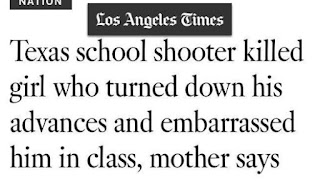
A couple of weeks ago a guy walked into Santa Fe High School in Texas and shot people, killing ten of them. Following an excellent suggestion thats been passed around Twitter and Tumblr, Im going to refer to the perpetrator as Shooter #101 (this was the 101st mass shooting in the United States this year). The mother of one of the dead, Shana Fisher, has claimed that her daughter was repeatedly harassed by Shooter #101 for a date and ultimately turned him down publicly in front of the school, and that she was the first person he shot. Several articles on the incident have used this for a lede. Apparently it hasnt been corroborated by witnesses which is bad enough, but Ive worked in journalism in a very small way, I can understand going ahead with the article on the assumption that the mother knew what she was talking about. Whats not forgivable is that this was how they framed this element of the case:
![Spurned advances from [Shooter #101] provoked Texas shooting, says mother of girl killed (NZ Herald) Spurned advances from [Shooter #101] provoked Texas shooting, says mother of girl killed (NZ Herald)](https://blogger.googleusercontent.com/img/b/R29vZ2xl/AVvXsEjgVCEJ6z8jWhhFNm8c0jcO9Kpiu6z6KMbsXi2kuQHoSbWxNr5miIiPGT5XcxfkcyvzXIF4GpRI7JxQImrWkPw5canjZBSB4jgkOa99i0uBWFhBVRCPk6wA-gfsq6JQj2qdVt6ope7S5FeI/s320/santafe1.jpg)

And these are far from the worst. You see the narrative being put forward here? Men (overwhelmingly) do the shooting, but never fear, we can always find a way that its ultimately a womans fault. Women are put on earth to meet mens needs, and men go astray when women fail to fulfill that function. Mens sexual and romantic yearnings give them a proprietary right over womens bodies, attention, and time. Most commentators would recoil from this position if it were stated openly; the danger of framing male violence as the headlines above do is precisely that this narrative sneaks under the radar as a tacit premise instead of being exposed to challenge as an explicit proposition. To men who do believe that women owe them sex, this subtextual confirmation helps that belief fit just that little bit more comfortably into their picture of the world.
Wednesday, 21 March 2018
What economic and government systems do you think function best?
Last week one of my Tumblr followers asked me the above question. I wrote down as many things as I could think of in the time I had, which wasnt everything. I started putting down justifying arguments for each point, but found that this was making it far too long for a Tumblr post. So Im repeating my answer here, with a few more points and some argumentation to back it up and hopefully a bit more coherence (but you be the judge of that).
I try to keep my thinking grounded in empirical evidence, but I only have so much time for doing research and what I do find is inevitably biased by being filtered through my own perspective, which is not neutral but was formed through many years of political involvement. I began my political life in 1996, at the age of 18, in a protest against Otago University raising tuition fees. It was a big protest, because at that point New Zealand tertiary institutions had only been charging tuition for a few years and it had caught a lot of people by surprise. So there were a lot of dedicated protesters involved. Many of them were Marxists, so I started off as a kind of Marxist camp follower leaning towards anarchism of sorts. I still feel loyalty to this crowd, and there are some social values that I still think Marxism captures better than most other politics. But looking at the empirical evidence I am unable to endorse the prototypical Marxist plan for achieving those values.
In particular, countries that remodel themselves from the ground up with armed Marxist revolutions always end up as repressive, poverty-stricken dictatorships. I know of no exceptions. Some are worse than others if I had to choose, Id much rather live under Fidel Castro or Muammar Gaddafi than Pol Pot but none of them have ever produced the communist paradise, or even the socialist interim state, that Marx envisioned. In a few places in the world you can see a Marxist regime and a liberal regime side by side, with the same geopolitical and environmental conditions, and compare their socioeconomic outcomes; the liberals (West Germany, South Korea, Botswana) always do better than the Marxists (East Germany, North Korea, Zimbabwe). And really, Marx should have known better, given that the prime real-life event he used to exemplify his theories was the French Revolution, which had exactly the same effect in installing the Napoleonic Empire.

Empirically, the systems which function best, in the sense of facilitating human life, health, knowledge, freedom, prosperity, and equality, are those known as mixed economies, like those of Scandinavia and Japan and formerly New Zealand. These combine open but well-regulated markets with stable democratic government, progressive tax systems, state-owned infrastructure, and high public expenditure on social welfare, health, and education. But of course there are still a great many areas in which I believe progress could be made. And here they are.
Monday, 29 January 2018
Economics, the evidence-free discipline – from the horse’s mouth
If economists wished to study the horse, they wouldnt go and look at horses. Theyd sit in their studies and say to themselves, What would I do if I were a horse?
Ever since I started working in a job that periodically puts me in economics lectures, Ive noticed that economists have a very different idea of what constitutes evidence for their statements than what scientists do. And when I say noticed, I mean its been thunderingly obvious. The health sciences, in particular, spend hours upon hours drumming into their students heads how much it takes to call your practice evidence-based. In economics lectures Ive heard lecturers say outright, If your analysis of the data disagrees with economic theory, trust economic theory. Economics is at about the stage medicine was at in the mid-nineteenth century, when blood-letting and cold showers were the go-to treatment for every ill because physicians knew how the body worked, damn it, and didnt need jumped-up empiricists coming in telling them how to do their job thank you very much.
But I dont think nineteenth-century physicians ever proudly declared that their theories were evidence-free and thought it a mark of superiority. Yet I encountered economists saying exactly that, in an article from only a year ago, in a debate with a libertarian on Tumblr recently. Im referring to the Mises Institutes Ten Fundamental Laws of Economics. The list includes some uncontroversial items, but also contentious ones such as Productivity determines the wage rate, Labour does not create value, and Profit is the entrepreneurial bonus. It ends with Law 10: All genuine laws of economics are logical laws. This is explicated as
Economic laws are synthetic a priori reasoning. One cannot falsify such laws empirically because they are true in themselves. As such, the fundamental economic laws do not require empirical verification.
Which basically translates to Anyone who disagrees with us is wrong by definition. This is not about economics being a soft science rather than a hard science. This statement makes economics as practised by the Mises Institute not a science at all.
The phrase synthetic a priori is, in this context, pure bafflegab, but unfortunately its going to take a bit of unpacking. The philosopher Immanuel Kant divided truths along two lines. First, they can be synthetic or analytic. An analytic truth is basically simply a definition of a word: the usual go-to example is All bachelors are unmarried, which is true because being unmarried is part of the definition of being a bachelor. A synthetic truth is one that cant be derived from the definitions of words alone, such as I have two cats. Second, truths can be a priori or a posteriori Latin for from before and from after, respectively. An a priori truth has to be true in any conceivable universe; you know it is true before you go investigating. One plus one equals two is an a priori truth. An a posteriori truth is one that might or might not be true, and that you therefore cant know is true until somebody investigates, such as I have eaten the last of the cheese.
Two lines of distinction potentially divide a set into four subsets, in this case analytic a priori, analytic a posteriori, synthetic a posteriori, and the one were interested in, synthetic a priori. Three of these are uncontroversial. All philosophers agree there is no such thing as an analytic a posteriori truth, and most philosophers agree there are analytic a priori truths and synthetic a posteriori truths. The big disagreement over Kantian philosophy is over whether there is such a thing as a synthetic a priori truth whether there is anything that has to be true in any conceivable universe, but that cant be reduced to definitions of terms and logical deductions from such definitions. The Mises Institute puts economic principles in this category. What would this mean?
Kant himself populated the synthetic a priori category with mathematical truths like One plus one equals two. Personally Im inclined to the school of thought that mathematics is in fact analytic. There are arguments to be had on both sides, and I wont go into them. I suppose the four-colour map theorem might count as synthetic a priori no-one has ever created a map that needed more than four colours to fill it without any two areas of the same colour touching, and somebody has proved that this is indeed impossible via a computer program, but the proof is too complex for a human mind to comprehend. The point is that no-one can even imagine such a map. Its inconceivable. For the Mises Institutes laws to be synthetic a priori, it would have to be the case that no-one could even imagine a world in which productivity did not determine the wage rate.
The Mises Institute might respond that someone who thinks theyre imagining a world in which productivity doesnt determine the wage rate is kidding themselves, just as someone who thinks theyre imagining a five-colour map is kidding themselves (your mental picture is just a vague squiggle; you arent filling in the details). But it is not at all difficult to imagine a shareholder-profit-maximizing corporation deciding to funnel 100% of the profit margin from a productivity boost into shareholder dividends instead of wages. Nor is it hard to imagine every other firm in the market doing the same, thus leaving no competing employer to whom the employees could defect. The Mises Institute is committed to the claim that this scenario is not merely implausible but unimaginable. Either that, or the phrase synthetic a priori in their statement is bafflegab.
Of course, if economic principles are not synthetic a priori, then what the Mises Institute is doing is making up excuses for why their beliefs shouldnt be exposed to empirical testing, and if you find someone doing that then theyre up to something dodgy. My Tumblr correspondent claimed that societies organized according to these theories could produce and distribute goods and services way more [efficiently] than any Marxist or Keynesian society can. Well, thats an empirical question. I have sat through more than enough economics lectures to be well aware of the theories as to why the free market is meant to be the most efficient means possible of maximizing production and optimizing distribution of goods and services. But only empirical data can tell us whether it is the most efficient means possible. Any attempt to put it beyond the reach of empirical investigation, such as the Mises Institute is here guilty of, suggests that its proponents fear it would disappoint them.
And before someone asks, yes, for all the respect I have for the Marxist community for the work they do in activism towards social change, I do have to concede that Marxists are equally prone to shielding their theories from the possibility of being refuted by reality. I have written about that elsewhere on this blog, if you care to go looking. But Marxist theories dont at present dominate the global economic system. Capitalist ones do. The point is that only reality can tell you whats true. Nineteenth-century medicine wasnt dislodged by some other theory-driven approach; it was corrected by recourse to empirical evidence. In economics as in medicine, when the experts cling to their pet theories over reality, people die. We need evidence-based economics and we need it yesterday.
Friday, 20 October 2017
I thought I would feel better about this than I do
As of when Winston Peters finally made up his mind who to go with yesterday, Jacinda Ardern is now Prime Minister of New Zealand, in a coalition government formed of Labour, New Zealand First, and the Green Party. I have mixed feelings about this. There was no big surprise in the special votes; as commentators evidently better-informed than me predicted, they took two seats off National and handed one to the Greens and one to Labour. And, as any New Zealander with half a brain could have told you, the prospect of a National-Green coalition (raised in all seriousness by some pundits evidently lacking that endowment) was a chimaera.
The good part of my mixed feelings is obviously that weve got a new government, which if not for the presence of New Zealand First would have been the left-most one of my lifetime. In concrete terms, this countrys decades-long trajectory towards Dickensian inequality and poverty might actually go into reverse. We might get a liveable minimum wage. We might get housing for homeless people. We might get unions strong enough to make a difference. We might get an economic strategy that doesnt depend on turning our rivers into sewers and lying to the world about it.
The bad part starts with New Zealand First. I dont think were in for a three-ring circus like the National-New Zealand First coalition government of 1997, because this time Winston hasnt brought in a cadre of loudmouths with egos as big as his own. Jim Andertons old gibe, calling the party Winston First, is even truer now than when he made it in the 1990s. But I dont know, and Im not looking forward to finding out, how much of its left-wing promise the Labour-Greens bloc has had to concede in order to secure Winstons support.
I do know, as Ive said on this blog more than once, that Winstons anti-immigrant stance is a cynical façade put on to garner votes. I also know that Winston is 72 years old, and likely to retire within a decade possibly by next election, depending on how well his health weathers old age. What happens to New Zealand First then? Will it crumble, leaderless, into irrelevance? Or will Winston be succeeded by one of his many sincerely racist admirers? And then will New Zealand have its own Brexit, its own Trump, to deal with? These questions scare me.
Also not comforting is the fact that National still has two more seats than Labour and the Greens combined. Im not confident enough in my expectation of a stable coalition not to worry about what that will mean if it does fall apart; and Im bamboozled, frankly, by the fact that it happened at all. How does a government preside over as big a social and economic crisis as this one has and still attract more votes than its competitors? What does it say about my countrys soul that nearly half of us are prepared to shrug off the child poverty and homelessness were seeing now as long as the men in suits get to hang on to more cash come tax time? Are we all clones of Cersei Lannister?
I dont like not understanding these things, I honestly dont. Its a cheap rhetorical trick to claim to be mystified by your opponents stupidity and malice, and more to the point its purely performative. It makes a good show if all you want is to assure people on your own side that youre one of them, but it doesnt budge your opponents an inch except to confirm their belief in your stupidity and malice. And if you really care about your political ideals, its your opponents you want to be shifting. The fact that I dont understand what motivates people to vote National means I have no idea how we can motivate them to vote more leftward. Maybe thats the real reason why this election result brings me so little joy.
Friday, 6 October 2017
Mass shootings are not a mental health problem
A few days ago, an old white man fired a lot of guns into a crowd of people at a music festival in Las Vegas. Apparently he also shot at a nearby fuel storage site in a failed attempt to cause an explosion. You can find his name on the news sites; in the distant hope of setting some kind of example with the ultimate goal of cutting off the notoriety that motivates others to emulate these killers, Im not going to repeat it. He killed 59 people, I think the current count is, and wounded a number estimated at over 500. Some people are calling this the biggest mass shooting in US history, which of course has prompted others to bring up bigger ones, like the Greenwood Massacre of 1921 and the Battle of Wounded Knee in 1890. Perhaps they mean the biggest mass shooting by a single shooter.
Last month I said the following about the politics of climate change in the hurricane-torn US, and it goes treble for gun control and mass shootings:
More often, however, Dont politicize this problem means Your politics offer a better way of fixing it than mine do, and Id rather people didnt figure that out. I can sympathize with a preference for peace over contention, but politics can be operationally defined as the set of problems which are more important than not being contentious.
Gun control laws work. They dont prevent every single possible shooting, but they cut them down dramatically. Here in New Zealand, we have civilized gun laws. You cannot buy a gun in The Warehouse here like you can in Walmart in the US. You cant open-carry in New Zealand. Nobody keeps a handgun for protection you dont need one, because you know other people dont have them either. The last time anyone shot and killed members of the public here was in 1990, when I was twelve, at Aramoana north of Dunedin. (There have been a handful of incidents since when angry men shot their family members.) In Australia thirty-five people were killed at a place called Port Arthur in 1996, so they tightened up their gun laws and the government bought everybodys guns off them, and they havent had a mass shooting since. You can Google other countries and their gun laws and mass-shooting prevalences for yourself. Youll find the pattern holds.
Yes, there have been scary incidents in my life when I was exceedingly grateful that the person confronting me wasnt allowed a gun; and no, they werent carrying guns illegally. Turns out our firearms licensing laws actually do make it difficult for dangerous people to get hold of them. So not many people in New Zealand want American-style gun freedom. But Ive met one or two who do, enough to have figured out whats wrong with their arguments. First up: no, America, you do not have more freedoms or better-functioning democracy as a result of your guns. New Zealand has the same freedom of expression that you do, rather better freedom of religion in practice, a much more representative electoral system, far less gerrymandering, automatic voter registration, and vastly more time to vote when elections roll around. Your idea that your guns keep dictatorship and corruption at bay is a peculiarly American fantasy.
The guy Im thinking of reckoned the whole problem with American mass shootings was that they let people have guns without taking a mental health exam. He was recommending target-shooting as, he said, a tremendously calming sport. Apparently its meditative to squeeze a trigger and see a hole appear in the centre of a target. I told him this wouldnt work for me because I have terrible, terrible aim. I cant skip a stone over a lake or win a game of pool against a three-year-old or get past level 1 of a first-person-shooter video game. I didnt add that I would fail his mental health criterion, that I have exactly the same psychiatric diagnosis as the guy who killed six people in Santa Barbara in 2014 and also, at his age, the same difficulties with romance and sexuality that he was so enraged about.
Now if youre wondering, no, Ive never killed anybody, and no, I dont think I would have done if only Id had access to a gun at age 22. Which just goes to show: mental health is not the problem. Though hyperbolic, Michel Foucaults assertion that mental health diagnoses are primarily a method of social control isnt completely off the mark. Ive seen an otherwise pleasant-seeming person try to get library security to eject another library user who was making a bit of noise, not because of the noise primarily but because in a harsh, horrified whisper Shes a handicap! As a funny-looking person myself (my fashion options are basically deliberate eccentric or aimed at normal and missed), I occasionally get things thrown at me in the street: usually water-balloons, once an egg, once a lighted cigarette. One acquaintance, when I mentioned this, responded with sympathetic incredulity I guess some people just have mental problems. No. This is how people treat people with mental problems. This is the behaviour of a mentally normal human being towards someone they feel entitled to disrespect.
Id be remiss if I didnt concede that like most laws, in practice if not on paper, gun restrictions disproportionately target people of colour. That has certainly been the case in New Zealand, from 1869 when selling guns to Māori became a crime to 2007 when armed police stopped traffic and raided peoples homes and arrested seventeen people, most of them Māori, on dodgy charges under the Terrorism Suppression Act. Itll be the tenth anniversary in about a week, and I dont think we should let them forget. But to suggest that Americans of colour are better off with their on-paper right to bear arms would be a joke in very poor taste. Ask Tamir Rice or Philando Castile how that worked out for them.
Theres always a lot of discourse about either race or mental illness after mass killings, depending on whether the killer was white. You dont hear so much about gender, despite the fact that its a better predictor of deadly violence than either. I know of only one mass shooting by a woman ever, that being the one that inspired the Boomtown Rats song I Dont Like Mondays. What does seem to come out repeatedly when people analyse these killers backgrounds after the police have shot them dead is anger, hatred, possessiveness, and entitlement, and especially towards women. Its entirely unsurprising to me that people remember the Las Vegas killer pushing his girlfriend around.
Anger and possessiveness are going to take a lot of time and work to expunge from the culture. In the meantime, the quickest way to make a difference is to prevent these people from getting their hands on the means to kill dozens from a distance. In the longer term I cant help thinking that the American sanctification of the right to bear arms that is, the right to have the power to kill itself encourages the attitude that deadly violence is an appropriate response to perceived social wrongs. Either way, America, youre never going to fix this problem you have without gun control.
Tuesday, 26 September 2017
We don’t know how our election went yet
I shouldnt think anybody gets their news about New Zealand from this blog and has been waiting on tenterhooks. But in case my last post left you wondering, I had to go back to hospital again and it turned out to be a kidney stone rather than the gastrointestinal issue I was diagnosed with at first. Oh, the election? How did that go? Whos going to govern New Zealand for the next three years? The answer, I can reveal, is: we dont know either.
No party commands a majority in Parliament. On the votes so far counted, the neoliberal National Party has several more seats in Parliament than the edging-towards-social-democratic Labour-Greens bloc. But the key phrase there is so far counted. Ive seen several media commentators jumping the gun at this point and talking about what happens next as if the count was over. It isnt. New Zealand electoral law allows for people to cast what are called special votes before election day, if theyre not going to be in their home electorate on election day, or if theyre not enrolled to vote yet and want to cast a vote at the same time that they enroll instead of waiting, or theres a few other things, I think. (Lately we also allow people to vote early just because they want to, but those dont necessarily count as special votes.) The point is, special votes arent counted on election night. Theyre counted over the next couple of weeks, since a lot of them have to come in from New Zealanders travelling overseas. So we dont have them yet.
Special votes often swing one or two seats generally not enough to upset the election result. This year, however, there was a record number of special votes, amounting to about 15% of the ballots. Before the election there were predictions of a youthquake driven by the rise of Jacinda Ardern. Some commentators are saying that didnt happen after all. Those commentators, I hereby confidently predict, are going to end up with egg on their faces when the special votes come in. Elections across the Western world have been going quite differently, the last couple of years, from what pundits have predicted; its a good bet that the youthquake and the record special vote are the same thing. Im not counting chickens.
Unfortunately, unless the special votes are wildly out of kilter with the other 85%, it wont be enough to change the practical outcome of the election, which is that either bloc will have to make nice to Winston Peters and his New Zealand First party in order to gain a majority. This is the third time hes held this position. In 1996, having campaigned on a promise to get rid of the National government, he supported National, who made him Deputy Prime Minister. In 2005 he supported Labour, whose then leader Helen Clark made him Minister of Foreign Affairs but that time arguably there was a real risk of a Left government forming without him, if only Clark had had the stomach to reach out to the Greens. Now hes back in the kingmaker seat again. Whether the final distribution of votes between Left and Right will influence his choice remains to be seen.
Ive had occasion before, on this blog, to talk about what kind of a politician Winston Peters is. With apologies to those of my readers who dont watch Game of Thrones: back when Metiria Turei resigned from the Green co-leadership, a Facebook friend of mine compared her to Ned Stark and National to the Lannisters. (Another objected that Lannisters always pay their debts.) On that analogy, Winston Peters is Littlefinger, playing off all the parties against each other and thriving on division if Littlefinger, instead of being a preternaturally cunning manipulator, were a cynic whod happened to find a single unvarying tactic that, depressingly, always worked. Think of Donald Trump for a moment (sorry). Remember how a lot of people last year were pinning their last desperate hope on the possibility that he was just faking it for votes? Winston is like if Donald Trump had been just faking it for votes. He runs the same campaign every three years, like clockwork, blaming immigrants for New Zealands troubles; then he gets voted back in, shoots his mouth off a lot, and does nothing whatsoever about immigration.
He does, nevertheless, do considerable damage to New Zealand political life by keeping open and inflamed the festering sore that is anti-Asian racism in this country. Its 2017 and we still cant have a sensible conversation about immigration policy without scads of conspiratorial rubbish about clandestine Chinese takeovers asinine comments on the level of Asians arent bad people but theres too many of them. To give credit where its due, National no longer pander to this particular prejudice, which is not to say that theyve repudiated racism in general. I have lived to see the Left-Right cultural divide in New Zealand turn into a question of which kinds of racism we have to tolerate: racism against Asian and sometimes Jewish people, or racism against Māori, Pacific Islanders, and Muslims. No wonder its difficult raising political enthusiasm in young progressive types these days. And no wonder the electorates with the largest Asian populations were those which saw the support for National rise. I blame Winston.
Tuesday, 19 September 2017
Just one reason to vote Left this weekend
This was going to be a great big post setting down who I was going to vote for this weekend and why. But on Monday I fell ill during a lecture severe abdominal pains and took myself off to Dunedin Hospital, where I spent the next twenty-four hours. Pretty much the same thing happened to me about six years ago, only I didnt have this job then and was in the middle of a life-modelling session for some local artists. And Ill tell you, after six more years of tax cuts and government neglect, New Zealands health system is showing quite a bit of strain. I dont blame the nurses and doctors for putting me off until theyd looked after other people. I blame the system that cut funding for health professionals to be paid and placed and allowed to rest appropriately. I blame the political ideology and the economic orthodoxy that hold that this is all for the good if it means more money in the pockets of the rich.
So who am I voting for? The Labour Party is the furthest left right now that its been in my lifetime, and theyre promising free tertiary education, which gladdens my heart as one whose political awakening began in 1996 with the chant What do we want? Free education! When do we want it? Now! But Im still voting Green; partly because they still have a small edge over Labour in some policy areas, mainly because theres a serious possibility that theyll drop under the 5% threshold this election and if that happens then their six seats will be divided up between the parties that do get in, which means National will get two or three of them, and the Left may end up without a majority after all.
Thats about as much as I can manage right now. Hospital takes it out of you and I havent managed to eat much and keep it down over the last couple of days.
Thursday, 14 September 2017
Hurricanes are not a matter of opinion
As I write, the southeastern United States is being torn apart by hurricanes, and the west coast ravaged by bushfires. Id say I was wondering how long itll take before the global warming deniers admit they were wrong and apologize. But of course that isnt going to happen. Individuals sometimes change their minds when presented with counter-evidence, but it never happens en masse. Dont wait for it.
Perhaps the news shouldnt be expected to make much difference. Science is already based on real-world facts; if youre going to deny science, why should a hurricane in the Caribbean be any harder to handwave away than an oxygen isotope reading in the Antarctic? A small subset of deniers are consciously dishonest. Rush Limbaugh, for instance, told his listeners that Hurricane Irma was a government conspiracy and then quietly left town. More often, they query whether this or that particular hurricane is caused by global warming, which is hard to fact-check because its always difficult to demonstrate the causes of a single event by scientific means. What science can tell us is that phenomenon A (here global warming) will cause phenomenon B (hurricanes) to happen more often and get bigger. And lo and behold, hurricanes are happening more often and getting bigger. As evidence mounts, there comes a point where scepticism is just quibbling.
Once global warming becomes undeniable, deniers have a position to retreat to: yes its happening, but its not our fault. There are natural climate change cycles! they exclaim, apparently under the impression that climate scientists are unaware of this. (I wonder who they think the information comes from?) One particularly vociferous climate change denier in my Facebook feed keeps posting, over and over again, a graph showing cyclic changes in temperature over the last 450 thousand years from three sites in Antarctica a graph which conveniently happens to be on too small a scale to show the drastic uptick of the last fifty years. Heres a better visualization from xkcd.
Global warming is an imminent threat. We should be mobilizing against it the way our grandparents did against the Nazis. The problem with that, of course, is that it isnt a personal enemy with a villainous face to trigger our primate intruder-alert instincts. The villain is ourselves and the very systems we have laboured so hard over generations to build so that those who come after us can have a better life. Its not just one technology that can be stopped, excised, and cleaned up, like asbestos or chlorofluorocarbons. Its everything. Part of the problem is that, having put off and put off and put off doing anything about it for so long, we now need both an urgent solution and a permanent solution, and those may end up being very different things. Nuclear power might have to be part of the urgent solution. It cant be the permanent solution, because uranium, like fossil fuels, will run out.
Politically, global warming is a hard issue to pigeonhole: its scientific and environmental and economic and geopolitical and educational and a Left/Right tribal marker. And that leads to the weakest and worst last-ditch attempt to stop people talking about it in connection with the hurricanes: Stop politicizing tragedies! I mean, yes, sometimes politicians do cynically exploit unfortunate events to raise their own profile; Im not excusing that. More often, however, Dont politicize this problem means Your politics offer a better way of fixing it than mine do, and Id rather people didnt figure that out. I can sympathize with a preference for peace over contention, but politics can be operationally defined as the set of problems which are more important than not being contentious. Saving the world from disaster certainly qualifies.
Wednesday, 30 August 2017
So glad I’m not an American right now
Living in a small country can be strange sometimes. Over here were gearing up for an election, and a change of government is looking likelier than it has for quite a while. Meanwhile its raising barely a ripple on the internet, except of course on New Zealand social media, but in numerical terms New Zealand is a minuscule niche interest. There are more Marvel Comics fans, more redheads, more intersex people in the world than there are New Zealanders. Nevertheless our politics are important to us, which is why I was busy writing about changes of leadership in the Green Party when, in the United States, the sewage treatment plant fire that was the Charlottesville incident was happening. By the time I had space to write about it, everything I could have said had already been said by somebody else.
But now Trump has done some more bad things: hes pardoned Sheriff Joe Arpaio and made official his ban on transgender people in the military, under cover of the impending storm in Texas. Put together I was about to say those things and Charlottesville had revealed something about Trumps view of the world, but revealed would imply we didnt already know it. Perhaps confirmed or highlighted. Something, anyway, that bodes very ill for the future of the administration and the country, and, given the United States international clout, therefore also for the world.
(Before I launch into that, though, I have an admission to make. Back in April Trump ordered a unilateral missile strike on Syria, and I commented: If this isnt the beginning of a war to dwarf Iraq and Afghanistan, I will publicly eat these words. Since then, well, there have been ongoing white phosphorus attacks, but in five months there has been no escalation, no troop commitment, no bombastic public challenge like George W. Bush made to Iraq in 2003. Consider those words eaten.)
Now to the recent events. Responding to Charlottesville, Trump wriggled out of condemning the fascists even when he had a teleprompter telling him exactly what to say. However abysmal his verbal skills or his comprehension might be, they can no longer bear the blame for Trumps bigoted stance. Despite being from a Union state, his sympathies, conscious and intentional, are with the Confederates. To him, Robert E. Lee and the rest are the good guys. So far so bad. We know his father was arrested at a Ku Klux Klan rally in 1927, which doesnt prove anything per se but does add weight to the claim that Trump is a Klansman at heart himself. Theres not much doubt left to give him the benefit of.
Then theres Sheriff Arpaio. Arpaio disobeyed court orders and was found in contempt, and now Trump has pardoned him. Court orders to do what? Trump says he was convicted for doing his job. If so, then we would have to conclude that an American sheriffs job description includes profiling Hispanic people with a view to deporting them, and treating those in his custody with the greatest cruelty the letter of the law can be twisted to allow. Those, according to the current President of the United States, are the duties of a law enforcement officer. This is of course the same President who about a month previously advised the police to be more violent when making arrests. By itself the Arpaio pardon suggests a philosophy such as Criminals deserve the harshest treatment we can dish out, but that doesnt sit well with Trumps leniency to the Charlottesville thugs. What principle can we find that makes sense of both? How about Brown people are inherently criminal and deserve the harshest treatment we can dish out?
And finally the military transgender ban. Im going to assume nobody reading this is naïve enough to be taken in by excuses about the cost of surgery or hormone treatments. There are several different motivations for transphobia, but we can eliminate most of them pretty quickly. Trump is not a transgender-exclusionary radical feminist, nor does he have religious concerns about sexual purity. To him the prime virtue is strength. Soldiers need to be strong, and, in Trumps mind, being transgender is a weakness. I could write a whole essay linking this to his many derogatory remarks, public and private, about women. The point I want to make here is that hes not alone. Gender diversity is one of the major front-lines at present in the battle between social justice and bigotry, and Trump has definitively sided, once again, with the bigots. Apparently being transgender makes you a special snowflake with paralysingly sensitive feelings. No evidence is ever of course adduced for this proposition, because there isnt any.
Putting it all together, the most powerful person in the world believes, as of now, that strength is the ultimate good and that it is rightfully an exclusive possession of white cisgender men. The word fascist has been greatly weakened by being bandied about for anybody whose politics the writer dislikes, and Im afraid my generation of Leftists must bear much of the blame. But there is no hyperbole in applying it to Donald Trump. Hes a fascist, and a fascist with access to nuclear weapons.
So you can see why Id rather keep my head in New Zealand politics right now. Even in the worst-case scenario its a much more cheerful subject.
Wednesday, 16 August 2017
Don’t let them defeat us
Well, as everyone in New Zealand already knows, Metiria Turei resigned from the co-leadership of the Green Party on Thursday. Apparently she and her family have been subjected to an unbearable invasion of their privacy since she confessed to having claimed more from WINZ than she was supposed to. Apparently, according to various commentators, this is no more than she should have expected, which is a more damning indictment on the state of the New Zealand publics soul than anything Turei was accusing them of.
The original Dependent Parent Benefit (DPB) which Turei was collecting back in the 90s was, designedly, not quite enough to live on. There have been all sorts of overhauls to the benefit system since then, but that hasnt changed. Even so, its always been too much for a certain segment of the population to accept, and the National Party has ridden to many election victories on the promise of reducing benefits. The first explanation that springs to my mind is that New Zealanders are a pack of selfish, compassionless pricks, but this is not much more charitable than the attitude Im trying to criticize. A few might perhaps be motivated by the belief that social welfare cannot be competently managed by government departments, and as a former long-time welfare beneficiary I have to say theyve got a point; but this cant account for the contempt and anger that pulses through public discourse whenever the subject reaches the headlines. Nor can it explain why welfare is consistently under-resourced mere random incompetence would lead to over-funding as often as to under-funding. The real consensus New Zealand attitude must lie somewhere between this creditable theory and my jaundiced initial prejudice.
Actually, I think my initial prejudice is a clue. All I have to suppose is that a lot of people have the same knee-jerk indignant reaction to people getting benefits that I do to people cutting benefits. They see benefits as a form of theft; they see people like me or Turei as lazy bludgers stealing what rightfully belongs to hard-working taxpayers. The questionable assumptions underpinning this framework are too many to go through in depth here. Theres the idea that the number of people who choose not to work increases linearly with the value of the benefit entitlement, which makes for a nice straight line on a whiteboard in an economics classroom but doesnt have much else going for it. Theres the idea that capitalist systems naturally reward hard work and ability, which is false, and the idea that theres nothing wrong with inequality in and of itself, which is also false. And theres the idea that the personal qualities which make someone a productive citizen rather than a parasite diligence, perseverance, respect, etc. can only instilled by hardship, not inspired by kindness.
(That is presumably the attitude that the National Party is appealing to with their recently-announced policy of sending teenage criminals to military boot-camps. The evidence which I imagine National will, if they win the election, magically rediscover right about when they have to start putting their promises into practice shows clearly that, absent stable positive relationships with caring adults, what boot-camps basically do is turn young criminals into young militarily-trained criminals.)
In Tureis case of course all the class prejudice is aggravated by her gender, race, and marital status at the time of the offence. New Zealand culture shares with America the image of the welfare queen, in Ronald Reagans words, who repeatedly gets pregnant outside wedlock so she can collect more money from the government without having to work. Reagan didnt have to specify outright that he meant African American single mothers; in New Zealand, you dont have to specify that a DPB bludger is a Māori woman. That way, you can leverage racist stereotypes and then affect injured innocence when people call you on it. The bogey of the Bad Māori Mother has caused at least one serious miscarriage of justice in this country, in 2006, when a pair of twin babies were beaten to death and all the evidence pointed to their father but the jury acquitted him for apparently no better reason than that their mother had gone out for the night and entrusted them to his care. (I say no better reason because the defences alternative theory was that she had swung by the house, nipped in the window, murdered them, climbed out again, and headed off to a nightclub.)
Turei has not left the Green Party, nor is she standing down from Parliament; shes running for the Te Tai Tonga electorate. I havent seen the new Green Party list rankings obviously, having resigned the co-leadership, she cant be at #1 any more. But I accept, painfully and reluctantly, that she is not going to be our first Māori Prime Minister now. Im writing this to explain why, nevertheless, my resolve is stronger than ever to vote Green in September.
I am not here for bromides along the lines of Yes, its a shame, but we dont live in an ideal world. Not living in an ideal world is why we need leaders like Turei. Ive read multiple different analyses of exactly what shes supposed to have done wrong, but none of them add up to anything but: she confronted New Zealand class prejudice head-on. Apparently she was supposed to do that without suggesting that there might be good reasons why people bend rules designed to starve them until their self-discipline is strong enough to conjure job opportunities out of thin air. Im all for strategic compromise if it achieves more than direct opposition, but thats a very situational if. Sometimes you have to plant your feet and tell the truth.
But even less time do I have for the opposite error that voting is pointless because all politicians serve the same wealthy interest groups and the masters tools will never dismantle the masters house. That, Ive always felt, is a singularly inept metaphor. My carpentry tools could quite easily be used to dismantle my house if I were so inclined. If voting doesnt make any difference, why have the powerful fought tooth and nail against every extension of the franchise to the working class, to women, to people of colour? The system may be stacked against us, but you dont unstack a system by failing to take advantage of what handholds it does afford you. Yes, lobbyists have inveigled themselves into the electoral process but why did they need to? Why did the New Zealand Right mount their disgraceful hate campaign against Turei this past month, except that they feared she was going to make a difference where it counted? Evidently the wealthy interest groups dont think all politicians serve them equally.
Ill freely confess that I didnt vote in last years flag referendum, because neither ballot had any option I wanted. Thing about the flag referendum, though? None of the options had any bearing on homelessness, child poverty, climate change, corporate power, racism against Māori or immigrants, or the possibility of New Zealanders being sent to fight for Donald Trump. (Though, credit where its due, even National is shying back from getting involved in this presidents wars.) I didnt vote because it didnt matter. When it does matter, voting for the least-worst option is better than not voting.
Yes, parliamentary democracy requires compromise and occasional acceptance of defeat. Ive got some bad news for you: so does every other political system that's ever been put into practice. Ill grant, for instance, that no party is likely to eliminate child poverty. But suppose that the Red partys policies will reduce it by 50% and the Blue partys policies by only 10%, while the Yellow partys are likely to increase it by 5%. Is there no difference between the three, just because none of them reach the finish-mark? Do the thousands more children who get lunch and shoes and school books under Red party policies count for nothing?
So heres my message to my fellow Metiria fans. If this makes you decide not to vote, it strengthens the bullies who pushed her out. If you supported the Greens with Metiria Turei at the helm, support them now with your votes and your voices. Dont let her sacrifice have been in vain. Show the wealthy and the powerful and their lobbyists how many people in this country do care about the poor and the disadvantaged.