Showing posts with label war. Show all posts

Saturday, 13 April 2019

Game of Thrones: a pre-Season 8 thoughtdump

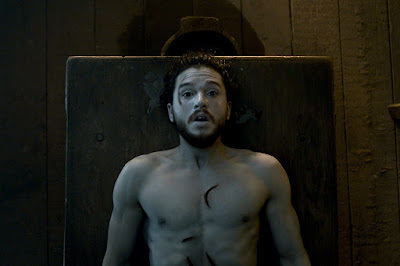
Jon Snow

Crossposted from Dreamwidth

To get this out of the way first: a large proportion of my family and close friends don’t watch Game of Thrones for various reasons. I gather this makes them feel a bit left out of some online conversations, since Game of Thrones has pervaded pop culture so thoroughly by now. I can relate. When I was a kid at primary school, we were the only household that didn’t have a TV. For context, in 1980s New Zealand there were exactly two TV channels, of which only one had children’s programming; so every day, every kid in the school had seen the exact same TV the previous afternoon, which made it ideal fodder for conversation icebreakers and small-talk. Every kid, except us. At the time I blamed this fact for the social difficulties which later turned out to be autism.

...annnd I’m already getting sidetracked in the first paragraph. What I was going to say was, I know how something just being popular with other people creates social pressure, even if it’s unintended, for you to join in and pretend you enjoy it as well. And honestly Game of Thrones is not for everybody. I’m going to be talking about its merits quite a bit, so I want to be clear from the get-go that if it isn’t your thing then it isn’t your thing and that’s fine. (Though I should warn you that I’m assuming my readers are familiar with the series, so this post will be both confusing and spoilery to those who aren’t.)

Indeed, you’ll notice as we go through that I’m not doing comparisons with the books very much, and the reason for that is that the books aren’t my thing. I’ve kind of skimmed through them and occasionally browsed a page or two in bookshops, but I haven’t read them properly, and that’s because I can’t. I understand (and I’ll get into) the reasoning behind the “any character can die” dynamic, and it works onscreen for me, but on the page I don’t get the intended effect. My emotional brain basically goes “Well, if I’m going to be punished for caring about these characters then I’m not going to care about them any more.”

I’m not entirely sure what difference the transition from page to screen makes. I used to think it was because the TV characters had faces and I couldn’t help empathizing with them, but the characters on The Walking Dead have faces too and I gave up on that a couple of seasons ago because I was disengaging from the characters for much the same reason I do with the Game of Thrones books.

Ahahahaha. Yes, yes, I mean the A Song of Ice and Fire books, A Game of Thrones being the title merely of Book I (roughly equivalent to Season 1 of the show). In this instance I’ll grant the book purists the point: A Song of Ice and Fire is a much more appropriate title for the series as a whole.

Whilst most fans as far as I can tell are loving the way things have developed in the later seasons, there’s also a dissatisfied contingent who argue that the whole thing started to go downhill as soon as the showrunners got ahead of George R. R. Martin’s published material. They seem to particularly dislike the way the characters have now fallen into some pretty solid coalitions of people who mostly trust each other, leaving behind all the politicking and betrayals and whisperings and jockeying for power – the game of thrones – that characterized the earlier seasons.

Not to be overly snarky, I think these people are missing the entire point of the series from start to finish. (This is as good a point as any to cut for spoilers.)

Wednesday, 30 August 2017

So glad I’m not an American right now

Living in a small country can be strange sometimes. Over here we’re gearing up for an election, and a change of government is looking likelier than it has for quite a while. Meanwhile it’s raising barely a ripple on the internet, except of course on New Zealand social media, but in numerical terms New Zealand is a minuscule niche interest. There are more Marvel Comics fans, more redheads, more intersex people in the world than there are New Zealanders. Nevertheless our politics are important to us, which is why I was busy writing about changes of leadership in the Green Party when, in the United States, the sewage treatment plant fire that was the Charlottesville incident was happening. By the time I had space to write about it, everything I could have said had already been said by somebody else.

But now Trump has done some more bad things: he’s pardoned Sheriff Joe Arpaio and made official his ban on transgender people in the military, under cover of the impending storm in Texas. Put together – I was about to say those things and Charlottesville had revealed something about Trump’s view of the world, but “revealed” would imply we didn’t already know it. Perhaps “confirmed” or “highlighted”. Something, anyway, that bodes very ill for the future of the administration and the country, and, given the United States’ international clout, therefore also for the world.

(Before I launch into that, though, I have an admission to make. Back in April Trump ordered a unilateral missile strike on Syria, and I commented: “If this isn’t the beginning of a war to dwarf Iraq and Afghanistan, I will publicly eat these words.” Since then, well, there have been ongoing white phosphorus attacks, but in five months there has been no escalation, no troop commitment, no bombastic public challenge like George W. Bush made to Iraq in 2003. Consider those words eaten.)

Now to the recent events. Responding to Charlottesville, Trump wriggled out of condemning the fascists even when he had a teleprompter telling him exactly what to say. However abysmal his verbal skills or his comprehension might be, they can no longer bear the blame for Trump’s bigoted stance. Despite being from a Union state, his sympathies, conscious and intentional, are with the Confederates. To him, Robert E. Lee and the rest are the good guys. So far so bad. We know his father was arrested at a Ku Klux Klan rally in 1927, which doesn’t prove anything per se but does add weight to the claim that Trump is a Klansman at heart himself. There’s not much doubt left to give him the benefit of.

Then there’s Sheriff Arpaio. Arpaio disobeyed court orders and was found in contempt, and now Trump has pardoned him. Court orders to do what? Trump says he was convicted for “doing his job”. If so, then we would have to conclude that an American sheriff’s job description includes profiling Hispanic people with a view to deporting them, and treating those in his custody with the greatest cruelty the letter of the law can be twisted to allow. Those, according to the current President of the United States, are the duties of a law enforcement officer. This is of course the same President who about a month previously advised the police to be more violent when making arrests. By itself the Arpaio pardon suggests a philosophy such as “Criminals deserve the harshest treatment we can dish out,” but that doesn’t sit well with Trump’s leniency to the Charlottesville thugs. What principle can we find that makes sense of both? How about “Brown people are inherently criminal and deserve the harshest treatment we can dish out”?

And finally the military transgender ban. I’m going to assume nobody reading this is naïve enough to be taken in by excuses about the cost of surgery or hormone treatments. There are several different motivations for transphobia, but we can eliminate most of them pretty quickly. Trump is not a transgender-exclusionary radical feminist, nor does he have religious concerns about sexual purity. To him the prime virtue is strength. Soldiers need to be strong, and, in Trump’s mind, being transgender is a weakness. I could write a whole essay linking this to his many derogatory remarks, public and private, about women. The point I want to make here is that he’s not alone. Gender diversity is one of the major front-lines at present in the battle between social justice and bigotry, and Trump has definitively sided, once again, with the bigots. Apparently being transgender makes you a “special snowflake” with paralysingly sensitive feelings. No evidence is ever of course adduced for this proposition, because there isn’t any.

Putting it all together, the most powerful person in the world believes, as of now, that strength is the ultimate good and that it is rightfully an exclusive possession of white cisgender men. The word “fascist” has been greatly weakened by being bandied about for anybody whose politics the writer dislikes, and I’m afraid my generation of Leftists must bear much of the blame. But there is no hyperbole in applying it to Donald Trump. He’s a fascist, and a fascist with access to nuclear weapons.

So you can see why I’d rather keep my head in New Zealand politics right now. Even in the worst-case scenario it’s a much more cheerful subject.

Monday, 10 April 2017

Syria: what I get and what I don’t get

So Donald Trump has fired missiles at Syria. So much for the theory that he was better than Hillary Clinton because he wasn’t a warmonger. I did tell you. If this isn’t the beginning of a war to dwarf Iraq and Afghanistan, I will publicly eat these words. I’m not betting either way on whether there will be a nuclear strike, but if there is it will be Trump’s doing.

At least some of the people who voted for Trump did so because they thought he wouldn’t do this. I get that. Clearly they were wrong, and frankly it should have been obvious that the reason he never voted for war was because he was never in politics. But I get why that would be your concern. What I don’t get is why some of his opponents are now suddenly calling him “presidential”. I mean, sure, yes, blowing people up in other countries without asking the people they’re pretending to try to help is something American presidents do, but that’s not supposed to be a good thing.

There’s so many conspiracy theories going around at the moment that it’s hard to get a handle on what’s true. I used to trust Wikileaks, but they’ve been so nakedly partisan for the last year or so that I’ve given up on them. The evidence for some kind of Russian interference with the American election continues to pile up, and denials from Wikileaks aren’t going to sweep it away. On the other hand, Putin is buddies with Assad, isn’t he? How is Trump’s attack on Syria supposed to advance a hidden Russian agenda? Or did Trump just get pissed off with everybody calling him Putin’s puppet? Is that what this is about?

The other thing I don’t get is why so many people who would proudly call themselves “radical” seem to support, or at least sympathize with, Putin and Assad. Putin is an aggressively homophobic dictator, and Assad is a lesser dictator with zero concern for human rights. I’ve seen a video of two journalists disagreeing over what’s happening in Syria, and the one who the viewer was supposed to agree with claimed that Assad was loved by his people because he got so many votes in Syria’s elections. How does an international journalist not know how elections work in dictatorships?

I think I do get why so many people think, “Well, the US has to do something.” I guess it’s like the recent trailer for Deadpool II, where the inept superhero title character tries to prevent a murder but can’t change into his superhero costume in time. The US with its giant military is the superhero, and superheroes are not supposed to sit around watching other people kill each other. Only, so far, the US’s record for solving problems with its powers is worse than Deadpool’s. Trump’s “rush in without a strategy” strategy will change that only for the worse.

I don’t know where the world goes from here. I don’t know how we solve this problem. I don’t know how we get rid of a dictator who kills lots of people without a war that kills lots of people and ends up installing a worse dictator who kills lots more people.

Trump doesn’t know either. But Trump will bring the whole world down around all our ears before he admits that.

Friday, 11 November 2016

Are you awake yet?

Politics as usual is over.

There are two questions on everyone’s mind, I’m sure. What the hell just happened? And what the hell’s going to happen now?

I’ll start with the second one. If the UK after the Brexit vote is any guide, before the new President is even sworn in there’ll be a groundswell of criminal violence against people of colour – Latin Americans and Muslims in particular, but I don’t imagine they’ll be too picky. The word will be “We just voted to kick you lot out.” That was, after all, Trump’s main platform.

(Just so you know: I wrote that paragraph before I read the innumerable news reports confirming it.)

You needn’t bother arguing with me on this part, by the way. You may have a different view of Trump’s character than I do; but I’m not going to drag you through a whole bunch of news items and political analyses you can Google for yourself and a discussion you won’t read, just to provide back-up evidence of who he is. Instead I’m going to make predictions, and the next few years will prove me right or wrong.

Trump will begin his Presidential career with an aggressive and vindictive purge of every high-ranking Republican who walked out on him. (“You’re fired.”) He will then issue an executive order to deport undocumented immigrants. Existing law enforcement and military will not be up to the job, so he will create a special taskforce and recruit the kind of people who were chanting his name at rallies to staff it – i.e. men who relish the chance to point guns at brown people with the government’s blessing. There will be deaths.

Work will begin on the Mexico border wall fairly early on. It will have to be financed. Even the President of the United States doesn’t have the power to make Mexico pay for it, as he promised. He will demand payment, and Mexico will say “No.” Most likely he’ll stump up the cash in the meantime by gutting some public service he doesn’t think important, like the unemployment benefit – hey, with all the lazy illegals gone who needs it, right? But he’ll also threaten Mexico with military action if they don’t pay up. He will eventually carry out that threat.

Yes, I know Trump has promised not to send more soldiers to war. Of all the promises he’s made, that’s the one I’m most sure he’ll break. He may only rattle sabres at Mexico, but there will definitely be another Middle East bloodbath. Trump is an over-confident man, and that’s the biggest risk factor there is both for starting wars and for escalating wars. The decision-makers on both sides in World War I were certain they’d be holding victory parades before Christmas 1914. That’s why there was a World War I.

Tuesday, 1 November 2016

Americans, please vote for Hillary Clinton

It’s a week till the big day. Much as I like to surprise readers with new perspectives on things, I don’t have one this time. I don’t know how far this will go, it’s not like this blog has a big readership. But this is perhaps the most urgent thing I’ve ever blogged about. So, small as my part must be, I’m doing what I can do. Maybe this will reach a few people who are wavering and tip them the right way. In 2000 the election was lost on a whisker-thin count in Florida, and this election is more consequential than that one.

I can’t vote for anyone, I’m not an American. But this election will reverberate around the world. I suspect it’ll have more impact on our lives here in New Zealand than our own election next year will. I have no rewards or threats to offer. All I can do is beg, and American readers, I’m begging you: please vote for Hillary Clinton this week.

It’s not the Trump voters I’m trying to reach, or not mainly. The people we see at those scary-looking rallies on the news wouldn’t listen to me if I did have anything to say to them. I mean, I could yell insults at them if I thought that would be helpful, but it wouldn’t change any minds. They might listen to this guy from GQ, perhaps. He seems at least to be in their world – I’m not.

There does exist at least one Trump supporter who is not a hateful bigot, because I’ve seen him on YouTube: his name’s Peter Thiel. [EDIT: I’m informed that this is not actually true, that Thiel doesn’t, for instance, see anything wrong with apartheid. But he’s not a thoughtless hateful bigot; he produces arguments that are worth answering.] But the arguments he uses are the same ones that other people use, the ones who I am trying to reach, so I’ll address them in a minute. No, the people I’m trying to reach are those who aren’t voting, or (equivalently) are voting Jill Stein or Gary Johnson or writing some other name in on the ballot. People who claim that yes, Trump is bad, but Clinton is just as bad. Because it’s them I fear. If everyone who understands what Trump is votes for Clinton, the election is a shoo-in. If enough people sit it out or vote third parties in protest, it’s not. Again, 2000 stands as a warning.

Yes, you guys, your grievances with the American electoral system are absolutely legitimate. Yes, it’s ridiculous that the self-proclaimed inventors of democracy are still using non-proportional voting. Yes, it is a serious problem that only two points of view get a go at the Presidency. You need to amend your Constitution. But you can’t do that at a presidential election. I understand why that’s when these problems get attention. Plebiscites are like magazine covers; they sell better with a human face on them. But you can’t fix a whole system by bringing in one new person. You need to run a referendum to change your electoral system, like New Zealand did in 1993. You can’t do that this week. You’ll have to wait, and plan.

No, Hillary Clinton is not guaranteed to get in no matter what happens. The Presidency goes to the candidate who gets the single highest number of Electoral College votes. Remember 2000 – that’s going to be the refrain for this post. Suppose that next week, as then, the Presidency depends on a single swing state. Suppose, in that swing state, Trump gets 48% of the vote and Clinton gets 47% and Jill Stein and Gary Johnson between them get 5%. If that happens, who’s President? I’ll give you a hint: it’s not a Clinton-Stein-Johnson co-presidency. That’s not how America works.

No, Hillary Clinton is not guaranteed to get in no matter what happens. If 2000 is too distant, remember Brexit. We all thought that was bound to lose. None of the politicians pushing it had a plan for what to do if they won. Yes, that is indeed due to the failures of neoliberalism, but xenophobia and racism are not better than neoliberalism. They are worse. And right now they are rallying.

No, Clinton is not just as bad as Trump. Consider the e-mail scandal going on around her right now. Clearly the FBI, or at least some very influential people in the FBI, are trying to stop her from becoming President – and those e-mails are the worst thing they’ve found on her, or they would be trumpeting whatever they’d found that was worse. Trump, by contrast, has among other things been indicted on child sex charges.

No, Clinton is not just as bad as Trump. Yes, she’s called for more American military engagement in the Middle East – America is currently involved in Syria, Iraq, Yemen, Libya, and Somalia, if I recall correctly. Her stance is that American intervention will prevent more deaths than it causes. I think she’s wrong about this and if I were in a position to argue with her directly I would take a very strong line. Trump, on the other hand, favours pulling the troops out. That was Peter Thiel’s big argument for supporting Trump. And I’d agree – except that “pulling the troops out” might mean either of two utterly different things.

  1. Send all the soldiers and military trainers home. Send diplomats to the governments of the various countries with this message (worded diplomatically): “We’re not going to kill for you any more. If you need a hand rebuilding civil institutions, we can talk. But no more bullets, no more drones, no more weapons.”
  2. Send all the soldiers, military trainers, and every other American home. Fire nuclear missiles at Damascus, Baghdad, Aden, Tripoli, and Mogadishu. Declare victory.

Which of these options do you think will be favoured by a man who has publicly said that all Muslims are potential terrorists and that he doesn’t know why America can’t use its nuclear weapons?

No, Clinton is really not just as bad as Trump. We on the Left have a bad habit of overusing the word “fascism”, with much the same effect as the boy who cried “wolf!” in Aesop’s fable. It’s not a lie, exactly, but it’s a worn-out hyperbole, and the trouble with wearing out a word with hyperbolic use is that you’ve then lost the impact of the word when it literally applies. Donald Trump really is a fascist. No scare-quotes, no “almost” or “virtually” or “practically” or any other hedge-word, he’s a fascist.

Fascism (unlike communism or neoliberalism) lacks any single definable credo, because it doesn’t seek international cooperation. It has, nevertheless, certain characteristic diagnostic features, and Trump displays them all. He preaches a lost era of national greatness; he proposes to restore it by purifying the nation of undesirable nationalities, religions, and races; he idolizes ruthless businessmen, or at least one ruthless businessman. These things he inherits from the Republican party he has commandeered. But he also has the other, still more sinister symptoms of fascism. He threatens his political opponents with the police; he chafes at the democratic restraints on his power; he encourages his followers to promote the cause through violence. Even George W. Bush didn’t do that.

This is not a drill. This is not a joke. This is not politics as usual. This is how democracies are overthrown. Just because you’re the United States of America doesn’t mean it can’t happen to you. Don’t let it. Vote Hillary Clinton on 8 November. I’m begging you.

And then, on 9 November, go and protest the Dakota Access Pipeline. Tell the President-Elect that you think it’s wrong. Tell her loudly, tell her angrily. Anger is appropriate. But remember, as you do, what the other potential President-Elect does to protesters.
Sunday, 2 October 2016

Why women are better than men

Once upon a time, people say, you could tell the plain truth about things and be admired for it. Now they make you shut up and call you, as it might be, racist, sexist, or homophobic. I’ve had my quarrels with these people before and I expect I will again. But today I share their experience. I have a truth to tell which will offend people because it upsets the illusion that we are all equal. Here it is:

Women are better than men.

This is not hyperbole, rhetorical or otherwise. Nor is it a joke, though I confess myself slightly amused to imagine the offended huffing and puffing it will cause among some who pride themselves on being immune to offended huffing and puffing. It is, I admit, a generalization; but it is, I insist, a valid generalization.

Consider, as a parallel, the statement “Women are shorter than men.” That’s a generalization, but a valid one. It doesn’t mean that women can walk upright under toilet stall doors while men frequently get their hair tangled in power lines. It doesn’t even mean that the tallest woman is shorter than the shortest man. You can’t falsify it by picking Gwendoline Christie as your exemplar of women and Peter Dinklage as your exemplar of men. No-one denies that the distributions overlap – that many men are shorter than many women. But you still know perfectly well that women, in general, are shorter than men, in general.

Likewise, I’m not claiming that all women are saints and all men are serial killers. I’m not claiming that the worst woman in the world is better than the best man. I am claiming that women, in general, are of better moral character than men, in general. This claim being a generalization, you can’t falsify it by picking, say, Ann Coulter as your woman versus William Kamkwamba as your man. And in case you didn’t believe me the first time, this is neither a hyperbole nor a joke. So you’re going to want some evidence, aren’t you?

Thursday, 21 July 2016

Racism is crawling back out from under the rug

The world is changing. The last time the World News pages looked this unfamiliar was fifteen years ago, in September. Fortunately, this time the death toll has not been in the thousands. But Britain leaving the European Union is a much further-reaching geopolitical shift than the World Trade Centre attack – assuming it ends up happening. Since the referendum it’s become apparent that none of the people pushing the Leave campaign had a plan for what would happen if they won.

But there have already been very ugly consequences in Britain. Despite the denials coming from the Conservative section of the Leave campaign (less so from UKIP), it seems that at least a large minority of their supporters believed they were voting to expel immigrants and people of colour from the country. Content note: racism.

Thursday, 26 May 2016

“Innate” ≠ “inevitable”

I’m old enough, and Left enough, to remember when science was merely a tool of the patriarchal Western capitalist military-industrial hegemony. If you tried to argue a scientific point that seemed to be in conflict with leftist politics – even to demonstrate that it wasn’t, in fact, in conflict with leftist politics – people would refer you to Thomas Kuhn, assure you that a “paradigm shift” was on its way, and change the subject. I never could see why Kuhn was supposed to be so liberatory. If science is constrained by “paradigms” which are themselves determined by politics, then politics dictates what’s a fact and what’s not. This would imply that power controls the truth as it controls everything else, and therefore there can be no such thing as an inconvenient truth wherewith one might challenge power.

Thankfully science is much more accepted among people of my political persuasion now than it was fifteen years ago. Contrary to the dire warnings we Humanities students used to congratulate ourselves – sometimes for hours at a time – on grasping, we now seem as a result to be more critical, not less, of scientific concepts served up in the media. But this is an overall trend, not (hah) a paradigm shift. There are still plenty of people about who will criticize science on the basis that it doesn’t suit the Left and think they’re being helpful. And last week I came across one such criticism, in the form of this address by John Horgan to the Northeast Conference on Science and Scepticism.

I’m not going to pull apart the whole thing. That’s already been done by others, such as David Gorski and Steve Novella. Horgan has a bee in his bonnet about something he calls the “deep roots theory of war”, most famously promulgated by Steven Pinker in The Better Angels of Our Nature. Broadly, this means the idea that human societies have always known war, going back to our common ancestor with chimpanzees. It’s hard to determine exactly what Horgan thinks is wrong with this idea; the goalposts in his discussions of it are stricken with chronic wanderlust. He’ll flag up particular archaeological sites where relatively few of the skeletons show signs of violence and go “Well, these people didn’t have deep roots of war in their nature!” He’ll flag up sites where there are a lot of signs of violence and say “This was murder, not war – yet another mark against the deep-roots theory!”

For the record, I disagree with Steven Pinker’s position on a lot of political questions. I don’t think warning women to dress conservatively reduces rape or sexual harassment. I’m broadly in favour of trigger warnings and safe spaces (without denying the possibility of excesses in their application). If crime rises when the police lose the public trust, then I think it is the police’s responsibility to win back that trust. I consider nuclear power at best a stop-gap measure against climate change, since uranium is unrenewable, and I fear that long-term accumulation of radioactive waste may seed a different, but equally acute, global environmental problem. I think disinvesting in fossil fuels is a good idea while we’re waiting for the world’s governments to divorce Big Oil and bring in a universal carbon tax. But I’m not going to dismiss Pinker’s contributions to the science of humanity just because politics would be easier if some of them weren’t true, and I’m especially not going to castigate him for two opposite and mutually incompatible faults, as Horgan does on the deep-roots-of-war issue.

Monday, 1 June 2015

How evolutionary psychology supports feminism

Yes, I know, that title could just about be my tag-line. Most of my blog these days seems to be about how various evo-psych concepts actually have feminist, rather than anti-feminist, implications. So I thought I’d gather it all together in one place for convenience of reference. (Indeed, parts of this post are directly copypasted from older ones.) Evolutionary biology is one of my persistent fascinations, and I really don’t like seeing misogynists using it as ammunition against social justice for women. Which is how it gets used a lot. Basically, if you get a guy on the internet mansplaining to you how oppression is due to biology and you should just accept it, please feel most free to link to this post.

Speaking of mansplainers, before I get into specifics: there’s a widespread double standard where, if something specific to women’s minds has a biological component, this means that women are irrational and their needs should be ignored, but if something specific to men’s minds has a biological component, this means that men can’t change and their needs should be pandered to. I’m making this explicit so you know that anyone trying to score that sort of point from what I say in this post is being deliberately dishonest, not just thoughtlessly inconsistent.

There’s another kind of dishonest quote-mining I’d like to forestall, too. Natural selection works on gene pools, that is populations of interbreeding individuals. “Women evolved to have trait X”, for instance, is a shorthand for “On average, women who had trait X had more surviving children than women who did not, and therefore trait X became more common in women of the next generation.” This does not mean to say that women who happen not to have trait X are therefore somehow not women, or not “proper” women, or any such nonsense. If you want to argue that, go do it on my previous post. Further, just because something is “natural” as in biological, that doesn’t mean it’s either desirable or unfixable. Actually, that’ll do for the first couple of points.

Friday, 24 April 2015

Remembrance and hypocrisy

One hundred years ago the Australian and New Zealand Army Corps (ANZAC) landed on the coast of Gallipoli in Turkey, their mission being to take out the Ottoman artillery which had held back the Allied navy from securing the region. The immediate objective was to allow military traffic between the West and Russia, while closing it off for the Austria-Hungarian and Ottoman Empires; in the longer term, the British Empire hoped to gain privileged access to Middle Eastern oil, having recently upgraded their navy from coal-powered to oil-powered ships. Reconnaissance of the area had been grossly inadequate, and the Anzacs found themselves facing a steep slope and a well-prepared enemy. The Ottoman army couldn’t stop the landing but easily prevented the Anzacs from advancing past the beach. A classic war of attrition followed, with corpses mounting on both sides for very little strategic gain.

New Zealand and Australia commemorate the anniversary every year on what we call Anzac Day. It’s become a bigger and bigger thing recently as the centenary approaches. Red poppies appear all over the place like Santa Clauses at Christmas, phrases like “Honour the Fallen” and “We Will Remember Them” being the equivalent of “Season’s Greetings”. Predictably, our cultural gatekeepers seem to have decided that the Fallen are best honoured by sanctifying the lies that got them killed. But they’ve revised and updated them, because “freedom and democracy” are more appealing causes nowadays than “king and country”. I suppose that’s progress of a sort. (World War II, at least the European arena of it, could reasonably be called a war for freedom and democracy; World War I cannot.)

At least the Anzacs at Gallipoli were all volunteer soldiers, not conscripts. The following year New Zealand passed an Act of Parliament drastically reducing the permissible grounds of conscientious objection – you only got out of military service if you belonged to one of three small religious groups who believed God forbade it. Otherwise, you were arrested and shipped to the front by force. Then you were punished like any disobedient soldier, which as flogging had recently been banned typically meant you were tied to something and left there for hours, often in places likely to come under enemy fire. Deserters were shot, and in some places advancing troops were followed by squads called “file closers” with orders to kill straggling men of their own side.

I wear a white poppy on Anzac Day, not a red one. I don’t do it to disrespect the soldiers who have died in war, though that accusation was certainly levelled at the white poppy when it first came into the public eye a few years ago. The thing is, wars kill more than just soldiers. We in the West are in the privileged position of losing only soldiers to war, because in the last seventy-odd years we’ve always been the invaders, and it’s been Johnny Foreign across the sea whose civilians get the pointy end. It is a terrible thing to be sent into harm’s way by your government, but it is also a terrible thing to be cluster-bombed, napalmed, mined, or drone-struck. Those who call my concern for the latter an insult to the former will get no respect from me.

Prime Ministers Tony Abbott and John Key, having zero sense of irony, have decided that the centenary of Gallipoli is a good time to have Australian and New Zealand military personnel headed for a conflict in the Middle East. This is particularly poignant for New Zealand, since we proudly abstained from George Bush’s Iraq War. OK, sure, ISIS are very bad people, and they are killing lots of people. That actually doesn’t make it OK to go around killing just as many people ourselves just in the hope that some of them will be ISIS.

ISIS may be doing things that are as bad as what the Nazis did, but they are not the threat that the Nazis were. They don’t have the industrial infrastructure to produce armaments, they don’t have productive land to feed soldiers on. Cut off their supply of weapons and they’ll be stuck. I’m no military strategist, but wouldn’t a moratorium on the arms trade be just a little bit helpful here? As for the human rights violations, surely the least the West could do is open our arms to refugees from the conflict. If we’re going to go in there at all, let it be to help smuggle innocent people out. Well, New Zealand isn’t increasing our refugee intake this year, and – look, just go and Google “Australia refugees”, OK? I’ll wait.

Monday, 23 February 2015

Not in my name

Today New Zealand’s Prime Minister John Key announced in Parliament that New Zealand would be sending troops to Iraq to help the US fight the Islamic State. There was no vote.

I could really just finish with that. When you look at the other parties’ responses it’s pretty clear why National didn’t risk putting it to a vote. The aim, Key says, is to protect “the rule of law”, which he identified with “the international rules-based system”. I’m not sure whether I’m alarmed or relieved that he didn’t claim to be acting for “democracy”. Was that because he thinks you can have the rule of law without democracy? Or was the irony of sending people to die for democracy without a vote just that little bit too uncomfortable even for him?

Here’s the thing, if you don’t see the problem. Every system of government is “rules-based”. Slavery was “rules-based”, with rules like “Slaves must not run away” and “Slaves may not be taught to read”. The Nazis had all sorts of rules – about who could marry whom, about what you could say about the Führer. There is no reason in principle why rules shouldn’t coexist comfortably with hideous violence. The question that matters is whether the rules are devised by the powerful or by the people.

But given the disgraceful behaviour of the New Zealand police at the Auckland Pride Parade on Saturday, I’d say the people who run our country have long since forgotten that.

Thursday, 27 November 2014

This time, there is a right side and a wrong side to be on

I wasn’t going to say anything about what’s going on in Ferguson because I haven’t got anything to say that isn’t already being said. I’m white, so my voice is not the voice you need to hear, and I’m neither an American nor resident in the United States so my influence over what’s happening is distant-to-nil. But some well-meaning people are posting memes on my Facebook to the effect of “let’s everybody calm down and stop calling each other names.” As if there were anything remotely resembling equality or balance in the situation.
Here is what’s going on, people. Some people are angry and yes, some of them are probably making a bit of a mess. The reason why they’re angry is because the people tasked with protecting them (as members of society) from harm and exploitation are killing them without provocation because of their skin colour. That is only happening on one side. There have been no cases of black police officers killing unarmed white youths.
You do not get to tell people to stop expressing their anger about their families being killed by agents of the Government for no reason. You just don’t.

Wednesday, 22 October 2014

The “context” doesn’t always make it better

When Libby Anne of Love, Joy, Feminism wrote this post about being an atheist but not working against religion, I started drafting a reply. But that was three weeks ago, and other things have taken up my attention in the meantime. Then Sam Harris posted this complaint about having his words (from The End of Faith) taken out of context in an image meme. And he provided what he considered to be the necessary context. The thing is, the context doesn’t actually make him look much better. I do think that religion in general is something that should be opposed, and some day I’ll get around to explaining why. But it is much more important that Sam Harris’s kind of atheism be opposed. I’ll give you the full passage, with the offending sentence in bold. Content note: violence, casual reference to torture, fear tactics targeting a non-Western religion.
The power that belief has over our emotional lives appears to be total. For every emotion that you are capable of feeling, there is surely a belief that could invoke it in a matter of moments. Consider the following proposition:
Your daughter is being slowly tortured in an English jail.
What is it that stands between you and the absolute panic that such a proposition would loose in the mind and body of a person who believed it? Perhaps you do not have a daughter, or you know her to be safely at home, or you believe that English jailors are renowned for their congeniality. Whatever the reason, the door to belief has not yet swung upon its hinges.
The link between belief and behavior raises the stakes considerably. Some propositions are so dangerous that it may even be ethical to kill people for believing them. This may seem an extraordinary claim, but it merely enunciates an ordinary fact about the world in which we live. Certain beliefs place their adherents beyond the reach of every peaceful means of persuasion, while inspiring them to commit acts of extraordinary violence against others. There is, in fact, no talking to some people. If they cannot be captured, and they often cannot, otherwise tolerant people may be justified in killing them in self-defense. This is what the United States attempted in Afghanistan, and it is what we and other Western powers are bound to attempt, at an even greater cost to ourselves and to innocents abroad, elsewhere in the Muslim world. We will continue to spill blood in what is, at bottom, a war of ideas.

Note on the above:
We do not have to bring the membership of al-Qaeda “to justice” merely because of what happened on Sept 11, 2001. The thousands of men, women, and children who disappeared in the rubble of the World Trade Centre are beyond our help – and successful acts of retribution, however satisfying they may be to some people, will not change this fact. Our subsequent actions in Afghanistan and elsewhere are justified because of what will happen to more innocent people if members of al-Qaeda are allowed to go on living by the light of their peculiar beliefs. The horror of Sept 11 should motivate us, not because it provides us with a grievance that we now must avenge, but because it proves beyond any possibility of doubt that certain twenty-first-century Muslims actually believe the most dangerous and implausible tenets of their faith.
Sam Harris, The End of Faith, cited by the author in On the Mechanics of Defamation
I hadn’t read The End of Faith before. Otago University’s copy is housed in a special collection of books on religious topics which for historical reasons is outside the campus and bothersome to get to. If I had read this passage before now, I would have held Harris in much lower esteem than I did up until he blogged it. Honestly, I’m mystified as to what part of the “context” he provides is supposed to make it any better to suggest it might ever be OK to kill people for their beliefs. Granted that a person’s beliefs motivate their action to an extent that nothing else does; still, belief in turn is contingent upon circumstances, as the gratuitously horrifying analogy Harris himself opens with should have demonstrated (what would have been wrong with Steven Pinker’s illustration of the same point, “Your car is being towed”?). One way belief can change is through rational conversation, albeit usually some time after the fact, but I can think of no strategy better designed to close the doors on rational conversation than to suggest you might be justified in killing your interlocutor for their beliefs. A more common reason for belief to change is that the new belief makes better sense of the believer’s life experience than the old one, but if the old one is “Westerners are evil and must be destroyed”, then a pronouncement like Harris’s is only going to confirm it.
There was a time when it was generally accepted that it was reasonable to kill someone for their beliefs. Then people changed their minds about that, and there’s a reason why that change of mind was called “the Enlightenment”. Yes, I know that Europeans used the gains they enjoyed from killing each other less to consolidate their power and go and harass the rest of the world. Nevertheless, Enlightenment sceptics didn’t go around killing Christians. Or suggesting killing Christians. Or saying it would be ethical to kill Christians if they couldn’t capture them. Considering what Catholics and Protestants as groups at that time earnestly believed they needed to do to sceptics, as well as to “witches” and each other, by Harris’s standards the sceptics’ conduct was needlessly and indeed foolhardily restrained. Does Harris – does anyone – think civilization would have been better advanced if they’d taken up arms?
Harris might answer that those are pragmatic considerations, bearing on the wisdom of saying that it’s ethical to kill some people for their beliefs rather than on whether it’s true. Harris and I have different views of what constitutes the ethical, of course. I agree with him that the basic measure of goodness is subjective well-being. And my view on subjective consciousness allows at least the theoretical possibility of aggregating and comparing well-being across multiple subjects (Harris’s view, that consciousness is irreducibly and unfathomably mysterious, would rule this out). But ethics is not just about what circumstances would, in theory, be best, if only they could happen. It’s about what actions on our part will bring about the best result. For this purpose there is no getting around the fact that you can’t measure well-being in practice. You have to factor your uncertainty, and other people’s uncertainty about you, into your calculations. In the end it works out to maximizing trust and minimizing fear. If someone is actively trying to kill you or other innocent people, killing them might in many tragic cases be the best you can do; but attacking first creates fear, not trust, and is therefore unethical. I can’t quite believe that actually needed saying.

Monday, 4 August 2014

What have we learned?

A hundred years and a month or so ago, Serbian nationalist Gavrilo Princip shot dead Archduke Franz Ferdinand of Austria in Sarajevo. This triggered a wave of anti-Serb violence across the Austro-Hungarian Empire, because apparently what one Serb did every Serb was responsible for. As he was a minor, Princip got twenty years in prison instead of the death penalty. He died of tuberculosis just a fifth of the way through his sentence. The Empire demanded that Serbia suppress all anti-Imperial actions and publications and accept Austrian control of their police force. Serbia said “OK,” but they didn’t say “OK” to every single demand, and Austria-Hungary declared war.
Some bits of what happened next, I’m not clear on. The Russians felt obliged to intervene on Serbia’s behalf. The Germans had been itching for a war with both Serbia and Russia for some time. Germany and Austria-Hungary had an alliance with the Ottoman Empire. France and Britain stepped in to help Russia. I don’t know why any of that was the case. I do know that one hundred years ago yesterday, Britain declared war on Germany. At that time, white New Zealanders and Australians identified as British, so from that point on “we” were at war. Which I guess is why my local newspaper dedicated its front page yesterday to the centennial.
Get used to this kind of thing. You’ll be seeing it a lot in the next four years. Thought for the day: World War I was rich countries invading rich countries. Nowadays you don’t see that, “nowadays” here meaning since 1945. Why not? What changed? Why, for the last seventy years, has it only been poor countries being invaded? What trick have rich countries learned in that time for avoiding being warred upon? (It’s certainly not that rich countries no longer go to war.) Steven Pinker’s The Better Angels of Our Nature is required reading here, but has he got it right? He dismisses the popular “nuclear deterrent” theory; I have no problem with that. He also claims that global trade has been a major force for peace, which sits most uncomfortably with my politics but Pinker’s data and logic are persuasive. Basic idea: if country A is a source of trade goods for country B, country B has an incentive not to want country A’s economy disrupted by war.
Something’s missing. One lucrative set of trade goods is armaments, which reverse the incentive structure. If you’re selling guns, you want your customers threatened by wars, so that they’ll buy your guns. Also, protecting trade ships and trade zones has become a major raison d’etre for military deployments. And then look at the protests at all the big free trade conferences; look at the violence governments are prepared to deploy against their own citizens in defence of commerce. Free-trade apologists might reply that the protesters are mistaken or misguided in their choice of political goals, and that trade is a powerful enough force for peace to justify suppressing dissent. But even if trade is a force for peace, so too – taking my information from The Better Angels of Our Nature once again – are democracy and the free exchange of information. Trade deals like the Trans-Pacific Partnership Agreement threaten both.
I take Pinker’s point. Economic interdependence links nations together, it helps people put a value on each other’s lives who otherwise didn’t have a reason to care. Yes, that sounds awful, but the reality is no human being could care about every single other one of their seven billion fellow human beings. We care about the couple of hundred people we know personally, and we can have our consciences and our compassion stung by stories and images of a few more, but there comes a point at which it’s just too much. So we can’t hang our plans for world peace on everybody caring, personally, about everybody else. That’s not going to happen.
But granted that economic ties between nations are a good idea per se, is this really the best we can do? Do we have to sign our democracy and our freedoms over to giant corporations and their neoliberal running-dog enforcers? Corporate capitalism is addicted to fossil fuels, which has historically caused shortage crises as well as global warming, and to dirt-cheap labour, which has historically caused large-scale political unrest. Fuel crises and political unrest are both causes of violence. Being better than 1914 is not much to congratulate ourselves on.

Monday, 21 July 2014

I only have one thing to say about Gaza

Content note: violence
There is a lot of anger coming across my Facebook feed about Gaza. More of my friends are pro-Palestine than pro-Israel, but one of the pro-Israel ones makes up for it by posting nearly as much as all the pro-Palestine ones combined. You know who you are. But it wasn’t him who posted this image:
“We can forgive the Arabs for killing our children.  We cannot forgive them for forcing us to kill their children.  We will only have peace with the Arabs when they love their children more than they hate us.” —Golda Meir, former Prime Minister of Israel
I’ve been saying nothing because I don’t know any more about Gaza than any other New Zealander who follows international news, and saying anything would only mean I’d have to deal with a storm of anger from somebody. But I’m getting the storm of anger anyway. So this is the one thing I have to say about Gaza:
It is morally wrong to fire explosive devices at people just because they are of the same ethnicity, and live near the same place, as the people who have hurt you. Even if they are also politically aligned with those people. It doesn’t make a moral difference whether the explosive devices are mortar rockets or missiles launched from planes. It is human nature to think essentialistically, but neither “Israel” nor “Palestine” is a monolithic entity that is collectively responsible for everything an individual might do in its name. Killing innocents does not redress any wrong, it compounds it.
The death toll in Gaza is in the hundreds, if it’s not thousands by now. I don’t think the death toll in Israel has cracked single figures yet. If you don’t think the number of people you kill is morally important, you are no better than a terrorist. So I am opposed to Israel’s actions. And I’m not swayed by Meir’s little piece of spin. Last I heard, Israel had a highly-trained military force called Mossad. If you want to convince me Mossad couldn’t enter Gaza and take out the individuals firing rockets – by “take out” I mean capture for trial in an international court of justice, but even targeted assassination would be better than bombing the whole place and killing children – then you have a lot of work to do.
But just because I’m opposed to Israel’s actions doesn’t mean I support Hamas. Look, when two groups of people are trying to kill each other you can bet they’re also telling lies about each other as loud as they can. In a movie one of them would be snowy pure and telling nothing but the truth, but real life isn’t a movie. So I don’t believe everything I hear that opposes Israel just because I also oppose Israel in this. But I do believe that young Gazans are likely to know more than me about the situation, and during an earlier outbreak of violence a year or two ago I read a manifesto by some young Gazans that began: “Fuck Israel! Fuck Hamas!”
Violence breeds violence. Two wrongs don’t make a right. These are clichés, but they’re clichés because everyone knows they’re true. And that’s all I have to say about that.

Tuesday, 8 July 2014

The Last Battle

        
Up far beyond [Jove]

Goes Saturn silent
in the seventh region,

The skirts of the sky.
Scant grows the light,

Sickly, uncertain
(the Sun’s finger

Daunted with darkness).
Distance hurts us,

And the vault severe
of vast silence;

Where fancy fails us,
and fair language,

And love leaves us,
and light fails us

And Mars fails us,
and the mirth of Jove

Is as tin tinkling.
In tattered garment,

Weak with winters,
he walks forever

A weary way,
wide round the heav’n,

Stoop’d and stumbling,
with staff groping,

The lord of lead.
He is the last planet

Old and ugly.
His eye fathers

Pale pestilence,
pain of envy,

Remorse and murder.
Melancholy drink

(For bane or blessing)
of bitter wisdom

He pours for his people,
a perilous draught

That the lip loves not.
        

Sunday, 31 March 2013

Prince Caspian

        
But other country

Dark with discord
dims beyond him [Sol],

With noise of nakers,
neighing of horses,

Hammering of harness.
A haughty god

Mars mercenary,
makes there his camp

And flies his flag;
flaunts laughingly

The graceless beauty,
grey-eyed and keen,

– Blond insolence –
of his blithe visage

Which is hard and happy.
He hews the act,

The indifferent deed
with dint of his mallet

And his chisel of choice;
achievement comes not

Unhelped by him;
– hired gladiator

Of evil and good.
All’s one to Mars,

The wrong righted,
rescued meekness,

Or trouble in trenches,
with trees splintered

And birds banished,
banks fill’d with gold

And the liar made lord.
Like handiwork

He offers to all –
earns his wages

And whistles the while.
White-feathered dread

Mars has mastered.
His metal’s iron

That was hammered through hands
into holy cross,

Cruel carpentry.
He is cold and strong,

Necessity’s son.