Showing posts with label America. Show all posts

Sunday, 3 November 2019

Why you’re wrong about “Joker”

Joaquin Phoenix as Arthur Fleck in Joker

Crossposted from Dreamwidth

  • Joker is not a comic book movie, at least in the sense of giving you anything you would remotely expect from a comic book movie. It has some character names and place names the same as in the comics, and near the end there’s a scene which will be instantly familiar to anyone who knows anything about Batman, but there are no superpowers, no costumes, no heroes, no fantasy or science fiction elements at all. People who enjoy comic book movies but not bleak gritty character dramas won’t like it. People who enjoy bleak gritty character dramas but not comic book movies will find nothing objectionable in it.

    (Mild spoiler warning, by the way. I don’t get into specifics but you may find the edge of surprise dulled on some elements of the movie if you read this post before you see it.)

Wednesday, 24 July 2019

The summer of ’69

Trick photo shows a person appearing to lay their hand on the Moon

When I was three years old, my father tried to trick me into believing a tall tale – or so I concluded at the time. He told me that a man named Neil Armstrong had stepped onto the Moon twelve years before, and had said “That’s one small step for a man, one giant leap for mankind.” Now it had not escaped my notice that my mother called my father Neil instead of Daddy, whereas “Arm-Strong” sounded like the name of a story-book giant; and also, somewhat crucially, Dad neglected to mention anything about a spaceship. I therefore pictured a world-bestriding Titan with Dad’s face and beard (because of the name) lifting up one monstrous foot into the heavens. Even to three-year-old me, this seemed a bit beyond the bounds of physical possibility. Yet Dad kept an utterly straight face and clearly expected me to believe him.

What did Neil Armstrong and his companions actually accomplish? What has humanity gained that we wouldn’t have gained without going to the Moon? Was it merely an “unlikely piece of art”, albeit a “triumph of our aesthetic instincts” constituting “the culmination of the Romantic cult of the sublime”, but “undertaken for no meaningful scientific purpose”, as a recent opinion piece would have it? Not according to at least one astrophysicist:

In case you didn’t play the video for whatever reason, Dr Smethurst identifies five pieces of scientific knowledge we wouldn’t have had without the Apollo missions. One, surprisingly to me, is the distance to the Moon. One is an explanation of a phenomenon called solar wind. More as you’d expect, we learned what stuff the Moon is made of and how that stuff is arranged, which then allowed us to figure out how the Moon was originally formed. (Turns out to be quite dramatic, if you haven’t seen it before.)

NASA nowadays gets about an eighth the proportion of the US budget that it did back then – from 4% down to 0.5% – and yet you still see people arguing that space research should be defunded to pay for hospitals. Guys, there’s vastly more money being sunk into corporate subsidies and the military; why not complain about those instead of squabbling over the tiny scrapings they leave behind? The thing about science, the point of acquiring knowledge for knowledge’s sake, is that you cannot know what that knowledge is going to turn out to be useful for until you’ve got it. You like hospitals? It would be a pretty poor hospital that didn’t have an X-ray machine, but X-ray machines could never have been invented if people hadn’t been doing purely curiosity-driven research on radiation decades before. As far as I know space research hasn’t turned out anything quite that directly useful for human health. Yet.

Also, let me be direct: people want to know stuff. Quite a lot of debates in ethical philosophy become a whole lot easier if you allow that happiness is about knowing fortunate truths as well as having pleasant sensations. That’s why it wouldn’t be ethical to make everybody happy by spiking the water-supply with some euphoriant drug, or to euthanize an old lady’s pet when she moves into palliative care and tell her for the remainder of her life that it’s being looked after. People want to know the truth. We’ve always wanted to understand what the Moon is and how it got there. Finding the answers was a service to humanity.

All the same, it seems kind of a small return for the phenomenal amount of money that the American taxpayer poured into Apollo throughout the 1960s. Come to think of it, the government’s commitment to the project is remarkable in itself. Public support for Apollo was far from unanimous, given the many other social and economic concerns facing the country at the time. It had been pushed along for seven years by Lyndon B. Johnson through his Vice-Presidency under John F. Kennedy and his own term as President. Then in 1968 the Republican Richard Nixon was elected (Kennedy and Johnson having been Democrats). Nowadays the story would end with Nixon cancelling Apollo on a promise to free up the money for social rejuvenation, then actually spending it on a massive tax-cut for the top income brackets. Apparently Presidents didn’t disrespect their predecessors’ legacies quite that much in the ’60s.

Three other names help to explain why Apollo had to go ahead come what might: Sputnik, Yuri Gagarin, and Lee Harvey Oswald. Sputnik, the first artificial satellite, made it undeniable that the Soviets could pull their weight in science and technology, a field in which the US had previously been rather complacent. Gagarin, the first man in space, showed it hadn’t been a one-off. And when Oswald shot Kennedy dead in 1963, Johnson’s Presidency stood or fell on how well he was seen to honour Kennedy’s aspirations. In fact a month or two before his death Kennedy had decided to scrap Apollo in favour of a joint Soviet-American Moon endeavour, but that never became public knowledge.

Unfortunately Kennedy also left another legacy: the Vietnam War. Not that he started it, exactly – there had been conflict there, and the United States had been meddling in it, for years before – but Kennedy was the President who committed the US to military intervention. It raged on, dividing the American public, throughout the ’60s, and ended up outlasting the Apollo programme by several years. Odious and expensive though it was, neither Kennedy nor Johnson nor Nixon wanted to be the first American president ever to lose a war. It has been speculated (and is repeated as fact in some quarters) that the real purpose of Apollo was to distract Americans from what was happening in Vietnam.

Whilst a certain degree of cynicism is warranted and indeed necessary in political studies, I don’t find that the rule “Always assume the worst possible motivation” generates much better predictions of government policy than “Always give the benefit of the doubt,” except insofar as it errs on the side of vigilance. Better is “Politicians are no more altruistic, honest, or intelligent than anyone else, and to get things done they have to placate millions of people with conflicting priorities.” A much cheaper way to distract the public from Vietnam would have been to distribute psychedelic drugs en masse. As things turned out, psychedelics became identified with the anti-war subculture shortly before getting banned, but that wasn’t inevitable in the mid-’60s.

Looking at the period from fifty years’ distance, it’s hard not to see a certain congruence between the psychedelics and the Apollo programme. Both were motivated to cross the boundaries of the very world and see things no-one had ever seen. It doesn’t feel coincidental that the ’60s was also the decade of the Civil Rights movement and the Sexual Revolution and, a month or so before the first Moon landing, the Stonewall riot. The phrase “To boldly go where no man has gone before” predates “One giant leap for mankind” by less than three years.

So then what happened? The science fiction writers who were bold enough to foresee a Moon landing before 1970 also all thought we’d be on Mars by 2000. It’s always easy to think up ways that problems and disappointments are one’s political opponents’ fault, so it won’t surprise you that I place a large chunk of the blame on Reaganism. You can’t slash taxes for decades and still fund an Apollo. The Space Shuttle programme that was meant to follow it was plagued by the characteristically Reaganistic combination of cutting corners on safety measures and requiring conspicuous success from every project, with predictably disastrous consequences.

Maybe that op-ed piece wasn’t completely off the mark: Apollo’s primary significance is as a work of art rather than a scientific venture. It became a symbol, a sign showing future generations forever after that we are not stuck in the world we know, that just because something hasn’t been done before doesn’t mean it can’t be done – like, say, allowing people of the same gender to marry, or electing an African American to the White House. It takes commitment and care and perseverance and the humility to listen to criticism and learn from past mistakes, but it can be done. Every giant leap is actually a concatenation of small steps.

Just in case you were wondering – the time interval from the launch of Sputnik to Armstrong’s one small step was roughly as long as we now have to solve climate change. Worth thinking about.

I still look up at the Moon every so often and think about it – this thing so familiar and so remote, this alien planet that every generation of humanity has known from infancy. Contrary to some people’s fears at the time (C. S. Lewis, for instance), knowing that humans have touched it for me deepens the wonder rather than deadens it, because it brings the Moon out of the backdrop and onto the stage. Maybe we’ll go there again one day; maybe we need to let our wisdom catch up with our hope before that can happen. But we know it can be done, and that’s never going away.

Thursday, 27 December 2018

The imminent and well-deserved demise of Tumblr

Truth Coming Out Of Her Well to Shame Mankind

On 3 December Tumblr announced it was getting rid of adult content, starting in two weeks from the announcement. Tumblr management has never been competent at the best of times, but this takes the cake. This will kill the site.

Those of you who don’t have Tumblr accounts will scarcely imagine what a dumpster-fire this is. Just to start with, the main draw of Tumblr was that it was the one social media site that allowed adult content. What Tumblr has just done is basically what I’ve seen a couple of local hospitality businesses do – a pub on the Otago University campus years ago, and a café in Port Chalmers more recently. Both had quirky art-work that gave them an alternative vibe; both were bought by new owners who removed the quirky art-work and tried to rebrand them as bland mainstream venues; both promptly went out of business. The campus pub was eventually revived by a competent proprietor; the Port café is currently sitting empty, a monument to the folly of erasing a successful enterprise’s main point of distinctiveness. The same fate awaits Tumblr.

I was on Tumblr for nearly two years. My original hope, when I joined, was to spread this blog a little further, since after six years I have exactly two followers here. This was not to be, because Tumblr’s search software passes over posts that contain links to other sites – far from the only way in which Tumblr fails its users – which meant that the links to this blog were only seen by those few of my followers who happened to be online at the moment I posted the links. Additionally, I gained Tumblr followers relatively slowly; I think my peak following, after two years, was 182 including spambots. I think this may have been because I declared on my blog header that I was a nudist but didn’t intend to post any nude photos, which lost me both the people who think nudism is skeevy and the people who want to see nude photos. But I can’t be sure.

(Tumblr advertises itself as being good for artists. How are they any good for artists if they make posts with external links non-searchable, you might wonder, so that artists can either get their art seen or link to places where people can pay them for it, but not both? Well, they aren’t, that’s how. And yet, so many of us put up with them, until now.)

The announcement came in the form of an official letter from the Tumblr staff account, which I would go through and point out all the lies except that it’s all lies. The new guidelines ban, and I quote, “images, videos, or GIFs that show real-life human genitals or female-presenting nipples,” in case you were wondering why the phrase “female-presenting nipples” became a commonly repeated joke in early December. So Tumblr is apparently enlightened enough to talk in terms of gender “presentation”, and yet reactionary enough to frame femaleness as inherently more sexual than maleness. Remember, this is not an old policy. This is a policy devised in 2018 by the curators of one of the internet’s biggest platforms for feminist and LGBT content.

Most of us first knew something was going wrong on 16 November, when the Tumblr app disappeared from Apple’s App Store. For those like me who used Tumblr on our computers rather than on mobile, the first sign was when Tumblr responded by suddenly making huge numbers of posts non-searchable, based on their tags – not just things like #NSFW and #nudity but hundreds more, some quite inexplicable. I never did find out why we suddenly couldn’t search for #chronic pain. Meanwhile, posts tagged with things like #white supremacy and #white genocide continued to pop up in search results.

Our first thought was that this was a ham-fisted attempt to deal with the exponentially-increasing nuisance of pornographic spambots. Any post on any subject at all whose count of responses reached five digits would suddenly start getting reblogged by porn-themed accounts with generic comments like “Cool, see my site here.” You could report and block, report and block, report and block, and new bots would keep on coming. They weren’t intended to attract the eyes of the bloggers they were harassing, but to piggyback off them to hoist their coders’ porn sites up the Google search rankings. You see, the way Tumblr works, if you reblog a post and add a caption, then there is now a link to your blog from every other blog that has also reblogged that post. If thousands of people have reblogged it then that’s thousands of links, all from legitimate content-bearing webpages that real people read, and that’s what Google’s search algorithms look for. So our first response was: well, yay that the staff are doing something about this at last, but they need to get a lot smarter about it, please.

Of course we were quite mistaken to think Tumblr management had suddenly started caring about their users’ experience of the site. The pornbot coders wised up within a week or two and reprogrammed their bots to use the tag #SFW and no unsearchable tags, which it turned out was all it took to get past the algorithms. Those of us who conscientiously tagged Pre-Raphaelite paintings as #nudity (so people could filter them out on their work computer just in case their boss looking over their shoulder got the wrong idea) continued to be punished for our honesty.

The next hypothesis was that it was about the child porn, and that does seem to be what sparked Apple’s ire. Tumblr’s strategy for dealing with paedophiles was exactly the same as their strategy for dealing with Nazis, to wit “have a Block function and let the users do all the work”. I’m glad to say I never saw any myself, but many other users had been making complaints to the staff about the problem for years, with the same results as every other complaint to the staff. Getting dropped from the App Store, now that was something they cared about.

But while the App Store incident undoubtedly fast-tracked the adult content ban, the truth is it had been coming for months. Like many other social media platforms, Tumblr’s business plan is to hire out their users’ eyeballs to advertisers. They evidently noticed that their site was getting popular with the social justice crowd and in particular the Black Lives Matter movement, and they apparently had a big plan in the works to capitalize on that. And many advertisers baulk at the idea of people seeing their ads right next to GIFs of sex acts. So the nudity had to go. We used to think that if Tumblr had just one virtue, it was that they understood that not all nudity is sexual and not everything sexual is degrading; now it turns out they just didn’t care about being degrading until there was money in it.

On top of all that, there’s a draconian piece of legislation coming into force in the United States next year called SESTA/FOSTA – I can’t be bothered looking up the acronyms but the ST in both halves stands for “sex trafficking”. Nobody with any human decency could oppose stopping sex trafficking, which makes it the perfect pretext for interest groups pushing less creditable agendas. Under the new law, social media hosts based in the US will be liable for allowing sexual solicitation on their sites, even unknowingly, even if it’s just one ad. This is why Facebook, from next month on, is going to start cracking down on anything that could remotely be interpreted as a sexual invitation, up to and including posts consisting of “looking for a good time tonight ;)”. This legislation will incidentally stifle discussion of sexuality or sexual orientation in social media; I’m pretty sure that’s a plus as far as its originators are concerned, but it might come as an unpleasant surprise for some of its more liberal supporters.

How deleting Facebook posts saying “looking for a good time tonight ;)” will contribute to stopping sex trafficking is: it won’t. But at least Facebook understands that you need human intervention to make this sort of thing work. Tumblr think they’re going to accomplish it with software, and indeed with ludicrously simplistic software. They’ve promised that nude paintings and breastfeeding photos and news articles about nude protests will be safe once they get their programs properly trained, but the algorithm they’re using could not possibly make such fine distinctions even if you trained them on all the data on the internet for a thousand years. You may have seen funny Facebook posts about the photo-captioning AI, trained on pictures of fields of sheep, that tagged all fields as “sheep” and failed to recognise sheep in any other context. It’s the same algorithm.


Nude images follow.

Thursday, 4 October 2018

Cannabis

So it turns out the Otago University Proctor has been burgling student flats and nicking people’s bongs. There was a big protest against him last week, which I sadly couldn’t attend due to a class. I remember a time when the student libertarians could make common cause with us campus Lefties on cannabis decriminalization, if nothing else, but all the right-swinging commentary I’ve seen on the issue this week has been of the bog-standard cookie-cutter “if you think this is abuse of power go live in North Korea” variety.

It is morally wrong for a person in authority to break into people’s private spaces and remove things unless their authority is specifically and publicly constituted to grant them the power to do that, and the Proctor’s is not. This follows so straightforwardly from the trust principle that I can’t be bothered laying it all out. It is equally clearly morally wrong to constitute any authority to give its bearer the power to break into people’s private spaces and remove things unless the things in question pose sufficient risk of harm in that space to outweigh the breach of trust occasioned by the break-in. Any law which grants (for example) the police such powers is an immoral law and ought to be both changed and, until it is changed, resisted. Again, taking the trust principle as the basis of morality, which I do, that follows as night follows day. And I’ve argued the trust-morality connection over and over again on this blog, so I shall skip over that too. The only remaining question, and the topic of this post, is: does cannabis pose a risk of greater harm than is caused by arrests, seizures, prison sentences, and permanent criminal records?

The answer to that question is as follows:

No.

Well, that was easy. See you next ti—

...oh, all right. Here, have a graph. If you click it, the link will take you to the data behind it.

There are exactly zero confirmed cases of death from cannabis use – in stark contrast with alcohol and tobacco, both of which are legal. For addictiveness it’s roughly on a par with caffeine. It is associated with the same sorts of respiratory injuries that tobacco is, but that’s (as far as researchers can tell) because it’s delivered as a smoke and so comes along with tars and similarly harmful products of combustion. Hence if your drug laws are to have any semblance of logic or consistency, either you must allow cannabis or you must ban alcohol and tobacco. And if you’re thinking about the latter option, the United States already tried that with alcohol and it was a disaster.

Cannabis does bring a heightened risk of developing schizophrenia if it’s heavily consumed in adolescence. That, I’ll grant you. And it is reasonable to ask how, once legalized, it would be kept out of the hands of teenagers, given that the surest way to get teenagers to try something is to tell them it’s for adults only, as the tobacco companies know to their tremendous profit. But I’ll tell you a big secret: prohibition isn’t keeping it out of the hands of teenagers either. If you sell a substance legally, you’ll probably think twice about selling it to under-age people because that’ll get you in trouble. If it’s a prohibited substance you’re in trouble anyway, so why narrow your market?

The damping effects of cannabis on motivation are much better-known than the medical evidence for them actually warrants. Part of the problem is that people assume the cause upon seeing the effect. I have long hair that I can’t seem to get the knots out of, and I don’t wear shoes much, and so I have often been asked by complete strangers where they can score some pot in Dunedin; whereas you probably wouldn’t make that assumption of an internationally successful scientist and author like, say, Carl Sagan. On the handful of occasions when I have smoked pot, I’ve found my motivation increased rather than lowered – one time I stayed up all night writing.

I won’t deny there are people who take up cannabis and proceed to lose all interest in life; but, as is typical with other substance dependencies, I suspect you’ll find this is a sign of underlying stressors like an abusive home life or an unsustainable work or study schedule with no other way out. And if someone is having substance problems, it’s easier for a legal supplier than an illegal one to refuse their business, as G. K. Chesterton long ago pointed out with regard to alcohol. Perhaps this is why Portugal has experienced such a drop in drug-related social problems since they legalized all recreational drugs there.

There are of course many wild claims out there about the health benefits of cannabis; if you believe some people, it’ll cure everything from cancer to the common cold. It’s hard for researchers to find out which of these claims have substance on account of, you guessed it, prohibition. I mean, sure, a government can license a pharmacology institute or whatever to do controlled experiments, but they can’t exactly license the entire supply chain so the institute can get hold of enough of the stuff to run anything with a meaningful sample size. Nevertheless, it’s pretty clear that cannabis is an effective painkiller, and last I heard there was some evidence – at a “not sure yet but worth following up” level – that it might slow the progression of some cancers.

Even if you want to be cautious about recreational cannabis, there is absolutely no justification for keeping it from being used as a medicine. Obviously it wouldn’t come from the pharmacist as a cigarette, since smoke and tars do so much damage to your lungs. And it’s a bit slow to get working when taken orally, hence why people sometimes get into trouble the first time they try edibles, eating more and more just because it hasn’t hit yet. The fastest form of delivery might be a nasal spray; your smelling nerves take in molecules from the air because that’s how smell works, and they’re a direct channel to the brain because that’s how nerves work. For people with impaired olfactory function, an inhaler might be a second option.

Actually I started writing this a few days before the protest. I was editing some lecture notes in a university library a couple of tables away from the door to a videoconference room, and three students went in and proceeded to hold what was evidently the Nay side of a video-link debate on the legalization of cannabis. The male one of the three had a particularly loud and annoying voice, but all of their arguments were so stupid that I must, in charity, suppose that they had been roped in to argue the Nay side without believing a word they were saying. (This is why I’ve never done competitive debating.)

Their worst argument of all was against medicinal cannabis. We don’t need it, said Mister Loud Voice, because we’ve already got painkillers. Maybe if I hadn’t had so many pharmacy lectures in the last few years that wouldn’t have sounded quite so head-smackingly silly. Yes, we have other painkillers. We have paracetamol (what North Americans call acetaminophen), which is safe unless you have liver disease. We have non-steroidal anti-inflammatories like aspirin and ibuprofen, which are moderately safe unless you have stomach ulcers or acid reflux. We have corticosteroids, which do nasty things to your bones if taken for any length of time, and we have opioids, which right now are killing Americans in record numbers as the cohort who got addicted to them en masse in their teens enter retirement. A lot of elderly people have both liver and stomach trouble and can’t really afford to make their bones any weaker than they already are. What possible justification can there be for denying them a safe, effective painkiller?

Close behind was the bit where they said their main concern about cannabis was that it might lead people on to other, more harmful drugs. Yes, I’m sure that happens. But do you know why it happens? It happens because once you’ve got into cannabis, well hey, you’re already breaking the law and thumbing your nose at a disapproving society, so why not go for a harder-core experience? The same happened with alcohol when that was prohibited. Once again, legalization would lighten the problem, not worsen it.

All the same, that argument does illuminate the cultural mindset that hangs like a ball-and-chain about the ankles of the legalization movement. The basic problem is one of our mental categories for hazardous substances. Some substances are filth and some are poisonous and some are medicines and some are chemicals, but the troublesome class here, the one cannabis has been put into, is the class we think of as Drugs! (The exclamation mark should be pronounced as a horrified gasp.) I can’t just call them “drugs”, because that word, like “chemicals”, has an application which is scientifically meaningful, morally neutral, and vastly broader than the colloquial one. Drugs in the scientific sense do include cannabis, and also alcohol – the phrase “drugs and alcohol” makes about as much sense as “vehicles and cars” – and caffeine, and nutmeg, and St John’s wort, and moisturizers, and anything else that has a dose-dependent effect on the human body or mind.

Drugs! as a subclass of drugs share no common attribute but that they are illicit. But because they’re a culturally recognisable category, it’s easy to think of them going together. Thus, to Mister Loud Voice and millions like him, cannabis goes naturally with heroin and cocaine and methamphetamine because they are all Drugs! The government in its infinite wisdom has recognised that people should not use Drugs! and so has passed laws against them. If you let people use one kind of Drugs! then you are declaring that Drugs! are OK after all, so of course they’re going to move on to other kinds of Drugs! as well. In case you haven’t guessed, I think the very concept of Drugs! hinders rather than helps us in developing rational drug safety policies. But that’s by the by.

So if there’s nothing wrong with cannabis, why is it illegal? I don’t think Mister Loud Voice used that particular argument, but others certainly have. The answer, of course, is that most law-makers think that way too. But why did it become illegal in the first place? Recreational marijuana, previously the most popular legal alternative to alcohol, was banned in the US just when Prohibition was lifted and all the enforcement officials were looking for new jobs. Medical cannabis followed in the 1970s as a casualty of Richard Nixon’s War On Drugs. And the US has enough clout internationally that a lot of other countries still think it’s an example worth following. I’m chary as a rule about Big Bad Government conspiracy theories, but in this case we have a paper trail and a confession:

The Nixon campaign in 1968, and the Nixon White House after that, had two enemies: the anti-war Left and black people. You understand what I’m saying? We knew we couldn’t make it illegal to be either against the war or black, but by getting the public to associate the hippies with marijuana and blacks with heroin, and then criminalizing both heavily, we could disrupt those communities. We could arrest their leaders, raid their homes, break up their meetings, and vilify them night after night on the evening news. Did we know we were lying about the drugs? Of course we did.
John Erlichman, Assistant to President Nixon for Domestic Affairs, speaking to Harper’s Magazine in 1994

And nowadays of course you have the private prison industry in the US, which has threatened to sue several states if they legalize cannabis and thus reduce the prison population with its convenient supply of cheap labour and legal inability to vote. So in summary, the Proctor of Otago University has committed burglary against the community he is tasked with serving in order to uphold a legally-sanctioned societal prejudice known to be based on fifty-year-old racist lies. I would have joined in the protest if I could. Consider this my contribution.

Friday, 1 June 2018

Against enforced monogamy

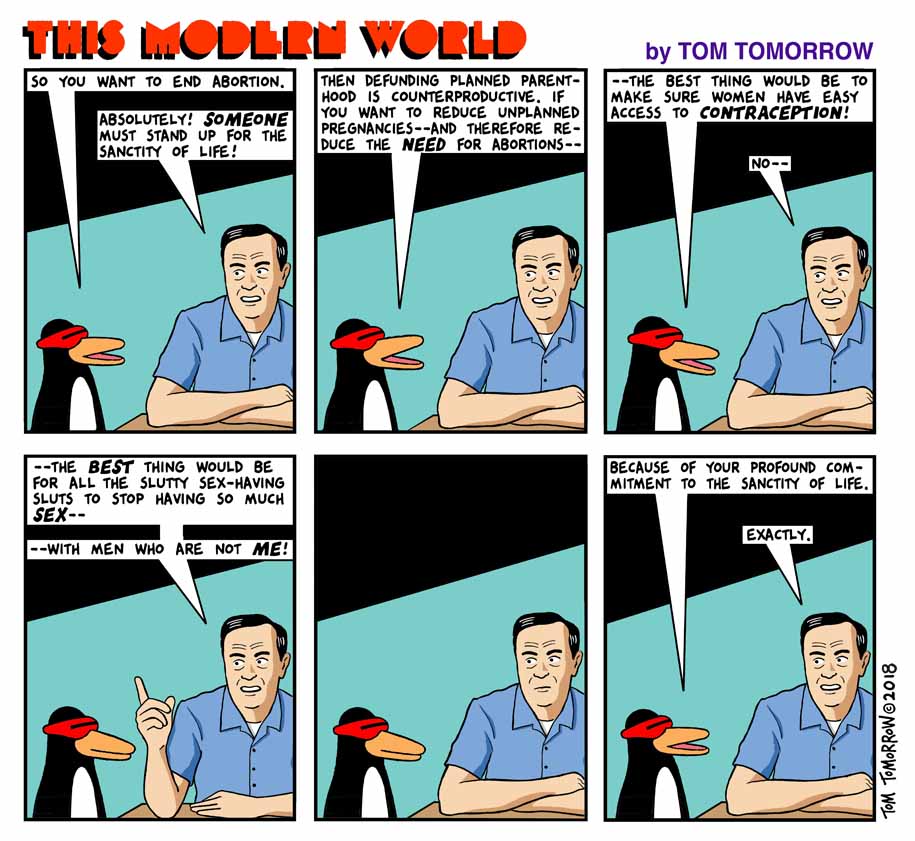
The issue of sexual violence has never gone away. The #metoo movement is just one more response to it, though so far one that’s been getting more notice than many. In the last, I don’t know, month or so, the media at large has at last started to notice the well-established connection between misogynistic violence and mass shootings, and the word “incel” – involuntarily celibate – has achieved a greater currency than it had before. I gather “incel” was first coined to describe the experience of being queer and unable to find someone of the gender you like who likes people of your gender, but it has now unfortunately been very firmly appropriated as a self-identifier for that subset of men who (a) aren’t getting sex and (b) believe they are owed sex. And this of course has led to suggestions that maybe mass shootings would be averted if more women would “take one for the team” and have sex with incels. Because, apparently, some people aren’t content with being horrible human beings in the privacy of their own homes.

I have seen it claimed, mind you, that incels aren’t real because it’s not actually hard to find someone to have sex with and these men must be just being needlessly picky (or obsessive) about their choice of partner. I can’t hold with this. For some people it may be easy to find people to have sex with, but there are many circumstances which make it difficult for others. One, as already noted, is being the only queer person in your offline circle. Various disabilities – physical and social – have similar effects. It’s not the not getting sex that makes incels horrible people, it’s the belief that they are owed it. Men who believe they’re owed sex are horrible people whether or not they’re getting it, which brings this digression nicely back to the point.

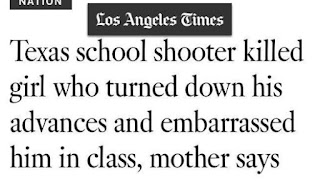
A couple of weeks ago a guy walked into Santa Fe High School in Texas and shot people, killing ten of them. Following an excellent suggestion that’s been passed around Twitter and Tumblr, I’m going to refer to the perpetrator as “Shooter #101” (this was the 101st mass shooting in the United States this year). The mother of one of the dead, Shana Fisher, has claimed that her daughter was repeatedly harassed by Shooter #101 for a date and ultimately turned him down publicly in front of the school, and that she was the first person he shot. Several articles on the incident have used this for a lede. Apparently it hasn’t been corroborated by witnesses – which is bad enough, but I’ve worked in journalism in a very small way, I can understand going ahead with the article on the assumption that the mother knew what she was talking about. What’s not forgivable is that this was how they framed this element of the case:

Spurned advances from [Shooter #101] provoked Texas shooting, says mother of girl killed (NZ Herald)Texas school shooter killed girl who turned down his advances and embarrassed him in class, mother says (LA Times)

And these are far from the worst. You see the narrative being put forward here? Men (overwhelmingly) do the shooting, but never fear, we can always find a way that it’s ultimately a woman’s fault. Women are put on earth to meet men’s needs, and men go astray when women fail to fulfill that function. Men’s sexual and romantic yearnings give them a proprietary right over women’s bodies, attention, and time. Most commentators would recoil from this position if it were stated openly; the danger of framing male violence as the headlines above do is precisely that this narrative sneaks under the radar as a tacit premise instead of being exposed to challenge as an explicit proposition. To men who do believe that women owe them sex, this subtextual confirmation helps that belief fit just that little bit more comfortably into their picture of the world.

Friday, 6 October 2017

Mass shootings are not a mental health problem

A few days ago, an old white man fired a lot of guns into a crowd of people at a music festival in Las Vegas. Apparently he also shot at a nearby fuel storage site in a failed attempt to cause an explosion. You can find his name on the news sites; in the distant hope of setting some kind of example with the ultimate goal of cutting off the notoriety that motivates others to emulate these killers, I’m not going to repeat it. He killed 59 people, I think the current count is, and wounded a number estimated at over 500. Some people are calling this the biggest mass shooting in US history, which of course has prompted others to bring up bigger ones, like the Greenwood Massacre of 1921 and the “Battle” of Wounded Knee in 1890. Perhaps they mean the biggest mass shooting by a single shooter.

Last month I said the following about the politics of climate change in the hurricane-torn US, and it goes treble for gun control and mass shootings:

More often, however, “Don’t politicize this problem” means “Your politics offer a better way of fixing it than mine do, and I’d rather people didn’t figure that out.” I can sympathize with a preference for peace over contention, but politics can be operationally defined as the set of problems which are more important than not being contentious.

Gun control laws work. They don’t prevent every single possible shooting, but they cut them down dramatically. Here in New Zealand, we have civilized gun laws. You cannot buy a gun in The Warehouse here like you can in Walmart in the US. You can’t open-carry in New Zealand. Nobody keeps a handgun for “protection” – you don’t need one, because you know other people don’t have them either. The last time anyone shot and killed members of the public here was in 1990, when I was twelve, at Aramoana north of Dunedin. (There have been a handful of incidents since when angry men shot their family members.) In Australia thirty-five people were killed at a place called Port Arthur in 1996, so they tightened up their gun laws and the government bought everybody’s guns off them, and they haven’t had a mass shooting since. You can Google other countries and their gun laws and mass-shooting prevalences for yourself. You’ll find the pattern holds.

Yes, there have been scary incidents in my life when I was exceedingly grateful that the person confronting me wasn’t allowed a gun; and no, they weren’t carrying guns illegally. Turns out our firearms licensing laws actually do make it difficult for dangerous people to get hold of them. So not many people in New Zealand want American-style gun “freedom”. But I’ve met one or two who do, enough to have figured out what’s wrong with their arguments. First up: no, America, you do not have more freedoms or better-functioning democracy as a result of your guns. New Zealand has the same freedom of expression that you do, rather better freedom of religion in practice, a much more representative electoral system, far less gerrymandering, automatic voter registration, and vastly more time to vote when elections roll around. Your idea that your guns keep dictatorship and corruption at bay is a peculiarly American fantasy.

The guy I’m thinking of reckoned the whole problem with American mass shootings was that they let people have guns without taking a mental health exam. He was recommending target-shooting as, he said, a tremendously calming sport. Apparently it’s meditative to squeeze a trigger and see a hole appear in the centre of a target. I told him this wouldn’t work for me because I have terrible, terrible aim. I can’t skip a stone over a lake or win a game of pool against a three-year-old or get past level 1 of a first-person-shooter video game. I didn’t add that I would fail his mental health criterion, that I have exactly the same psychiatric diagnosis as the guy who killed six people in Santa Barbara in 2014 – and also, at his age, the same difficulties with romance and sexuality that he was so enraged about.

Now if you’re wondering, no, I’ve never killed anybody, and no, I don’t think I would have done if only I’d had access to a gun at age 22. Which just goes to show: mental health is not the problem. Though hyperbolic, Michel Foucault’s assertion that mental health diagnoses are primarily a method of social control isn’t completely off the mark. I’ve seen an otherwise pleasant-seeming person try to get library security to eject another library user who was making a bit of noise, not because of the noise primarily but because – in a harsh, horrified whisper – “She’s a handicap!” As a funny-looking person myself (my fashion options are basically “deliberate eccentric” or “aimed at normal and missed”), I occasionally get things thrown at me in the street: usually water-balloons, once an egg, once a lighted cigarette. One acquaintance, when I mentioned this, responded with sympathetic incredulity “I guess some people just have mental problems.” No. This is how people treat people with mental problems. This is the behaviour of a mentally normal human being towards someone they feel entitled to disrespect.

I’d be remiss if I didn’t concede that like most laws, in practice if not on paper, gun restrictions disproportionately target people of colour. That has certainly been the case in New Zealand, from 1869 when selling guns to Māori became a crime to 2007 when armed police stopped traffic and raided people’s homes and arrested seventeen people, most of them Māori, on dodgy charges under the Terrorism Suppression Act. It’ll be the tenth anniversary in about a week, and I don’t think we should let them forget. But to suggest that Americans of colour are better off with their on-paper right to bear arms would be a joke in very poor taste. Ask Tamir Rice or Philando Castile how that worked out for them.

There’s always a lot of discourse about either race or mental illness after mass killings, depending on whether the killer was white. You don’t hear so much about gender, despite the fact that it’s a better predictor of deadly violence than either. I know of only one mass shooting by a woman ever, that being the one that inspired the Boomtown Rats song I Don’t Like Mondays. What does seem to come out repeatedly when people analyse these killers’ backgrounds after the police have shot them dead is anger, hatred, possessiveness, and entitlement, and especially towards women. It’s entirely unsurprising to me that people remember the Las Vegas killer pushing his girlfriend around.

Anger and possessiveness are going to take a lot of time and work to expunge from the culture. In the meantime, the quickest way to make a difference is to prevent these people from getting their hands on the means to kill dozens from a distance. In the longer term I can’t help thinking that the American sanctification of the right to bear arms – that is, the right to have the power to kill – itself encourages the attitude that deadly violence is an appropriate response to perceived social wrongs. Either way, America, you’re never going to fix this problem you have without gun control.

Thursday, 14 September 2017

Hurricanes are not a matter of opinion

As I write, the southeastern United States is being torn apart by hurricanes, and the west coast ravaged by bushfires. I’d say I was wondering how long it’ll take before the global warming deniers admit they were wrong and apologize. But of course that isn’t going to happen. Individuals sometimes change their minds when presented with counter-evidence, but it never happens en masse. Don’t wait for it.

Perhaps the news shouldn’t be expected to make much difference. Science is already based on real-world facts; if you’re going to deny science, why should a hurricane in the Caribbean be any harder to handwave away than an oxygen isotope reading in the Antarctic? A small subset of deniers are consciously dishonest. Rush Limbaugh, for instance, told his listeners that Hurricane Irma was a government conspiracy and then quietly left town. More often, they query whether this or that particular hurricane is caused by global warming, which is hard to fact-check because it’s always difficult to demonstrate the causes of a single event by scientific means. What science can tell us is that phenomenon A (here global warming) will cause phenomenon B (hurricanes) to happen more often and get bigger. And lo and behold, hurricanes are happening more often and getting bigger. As evidence mounts, there comes a point where scepticism is just quibbling.

Once global warming becomes undeniable, deniers have a position to retreat to: yes it’s happening, but it’s not our fault. There are natural climate change cycles! they exclaim, apparently under the impression that climate scientists are unaware of this. (I wonder who they think the information comes from?) One particularly vociferous climate change denier in my Facebook feed keeps posting, over and over again, a graph showing cyclic changes in temperature over the last 450 thousand years from three sites in Antarctica – a graph which conveniently happens to be on too small a scale to show the drastic uptick of the last fifty years. Here’s a better visualization from xkcd.

Global warming is an imminent threat. We should be mobilizing against it the way our grandparents did against the Nazis. The problem with that, of course, is that it isn’t a personal enemy with a villainous face to trigger our primate “intruder-alert” instincts. The villain is ourselves and the very systems we have laboured so hard over generations to build so that those who come after us can have a better life. It’s not just one technology that can be stopped, excised, and cleaned up, like asbestos or chlorofluorocarbons. It’s everything. Part of the problem is that, having put off and put off and put off doing anything about it for so long, we now need both an urgent solution and a permanent solution, and those may end up being very different things. Nuclear power might have to be part of the urgent solution. It can’t be the permanent solution, because uranium, like fossil fuels, will run out.

Politically, global warming is a hard issue to pigeonhole: it’s scientific and environmental and economic and geopolitical and educational and a Left/Right tribal marker. And that leads to the weakest and worst last-ditch attempt to stop people talking about it in connection with the hurricanes: “Stop politicizing tragedies!” I mean, yes, sometimes politicians do cynically exploit unfortunate events to raise their own profile; I’m not excusing that. More often, however, “Don’t politicize this problem” means “Your politics offer a better way of fixing it than mine do, and I’d rather people didn’t figure that out.” I can sympathize with a preference for peace over contention, but politics can be operationally defined as the set of problems which are more important than not being contentious. Saving the world from disaster certainly qualifies.

Wednesday, 30 August 2017

So glad I’m not an American right now

Living in a small country can be strange sometimes. Over here we’re gearing up for an election, and a change of government is looking likelier than it has for quite a while. Meanwhile it’s raising barely a ripple on the internet, except of course on New Zealand social media, but in numerical terms New Zealand is a minuscule niche interest. There are more Marvel Comics fans, more redheads, more intersex people in the world than there are New Zealanders. Nevertheless our politics are important to us, which is why I was busy writing about changes of leadership in the Green Party when, in the United States, the sewage treatment plant fire that was the Charlottesville incident was happening. By the time I had space to write about it, everything I could have said had already been said by somebody else.

But now Trump has done some more bad things: he’s pardoned Sheriff Joe Arpaio and made official his ban on transgender people in the military, under cover of the impending storm in Texas. Put together – I was about to say those things and Charlottesville had revealed something about Trump’s view of the world, but “revealed” would imply we didn’t already know it. Perhaps “confirmed” or “highlighted”. Something, anyway, that bodes very ill for the future of the administration and the country, and, given the United States’ international clout, therefore also for the world.

(Before I launch into that, though, I have an admission to make. Back in April Trump ordered a unilateral missile strike on Syria, and I commented: “If this isn’t the beginning of a war to dwarf Iraq and Afghanistan, I will publicly eat these words.” Since then, well, there have been ongoing white phosphorus attacks, but in five months there has been no escalation, no troop commitment, no bombastic public challenge like George W. Bush made to Iraq in 2003. Consider those words eaten.)

Now to the recent events. Responding to Charlottesville, Trump wriggled out of condemning the fascists even when he had a teleprompter telling him exactly what to say. However abysmal his verbal skills or his comprehension might be, they can no longer bear the blame for Trump’s bigoted stance. Despite being from a Union state, his sympathies, conscious and intentional, are with the Confederates. To him, Robert E. Lee and the rest are the good guys. So far so bad. We know his father was arrested at a Ku Klux Klan rally in 1927, which doesn’t prove anything per se but does add weight to the claim that Trump is a Klansman at heart himself. There’s not much doubt left to give him the benefit of.

Then there’s Sheriff Arpaio. Arpaio disobeyed court orders and was found in contempt, and now Trump has pardoned him. Court orders to do what? Trump says he was convicted for “doing his job”. If so, then we would have to conclude that an American sheriff’s job description includes profiling Hispanic people with a view to deporting them, and treating those in his custody with the greatest cruelty the letter of the law can be twisted to allow. Those, according to the current President of the United States, are the duties of a law enforcement officer. This is of course the same President who about a month previously advised the police to be more violent when making arrests. By itself the Arpaio pardon suggests a philosophy such as “Criminals deserve the harshest treatment we can dish out,” but that doesn’t sit well with Trump’s leniency to the Charlottesville thugs. What principle can we find that makes sense of both? How about “Brown people are inherently criminal and deserve the harshest treatment we can dish out”?

And finally the military transgender ban. I’m going to assume nobody reading this is naïve enough to be taken in by excuses about the cost of surgery or hormone treatments. There are several different motivations for transphobia, but we can eliminate most of them pretty quickly. Trump is not a transgender-exclusionary radical feminist, nor does he have religious concerns about sexual purity. To him the prime virtue is strength. Soldiers need to be strong, and, in Trump’s mind, being transgender is a weakness. I could write a whole essay linking this to his many derogatory remarks, public and private, about women. The point I want to make here is that he’s not alone. Gender diversity is one of the major front-lines at present in the battle between social justice and bigotry, and Trump has definitively sided, once again, with the bigots. Apparently being transgender makes you a “special snowflake” with paralysingly sensitive feelings. No evidence is ever of course adduced for this proposition, because there isn’t any.

Putting it all together, the most powerful person in the world believes, as of now, that strength is the ultimate good and that it is rightfully an exclusive possession of white cisgender men. The word “fascist” has been greatly weakened by being bandied about for anybody whose politics the writer dislikes, and I’m afraid my generation of Leftists must bear much of the blame. But there is no hyperbole in applying it to Donald Trump. He’s a fascist, and a fascist with access to nuclear weapons.

So you can see why I’d rather keep my head in New Zealand politics right now. Even in the worst-case scenario it’s a much more cheerful subject.

Friday, 9 June 2017

A lesson for the Left

Would Sanders have beat Trump? We’ll never know for sure. The polls seemed to say he would, but then the polls also seemed to say that Clinton would, and for that matter they also said that the UK would stay in the EU. Actually, given the parallels between this election and the Brexit vote, we might have a test for that. The UK’s Labour Party is currently led by Jeremy Corbyn, who is very similar in both politics and temperament to Bernie Sanders. If the UK were to hold a general election next year and Corbyn won convincingly, that might be an indication that Sanders could have beaten Trump. Unfortunately the UK’s next general election is not until 2020, by which time things will have changed a lot and it won’t be much of an indication either way.

That’s what I said seven months ago after Donald Trump won the US presidential election. Well, a couple of days ago the UK did hold a general election. Corbyn can’t exactly be said to have “won convincingly” – the result was a hung Parliament (no party holding a majority). On the other hand, given that only weeks ago the polls had Labour riding towards the biggest trouncing in a century, I think this result does strengthen the case for Sanders’ beating Trump if only he had been nominated. Assuming of course, as before, that the US and UK are riding on broadly the same political currents.

What happens now for the UK? Too early to say. Clearly Prime Minister Theresa May’s hope of negotiating Britain’s exit from the European Union with an improved mandate has gone to pot. Will her Conservatives and Northern Ireland’s Democratic Unionist Party manage to form a stable enough government to hold a majority in the House? I wouldn’t bet money on it. The DUP’s beef with Labour is purely due to Corbyn having entered talks with Sinn Féin and the Irish Republican Army decades ago to end the chronic violence between Catholic separatists and Protestant unionists in Northern Ireland, apparently successfully as it turned out, rather than – well, rather than what? Wiping Irish Catholics from the face of the Earth? You’d have to ask the DUP.

I’m not as surprised as most commentators seem to be by Corbyn’s success; in a country ravaged by unending austerity and stale promises of improvement just around the corner, promising to stop austerity politics was always going to be popular. The biggest surprise to me is Scotland. What has the Conservative Party done for Scotland lately, and how has the Scottish National Party failed it, that so many votes swung from the latter to the former? Did Scots see the SNP’s renewed calls for independence after Brexit as cynical opportunism? I don’t know how to answer that question. If, as seems likely, May loses her position as Conservative leader and it all triggers yet another election in a few months’ time, Scotland would be the place to watch. In any case, my prediction that the United Kingdom will cease to be United within a decade so that Scotland can remain European appears presently to have been wrong.

You wouldn’t know it yet to look at our news media, but New Zealand has a general election of our own coming up in a few months. Should any Labour or Green politician happen to read this post, I would urge them to take the lessons of the UK to heart. For a generation, nominally Left parties throughout the English-speaking world have put all their energy into winning centrist voters away from the Right. This strategy is not going to work any more. Business as usual is over. You need to get young people voting again, and to do that you need to provide them with a bold and credible alternative to the status quo. You are competing with the seductive, poisonous notion that immigrants and brown people are the cause of our economic struggles and we need to kick them all out. You won’t counter that with “Everything is fine, let’s just keep on the way we’re going.” Hillary Clinton, David Cameron, and Theresa May all tried that, and look where it’s got them. Please don’t deliver us into the hands of racists and bigots like they did. Please be strong.

Monday, 10 April 2017

Syria: what I get and what I don’t get

So Donald Trump has fired missiles at Syria. So much for the theory that he was better than Hillary Clinton because he wasn’t a warmonger. I did tell you. If this isn’t the beginning of a war to dwarf Iraq and Afghanistan, I will publicly eat these words. I’m not betting either way on whether there will be a nuclear strike, but if there is it will be Trump’s doing.

At least some of the people who voted for Trump did so because they thought he wouldn’t do this. I get that. Clearly they were wrong, and frankly it should have been obvious that the reason he never voted for war was because he was never in politics. But I get why that would be your concern. What I don’t get is why some of his opponents are now suddenly calling him “presidential”. I mean, sure, yes, blowing people up in other countries without asking the people they’re pretending to try to help is something American presidents do, but that’s not supposed to be a good thing.

There’s so many conspiracy theories going around at the moment that it’s hard to get a handle on what’s true. I used to trust Wikileaks, but they’ve been so nakedly partisan for the last year or so that I’ve given up on them. The evidence for some kind of Russian interference with the American election continues to pile up, and denials from Wikileaks aren’t going to sweep it away. On the other hand, Putin is buddies with Assad, isn’t he? How is Trump’s attack on Syria supposed to advance a hidden Russian agenda? Or did Trump just get pissed off with everybody calling him Putin’s puppet? Is that what this is about?

The other thing I don’t get is why so many people who would proudly call themselves “radical” seem to support, or at least sympathize with, Putin and Assad. Putin is an aggressively homophobic dictator, and Assad is a lesser dictator with zero concern for human rights. I’ve seen a video of two journalists disagreeing over what’s happening in Syria, and the one who the viewer was supposed to agree with claimed that Assad was loved by his people because he got so many votes in Syria’s elections. How does an international journalist not know how elections work in dictatorships?

I think I do get why so many people think, “Well, the US has to do something.” I guess it’s like the recent trailer for Deadpool II, where the inept superhero title character tries to prevent a murder but can’t change into his superhero costume in time. The US with its giant military is the superhero, and superheroes are not supposed to sit around watching other people kill each other. Only, so far, the US’s record for solving problems with its powers is worse than Deadpool’s. Trump’s “rush in without a strategy” strategy will change that only for the worse.

I don’t know where the world goes from here. I don’t know how we solve this problem. I don’t know how we get rid of a dictator who kills lots of people without a war that kills lots of people and ends up installing a worse dictator who kills lots more people.

Trump doesn’t know either. But Trump will bring the whole world down around all our ears before he admits that.

Sunday, 19 February 2017

The question of punching Nazis

This blog tends to straggle a fortnight or so behind the news, but people haven’t stopped talking about this yet:

You know, if there were two propositions I’d always have thought were established beyond doubt, it’s that the world is round and that the Nazis were bad. But in the last year there have arisen fad movements questioning both. I imagine, though I admit I don’t have any data here, that there’s quite a large membership overlap between the two movements. I don’t intend to defend either proposition here. My question instead is whether it’s morally defensible to do what that guy in the GIF is doing, i.e., punching Richard Spencer in the face.

This is an interesting test case for the ethics around free speech; it’s so extreme, in two different ways. On the one hand, the usual defences for limiting speech do not apply. Spencer in that clip is not being argued with angrily, blocked from an internet forum, disinvited from a speaking engagement, or having a newspaper refuse to publish his letters – he’s getting punched in the face while trying to speak to a camera. We can’t say that he’s merely being “shown the door” or that the attacker is exercising his right to free speech. This was a violent act, an act of physical force. On that basis many people have condemned it, including Jerry Coyne:

If the Left is to keep the moral high ground, we simply can’t go around physically attacking those whose views we don’t like. In fact it’s ironic, because when progressives do this, they’re implicitly denying someone a real safe space: a space to be free to express your opinions and remain physically safe. “Safety” refers to freedom from physical attack or illegal harassment, not to freedom from hearing views you don’t like.
As a conscientious objector, I’ve always adhered to the nonviolent philosophies of Martin Luther King and Mahatma Gandhi, for if you start violence, you lose credibility.

But Coyne is misrepresenting the situation when he lumps Spencer under “those whose views we don’t like”. Elsewhere he has disputed the characterization of Spencer as a “Nazi”, since Spencer is not a formal member of a National Socialist party. Given that Spencer is on record as questioning whether Jews are people and proposing that Africans be exterminated, I’d call that hair-splitting. Coyne is Jewish; if he wants to forgive a man who denies his humanity, that’s his prerogative. But I think other Jewish and African people might want a say in the matter as well.

Spencer’s racist views constitute the second way in which this is an extreme case. The usual arguments for protecting offensive speech also do not apply here. Spencer is not speaking truth to power. He is not proposing a crackpot idea that just might be true, or even one whose falsehood offers us teaching opportunities in the effort of rebuttal. We already know what happens when the assumptions he is challenging cease to hold; that’s what the 1930s and 40s were all about. And the punch doesn’t set a precedent for violent state intervention against dissidents, because it wasn’t delivered by an agent of the state.

What about the moral high ground, as per Coyne’s objection? The moral high ground isn’t just a place to keep your own self-image squeaky-clean; it’s a critical strategic position which any resistance movement abandons at its peril. At some point, you must gain the support of the public or abandon your cause. To do that, you must inspire them either with sympathy or with fear. Fear has short-term advantages that make it tempting – not least that you control the media’s attention. But it is fatal in the long run. If the citizens sympathize, some of them may help you stay off the state’s radar; if they’re afraid, they’ll hold the state’s coat while it swats you like a fly. India is no longer a British colony because Gandhi didn’t terrorize people. Northern Ireland is still a British colony because the IRA did terrorize people.

(Worse still, you might buck the odds and win. The English Civil War, the French Revolution, and the Russian Revolution are examples. It’s no coincidence that these were followed by the tyrannies of, respectively, Oliver Cromwell, Napoleon Bonaparte, and Joseph Stalin. Power gained by fear can only be held by fear.)

But America is in an even sorrier state than I thought if one sucker-punch is all it’s going to take to divert the sympathy of the public to “alt-right” Nazis. Not many resistance movements can survive without being prepared to occasionally defend themselves, either. Martin Luther King didn’t riot, but he openly sympathized with those who did. The gay rights movement in the US began when the patrons of the Stonewall Inn fought back – yes, fought back – against police harassment. The boundary between sympathy and terror is not the same as the boundary between using force and not using force. Most people are not complete fools; they can tell the difference between hitting people to make them do what you say and hitting people to stop them kicking you around.

All in all, I can’t see that the person who punched Richard Spencer in the face did anything wrong. What does bother me is the idea some people seem to have that more punching is the way we’re going to win this thing. It’s not. This is one of the deep cognitive flaws in the human psyche: “Find out whose fault the problem is and hurt them until it goes away.” That very flaw is the core of Nazism and fascism, and for that reason Nazis and fascists are always going to be better at hurting people than we who oppose them. Force may sometimes be necessary, but if the decisive contest is our force against theirs, they will win.

What we’re better at doing than they are is telling the truth. (The Trump White House has already, in its first month, invented three non-existent terrorist attacks to justify Trump’s anti-Muslim measures.) The Nazis themselves are obviously not going to be listening, but other people are. They need to see that we have answers to every one of the fascists’ lies. I salute the brave scientists, reporters, judges, and bloggers who are standing up for the truth. We need more of you. Kia kaha.

Monday, 5 December 2016

A big news day

Whoa. I should write to world leaders more often!

Yesterday there were two big, startling pieces of news, and for a change both of them were good news – if you happen to share my political views. The Dakota Access Pipeline has been stopped at Standing Rock. And John Key has resigned as Prime Minister of New Zealand.

I don’t imagine, of course, that the e-mail I sent to President Obama and posted on this blog last week had anything to do with the first piece of news. (Well, that’s not technically true. I do imagine it, because it’s a nice little ego boost, but I don’t seriously imagine it.) The people who won this fight are the Water Protectors who stood their ground so long and so bravely. If you asked me to guess what changed the state’s mind, my best guess is the army veterans who pledged to stand with the protesters. Armies are held together by honouring loyalty and bravery, and you can’t honour loyalty and bravery and also point weapons at veterans from your own side.

The Standing Rock news is cause for celebration – for now. It’s not the end of the war. The Pipeline will be put somewhere else, not scrapped altogether, which is good news for the Lakota people and their water supply but not great for stopping climate change. And there will be more pipelines to come. This time, Donald Trump didn’t get his hands on the situation. Next time will be on his watch. It will be worse than this one. But for now, we can celebrate.

John Key’s resignation I’m not so positive about. Don’t get me wrong, it’s good news for my side. Not that Key is an unpleasant person as National leaders go; he’s always presented himself as a cheerful, friendly, down-to-earth Kiwi bloke. That’s why his resignation is good news, because that persona – I’m not committing myself to any hypothesis about how genuine it was – has been the cornerstone of the National Party’s election strategy for over a decade, and now they’re going to have to come up with a new one. One lecturer a couple of years ago pointed out that whenever the Government was getting criticized in the news it was always some other minister facing the cameras, but whenever they were getting praised it would be John Key we saw. The lecture in question was on Machiavelli. I’m just putting that out there.

No, what concerns me about John Key resigning is the why. All indications up till now, including Key’s own public statements, were that he intended to run for a fourth National term in Government and, if he got it, to lead it through. The only reason he gave yesterday was that he wanted to spend more time with his family, which if you’ve watched any political dramas you will recognise as Politician Blackmail Avoidance 101. But what kind of pending scandal would spook the man who, in 2014, won an election with a book about him titled Dirty Politics fresh off the press?

It surely can’t be coincidence that National just lost a by-election to Labour in Mt Roskill, by a landslide comparable to those we recently had in Canterbury – and that National apparently had no plan for winning it. But that just compounds the mystery. What happened in Mt Roskill? Why has the National Party suddenly lost its will to fight? There is something going on here that we haven’t seen yet. And, much as I want National out next year, it bugs me that my country’s government can be thrown off balance by things that the public don’t get to see.

Wednesday, 30 November 2016

An open letter to President Obama regarding the Standing Rock crisis

To: president@whitehouse.gov

Dear President Obama,

I am writing to express my deep and urgent concern regarding the crisis presently unfolding at Standing Rock.

I am not (and have never been) an American citizen. My concern is that of a citizen of the world, and it is fourfold. First, for the injustice the Dakota Access Pipeline represents to the indigenous people of Standing Rock, whose trust with the United States it will violate. Second, for the acceleration of global warming by the use of fossil fuels, which the Pipeline is designed to facilitate. Third, for the precious water supplies it endangers. And fourth, for the human rights abuses which have been perpetrated, contrary to the First Amendment of your Constitution, against those exercising their sovereign right to oppose it.

I have been given to understand that the State intends to bring military force to bear on the activists within four days of this writing. I ask you, Mr President, to exercise your power, as perhaps the final act for which your Presidency will be remembered, to bring about a resolution to the crisis that is favourable with respect to the fourfold concerns I have outlined.

As a private citizen who cannot vote in the United States I have no inducement to offer. I implore you, however, to consider what your successor is likely to make of the situation if it remains unresolved when he takes office; and what precedent it will provide for him if it is resolved by the use of military force against a legitimate, peaceful demonstration.

Yours with the greatest and most urgent of sincerity,

Daniel Copeland

Wednesday, 23 November 2016

We won’t defeat bigotry by ignoring it

“We really should just be completely ignoring Tamaki,” said a friend of mine (whose name is Andy) on Facebook last week. “I’m thoroughly sick of giving time and space to nonentities. Sign of the times unfortunately – lazy, sensationalistic journalism, and all that.”

Tamaki who? Well, my little country made international news a couple of days previously when we had a gigantic earthquake, which fortunately hit a rural area in the early hours of Tuesday morning with very few people in harm’s way, and I think the death toll stands at 2. Now Brian Tamaki, self-anointed Bishop of Destiny Church, had preached on Sunday that major earthquakes (such as those that devastated Christchurch, our second-largest city, back in 2011) are Nature crying out to God in grief at human sin – sin being murder, gay marriage, and Lloyd Geering. After Monday night’s events he put up a blog post claiming that the sermon had been a prophecy.

Maybe Andy is right in the specific case of Brian Tamaki. He gets media space because his Destiny Party was the second-latest in the ongoing series of attempts to forge authoritarian Christianity here in New Zealand into the kind of political force that it is in the US. The pattern is: rebuke sin, claim endorsement from God, announce a nationwide revival, fail to cross the 5% vote threshold required to get your party into Parliament, fall off the radar, surface a year or two later in a sex scandal. Except in Tamaki’s case it was a money scandal, and it didn’t sully his standing within the small group of devout followers who are his season-pass on the gravy train.

I can’t fault Andy’s opinion of current standards of journalism either. Objectionable behaviour from public figures gets clicks, and clicks get advertising dollars. But in the light of the recent US election, it’s now clear that the Left has catching up to do; and one thing we need to catch up on is convincing people that we have answers worth listening to. During my time in student political activism there was a general practice – nothing ever so concrete as a policy – of avoiding engaging with our opponents’ arguments directly so as not to give the impression we thought them worth bothering with. In effect we assumed that our target audience’s default position was to agree with us as long as they didn’t encounter opposing views. I believe a similar assumption was a big part of Hillary Clinton’s failure.

So if certain people blame earthquakes on deviant sexual activity, does that mean we need to go out and hold educational community seminars on plate tectonics? Not what I have in mind. Apart from anything else, we don’t know why earthquakes strike at one point on a fault rather than another, and for people who think like Tamaki, that sort of gap in our knowledge means there’s still room for God (or aggrieved Nature) as an explanatory factor. Anyway, the earthquakes per se aren’t the point. The point is whether being LGBT, or tolerating LGBT partnerships, is the sort of thing that makes a country deserve earthquakes. We progressives say “No.” Many people still say “Yes.” We have not worked hard enough at convincing them otherwise.

Friday, 11 November 2016

Are you awake yet?

Politics as usual is over.

There are two questions on everyone’s mind, I’m sure. What the hell just happened? And what the hell’s going to happen now?

I’ll start with the second one. If the UK after the Brexit vote is any guide, before the new President is even sworn in there’ll be a groundswell of criminal violence against people of colour – Latin Americans and Muslims in particular, but I don’t imagine they’ll be too picky. The word will be “We just voted to kick you lot out.” That was, after all, Trump’s main platform.

(Just so you know: I wrote that paragraph before I read the innumerable news reports confirming it.)

You needn’t bother arguing with me on this part, by the way. You may have a different view of Trump’s character than I do; but I’m not going to drag you through a whole bunch of news items and political analyses you can Google for yourself and a discussion you won’t read, just to provide back-up evidence of who he is. Instead I’m going to make predictions, and the next few years will prove me right or wrong.

Trump will begin his Presidential career with an aggressive and vindictive purge of every high-ranking Republican who walked out on him. (“You’re fired.”) He will then issue an executive order to deport undocumented immigrants. Existing law enforcement and military will not be up to the job, so he will create a special taskforce and recruit the kind of people who were chanting his name at rallies to staff it – i.e. men who relish the chance to point guns at brown people with the government’s blessing. There will be deaths.

Work will begin on the Mexico border wall fairly early on. It will have to be financed. Even the President of the United States doesn’t have the power to make Mexico pay for it, as he promised. He will demand payment, and Mexico will say “No.” Most likely he’ll stump up the cash in the meantime by gutting some public service he doesn’t think important, like the unemployment benefit – hey, with all the lazy illegals gone who needs it, right? But he’ll also threaten Mexico with military action if they don’t pay up. He will eventually carry out that threat.

Yes, I know Trump has promised not to send more soldiers to war. Of all the promises he’s made, that’s the one I’m most sure he’ll break. He may only rattle sabres at Mexico, but there will definitely be another Middle East bloodbath. Trump is an over-confident man, and that’s the biggest risk factor there is both for starting wars and for escalating wars. The decision-makers on both sides in World War I were certain they’d be holding victory parades before Christmas 1914. That’s why there was a World War I.

Tuesday, 1 November 2016

Americans, please vote for Hillary Clinton

It’s a week till the big day. Much as I like to surprise readers with new perspectives on things, I don’t have one this time. I don’t know how far this will go, it’s not like this blog has a big readership. But this is perhaps the most urgent thing I’ve ever blogged about. So, small as my part must be, I’m doing what I can do. Maybe this will reach a few people who are wavering and tip them the right way. In 2000 the election was lost on a whisker-thin count in Florida, and this election is more consequential than that one.

I can’t vote for anyone, I’m not an American. But this election will reverberate around the world. I suspect it’ll have more impact on our lives here in New Zealand than our own election next year will. I have no rewards or threats to offer. All I can do is beg, and American readers, I’m begging you: please vote for Hillary Clinton this week.

It’s not the Trump voters I’m trying to reach, or not mainly. The people we see at those scary-looking rallies on the news wouldn’t listen to me if I did have anything to say to them. I mean, I could yell insults at them if I thought that would be helpful, but it wouldn’t change any minds. They might listen to this guy from GQ, perhaps. He seems at least to be in their world – I’m not.

There does exist at least one Trump supporter who is not a hateful bigot, because I’ve seen him on YouTube: his name’s Peter Thiel. [EDIT: I’m informed that this is not actually true, that Thiel doesn’t, for instance, see anything wrong with apartheid. But he’s not a thoughtless hateful bigot; he produces arguments that are worth answering.] But the arguments he uses are the same ones that other people use, the ones who I am trying to reach, so I’ll address them in a minute. No, the people I’m trying to reach are those who aren’t voting, or (equivalently) are voting Jill Stein or Gary Johnson or writing some other name in on the ballot. People who claim that yes, Trump is bad, but Clinton is just as bad. Because it’s them I fear. If everyone who understands what Trump is votes for Clinton, the election is a shoo-in. If enough people sit it out or vote third parties in protest, it’s not. Again, 2000 stands as a warning.

Yes, you guys, your grievances with the American electoral system are absolutely legitimate. Yes, it’s ridiculous that the self-proclaimed inventors of democracy are still using non-proportional voting. Yes, it is a serious problem that only two points of view get a go at the Presidency. You need to amend your Constitution. But you can’t do that at a presidential election. I understand why that’s when these problems get attention. Plebiscites are like magazine covers; they sell better with a human face on them. But you can’t fix a whole system by bringing in one new person. You need to run a referendum to change your electoral system, like New Zealand did in 1993. You can’t do that this week. You’ll have to wait, and plan.

No, Hillary Clinton is not guaranteed to get in no matter what happens. The Presidency goes to the candidate who gets the single highest number of Electoral College votes. Remember 2000 – that’s going to be the refrain for this post. Suppose that next week, as then, the Presidency depends on a single swing state. Suppose, in that swing state, Trump gets 48% of the vote and Clinton gets 47% and Jill Stein and Gary Johnson between them get 5%. If that happens, who’s President? I’ll give you a hint: it’s not a Clinton-Stein-Johnson co-presidency. That’s not how America works.

No, Hillary Clinton is not guaranteed to get in no matter what happens. If 2000 is too distant, remember Brexit. We all thought that was bound to lose. None of the politicians pushing it had a plan for what to do if they won. Yes, that is indeed due to the failures of neoliberalism, but xenophobia and racism are not better than neoliberalism. They are worse. And right now they are rallying.

No, Clinton is not just as bad as Trump. Consider the e-mail scandal going on around her right now. Clearly the FBI, or at least some very influential people in the FBI, are trying to stop her from becoming President – and those e-mails are the worst thing they’ve found on her, or they would be trumpeting whatever they’d found that was worse. Trump, by contrast, has among other things been indicted on child sex charges.

No, Clinton is not just as bad as Trump. Yes, she’s called for more American military engagement in the Middle East – America is currently involved in Syria, Iraq, Yemen, Libya, and Somalia, if I recall correctly. Her stance is that American intervention will prevent more deaths than it causes. I think she’s wrong about this and if I were in a position to argue with her directly I would take a very strong line. Trump, on the other hand, favours pulling the troops out. That was Peter Thiel’s big argument for supporting Trump. And I’d agree – except that “pulling the troops out” might mean either of two utterly different things.

  1. Send all the soldiers and military trainers home. Send diplomats to the governments of the various countries with this message (worded diplomatically): “We’re not going to kill for you any more. If you need a hand rebuilding civil institutions, we can talk. But no more bullets, no more drones, no more weapons.”
  2. Send all the soldiers, military trainers, and every other American home. Fire nuclear missiles at Damascus, Baghdad, Aden, Tripoli, and Mogadishu. Declare victory.

Which of these options do you think will be favoured by a man who has publicly said that all Muslims are potential terrorists and that he doesn’t know why America can’t use its nuclear weapons?

No, Clinton is really not just as bad as Trump. We on the Left have a bad habit of overusing the word “fascism”, with much the same effect as the boy who cried “wolf!” in Aesop’s fable. It’s not a lie, exactly, but it’s a worn-out hyperbole, and the trouble with wearing out a word with hyperbolic use is that you’ve then lost the impact of the word when it literally applies. Donald Trump really is a fascist. No scare-quotes, no “almost” or “virtually” or “practically” or any other hedge-word, he’s a fascist.

Fascism (unlike communism or neoliberalism) lacks any single definable credo, because it doesn’t seek international cooperation. It has, nevertheless, certain characteristic diagnostic features, and Trump displays them all. He preaches a lost era of national greatness; he proposes to restore it by purifying the nation of undesirable nationalities, religions, and races; he idolizes ruthless businessmen, or at least one ruthless businessman. These things he inherits from the Republican party he has commandeered. But he also has the other, still more sinister symptoms of fascism. He threatens his political opponents with the police; he chafes at the democratic restraints on his power; he encourages his followers to promote the cause through violence. Even George W. Bush didn’t do that.

This is not a drill. This is not a joke. This is not politics as usual. This is how democracies are overthrown. Just because you’re the United States of America doesn’t mean it can’t happen to you. Don’t let it. Vote Hillary Clinton on 8 November. I’m begging you.

And then, on 9 November, go and protest the Dakota Access Pipeline. Tell the President-Elect that you think it’s wrong. Tell her loudly, tell her angrily. Anger is appropriate. But remember, as you do, what the other potential President-Elect does to protesters.